Someone brought up the doctrine of regeneration recently in the comment section. I suspect that most people have no idea — including Evangelical Christians — what regeneration is all about.
By definition, regeneration means the “giving of life” by God to sinners. No one is saved apart from being regenerated. Many Evangelicals believe regeneration and being born again are one and the same. When God saves you, you are regenerated — given new life.
Regeneration, while sometimes perceived to be a step in the Ordo salutis (‘order of salvation’), is generally understood in Christian theology to be the objective work of God in a believer’s life. Spiritually, it means that God brings a person to new life (that they are “born again”) from a previous state of separation from God and subjection to the decay of death (Ephesians 2:5). Thus, in Lutheran and Roman Catholic theology, it generally means that which takes place during baptism. In Calvinism (Reformed theology) and Arminian theology, baptism is recognized as an outward sign of an inward reality which is to follow regeneration as a sign of obedience to the New Testament; as such, the Methodist Churches teach that regeneration occurs during the new birth.
While the exact Greek noun “rebirth” or “regeneration” (Ancient Greek: παλιγγενεσία, romanized: palingenesia) appears just twice in the New Testament (Matthew 19:28 and Titus 3:5), regeneration represents a wider theme of re-creation and spiritual rebirth.
Furthermore, there is the sense in which regeneration includes the concept “being born again” (John 3:3-8 and 1 Peter 1:3). Regeneration is also called the “second birth”. When Christians believe in Jesus Christ for their salvation, they are then born of God, “begotten of him” (1 John 5:1). As a result of becoming part of God’s family, man believes to become a different and new creature (2 Corinthians 5:17)
As you can see, Christian sects have a variety of interpretations of what regeneration is and when it happens — just like with every other doctrine. The Bible says ONE Lord, ONE faith, and ONE Baptism, but modern Christians didn’t get the memo.
From 1988 to 2003, I was an Evangelical Calvinist. Calvinists have a different take on regeneration from that of other Christians. Calvinists are the intellectual party. They spend countless hours arguing and debating the finer points of Christian theology. I know I did. One Sunday night after church, the men sitting in the gates and I argued about whether Arminians are real Christians; about whether famous preachers of yesteryear such as D.L. Moody and Charles Finney were True Believers®. Some of the men believed the five points of Calvinism and the gospel were one and the same. Thus, Arminians were not Christians. Moody and Finney were in Hell. I objected to their claims, saying that the five points of Calvinism were NOT one and the same as the gospel and that Finney and Moody, who were greatly used by God in the nineteenth century, were most certainly saved. We argued back and forth, without resolution. Later on, a rumor was floated among the members that I was not a “true” Calvinist. If I learned anything about Calvinists, it is that they love (and even relish) doctrinal skirmishes.
One argument among Calvinists is whether regeneration precedes faith. Most Calvinists say yes. Unsaved sinners are dead in trespasses and sins, unable to believe unless God gives them the ability to believe. Dead people can’t do anything, right? Once God gives a sinner life, he or she can then exercise faith — which is also a gift from God. For the Calvinist, salvation is the work of God from start to finish. Arminians also believe that salvation comes from God alone, but they also believe that human volition plays a part. This leads some Calvinists to label Arminians as heretics — saying they believe in “works” salvation.
Who is right? Opine away in the comment section. Personally, I left the ministry believing that the measure of one’s relationship was not right beliefs, but good works. This led to the keepers of the Book of Life labeling me as a “works salvation” preacher. To that charge, I gladly pleaded guilty. While I no longer believe in the existence of God, I still believe that the measure of all of us is not what we believe, but what we do. Don’t tell me, show me.
Bruce Gerencser, 66, lives in rural Northwest Ohio with his wife of 45 years. He and his wife have six grown children and thirteen grandchildren. Bruce pastored Evangelical churches for twenty-five years in Ohio, Texas, and Michigan. Bruce left the ministry in 2005, and in 2008 he left Christianity. Bruce is now a humanist and an atheist.
Behold, how good and how pleasant it is for brethren to dwell together in unity! (Psalm 133:1)
A new commandment I give unto you, That ye love one another; as I have loved you, that ye also love one another. By this shall all men know that ye are my disciples, if ye have love one to another. (John 15:34,35)
Finally, be ye all of one mind, having compassion one of another, love as brethren, be pitiful, be courteous: Not rendering evil for evil, or railing for railing: but contrariwise blessing; knowing that ye are thereunto called, that ye should inherit a blessing. For he that will love life, and see good days, let him refrain his tongue from evil, and his lips that they speak no guile: Let him eschew evil, and do good; let him seek peace, and ensue it. (1 Peter 3:8-11)
These Bible verses and others present a strong argument for unity and love being essential to Christian faith. The writer of 1 John makes it clear that anyone who does not love his brother is not a Christian. Several times in the New Testament, the Law and the Prophets are summed up thusly: love God and love your neighbor as yourself. In the Gospels, professing followers of Jesus are commanded to love even those who hate them. And speaking of unity, the writer of Proverbs 6 lists seven things God hates, one of which is “sowing discord among the brethren.”
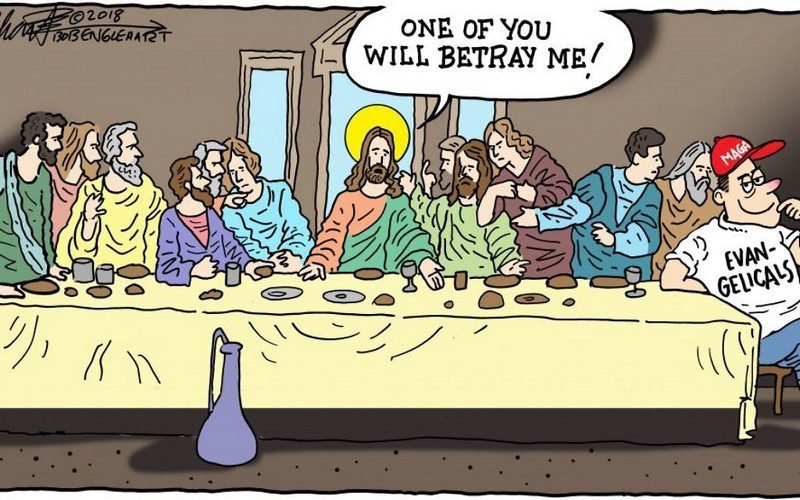
Love and unity are essential to Christianity, yet rarely, if ever, demonstrated by Evangelicals. Instead, Evangelicals are known for fussing and fighting over everything from theology to music styles. Countless internecine wars have been fought over matters as trivial as hairstyles, wearing jewelry, women wearing pants, which Bible translation to use, whether to give altar calls, and how often churches hold services. No matter is too trivial for Evangelicals to fight over. One need only look at how many Evangelical sects there are and how fragmented individual churches are to see that Evangelicals never received the “Love and Unity” memo. And thanks to the Internet, the MMA machinations of Evangelicals are on display for all to see, complete with violent personal attacks on fellow Christians deemed heretics.
What’s heresy? In the Evangelical world, heresy is any belief different from mine. One need only watch Arminians and Calvinists go toe to toe over who has the “true” gospel. Each side casts the other as heretical, calling into question the opponent’s salvation. As a long-time Calvinist, I met numerous pastors who believed Arminianism was a false gospel, and anyone who believed it was unsaved! And now that Calvinism has made huge inroads within the Southern Baptist Convention (SBC) and has infected numerous SBC colleges and seminaries, non-Calvinistic Baptists are saying that John Calvin’s progeny are preaching a false gospel. Some go even so far as to suggest that Calvinism leads to atheism!
Years ago, I pastored a church affiliated with the Christian Union (CU) denomination. In the early 1900s, CU suffered a schism over the doctrine of sanctification. This led to the establishment of a new denomination called the Churches of Christ in Christian Union. Both denominations have a strong, but aging/dying, presence in Ohio. As an Independent Fundamentalist Baptist (IFB) pastor, I witnessed numerous conflicts and church splits. While virtually all Evangelicals are Fundamentalists theologically, (see Are Evangelicals Fundamentalists?) some sects, pastors, and churches take it to the extreme. Such is the case with the IFB church movement. The narrower beliefs become the more likely it is that there will be division. One oft-told joke about how the IFB church movement got its start comes from a story about Abram and Lot in Genesis 13:
And Abram went up out of Egypt, he, and his wife, and all that he had, and Lot with him, into the south . . . And Lot also, which went with Abram, had flocks, and herds, and tents. And the land was not able to bear them, that they might dwell together: for their substance was great, so that they could not dwell together. And there was a strife between the herdmen of Abram’s cattle and the herdmen of Lot’s cattle: and the Canaanite and the Perizzite dwelled then in the land. And Abram said unto Lot, Let there be no strife, I pray thee, between me and thee, and between my herdmen and thy herdmen; for we be brethren. Is not the whole land before thee? separate thyself, I pray thee, from me: if thou wilt take the left hand, then I will go to the right; or if thou depart to the right hand, then I will go to the left. And Lot lifted up his eyes, and beheld all the plain of Jordan, that it was well watered every where, before the Lord destroyed Sodom and Gomorrah, even as the garden of the Lord, like the land of Egypt, as thou comest unto Zoar. Then Lot chose him all the plain of Jordan; and Lot journeyed east: and they separated themselves the one from the other.
Much like Abram (Abraham) and Lot, the IFB church movement came to be when they said to their former denominations or churches, you go your way and I’ll go mine. The IFB church movement was birthed from denominational battles over various points of Christian doctrine and practice. Scores of churches and pastors left denominations such as the Southern Baptist Convention and the American Baptist Convention, establishing their own fellowship groups or quasi-denominations. In the intervening seventy years, IFB churches and pastors have continued to squabble, fuss, and fight, resulting in a plethora of church splits and new, more “pure” groups. Each group believes they have the truth, and those who believe differently are either deemed heretics or heterodox brethren. This infighting is the main reason IFB churches tend to turn over their memberships every few years. The IFB churches I pastored had a steady stream of members from other churches visiting our services — church hoppers, I called them. These devoted followers of Christ were disgruntled or upset with their current churches, so they left, looking for greener pastures. One church I pastored took in over twenty-five members from one nearby IFB church. They loved my preaching, that is until they didn’t, and off they went to find a new church to attend. Many of them returned to their old church once the offending pastor left. Some of them were instrumental in starting new IFB or Bible Fellowship churches in the area.
I follow and read numerous Evangelical blogs and news sites. One thing is certain: Evangelicals continue to fuss and fight, not only with liberal/progressive Christians, mainline denominations, but amongst themselves. Proverbial blood runs in the streets, a never-ending stream thanks to perceived offenses and heresies. The last thirty-five years have given rise to what is called “discernment ministry.” These ministries believe God has called them to be gatekeepers or monitors of the Book of Life. They alone know what “truth” is, and they aren’t shy about calling out anyone and everyone who violates their standard of orthodoxy. Long-time readers — all the way back to 2007-2008 when I was still a Christian — might remember a previous iteration of this blog attracting the attention of “discernment” preachers such as the late Ken Silva and a man who called himself Pastor Boy (he is now divorced and no longer in the ministry). (Please see the post, Rob Bell and Homosexuals on Silva’s “discernment” blog. I was still a Christian when Silva and I got into a debate about homosexuality.) I was working my way through what it was that I actually believed theologically, and these esteemed discerners of “truth,” and others like them, decided that I was a false prophet and a heretic. My later deconversion was proof to them that they were right about me; that I never was a True Christian®.
It seems to me that there is a huge disconnect between what the Bible says about love and unity and how Evangelicals practice their faith. Evangelicals are roundly condemned as preachers of hate, even more so since they climbed into bed with the Republican Party and Donald Trump. Millennials and Generation Z are leaving Evangelical churches in record numbers. Many of them are abandoning organized religion altogether, and an increasing number of them have become agnostics or atheists. Why are Evangelical churches hemorrhaging young adults? Separatism and anti-culturalism, along with social Fundamentalism — anti-abortion, anti-LGBTQ, anti-public schools, anti-science, and anti-women, to name a few — are driving the train as it leaves the station. Evangelicalism is losing two generations of potential congregants, leading to widespread panic among church leaders and church growth gurus. Of course, Evangelical extremists see such departures as a good thing; that doctrinal purity is far more important than love and unity. Quality rather than quantity, they say. We need to love what God loves and hate what God hates! Of course, the beliefs and practices they love and hate are, oh so ironically, the very things they say their God loves and hates.
I am well aware of what the Bible does and doesn’t say on these issues. I long ago concluded that the Bible can be used to prove anything and that when asked which sect has the “truth,” I reply, all of them. They all have proof texts to support their versions of orthodoxy and orthopraxy. Thus, everyone is right. Here’s my advice to Evangelical truth seekers. Want to find the “true” church? Choose the one which has the best potlucks.
Christianity in general, and Evangelicalism in particular, is split into thousands of sects, and countless independent congregations, each believing that they are the holders of the one true faith. Lost on Protestants and Catholics and Evangelicals and Mainline Christians alike is what their fussing and fighting says to the unwashed, uncircumcised Philistines of the world. Where’s the love and unity? worldlings ask. Where are the believers who practice what the Bible says about love in 1 Corinthians 13?
What if I could speak all languages of humans and of angels? If I did not love others, I would be nothing more than a noisy gong or a clanging cymbal. What if I could prophesy and understand all secrets and all knowledge? And what if I had faith that moved mountains? I would be nothing, unless I loved others. What if I gave away all that I owned and let myself be burned alive? I would gain nothing, unless I loved others. Love is kind and patient, never jealous, boastful, proud, or rude. Love isn’t selfish or quick tempered. It doesn’t keep a record of wrongs that others do. Love rejoices in the truth, but not in evil. Love is always supportive, loyal, hopeful, and trusting. Love never fails! (CEV)
Where, oh where, can we find such faith? Not among Evangelicals, that’s for sure. I am an atheist for many reasons, one of which is the lack of love and unity among Christians. If I looked at Christianity as a whole and saw people loving God and loving their neighbors, I perhaps would pause and reconsider the value of being a follower of Jesus. If I saw a group united in doctrine and practice, I might, at the very least, ponder the historic claims of Christianity. However, all I see is the fussing and fighting, and this tells me that whatever Christianity might have been twenty centuries ago, THAT version of Christianity no longer exists. What we have today is a religious version of WWE (World Wrestling Entertainment). While it is unlikely that anything or anyone will successfully “save” me from atheism/agnosticism/humanism, if I truly saw love and unity in action, I might, at the very least, admire those who follow after Jesus. Until then, I will continue to treat Evangelicalism as a blight on the human race, a worldview that causes great harm. Want to change my opinion of you, Evangelicals? Repent.
Bruce Gerencser, 66, lives in rural Northwest Ohio with his wife of 45 years. He and his wife have six grown children and thirteen grandchildren. Bruce pastored Evangelical churches for twenty-five years in Ohio, Texas, and Michigan. Bruce left the ministry in 2005, and in 2008 he left Christianity. Bruce is now a humanist and an atheist.
What was it about Calvinism that attracted you, theologically and psychologically?
Calvinism is a theological system with points of doctrine that build upon one another. Pull any of the five points: Total Depravity, Unconditional Election, Limited Atonement, Irresistible Grace, and Perseverance of the Saints (TULIP), from the system and it collapses upon itself. Of course, the same could be said of any theological system. That said, Calvinism is the most complex, intricate theological system ever created by human minds.
It was the order and complexity of the system, then, that caught my attention. I have Obsessive Compulsive Personality Disorder (OCPD) and I am a perfectionist. (See Christian Perfection: A Personal Story.) I desire, crave, and need order. Theologically, Calvinism provided me just what the doctor ordered. As I read and studied the Bible, listened to preaching tapes of Calvin-loving preachers, and devoured countless Calvinistic books, I began to “see” the truthiness of the doctrines of grace, along with its attendant doctrines such as the Sovereignty of God.
The primary reason I became an atheist is that Christianity no longer made any sense to me. (See The Michael Mock Rule: It Just Doesn’t Make Sense.) The opposite was true with Calvinism. It simply, at the time, based on my reading and study, made perfect sense to me. Calvinism best explained certain Bible verses that had always perplexed me. Yet, at the same time, it created new interpretive problems for me. As a non-Calvinist, I found that words such as world and all meant everyone without discrimination (i.e. For God so loved the world — John 3:16). Calvinism, due to the doctrines of election and predestination, requires adherents to reinterpret verses that imply that Jesus died for everyone, Jesus loves everyone, etc. Of course, Arminians do the same with verses that speak of election and predestination.
I have long argued that the Bible is a book that can be used to prove almost anything. Whatever your theological beliefs might be, there’s support for them in the Bible. I’ve concluded, then, that all theological systems are Biblically “true” and that all sects – Baptists, Catholics, Presbyterians, Pentecostals, Methodists, to name a few — are right when they claim their beliefs are the faith once delivered to the saints.
How is Calvinism different from Independent Fundamentalist Baptist (IFB) theology?
While IFB churches are autonomous, each with its own set of beliefs and practices, they do, generally, have a common set of beliefs. (See What is an IFB Church?) When I entered the ministry in the 1970s, I didn’t know one IFB pastor who claimed the Calvinist moniker — not one. There were several pastors who, if rumors were true, had Calvinistic tendencies. Calvinism was routinely derided, criticized, and deemed heretical — antithetical to soulwinning and church growth.
In the late 1980s, Calvinism began to make inroads into the IFB church movement. Some IFB preachers embraced Amyraldism (four-point Calvinism). Wikipedia explains Amyraldism this way:
It is the belief that God decreed Christ’s atonement, prior to his decree of election, for all alike if they believe, but he then elected those whom he will bring to faith in Christ, seeing that none would believe on their own, and thereby preserving the Calvinist doctrine of unconditional election. The efficacy of the atonement remains limited to those who believe.
The issue, of course, was for whom did Jesus die? Evangelical Calvinists believe Jesus died on the cross only for the elect — those chosen by God from before the foundation of the world. Four-point Calvinists, uncomfortable with the doctrine of limited atonement (particular redemption), concocted a system that said, the atonement of Christ is sufficient to save everyone in the world, but efficient for only the elect. Got that?
While Calvinism continues to make inroads in IFB churches, many Calvinistic pastors tend to keep their beliefs to themselves. They preach Calvinism without ever mentioning Calvinistic buzz-words. Over time, congregations are converted without ever realizing they’ve changed.
Classic IFB beliefs are laughingly called one-point Calvinism. Yes, God is the one who saves sinners, but it’s up to them to decide whether to believe. As with Arminian churches, emphasis is placed on man’s ability to choose (free will). Calvinists, on the other hand, focus on the sovereignty of God and the inability of man. As you can see, these two theological systems are disparate, so much so that the two groups are continually at war, each believing the other is heretical.
Evangelical Calvinists generally believe that IFB churches preach works salvation, and they alone preach salvation by grace. Carefully examining Calvinism, however, reveals that they too preach salvation by works. In fact, outside of Pelagian sects, all Christian sects/churches preach some form of salvation by works. (Let the howling begin.)
There are numerous other theological differences between IFB theology and Evangelical Calvinism, but I have shared enough of the differences to show that these two groups generally don’t “fellowship” with each other. Calvinists view IFB (and Southern Baptist) churches as targets for subversive theological change. Pastors hide their Calvinistic beliefs, hoping, over time, to win them over to the one true faith. This approach has led to all sorts of church conflict.
Why would your change of theology cause friends and colleagues in the ministry to shun (abandon) you?
In the IFB church movement (and many other Evangelical sects), fealty to the right doctrine is paramount, as is following certain social practices. Some tolerance is granted for being slightly off the theological center, but major deviations result in shunning or being labeled a heretic/liberal. Calvinism was certainly considered antithetical to IFB doctrine and practice, so I was not surprised when many of my preacher friends distanced themselves from me as they would a gay man with AIDS. I moved on to new fellowship groups, those with Calvinistic, reformed beliefs and practices.
Bruce Gerencser, 66, lives in rural Northwest Ohio with his wife of 45 years. He and his wife have six grown children and thirteen grandchildren. Bruce pastored Evangelical churches for twenty-five years in Ohio, Texas, and Michigan. Bruce left the ministry in 2005, and in 2008 he left Christianity. Bruce is now a humanist and an atheist.
The first verse in the first book of the Christian Bible says, In the beginning God created the heavens and the earth. The verses that follow go on to explain all that God created. His crowning achievement was the creation of Adam and Eve — humans created in the image of God. Adam and Eve would later eat fruit from a tree that God said was off-limits. Their love of fruit brought sin and death into the world. From this point forward, humans come forth from their mother’s wombs at variance with God. According to the Bible, newborns come into the world speaking lies. Humans are, by nature, enemies of God. Wanting to repair the fractured relationship between the Creator and his creation, God cooked up a scheme through which sins could be forgiven. In the Old Testament, the Bible says God required blood sacrifices for the expiation of sin. Animals were ritually slaughtered and their blood was placed upon altars to provide atonement for national and personal sins. In the New Testament, the Bible says that God sent himself to earth in the form of a God-man by the name of Jesus. This Jesus was one hundred percent man and one hundred percent God. After traveling through Palestine for three years, working miracles, and preaching sermons, this Jesus was accused of heresy by the Jews, arrested by the Roman government, and executed. Three days later, this Jesus miraculously came back to life, spent forty days appearing to his followers, after which he ascended to Heaven. According to Christians, for the past 2,000 years, Jesus has been hanging out in heaven doing God things: building rooms (mansions) for Christians to live in, helping Christians score touchdowns, helping grandmas find their car keys, and controlling presidential elections. While Jesus, at least according to those who speak on his behalf, is intimately involved in the minutest details of the lives of his followers, it seems he can’t be bothered with important issues such as war, starvation, global climate change, human trafficking, and the Cincinnati Reds winning the World Series. Why is it that Jesus never seems to be around when you really, really need him?
Most Christian sects can be plotted along the line between Arminianism and Calvinism. While these two systematic theologies are poles apart from one another, both agree that the Christian God is the absolute, authoritative ruler of the universe. While Arminians and Calvinists argue amongst themselves about free will and the order of salvation, both agree that God is sovereign, and that he has the whole world in the palm of his hands. This God is omniscient, omnipotent, and omnipresent. The Bible says that none of us can escape the presence of this God. He is everywhere — the ultimate voyeur.
If everything is created by God, owned by God, known by God, and nothing escapes his ever-seeing eye, isn’t it logical to say that God is responsible for sin? Isn’t it logical to hold God responsible for everything that happens? If humans are not ultimately in control of their lives or their destiny, how then can they be held responsible? If God alone — either through predestination and election or prevenient grace — saves sinners and gives them keys to their Jesus-built mansions in the sky, how then can any of us be held accountable for not becoming Christians? If it is God, through the Holy Spirit, that gives life to dead sinners so they can believe, how then can any un-quickened sinners be held accountable for their depravity? Billions of people, past and present, live in places where Christianity has no influence. People can go through their entire lives without hearing the Christian gospel, yet when they die God will hold them accountable for not hearing that which they had no opportunity to hear. Does this sound just and fair?
Does any of this make sense to you? Wouldn’t it have been better for the Gods — Yahweh, Jesus, and Holy Spirit — to cut out all the bullshit and create a universe not tainted by sin and depravity? Surely it was in God’s power to create an Adam and Eve who were incapable of sinning. It’s a fair question, then, to ask why God did what he did. If God controls the universe and nothing escapes his sovereign grasp, why all the war, violence, rape, starvation, and terrible contemporary Christian music?
Start asking Christian pastors and laypeople these questions, and you’ll quickly conclude that they really don’t have any answers. Oh, they will spin some sort of elaborate theological answer that will leave you neck-deep in quicksand, but don’t expect them to give direct, succinct answers. Most often, apologists for the Christian God will give contradictory or incoherent answers, and when their nonsense is pointed out they will swiftly run to the house of faith, slamming the door while they scream, GOD’S WAYS ARE NOT OUR WAYS! GOD’S THOUGHTS ARE NOT OUR THOUGHTS! HOW DARE YOU CHALLENGE THE CREATOR! HE CAN DO WHAT HE WANTS! This screaming is the equivalent of la-la-la-la, I can’t hear you, now fuck off.
A perfect illustration of this can be found in a post on the Faith-It website by Christine Suhan. Titled, Dear Christians, Stop Saying ‘Everything Happens for a Reason,’ Suhan shows how it is impossible for Christians to develop a coherent understanding of the world while at the same time trying to hold on to Evangelical beliefs. Here’s some of what she had to say:
Have you ever found yourself, in the midst of unimaginable grief, pain, heartache or despair, wondering how you are going to make it through another day? Wondering where your next breath is going to come from? Your world has crumbled beneath you and you are left feeling shattered, empty and hopeless.
And then a well meaning friend or family member comes along and drops the infamous “Everything happens for a reason” bomb. You smile kindly and nod—that’s all you can do to keep yourself from punching them in the face.
….
Sometimes bad things happen for no reason other than we are human beings having a human experience. Pain, heartache, grief, loss, disease and death are inevitable parts of the human experience.
We hear people say “Life dealt me a crappy hand” as if pain and hardships are not the norm. We assume that life is supposed to be easy and when things don’t go our way, we feel like we have been wronged. Human beings seem to have an innate sense of entitlement. We think that we are owed a pain-free existence.
But the truth is that human beings are not exempt from the human experience. And struggle is an innate part of the human experience. None of us are exceptions to this rule. We all struggle. We all suffer. We all experience pain, heartache and loss. And sometimes, there’s just no reason other than we are human and pain is a part of the process.
I recently had a conversation with a friend who was struggling to find peace with “God’s plan” for her life including the recent death of a loved one.
“How could this possibly be God’s will?” she asked.
Here’s what I’ve come to know about God’s will:
God’s will is not the path we walk, but rather how we walk the path.
God’s plan is never for someone to have cancer. God’s will is not for an innocent child to be brutally murdered. God’s will is not for a teenage girl to be raped. God’s will is not chronic pain, illness, disability or death.
God’s will is not an event that happens to us, it’s how we respond to what happens.
God’s will for us is to walk with Him through the cancer. Through the abuse. Through the death. Through the illness. God’s will is for us to draw close to him in the midst of pain. God’s will is for us to use our painful life events to carry his message of hope, grace, forgiveness and mercy.
God’s plan was never for pain to be part of the human experience. His plan was for us to live in peace and harmony with Him. The human experience became painful when sin entered the world. Our own free will weaved threads of tragedy, loss, heartache and pain into the human experience.
God is not responsible for our pain. We are not responsible for our pain. What happened in the Garden of Eden is responsible for the human condition. And the human condition is hard wired for pain and suffering. God is not causing us to hurt. He is hurting with us. What we do with our hurt is what matters. How we handle tragedy is what brings purpose into our pain.
There’s hardly ever a justifiable reason for the bad things that happen in life. Tragic loss is not laced with inherent specs of good. I used to get so mad when people would say, “You can find good in every situation.” That’s just not true. There was nothing good about being raped. There is no good in murder or abuse.
Suhan takes the shit happens approach. Thanks to Adam and Eve and their progeny’s sin nature, pain, suffering, and death are part of the human (Westworld) experience. According to Suhan, there is no reason or purpose for these things to happen. The problem, however, is that Suhan’s worldview runs contrary to orthodox Christian doctrine. This often happens when Christians try to thoughtfully ponder about human existence. How can rape or murder be good or have some sort of higher purpose? If God is the sovereign of the universe, why does he permit, either passively or by decree, such things to happen? Surely, an all-powerful God can keep people from being raped or murdered. Why does he idly stand by and do nothing?
According to Suhan, God does do s-o-m-e-t-h-i-n-g. When a teenage girl is being ritually raped by her pastor or an altar boy is being repeatedly sodomized by his priest, Jesus is right there holding the victim’s hand. That’s right, the God who could stop sexual assault does little more than send victims a BFF text that says, I am with you in spirit. Love, Jesus. Millions of people will go to bed tonight hungry, and the God who owns the cattle on a thousand hills and sends sunshine and rain for crops to grow will do nothing to feed them, choosing instead to smile and hold their empty plates. While the risk of nuclear war between the United States and Russia continues to increase, Jesus wants everyone to know that he will be right there with them if they are turned into an ash heap. Is this the best that God can do for us — hold our hand?
If God is the supreme ruler of the universe, the creator of all things, the giver of life and death, and he who sees and knows everything, it is impossible to absolve him of culpability for pain, suffering, violence, and death. God could intervene, but he does nothing. Try as they might, Christian apologists have no suitable answer for their sovereign God’s inaction. The best these defenders of the faith can come up with is that Adam and Eve ate an apple, pissed off God in the process, and for thousands of years now he is been standing by while Evangelical pastors rape church children, serial killers murder innocents, and warring nations rain death down on the heads of innocent civilians.
And if this isn’t bad enough, Christian pastors and theologians remind us that there is coming a day when God will end his hand-holding ways, resurrecting everyone from the dead so he can judge them and fit those who don’t measure up with some sort of supernatural body that will survive an eternity of torture in a lake filled with fire and brimstone. This God, who couldn’t be bothered with stopping Hitler’s horrendous slaughter of six million Jews, will definitely be hands-on when the time comes to make his “chosen” people pay for their rejection and execution of Jesus Christ. Billions of Buddhists, Muslims, Hindus, and wrong-flavor-of-ice-cream Christians will be awakened from their slumber, only to be cast into Hell with the Devil, his angels, Barack Obama, Hillary Clinton, Joe Biden, Kamala Harris, Anthony Fauci, Nancy Pelosi, and Bruce Gerencser.
Who in their right mind would want anything to do with Evangelical Christianity?
It is for these reasons (and others) that many people turn to agnosticism, atheism, universalism, and other non-theistic religions. The only way to understand what goes on in the world is to realize that we humans are responsible for what does and does not happen. It is up to humans, not fictional deities, to put an end to violence and suffering. We are the masters of our universe, and if we want things to be different, then it is up to us to change them. A humanistic view of the world requires us to acknowledge that randomness and luck often affect our lives. Sometimes, we are at the right or wrong place at the right or wrong time. Slight variations in decisions or movements can drastically change outcomes. It is highly unlikely that a jet flying overhead will crash into my home. It’s possible, but the probability of it happening is minuscule. And when that unlikely event happens to some unlucky individuals, we must accept it as just that – an unfortunate incident that took lives, but not an act of God. Instead of attempting to develop some elaborate and often contradictory religious explanation of the world that supposedly matches the dictates of ancient religious texts, it is far better for us to just live in the moment and do what we can to improve life for not only ourselves and our progeny, but also for animals and other humans. Interjecting God into the discussion just complicates things. We humanists hope that Suhan and her fellow Christians leave off holding hands with their fictional best friend, and instead join hands with us as we try to combat violence, pain, suffering, disease, climate change, starvation, inequality, and death. Surely God is not so jealous that he can’t put off the handholding until Christians make it to the other side.
Bruce Gerencser, 66, lives in rural Northwest Ohio with his wife of 45 years. He and his wife have six grown children and thirteen grandchildren. Bruce pastored Evangelical churches for twenty-five years in Ohio, Texas, and Michigan. Bruce left the ministry in 2005, and in 2008 he left Christianity. Bruce is now a humanist and an atheist.
In the previous posts in this series, I talked a lot about the doctrines of grace, also known as the five points of Calvinism. Today, I want to talk about the sovereignty of God — the singular, overarching belief that binds Calvinistic theology together. What do Calvinists mean when they speak of the sovereignty of God? If there’s one book that every newly minted Calvinist has likely read — no, it’s not the Bible — it would be A.W. Pink’s classic, The Sovereignty of God. Since this book is widely accepted as the definitive Calvinistic statement on the sovereignty of God, I thought I would let Pink define the doctrine:
The Sovereignty of God. What do we mean by this expression? We mean the supremacy of God, the kingship of God, the godhood of God. To say that God is Sovereign is to declare that God is God. To say that God is Sovereign is to declare that He is the Most High, doing according to His will in the army of Heaven, and among the inhabitants of the earth, so that none can stay His hand or say unto Him what doest Thou? (Dan. 4:35). To say that God is Sovereign is to declare that He is the Almighty, the Possessor of all power in Heaven and earth, so that none can defeat His counsels, thwart His purpose, or resist His will (Psa. 115:3). To say that God is Sovereign is to declare that He is “The Governor among the nations” (Psa. 22:28), setting up kingdoms, overthrowing empires, and determining the course of dynasties as pleaseth Him best. To say that God is Sovereign is to declare that He is the “Only Potentate, the King of kings, and Lord of lords” (1 Tim. 6:15). Such is the God of the Bible.
….
The Sovereignty of the God of Scripture is absolute, irresistible, infinite. When we say that God is Sovereign we affirm His right to govern the universe which He has made for His own glory, just as He pleases. We affirm that His right is the right of the Potter over the clay, i. e., that He may mold that clay into whatsoever form He chooses, fashioning out of the same lump one vessel unto honor and another unto dishonor. We affirm that He is under no rule or law outside of His own will and nature, that God is a law unto Himself, and that He is under no obligation to give an account of His matters to any.
Sovereignty characterizes the whole Being of God. He is Sovereign in all His attributes. He is Sovereign in the exercise of His power. His power is exercised as He wills, when He wills, where He wills. This fact is evidenced on every page of Scripture.
Simply put, saying God is sovereign means that He alone is responsible for and controls EVERYTHING! Of course, such a statement quickly leads to the critics of Calvinism saying, so God is culpable for sin? Calvinists have all sorts of arguments they use to get around this logical conclusion, including answering in the affirmative — Yes, God is responsible for sin. If God is sovereign and decrees all that happens without exception, then the only conclusion one can come to is that God is responsible for sin. So what? some Calvinists say. God is God and he can do whatever he wants to do. Whatever God does is right because it is God who is doing it. When objections are raised, Calvinists reply, God’s thoughts are not our thoughts and his ways are not our ways. In other words, he is God, the creator and we are the created. He is the potter, as the book of Romans says, and we are the clay. God can and does do whatever he wants, and as the Apostle Paul says in Romans 9, those who object to God’s sovereignty need to shut the hell up (okay, he didn’t say it like that word for word, but you get my point). As finite beings, mankind has no right to criticize or condemn God’s works.
When I first came to know and understand the sovereignty of God, I was relieved. For the longest time, I was burdened with carrying a church congregation on my shoulders. While God was certainly there right along beside me, I knew it was up to me to get things done. As a Calvinist, I no longer felt pressured to get this or that done; that if God wanted me to do something he would bring it to pass; that if God didn’t want something done there was absolutely nothing I could do. Now, in retrospect, I know that the only way anything gets done is if I do it. I suspect that’s how it works for you in your life too. And Calvinism aside, a case can be made for taking this approach to life; that praying and “waiting” on God often become camouflage for laziness and indifference.
As the sovereignty of God permeated every aspect of my ministerial and personal life, how I approached things began to change. The first thing I did away with was giving altar calls — a manipulative tool popularized by nineteenth-century evangelist Charles Finney. The second thing I did was turn my attention away from aggressive evangelistic efforts. Instead, I focused more of my time on my studies; on preparing my sermons; on preparing lessons for Sunday school and, later, an elders’ class. As I mentioned in a previous post, I set my sights on un-saving congregants who had been saved during my Independent Fundamentalist Baptist (IFB) days. I believed that I had been preaching a truncated, bastardized version of the Christian gospel, so it was my solemn duty to preach the Calvinistic gospel. I learned, after six years of such efforts at one church, that it is much harder to get people un-saved than it is to get them saved. The third thing I did was breathe. God is in control, I told myself. No need to stress out over winning the lost. If God wanted them saved, well he would save them. My job was to preach the gospel.
During my early years as a Calvinist, I read John MacArthur’s book, The Gospel According to Jesus. In this book, MacArthur demolished my IFB soteriology. MacArthur believed: “The gospel call to faith presupposes that sinners must repent of their sin and yield to Christ’s authority.” IFB pastors generally believed that a person could be saved, yet not make Jesus Lord of their lives. The crux of the argument was whether sinners had to repent of their sins to be saved. Many IFB preachers believed in what Calvinists called decisional regeneration; the belief that by praying a simple prayer a sinner was saved. Requiring sinners to repent of their sins was, in the eyes of many IFB preachers, works salvation. MacArthur would not have any of that, saying that the lordship of Christ was not optional; that if a person was not willing to forsake his sin and totally follow Jesus there would be no salvation for him. (See One, Two, Three, Repeat After me; Salvation, Bob Gray Style.)
One story that stands out from this time is a written interaction I had with Curtis Hutson, editor of the Sword of the Lord — an IFB newspaper. Previous to Hutson, John R. Rice was the editor of the Sword. Rice had written in a tract titled What Must I Do to Be Saved? that sinners had to repent of their sins to be saved. No repentance, no salvation. Hutson, after taking over the Sword, decided to rewrite the part in the tract that talked about repentance. Hutson, like many of the big-name IFB preachers of the day, believed that repentance was a mere change of mind: I was against Jesus and now I am for him; I was headed east and now I am headed west; I was a sinner and now I believe in Jesus. Men such as Jack Hyles and Bob Gray, Sr. turned this intellectual assent into an art form. Thousands and thousands and thousands of people prayed the sinner’s prayer, believing that by doing so they became Christians. No mention of repenting of sin was mentioned. To do so was to preach “works salvation.” And that’s exactly what Curtis Hutson told me when I wrote him. I called him out on his secretive change of Rice’s tract. I told Hutson that he materially changed what Rice believed; that Rice’s gospel and his gospel were not the same. Hutson responded by telling me that I was preaching works salvation, a gospel that did not save.
Rice was no Calvinist, but he did believe that repentance was essential to salvation. If a person was not willing to forsake his sin and follow after Jesus, there would be no salvation for him. Back in my college days, I went door to door attempting to evangelize sinners. My goal was to share with them the simple plan of salvation (The Roman’s Road) and ask them if they wanted to be saved. If so, I asked them to pray the sinner’s prayer. (See The Top Five Reasons People Say the Sinner’s Prayer.) Once they prayed the prayer, I declared them to be newly-minted Christians. One day, I happened upon a woman I thought might need saving. As I started to go into my spiel, she — realizing I was one of those terrorist preacher boys from Midwestern Baptist College — stopped me and said, there’s no need for you to continue. I already did that. I asked her where she went to church and she replied, nowhere. I am saved now. Why do I need to go to church? Men such as Hyles, Gray, Sr, Dennis Corle, Hutson, Steven Anderson, and countless other IFB preachers believe that this woman, if she “sincerely” prayed the sinner’s prayer, was saved — a newborn child of God. Rice, MacArthur, and the now Calvinistic Bruce Gerencser believed the woman was still dead in trespasses and sins, and headed for Hell unless she repented of her sins and followed after the Shepherd, Jesus Christ.
As a Calvinist, I believed that sinners were spiritually dead, unable to believe without God giving them the ability to do so. Man was bound by sin, and unable to do anything about it unless God intervened. This intervention was called regeneration; the giving of life to dead sinners. For most (not all) Calvinists, regeneration preceded faith. Since unregenerate humans had no free will and were spiritually dead, it was impossible for them to believe on their own. As an IFB preacher, I believed faith preceded regeneration; that spiritual life came when a sinner, by faith, asked Jesus to save them. As a Calvinist, my response to this notion was this: how can a dead man do anything?
My goal, then, as a Calvinistic preacher, was to preach the gospel in the hope that what I preached would find fertile ground in hearts given life by the Holy Spirit. As an IFB preacher, so much of how people were saved depended on me: the right sermon, the right illustrations, the right delivery, the right invitation song. As a Calvinist, my objective was to simply preach the gospel; to declare the whole counsel of God. If sinners were going to be saved it was up to God, not me.
Numerically speaking, hundreds and hundreds of people were saved through my ministry and preaching as an IFB preacher. As a Calvinist, I saw a few people saved. As an IFB preacher, I expected people to be saved weekly. As a Calvinist, I found that months and months could pass without anyone saying that God had saved them. This, by the way, is typical. IFB churches tend to rack up large numbers of converts, whereas in Calvinistic churches conversions are few. IFB churches tend to focus on quantity, and Calvinistic churches on quality. Which is better? It all depends on what matters to a preacher. Does he want big attendance numbers, or does he value the intellectual growth of congregants?
Let me illustrate this difference with what is commonly called The Great Commission:
Go ye therefore, and teach all nations, baptizing them in the name of the Father, and of the Son, and of the Holy Ghost:
Teaching them to observe all things whatsoever I have commanded you: and, lo, I am with you always, even unto the end of the world. Amen. (Matthew 28:19,20)
IFB churches tend to focus on verse 19: Go ye therefore, and teach all nations, baptizing them in the name of the Father, and of the Son, and of the Holy Ghost. The goal is to preach the gospel to the whole world. Calvinistic churches, on the other hand, tend to focus on verse 20: Teaching them to observe all things whatsoever I have commanded you. The goal is to teach followers of Christ his commandments. Rare is the church that fulfills both parts of the Great Commission.
As I survey my years in the ministry, I have to say that my Calvinistic years were far more rewarding personally and intellectually. I enjoyed the hard work required for crafting good sermons. I enjoyed spending hours upon hours reading books and studying the Bible. When I was an IFB preacher, my life was consumed with the ministry, with winning souls, with building a growing church. As a Calvinist, I was content to be the resident intellectual; a man paid to study the Bible and read awesome books. I still cared about the souls of attendees and church members, but I no longer felt pressed to perform. Above all, as a Calvinist, I found that I had more time to spend with my wife and children.
In Part Five, I plan to write about how Calvinism affected my marriage and my relationship with my children. In particular, I plan to talk about birth control and family size. There’s a reason Polly and I have six children and why there are six years between child number three and child number four and why we stopped having children after our youngest son was born. Stay tuned.
Note
For you who are interested in the difference between Rice’s version of the tract What Must I Do to Be Saved? and Curtis Hutson’s:
Does not the Bible say that we must repent? Yes, the Bible plainly says that “God … commandeth all men every where to repent” (Acts 17:30), and again, “Except ye repent, ye shall all likewise perish” (Luke 13:3,5).
This was the preaching of John the Baptist, of Jesus, of Peter and of Paul, that men should repent. And certainly repentance is in God’s plan of salvation. The trouble here, however, is that men misunderstand what repentance means, and there has grown up an idea that repentance means a period of weeping and mourning over sin, or sorrow for sins. This idea comes from the Douay Version of the Bible which instead of “repent” says “do penance.”
So the place of inquiry, where people should be taught the plan of salvation from the Bible, in revival meetings, became “the mourner’s bench” and thousands of people have been taught that God would not hear their prayer nor forgive their sins until they went through a process of sorrow and mourning over their sins!
Do not misunderstand me. God is anxious for you to have a penitent, broken heart over your sins. You have gone away from God. You have trampled under foot the blood of Jesus Christ, wasted years of your life which you can never live over again. You have served your father, the Devil.
There is plenty for you to weep over, and I am not surprised if you feel deep shame and sorrow in your heart that you have so mistreated the God who made you and the Saviour who died for you. I am not surprised if you cannot keep back the tears! But what I want you to know is that tears or no tears, however much sorrow you may have in your heart, or not have, those things do not save you.
You ought to be sorry for your sins and ashamed of them. “Godly sorrow worketh repentance” (II Cor. 7:10)—the right kind of sorrow leads to immediate repentance, but mourning is not itself repentance.
“Could my tears forever flow, Could my zeal no respite know, These for sin could not atone; Thou must save, and Thou alone.”
To repent literally means to have a change of mind or spirit toward God and toward sin. It means to turn from your sins, earnestly, with all your heart, and trust in Jesus Christ to save you. You can see, then, how the man who believes in Christ repents and the man who repents believes in Christ. The jailer repented when he turned from sin to believe in the Lord Jesus Christ.
Does not the Bible say that we must repent? Yes, the Bible plainly says that “God … commandeth all men every where to repent” (Acts 17:30), and again, “Except ye repent, ye shall all likewise perish” (Luke 13:3, 5). This was the preaching of John the Baptist, of Jesus, of Peter and of Paul, that men should repent. And certainly repentance is God’s plan of salvation. The trouble here, however, is that men misunderstand what repentance means, and there has grown up an idea that repentance means a period of weeping and mourning over sin, or sorrow for sins. This idea comes from the Douay Version of the Bible which instead of “repent” says “do penance.” So the place of inquiry, where people should be taught the plan of salvation from the Bible, in revival meetings, became “the mourner’s bench” and thousands of people have been taught that God would not hear their prayer nor forgive their sins until they went through a process of sorrow and mourning over their sins! The right kind of sorrow leads to immediate repentance, but mourning is not itself repentance.
Bruce Gerencser, 66, lives in rural Northwest Ohio with his wife of 45 years. He and his wife have six grown children and thirteen grandchildren. Bruce pastored Evangelical churches for twenty-five years in Ohio, Texas, and Michigan. Bruce left the ministry in 2005, and in 2008 he left Christianity. Bruce is now a humanist and an atheist.
J.D. Rodgers is the young adult pastor (young adults associate director) at Watermark Community Church in Dallas, Texas. Recently, Rodgers delivered a sermon that categorically stated that once a person is saved (born from above) he can never, never lose his salvation. No matter what a person says, does, or believes, once he is married to Jesus, it’s forever.
If you can revoke your salvation, you are saying that the Holy Spirit can be unsealed, that the Holy Spirit won’t keep His promise to give you your inheritance. What is your inheritance? Glory. Eternal life. John 3:16 says that we will as Christians’ receive eternal life.’ If there’s something that you can do to take back the gift of eternal life, was it ever truly eternal?
He [ Jesus] lived on the earth 33 years. He then died a sinner’s death on a cross. He hung there. And on that cross, He took every sin that you committed against God that deserved death. He took it and He died in your place on the cross. And if you put your faith in that, what happens? You are justified. You are now a Christian because you’ve been justified by faith.
You were once opposed to God. Now, therefore, ‘because we have been justified by faith, we now have peace with God.’ Because of the death, burial and resurrection, Jesus went to the grave [for] three days. Three days later, He rose from the grave, conquering sin, conquering your shame, your guilt. So now, you don’t have to be afraid of death. You don’t have to be afraid of a penalty. You can stand free before God because of Jesus. You are justified.
[Christians who say you] “can lose your salvation” [are saying they can] “change the definition of the gift of eternal life that you receive the moment you were saved. To say you can lose your salvation [is] to say that God is not trustworthy, that God will take back what He’s promised and God will take back the gift that He’s given to you. All three of those things are inconsistent with what the Bible says is the character of God. God is trustworthy. God has given the gift of His Son of eternal life freely. He’s not taking it back. No matter what you’ve done
So there ya have it, once saved, always saved. I was saved at the age of fifteen at Trinity Baptist Church in Findlay, Ohio. Two weeks later, God called me to preach. Four years later I enrolled at Midwestern Baptist College to study for the ministry. I married a pastor’s daughter, and for twenty-five years I pastored Evangelical churches in Ohio, Texas, and Michigan. By all accounts, I was a devoted follower of Jesus. I loved the Lord, my God, with all my heart, soul, and might. Colleagues in the ministry and parishioners recognized that I was a man who loved Jesus; a man who devoted his life to preaching the gospel, winning souls, and ministering to the church. That’s the facts. Anyone who suggests otherwise has an agenda or wants to discredit me.
In November 2008, I walked out the doors of the Ney United Methodist Church for the last time. A few months later, I sent out a letter to family, friends, and former church members declaring that I was not a Christian. It was not long before I self-identified as an atheist.
According to Rodgers, I am still a Christian — a Christian atheist. 🙂
Recognizing that he has a theological conundrum on his hands, Rodgers, ends his sermon by completely contradicting what he said earlier. Realizing that there are people like me who “once proclaimed they were ‘in the faith’ left the faith to practice a different lifestyle or became an atheist,” Rodgers states:
“The problem with these two oppositions is they come with the assumption that these people were actually Christians to begin with.”
“1 John also actually says that, ‘if you walked with us, and you looked like us, and then you walked away, you were never one of us.’ 1 John 2:23-24, it says, ‘No one who denies the Son has the Father.’… So if there’s any point in your life where you say, ‘No, I don’t believe Jesus has done this for me,’ you do not have the Father. You never had the Father. That’s what the Bible would teach.”
So which is it? Am I still a Christian or was I never a Christian? Rodgers miserably fails to account for people like me. Either he must claim that I was never a Christian; that I was a false prophet; that I successfully deceived scores of Christians over the years, or I am still a bought-by-the-blood child of God.
Arminians, of course, will argue that I once was saved, and now I am lost; that I was a Christian who fell from grace. The problem with this position is all the Bible verses that suggest that once a person is saved, he can never lose his salvation. Who is right? Both appeal to the Bible to justify their positions. How can I possibly ever know whether I’m going to Heaven or Hell? 🙂 Not that I care. I’m an atheist. I will leave it to God’s chosen ones to debate and settle the eternal destiny of my non-existent soul. In the meantime, I’ll be cheering on the Reds and Bengals and having wild sex with my smoking hot heathen girlfriend. 🙂
Bruce Gerencser, 66, lives in rural Northwest Ohio with his wife of 45 years. He and his wife have six grown children and thirteen grandchildren. Bruce pastored Evangelical churches for twenty-five years in Ohio, Texas, and Michigan. Bruce left the ministry in 2005, and in 2008 he left Christianity. Bruce is now a humanist and an atheist.
Warning! Lots of snark ahead. Easily offended Christians have been warned!
From the Isaiah 53:5 Project blog (no longer active). My comments are indented and in italics.
“But he was pierced for our transgressions, he was crushed for our iniquities; the punishment that brought us peace was on him, and by his wounds we are healed.” – Isaiah 53:5
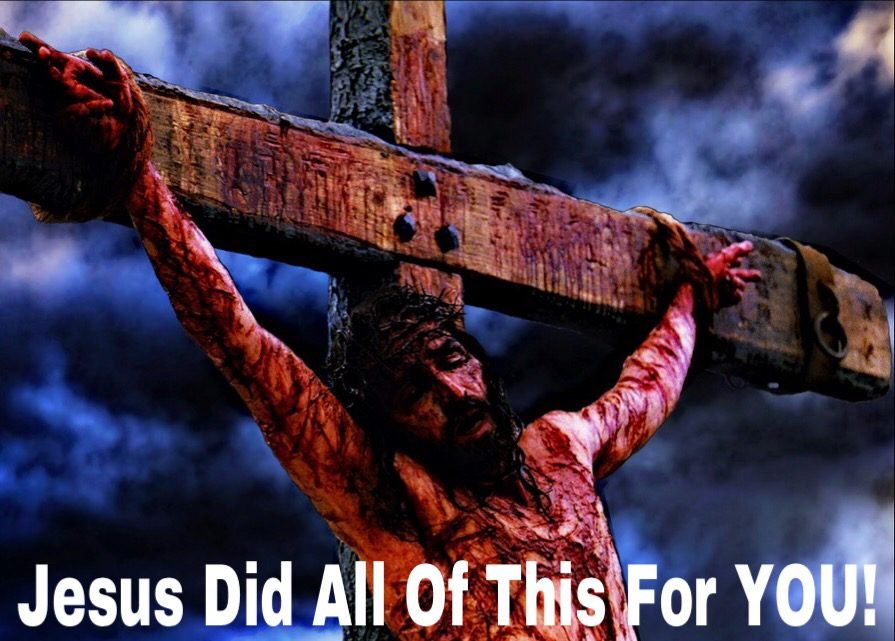
Jesus Christ left Heaven for YOU.
Jesus is God, right? So, when Jesus exited Heaven, it was left without a God? No, God the Father was still there. Wait a minute. I thought Christianity is a monotheistic religion. If there is a God on earth — Jesus — and a God in Heaven — the Father — doesn’t this mean that Christianity is actually a polytheistic religion?
How do you know Jesus left Heaven for me? Calvinists say that Jesus came to earth to only die for the elect — those predestined to salvation by God from before the foundation of the world. And doesn’t the Bible say that Jesus actually came to earth to die just for the Jews and that only after they rejected him did Jesus (God) decide to die for Gentiles?
Matthew 1:21 says: And she [Mary] shall bring forth a son, and thou shalt call his name Jesus: for he shall save his people [Jews] from their sins.
John 1:10-12 says: He was in the world, and the world was made by him, and the world knew him not. He came unto his own [Jews], and his own received him not. But as many as received him, to them gave he power to become the sons of God, even to them that believe on his name:
He left Heaven and entered a world He knew would hate Him, for YOU.
Jesus, God number two, came to earth because his Father, God number one, decided before he created the heavens and earth that he would send God number two to earth to be hated, physically assaulted, and killed. What kind of father sends his one and only son (well, God, according to the Mormons, has many sons) to a hostile environment, knowing that he will be viciously killed? Here in the 21st century, such a father would lose custody of his son and likely face criminal prosecution.
He endured beatings for YOU.
Actually, Jesus endured beatings because he pissed off his fellow Jews. Much like Fred Phelps, Jed Smock, and Steven Anderson, Jesus verbally attacked the Jewish religion and even went so far as to go into the Temple to physically assault people and destroy their property. In other words, Jesus is to blame for his ass-whooping, not me.
He was unimaginably tortured for YOU.
See previous paragraph. Yes, Jesus was tortured, but was it really as big of a deal as Evangelicals make it out to be? The United States government tortures people they deem terrorists for weeks, months, and years. Jesus suffered torture for about twenty-four or so hours. I know of people who have suffered with unrelenting pain and agony for decades. Oh, how they wish they could suffer as Jesus did and then be done with it. (Please see I Wish Christians Would be Honest About Jesus’ Three Day Weekend.)
He suffered for YOU.
See previous two paragraphs. Since Jesus, according to orthodox Christian theology, was fully God and fully man, does this mean God can suffer; that a perfect, sinless being can experience physical pain? I thought, as John 4:24 states, that God is a spirit. How, exactly, does a spirit suffer?
He hung on a cross for YOU.
See previous paragraphs. I think the record is stuck. Please bump the needle.
He shed his blood for YOU.
Christianity is a blood sacrifice cult, as is Islam, Judaism, and a host of other human religions. What’s with all the bloodshed? Couldn’t God have designed a better way of redeeming man from their sin? Why require the bloody sacrifice of innocents? Centuries ago, some religions sacrificed humans. Christians say these other religions are cults. Why is one human sacrifice right and another wrong? The Bible condemns the worshipers of Molech for offering their children as sacrifices, yet offering Jesus as a sacrifice or eating his body and drinking his blood every Sunday during communion are acts worthy of veneration and worship. Seems hypocritical to me.
Christians are divided as to for whom Jesus shed his blood. Did Jesus shed his blood for everyone, as Arminians claim? Or did Jesus shed his blood only for John Calvin’s elect? Or perhaps the Christians sects who believe that Jesus’ blood atonement was sufficient to save everyone, but only efficient to save the elect (Amyraldism) are right. Or maybe the Universalists are right — that Jesus’ blood sacrifice provides salvation for everyone regardless of belief.
So much blood, so many confusing, contradictory beliefs about Jesus’ shed blood. Why didn’t the writer of the Bible — God — make it clear exactly who it is that is covered by Jesus’ blood sacrifice?
He died for YOU.
I think I have snarkily established that Christian sects are divided over for whom Jesus died. From a historical perspective, Jesus didn’t die for anyone. He was executed at the behest of the Jews by the Roman government because he was viewed as a threat to the established order. At best, Jesus was executed because his political beliefs were causing social unrest — that is, if the secondhand reports recorded in the Bible are true. If, as Evangelicals claim, Jesus was/is a world-changing figure, why is there virtually no mention of him outside of the Bible?
I didn’t ask Jesus to die for me, nor did anyone else. God created us, gave us the capacity to sin, and then, when we act of the nature given to us by him, he requires that blood sacrifices be made to satiate his anger; anger, I might add, that should be directed at himself. If I create a car, fill it with gas, start it, and put the car in gear, only to have it go driverless down the road careening into bystanders, who is to blame? Not the bystanders. We humans are mere bystanders in the Christian God’s sordid morality play. God could have chosen a different path, but he didn’t. This is the best humans, uh I mean God, could come up with?
Amazing, isn’t it?
No, actually it is not. There’s nothing amazing about the blood sacrifice of Jesus. There’s nothing amazing about his suffering. There’s nothing amazing about his death. Jesus’ story is one of failure, that of a man who went against the political and religious powers of his day and lost. His story is repeated daily in countless places as people stand against oppression, only to end up imprisoned or killed. Instead of wallowing in the blood of Jesus, the world would be better served if Christians focused on reducing suffering and eliminating the bloody slaughter caused by war. You know, quit talking and start doing.
I have never asked anyone to die for me, nor would I. I recognize that police officers and soldiers might be called on to keep me safe. These are jobs that they have chosen to do. I would never ask anyone to die on my behalf. When someone says that American soldiers are fighting in the Middle East so I can enjoy life in the land of the free and home of the brave, I say, not for me! I would never ask such a thing. Bring all the soldiers home, today. Of course, the troops will not be brought home, betraying the fact that the real reasons for their deaths are imperialistic American ambitions and corporate profits.
There are certainly times when human death for others is worthy of praise and remembrance. Dying to protect and save others is certainly noble, and I honor those who have given their lives for others. Such people are heroes — hero being a word robbed of its significance by its shallow, frequent use. The death of Jesus is not worthy of such a designation. Think about it for a moment. Ponder the whole God/creation/Adam-and-Eve/Satan/original-sin/blood-sacrifice/Jesus/redemption/salvation/death/heaven-or-hell story line. Does any of it make any sense to you? When viewed with eyes that have not been colored by religious indoctrination, this story sounds like some sort of Stephen King novel — soon to be adapted into a feature film for the SyFy channel.
Why is that Christians never ask God WHY? Why this sordid story of animal and human sacrifices? Why the creating of Satan just so he could tempt humans to sin? Why create humans with a capacity to sin? If all of this was just a coder’s work gone awry I would understand. But, according to Christians, their God is all-knowing, all-seeing, and all-powerful. THIS was the best the Christian God could come up with? According to a Ken Ham-reading of the Bible, four thousand years ago, God killed every human, save eight, by drowning them in a worldwide flood. Millions of people died. Here was God’s chance to start over with just eight supposedly God-fearing humans. And what did these humans do? Got drunk and had incestuous sex. Why didn’t God kill Noah and his family and start over? Why didn’t God put an end to Satan and demons? Why did God kill millions of people because they committed execution-worthy sins, only to reboot the world without changing anything?
Didn’t God learn anything from the Human 1.0 experiment? Evidently not. Two thousand years after Noah’s flood, God decided he had to do something about the Human 2.0 experiment. God became human (much like he did when he walked in the Garden of Eden with Adam and Eve), traveled to earth, was born of a virgin, lived a sinless life for thirty-three years, only to commit suicide on a Roman cross. (Suicide? Therefore doth my Father love me, because I [Jesus] lay down my life, that I might take it again. John 10:17) And now, for two thousand years God is conducting the Human 3.0 experiment. And if the book of Revelation is to be believed, this experiment will also end in horrific violence and bloodshed.
It seems to me that God is having a hard time getting things right; that try as he might his multi-player action games are riddled with bugs — coding errors that often cause the games to either reboot or stop working. Perhaps it is time for another coder to try his hand at creation. Sorry God, you’ve been fired.
Christianity would be better served if the bronze-age blood sacrifices and cult worship found in the Bible were excised from its pages. Thomas Jefferson was on to something when he took a pair of scissors to the Bible. Instead of a God who became a man, we could have a sage who uttered sayings and teachings worthy of emulation. Few would argue with the value of such teachings. Human sacrifice? Blood sacrifice? These are relics best left in the dust bin of human history.
Bruce Gerencser, 66, lives in rural Northwest Ohio with his wife of 45 years. He and his wife have six grown children and thirteen grandchildren. Bruce pastored Evangelical churches for twenty-five years in Ohio, Texas, and Michigan. Bruce left the ministry in 2005, and in 2008 he left Christianity. Bruce is now a humanist and an atheist.
Ask an Evangelical Christian if God loves humans unconditionally and he or she will likely respond with a resounding YES!God loves us no matter what we do, they will say. An Evangelical familiar with the Bible might even quote Romans 8:38,39:
For I am persuaded, that neither death, nor life, nor angels, nor principalities, nor powers, nor things present, nor things to come, nor height, nor depth, nor any other creature, shall be able to separate us from the love of God, which is in Christ Jesus our Lord.
Do these verses apply to non-Christians? After all, when non-Christians die they go to Hell. So, this means they are separated from the love of God, right? Uh, well . . . the Bible says God is love! Okay, where does it say that God’s love is unconditional?
The word “unconditional” means without any conditions, not contingent, not determined or influenced by someone or something else. I know that Evangelicals desperately want God’s love to be unconditional, but any cursory reading of the Bible shows that God’s love is ALWAYS conditional.
Consider salvation for a moment. Are there any conditions that must be fulfilled before God will save a person? Or does a person go to bed one night unsaved and wake up the next morning saved? Of course not. In order for unbelievers to be saved, they must repent, believe, and follow. These are the conditions that must be fulfilled in order for a person to be considered a Christian.
Both Calvinism and Arminianism teach that God’s love is conditional. For the Calvinist, God’s love for a person is predicated on unconditional election and predestination. For the Arminian, God’s love for a person is predicated on prevenient grace. If God unconditionally loves everyone then he would save everyone. But, he doesn’t save everyone because he has already determined who he is going to save. But Bruce, the only reason people are not saved is that they choose not to be. Okay, so then them CHOOSING is the condition for God saving them, right? Well, uh . . . can’t get away from it . . . God is not the God of unconditional love.
When God created Adam and Eve, he told them that his love, favor, and blessing were contingent on one condition: don’t eat fruit from the tree of the knowledge of good and evil. Of course, we all know how that worked out.
From the time Adam and Eve sinned until Jesus died on the cross, God required a blood sacrifice in order to expiate the sins of humans, both individually and corporately. Forgiveness was contingent on the blood sacrifice. No sacrifice, no forgiveness. Even now, the forgiveness of sin is contingent on the blood atonement of Jesus on the cross (and sects argue endlessly about whose sins and what sins were expiated on the cross). Again, it is clear that salvation and the forgiveness of sin are conditional.
When I am talking to Evangelicals about the unconditional love of God, I ask them: give me one illustration from the Bible where God’s love is shown to be unconditional? If they think about this for a moment they likely will argue that God’s love is different from human love, so it is impossible for us to understand it. According to many Evangelicals, God is capable of perfectly loving and hating a person at the same time. This is a nice theory for which there is no Biblical foundation.
Genesis 6-8 states that God caused a flood to engulf the earth, killing every human and every animal that was not on the Ark with Noah and his family. Millions of people died. Men, women, children, and babies still in the womb, died because God drowned them. Was God’s love unconditional for those who drowned?
According to Genesis 6:3, God gave humans 120 years to repent. The New Testament tells us that Noah was a preacher of righteousness. Noah was God’s warning siren to the inhabitants of the earth. Their survival depended on them repenting of their evil ways. Granted, things were bad, according to the Bible; the sons of God, which many Evangelicals believe were fallen angels, were marrying human women and having sex with them. This sexual union produced what the King James Version calls giants, mighty men, men of renown.
The conditions on earth were so bad that God:
…saw that the wickedness of man was great in the earth, and that every imagination of the thoughts of his heart was only evil continually. And it repented the Lord that he had made man on the earth, and it grieved him at his heart. And the Lord said, I will destroy man whom I have created from the face of the earth; both man, and beast, and the creeping thing, and the fowls of the air; for it repenteth me that I have made them. (Genesis 6:7)
Humans had become so evil that God regretted creating them. He decided to kill everyone except Noah and seven members of his family. Simply put, God hit the reset button and started over.
When Evangelicals preach at me about the unconditional love of God, I always ask them to explain the unconditional love of God to me from Genesis 6-8. Usually, they will quickly say that God killed everyone because of their sin. So, God’s love was conditioned on them repenting, so his love wasn’t unconditional, right? Besides, God killed innocent children and unborn babies in the flood. God loved them so much that he killed them? Perhaps God thought they would be better off dead (an argument used by more than a few deranged psychopathic parents)?
It is clear from Genesis 6-8 that God’s love was NOT unconditional, and no matter where people read in the Bible, they are going to find that God’s love is conditional. If the Bible is anything, it is the written record of God’s wrath, vengeance, and hate towards those who do not accept and act on the conditions he gives them. The gospel message of the Bible is this, Do THIS and thou shalt live. Either we do things God’s way or he makes us pay.
Imagine a person saying, I love my wife, kids, neighbor, friend, et al. Yet, this person afflicts, starves, brutally punishes, and kills those he says he loves. Would we not rightly say that this person knows nothing about love? Yet, when the Unconditional Love God® does these things, he is given a pass. God is right in all he does because God is right. As the Apostle Paul said in Romans 9, many Evangelicals say, How dare you question what God does! He loves because he says he loves! End of discussion.
Shouldn’t we expect God to at least measure up to human standards? A person who afflicts, starves, brutally punishes, and kills people knows nothing about love. He is likely a sociopath. He is not a person any of us would want to have anything to do with. Yet, when God acts this way, the Evangelical choir begins to sing, What a Mighty God we Serve, followed by, Our God is an Awesome God.
The truth is this: many Christians are far more loving than the God they profess to worship. We all should be very glad that many Christians are more God-like than God himself. Imagine what the world would look like if Christians loved what God loved and hated what God hated. (Read the Bible for the list of people and behaviors God hates.)
I realize that most Evangelical readers and many non-Evangelical Christian readers will reject what I have written here. They are convinced that God is love, every time, all the time, and he can be nothing but love. They even carry it a step further when they naïvely say, not only does God love unconditionally but we are to love everyone unconditionally too.
While it is hard to “prove” that an invisible God does not love unconditionally, it is quite easy to prove that NO human loves unconditionally. At best, unconditional love is a grand ideal, but back here in the real flesh and blood world, human love always has conditions.
I am sure someone will say, I love my wife and my children unconditionally. This person’s thinking is well-intentioned, but it is based on sentimentality and not fact. Suppose for a moment this person went to work, came home early from work, and found his wife in bed with the neighbor. Would his love still be unconditional? Perhaps, he forgives his wife for her indiscretion, but what if she continues to sleep with the neighbor and even starts sleeping with numerous men. Would his love still be unconditional?
Parents like to say that they love their children unconditionally. Suppose for a moment a father went to work, and when he came home, he found his wife and four of his five children murdered. He soon finds out that his teenage son killed his wife and children. Would his love still be unconditional?
But Bruce, these are extreme examples. Yes, and shouldn’t unconditional love work no matter the circumstance? Remember:
The word unconditional means without any conditions, not contingent, not determined or influenced by someone or something else.
It is important for us to love others, and we all can and should broaden the limits of our love. But, as with the God of the Bible, our love does have limits, and this is why I must conclude that the notion of unconditional love is a myth. It is a belief rooted in human sentimentality. Perhaps it is a worthy goal, but all I know is that everywhere I look, be it the Bible, the actions of my fellow humans, or my own actions, all I see is conditional love.
Bruce Gerencser, 66, lives in rural Northwest Ohio with his wife of 45 years. He and his wife have six grown children and thirteen grandchildren. Bruce pastored Evangelical churches for twenty-five years in Ohio, Texas, and Michigan. Bruce left the ministry in 2005, and in 2008 he left Christianity. Bruce is now a humanist and an atheist.
In July of 1983, I started a new Independent Fundamentalist Baptist (IFB) church in the rural southeast Ohio community of Somerset. Over the course of eleven years, the church grew from sixteen to two hundred people. However, by early 1989, attendance stood at fifty due to people leaving the church and the church ending its bus ministry (4 busses). That same year, I embraced Evangelical Calvinism and started a tuition-free private school for church children. My ministry emphasis went from evangelism and topical/textual preaching to edifying the saints and expositional preaching. While I still preached on the street and attempted to win souls, my focus was on the church congregation, instructing them in the “doctrines of grace.”
I started preaching at the age of fifteen. Last night, Polly asked me if I remembered the first sermon I preached, the text I used. She was surprised when I told her I did: An Ambassador for Christ, 2 Corinthians 5:20. A preacher’s first sermon is much like having sex for the first time — both memorable experiences, moments in your life you don’t forget. I stopped preaching in the spring of 2005. I pastored my last church, Victory Baptist Church (now closed) in Clare, Michigan, in 2003. I briefly thought about pastoring again, candidating at two churches: New Life Southern Baptist Church in Weston, West Virginia, and Hedgesville Baptist Church in Hedgesville, West Virginia. Though both churches were interested in me becoming their pastor, I declined, and that was that . . . almost. My friend, Bill Beard, pastor of Lighthouse Memorial Church in Millersport, Ohio, believed, at the time, that I just needed to get back on the proverbial horse and start preaching again. Believing that it was impossible for me not to be a preacher,– For the gifts and calling of God are without repentance. (Romans 11:29) — Bill was insistent that I get back to doing what God had called me to do. Bill even went so far as to offer to buy me an unused church building in Zanesville, Ohio, to start a new church in. He was sorely disappointed when I “prayed” on the matter and said no.
Three years later, Bill received my infamous letter, Dear Family, Friends, and Former Parishioners. This letter detailed my reasons for leaving Christianity. Alarmed and disturbed by my letter, Bill jumped in his car and drove more than three hours north to rescue me from unbelief. After he returned to his home outside of Lancaster, Ohio, I sent Bill the following letter:
Dear Friend,
You got my letter.
I am certain that my letter troubled you and caused you to wonder what in the world was going on with Bruce.
You have been my friend since 1983. When I met you for the first time I was a young man pastoring a new church in Somerset, Ohio. I remember you and your dear wife vividly because you put a hundred-dollar bill in the offering plate. Up to that point we had never seen such a bill in the plate.
And so our friendship began. You helped us buy our first church bus. You helped us buy our church building. In later years, you gave my wife and me a generous gift to buy a mobile home. It was old, but we were grateful to have our own place to live in. You were a good friend.
Yet, our common bond was the Christianity we both held dear. I doubt you would have done any of the above for the local Methodist minister, whom we both thought was an apostate.
I baptized you and was privileged to be your pastor on and off over my 11 years in Somerset. You left several times because our doctrinal beliefs conflicted, you being an Arminian and I a Calvinist.
One day you came to a place where you believed God was leading you to abandon your life work, farming, and enter the ministry. I was thrilled for you. I also said to myself, “now Bill can really see what the ministry is all about!”
So you entered the ministry and you are now a pastor of a thriving fundamentalist church. I am quite glad you found your place in life and are endeavoring to do what you believe is right. Of course, I would think the same of you if you were still farming.
You have often told me that much of what you know about the ministry I taught you. I suppose, to some degree or another, I must take credit for what you have become (whether I view it as good or bad).
Yesterday, you got into your Lincoln and drove three-plus hours to see me. I wish you had called first. I had made up my mind to make up some excuse why I couldn’t see you, but since you came unannounced I had no other option but to open the door and warmly welcome you. Just like always . . .
I have never wanted to hurt you or cause you to lose your faith. I would rather you not know the truth about me than to hurt you in any way. But your visit forced the issue. I had no choice.
Why did you come to my home? I know you came as my friend, but it seemed by the time our three-hour discussion ended our friendship had died and I was someone you needed to pray for, that I might be saved. After all, in your Arminian theology there can be no question that a person with beliefs such as mine has fallen from grace.
Do you know what troubled me the most? You didn’t shake my hand as you left. For 26 years we shook hands as we came and went. The significance of this is overwhelming. You can no longer give me the right hand of fellowship because we no longer have a common Christian faith.
Over the course of three hours, you constantly reminded me of what I used to preach, what I used to believe. I must tell you forthrightly that that Bruce is dead. He no longer exists. That Bruce is but a distant memory. For whatever good may have been done I am grateful, but I bear the scars and memories of much evil done in the name of Jesus. Whatever my intentions, I must bear the responsibility for what I did through my preaching, ministry style, etc.
You seem to think that if I just got back in the ministry everything would be fine. Evidently, I cannot make you understand that the ministry IS the problem. Even if I had any desire to re-enter the ministry, where would I go? What sect would take someone with such beliefs as mine? I ask you to come to terms with the fact that I will never be a pastor again. Does not the Bible teach that if a man desires the office of a bishop (pastor) he desires a good work? I have no desire for such an office. Whatever desire I had died in the rubble of my 25-plus-year ministry.
We talked about many things, didn’t we? But I wonder if you really heard me?
I told you my view on abortion, Barack Obama, the Bible, and the exclusivity of salvation in Jesus Christ.
You told me that a Christian couldn’t hold such views. According to your worldview that is indeed true. I have stopped using the Christian label. I am content to be a seeker of truth, a man on a quest for answers. I now know I never will have all the answers. I am now content to live in the shadows of ambiguity and the unknown.
What I do know tells me life does not begin at conception, that Barack Obama is a far better President than George Bush, that the Bible is not inerrant or inspired, and that Jesus is not the only way to Heaven (if there is a Heaven at all).
This does not mean that I deny the historicity of Jesus or that I believe there is no God. I am an agnostic. While I reject the God of my past, it remains uncertain that I will reject God altogether. Perhaps . . .
In recent years, you have told me that my incessant reading of books is the foundation of the problems I now face.Yes, I read a lot. Reading is a joy I revel in. I read quickly and I usually comprehend things quite easily (though I am finding science to be a much bigger challenge). Far from being the cause of my demise, books have opened up a world to me that I never knew existed. Reading has allowed me to see life in all its shades and complexities. I can no more stop reading than I can stop eating. The passion for knowledge and truth remains strong in my being. In fact, it is stronger now than it ever was in my days at Somerset Baptist Church.
I was also troubled by your suggestion that I not share my beliefs with anyone. You told me my beliefs could cause others to lose their faith! Is the Christian faith so tenuous that one man can cause others to lose their faith? Surely the Holy Spirit is far more powerful than Bruce (even if I am Bruce Almighty).
I am aware of the fact that my apostasy has troubled some people. If Bruce can walk away from the faith . . . how can any of us stand? I have no answer for this line of thinking. I am but one man . . . shall I live in denial of what I believe? Shall I say nothing when I am asked of the hope that lies within me? Christians are implored to share their faith at all times. Are agnostics and atheists not allowed to have the same freedom?
I suspect the time has come that we part as friends. The glue that held us together is gone. We no longer have a common foundation for a mutual relationship. I can accept you as you are, but I know you can’t do the same for me. I MUST be reclaimed. I MUST be prayed for. The bloodhound of heaven MUST be unleashed on my soul.
Knowing all this, it is better for us to part company. I have many fond memories of the years we spent together. Let’s mutually remember the good times of the past and each continue down the path we have chosen.
Rarer than an Ivory-billed woodpecker is a friendship that lasts a lifetime. Twenty-six years is a good run.
Thanks for the memories.
Bruce
Bill never responded to my letter.
I saw Bill one more time a few years ago at a funeral service I held for a former member of Somerset Baptist. We briefly talked after service. I’m sure Bill was disappointed over the secular service I performed for our fellow church member (the deceased had left Christianity), but he said nothing. Two years ago, Bill — true to Jesus and Fundamentalist Christianity to the end — died.
Now to the subject of this post: the day my preacher friend (Bill) fired me. I could write thousands and thousands of words about my friendship with Bill Beard (and his wife, Peggie). Today, I want to focus on a story that took place in the fall of 1989. At the time, Bill was pastoring a Nazarene church he had started outside of Thornville, Ohio (now called Together Ministries Nazarene Church). Bill asked me to preach a revival for his church. Bill knew that I had embraced five-point Calvinism, and I knew his church was Arminian, with many members, including Bill and his wife, believing in sinless perfection (an absurd theological belief if there ever was one). I am sure readers sense an MMA fight waiting to happen.
Bill was a southern gospel aficionado. He had a different group scheduled for each night of the six-night meeting. On the first night, a quartet sang a dreadful song that suggested there were steps to salvation. I believed they were preaching heresy, works-based salvation. So, when it came time for me to preach, I made an “off-handed” comment about the song. Later in my sermon, I made an “off-handed” comment about “sinless perfection” — the belief that Christians can reach a state where they no longer sin. I put the word “off-handed” in quotes for this reason: I never made off-handed comments when preaching. I invested hours in preparing and crafting my sermons. Polly “fondly” remembers my epic OCD sermon outlines. Before I had a word processor or a computer, I would write my outlines long-form, and Polly would type them for me.
Many preachers are known for chasing rabbits, turning their sermons into a hot mess of incoherence. Polly’s father was a consummate rabbit chaser. Great with people, but a terrible preacher. I mean t-e-r-r-i-b-l-e. I worked with my father-in-law for two years, hearing him preach hundreds of sermons. I tried to teach him how to outline a sermon and deliver a coherent, structured message. But, Dad couldn’t make the magic happen. I, on the other hand, never chased a rabbit I didn’t intend to chase; and shoot, skin, and eat for dinner. I destroyed all of my sermon outlines — dumb idea, Bruce (please see Short Stories: The Night I Set My Life on Fire) — in the early 2000s, but I have no doubt I put handwritten notes on my sermon outline for the first night of the revival service that said: works-based gospel song, sinless perfection. These were prompts meant to remind me that I needed to point my shotgun at these rabbits and shoot them dead. And I did.
I was quite proud that I, as a preacher of the true gospel, had preached this gospel to several hundred Arminians. Good job, right? God was pleased with me, right? Right? I brought several Calvinistic acolytes with me, Rick and Lewis — men who daily immersed themselves in the doctrines of grace. Rick and Lewis, both single men in their late 20s and early 30s, praised me for my defense of free grace, my denunciation of works salvation and sinless perfection. Bill and his church had a far different view of my sermon. Shocker, right? Jesus, I poured gasoline on a centuries-old blazing theological bonfire.
The next day, I was sitting in the Somerset Baptist auditorium, pondering and praying about that night’s sermon. Through the oversized oak auditorium doors walked Bill. I was surprised to see him, but it was not uncommon for Bill to stop by the church when he was out and about (this was in the days before cellphones). Bill, of course, wanted to talk to me about the previous night’s sermon. Bill told me that he and his church’s board had decided not to have me preach again. Bill was profusely apologetic, but I understood why he was firing me. Bill handed me several hundred dollars, thanked me for preaching, and left. This was the first and only time this happened to me. At the time, I believed I was fired for preaching the “truth.” Years later, I concluded that my dismissal was the result of arrogance and disrespect. As a Calvinist, I knew there were certain theological subjects I should avoid when preaching to an Arminian congregation. Instead, I disrespected the congregation by stomping on their cherished beliefs.
Bill would later leave the Church of the Nazarene due to perceived “liberalism.” Bill, who had no post-high school education, was asked by denominational leaders to take classes part-time at Mount Vernon Nazarene University. Bill was exposed to ideas that directly challenged his rigid, absolute Fundamentalist beliefs for the first time. (Bill was King James-only.) Unfortunately, he rejected out of hand what his professors tried to teach him, leaving his church and the Church of the Nazarene denomination.
Bill took his outrage and rigidity to a new church, Lighthouse Memorial Church, and a new denomination, Christian Union. I preached special meetings for Bill’s new church. (Bill and his wife donated hundreds of thousands of dollars to build a new church building. Bill farmed 2,000 acres near the church.) I have an old VHS recording of a sermon I preached at Bill’s church. It is the only extant recording of a sermon I preached. I plan to have it converted into a digital recording that I will share on this blog and my YouTube channel.
Bruce Gerencser, 66, lives in rural Northwest Ohio with his wife of 45 years. He and his wife have six grown children and thirteen grandchildren. Bruce pastored Evangelical churches for twenty-five years in Ohio, Texas, and Michigan. Bruce left the ministry in 2005, and in 2008 he left Christianity. Bruce is now a humanist and an atheist.
My writing can be found all over the Internet: on social media, Reddit, websites, and private discussion groups. Recently, an ex-Catholic Reddit group was talking about my deconversion. Many of the participants actually found my story helpful, and for that I am grateful.
That “pastor” never knew Christ personally. He admits it [I most certainly did not]. What he did do, however, is just go through the motions. Putting on the show. Saying all the right things. [This is a baldfaced lie.]
That is what is called a false convert. One can be a false convert for a day, or for an entire lifetime.
No sinner is saved by saying some words. If all one knows is ABOUT God, but one does not KNOW God…then they too are just going through the motions.
As the cliche goes: relationship, not religion.
Roll2Tide:
God’s word is forever true. This pastor’s salvation will forever be secured from God’s perspective.
Separately, this pastor is free to change course and reject that salvation, which he is currently doing.
The OSAS is most commonly spoken to or about a person who is afraid of having their salvation taken from them, and virtually never about a person trying get rid of salvation.
If that pastor doesn’t understand these things………I mean, seriously, this is vacation bible school level knowledge.
RicketyTicketyTock:
So, without getting into pretentious acronyms and big words that try and prove a point. I was raised in the Independent Fundamental Baptist Church as well, from birth until I was 18, I didn’t leave because I lost my faith, I left because I didn’t agree with the ridiculously strict rules that we were made to live by. That being said, they believed in the idea that if you asked Christ to be your personal savior then you were saved from that point on, forever. If you made a mistake, if you hurt someone, then it didn’t mean you lost your salvation. They also believe that there is no one sin that is greater than another, that all sin is sin, so whether you tell a white lie to your child or commit murder, sin is sin and there is no measure that a sin can be so bad that you lose your salvation.
The Bible tells us that no man can do anything to separate a saved individual from God, the only way to have your name removed from The Lamb’s Book of Life is to remove scripture from The Bible. No man can remove your place in heaven, not even yourself.
BigCountryRon:
No it doesn’t. I don’t care if you are an atheist or not, if it has been confirmed through confirmation, you are always a Catholic.
Dude is still saved.
TheApostleJeff:
None of those passages in scripture you quoted speak to OSAS, they speak to patterns / habits / fleshly behaviors that are so dominant that anybody displaying them regularly does not have eternal life in them.
I’d argue the pastor in discussion was never saved, nor were the ‘Christians’ he is comparing himself to. As evidence – nobody who has tasted and seen the Lord is good and then walked in that freedom for 40 years would ‘leave the faith’.
At the end of the day, nobody knows who is truly saved and who isn’t but God
There were sixty-eight comments in this discussion thread. According to these Christians, I was: never saved, still saved, or lost my salvation.
Which is it, Christians? If the Bible is the inspired Word of God and true in all that it says, why can’t the followers of Jesus figure out whether I was or still am a Christian? The Bible says that there is ONE LORD, ONE FAITH, and ONE BAPTISM. One faith, but Christians argue amongst themselves about what that faith is. And yet, they expect unbelievers to figure out which salvation shtick is true.
Perhaps the real issue here is the fact that the Bible can be used to prove almost anything. That’s why Arminians, Calvinists, and once-saved-always-saved Baptists wage war against one another over which of them is right. Allegedly, getting saved is the most important decision you will make. Why, then, can’t the author of the Bible, God, make the matter crystal clear?
I’m waiting God. . .
Bruce Gerencser, 66, lives in rural Northwest Ohio with his wife of 45 years. He and his wife have six grown children and thirteen grandchildren. Bruce pastored Evangelical churches for twenty-five years in Ohio, Texas, and Michigan. Bruce left the ministry in 2005, and in 2008 he left Christianity. Bruce is now a humanist and an atheist.