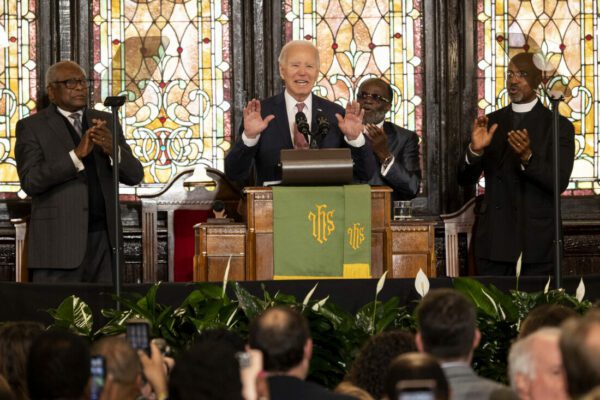
Recently, Democratic President Joe Biden gave a political speech before a historically black congregation at Mother Emanuel AME Church in Charleston, South Carolina. You may remember, that in 2015 White supremacist and neo-Nazi Dylann Roof murdered nine Mother Emanuel members while they were gathered for prayer. Democrats have often used Black churches to give political speeches — contravening the separation of church and state and the Johnson Amendment.
Democrats have long objected to Republican political candidates giving speeches at Evangelical churches. Republicans show no regard for the rule of law. How dare the government tell them who can or can’t give speeches in churches? However, religious sects, parachurch organizations (who increasingly claim they are churches), and churches are tax-supported institutions — exempt from most taxes. U.S. law requires tax-exempt religious institutions to refrain from endorsing political candidates (though they can endorse/support issues). Choosing to do so anyway can lead to religious institutions losing their tax-exempt status. Though to be honest with you, I can’t remember a time when the IRS revoked a church’s tax exemption. A cursory Google search showed that IRS tax revocations since the inception of the Johnson Amendment can be counted on one hand. The IRS has stopped enforcing the law, allowing Democrats and Republicans alike to use churches for political campaigning. Pastors freely endorse candidates, knowing that nothing will happen if they do. (Personally, I support revoking tax exemption for all religious institutions; that churches who claim to be tax-exempt charitable institutions must prove it.)
Liberals love to scream about Republicans giving political speeches at Evangelical churches, yet are silent when Democrats do the same at liberal, mainline Black churches. Democrats are hypocrites if they refuse to call out liberal Black churches for doing the very same things as Evangelical churches do. One liberal writer said “Yes, Biden shouldn’t have given a political speech at Mother Emanuel, but, hey, the Republicans are doing it, so, so should we.”
As long as churches are tax-supported to the tune of billions of dollars a year, the IRS MUST enforce the Johnson Amendment and laws governing the separation of church and state. If the government is no longer willing to enforce the law, then it is time for Congress to put an end to the tax-exemption scam, taxing churches as the businesses they most certainly are. If congregations want to be tax-exempt, they must justify and prove their exempt charitable status. If churches cannot show that the majority of their income is spent on genuine charitable activities — and not just on programs and ministries that primarily exist to make fat sheep fatter — then they must pay taxes just like other businesses do. This means they must file annual income tax returns. (Churches are not required to file tax returns, including informational forms.)
If President Biden wants to speak to the members of Mother Emanuel, he should stand on the public sidewalk in front of the church and do so. On the sidewalk, Biden is free to say whatever he wants. However, once the President walks in the church’s doors, he and the church must abide by the law. That they don’t is disheartening and discredits attempts to hold Republicans accountable for their own violations of the separation of church and state and the Johnson Amendment.
Bruce Gerencser, 66, lives in rural Northwest Ohio with his wife of 45 years. He and his wife have six grown children and thirteen grandchildren. Bruce pastored Evangelical churches for twenty-five years in Ohio, Texas, and Michigan. Bruce left the ministry in 2005, and in 2008 he left Christianity. Bruce is now a humanist and an atheist.
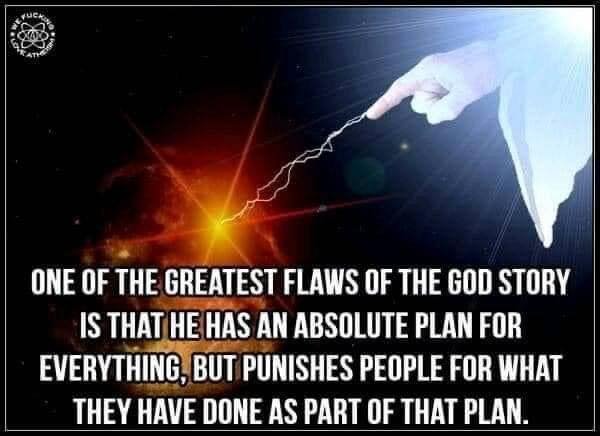
I don’t know why I keep trying. What follows is a discussion I had on a friend’s Facebook page today with a local liberal Christian — a mainline Lutheran. The focus of the discussion is a meme I posted to my page, which my friend shared on his page.
Christian: What an awful perspective. God is love and that is what Jesus preached. There are some things in the Old Testament that are questionable. Life and everything is how you choose to take it and live it. I choose love and happiness not the negative aspects. Those who do not believe don’t believe in God or Jesus so non of this(what the Bible says) matters to them. One does not have to believe to be a good person.
Christian: That is Old Testament. He gave us Jesus so our sins will be forgiven. We experience pain and suffering as a result of this world. I teared up the other night at my brother’s concert because of the wonderful message. ✌🏼❤️
Christian: He also gives us free will-big mistake on some people’s part!! I myself, have not made some good decisions and have suffered physically but I have turned to God to help me through these. He never promised that we will not suffer. I also don’t understand why some people suffer much more than I have and why He hasn’t stopped it. I am with you there!! Also some people take being a ‘Christian’ to a level that God never intended. It doesn’t make them any better than someone else!
Bruce: Well, it matters to the degree that their religion materially affects me. Evangelicals, in particular, don’t seem to want to live and let live. They are Heaven bent on shoving their religion down my throat and evangelizing my grandchildren (Lifewise Academy) who attend public schools. The primary Christian sect behind the 1/6 Insurrection? Evangelicalism.
Bruce: I didn’t read the comments you objected to, but you did make theological claims about the nature of God, the sovereignty of God, and Freewill. While I understand you are just stating your opinions, you did posit that your peculiar brand/flavor of religion is superior to others. Surely it is fair for someone to question/challenge your hermeneutics — in a friendly way, of course. Now if your intent was just to give a testimonial . . . that’s different.
For record, I was part of the Evangelical church for fifty years; a Bible college trained pastor for twenty-five years. I am now an atheist (and a liberal, politically.)
Christian: I did not post that my peculiar? brand/flavor of religion is superior to others. That is a lie. You are far from your biblical roots. Also politics and religion should not mix-that statement is irrelevant. You had better review your hermeneutics and learn how to be a better truthful,respectful person. You have fallen off the boat and are unfortunately have drowned in your hatefulness instead of the love of God. Yes, I am shaking-I don’t deal well with people like you.
Christian: I agree with your statement about evangelicals. I was in no way shoving my religion down someone’s throat. I was just stating what I have learned as a lifetime Lutheran. I can understand why you left that particular ‘kind’ of church.
Bruce: Wow.
You said:
“What an awful perspective. God is love and that is what Jesus preached. There are some things in the Old Testament that are questionable. Life and everything is how you choose to take it and live it. I choose love and happiness not the negative aspects. Those who do not believe don’t believe in God or Jesus so non of this(what the Bible says) matters to them. One does not have to believe to be a good person.”
This is a theological statement. You objected to the meme by positing that your religion of “love” (which you showed none of in your response to me) is better/superior/Christ-like.
You don’t know me, yet you think it’s okay to personally attack me. Let me share with you what the Bible says about such behavior:
“Answering before listening is both stupid and rude.” Proverbs 18:13
Bruce: You don’t know anything about me, yet you have jumped to all sorts of conclusions.
The reasons for my deconversion are many. I would be more than happy to share them with you.
You seem to confuse directness with hatefulness. I am the former, not the latter. Ask around. I doubt you will find anyone who says I’m “hateful.” Life is too short to hate.
Bruce: Virtually every Abrahamic religion believes in the sovereignty of God — God is in control. If humans can thwart the will and actions of God, he is not in control.
The Bible has much to say about God’s absolute rule and authority, right down to who he does and doesn’t “save.” Man doesn’t have free will in a soteriological sense. We “choose,” but only because God chose (election, predestination) us first. Even science today questions whether humans have “free will” — in the colloquial sense of the word. Most people think they have naked free will/libertarian free will. It “seems” right. I suspect, however, it’s not.
Christian: Yes love is better than hate. Then why do you say hateful things to me? Love IS Christlike. Truth is better than you telling lies about me by saying things I didn’t say. (Or misinterpret what I said)Calling someone stupid and rude is worthy of turning you into the Facebook police. I am done with your hate and negativity. Deconversion (Do you think it makes you superior by using big words?)
Bruce: sigh. I didn’t say anything hateful to you. I’m sorry that you can’t see that.
Bruce: deconversion: The loss of faith in a given religion and return to a previously held religion or non-religion (typically atheism, agnosticism, or rationalism).
Christian: I know what deconversion is.
Christian: I am also sorry that you did not take in ALL that I wrote either. I agree with you about leaving the ‘church’ that you left-Baptist- evangelical,I believe?(And also we share the same political views.) All I was doing is sharing what I think and follow. It always seems to turn nasty when people talk about their faith and it doesn’t have to be that way. Why can’t we just talk and be decent human beings? I do not quote the Bible or get philosophical. I know what I believe (and do question some things in the Bible). I use what brings me peace. I am highly educated but I think it is offensive when people pull out the big words or quote from the Bible. I would love to hear why you left organized religion but I wouldn’t want it to turn into a debate. I have had my beliefs for 74 years and will go to my grave with them. I am at peace in my life and wouldn’t like it any other way. I hope you too have found peace(I said that to another atheist friend of mine and she didn’t like it).
Bruce: When you share your beliefs/opinions/ruminations on social media, you should expect people to respond. ‘Tis the nature of the medium.
Christian: Yes, I read everything and why should I care what you were before. I was just saying I agree and can see why you left the evangelical church. You are the one who seems to jump to conclusions!! I try to say something nice and you turn it around-there lies the problem with our colliding personalities!!! Randy is a terrific person but I no longer will comment on his religious/ non religious posts.
Bruce: This has nothing to do with colliding personalities. I do agree that Randy is a terrific person — 98.9% of the time.
You have made several wrong assumptions about the trajectory of my life. My beliefs — theological, political, social — evolved over the twenty-five years I spent in the ministry. Just because I once was an Evangelical doesn’t mean I always was one.
Bruce: Words have meanings. Deconversion and its cousin deconstruction are not “big” words. They (generally) accurately describe the process of loss of faith. You seem to think, without evidence, that I used the word “deconversion” so I could be “superior.” I used the word because it best describes the process of loss of faith.
Sigh, right? (Please see Why I Use the Word “Sigh”.) My goal was to meaningfully interact with this woman, hoping to share with her my perspective on the meme and Evangelical Christianity. I could have went after her incoherent theological beliefs, but I chose not to. For whatever reason, she made it personal. In her mind, I was being “hateful” towards her. My words were so offensive that they should be reported to Facebook! Worse, she attacked my character, suggesting that I was trying to be the smartest guy in the room by using big words. By the time our discussion concluded, I wondered who the Hell she was talking to. It sure wasn’t me. 🙂
As readers know, I am more than capable of eviscerating people with words. I can be snarky, but generally, I try to be respectful, knowing that lurkers are reading my posts/comments. While most of my interactions are with Evangelical Christians, I do, on occasion, cross swords with liberal/mainline Christians, I find discussions with them to be quite frustrating, much like trying to nail Jell-O to the wall. As the aforementioned Christian showed, she has spent 7 decades picking and choosing what she wants to believe. All Christians are cafeteria believers, but liberal believers have turned it into a fine art. In their minds, the Bible is a book of suggestions. The OT God is different from the NT God. They focus on the LOVE of God, ignoring his judgment, wrath, and holiness. In other words, they do what all Christians do: shape and mold a God in their own image.
And that’s fine. I much prefer liberal Christianity when it comes to good works and the mark it makes on the world. Evangelicalism is harmful, both psychologically and physically. It destroys lives, harming children and adults alike. I have been blogging for almost sixteen years. There’s never been a time when someone left a comment on this site that said “liberal Christianity ruined my life.” I am good friends with several liberal Christians. I love the fact that we can talk about anything. That’s not the case with Evangelicals. Why? Liberal Christians have few theological hills they are willing to die on. Evangelicals, on the other hand, see every molehill as Mount Everest.
During the deconversion process, I tried to embrace liberal Christianity. I desperately wanted to hang on to “God.” Unfortunately, I found liberal Christianity to be intellectually unsatisfying. I found myself saying, “why bother”? What I was left with was a social club of sorts, with wonderful, thoughtful people as members. This was not enough for me, especially during football season. 🙂 While I genuinely love and respect my mainline Christian friends, I cannot intellectually embrace their beliefs. I love their good works, but not their theology.
In early 2008, Polly and I and our three youngest children attended Grace Episcopal Church in Defiance. Grace is a dying congregation of mostly elderly people. The music was atrocious, and on Sundays when the priest wasn’t there, the lay sermons were droning monuments to incoherence. We loved the priest and found the congregation to be friendly toward our family (though no attempt was made to assimilate us into the congregation). On our first Sunday there, one of the matrons of the church said to us “Welcome. You can believe anything you want here.” In this particular church, the Bible and theology were irrelevant.
In the fall of 2008, we attended Ney United Methodist Church for a few months. We loved the pastor and his family. The music was more lively than the unsingable high church music at Grace, but no attempt was made to embrace us as a part of the membership. The pastor (who is an Evangelical), Ron Adkins and I got along famously. We had numerous conversations about Evangelicalism and theology. However, by this time it was too late. Fourteen years ago this coming Sunday, we walked out of the doors of the church never to return. A letter to the editor of the Defiance Crescent News I wrote two years after we left the church caused a problem for Ron. He decided to publicly respond to me, ending our relationship. (Please see Evangelical Pastor Ron Adkins and THE Agnostic.) Evidently, my letter caused a stir in the membership, so he felt obligated to respond to me. Ron no longer pastors the church. For a time Ron was associated with the Free Methodist denomination. Presently, he pastors the Urbana Church of Christ in Christian Union in Urbana, Ohio. (I pastored a Christian Union church in Alvordton, Ohio in 1995.)
Polly and I attended other liberal/mainline churches as we attempted to find a church home. What we typically found was awful music, barely tolerable preaching, and nice people who took no interest in trying to engage us at any meaningful level outside of shaking our hands. Of course, we found these same things in Evangelical churches too, although Evangelical music tends to be more inspiring and singable. While our politics, social beliefs, and pacifism better aligned with the liberal/mainline churches we visited, we found their lack of passion and interest off-putting. In the end, both of us came to the conclusion that we had no interest in trying to breathe life into corpses.
Bruce Gerencser, 66, lives in rural Northwest Ohio with his wife of 45 years. He and his wife have six grown children and thirteen grandchildren. Bruce pastored Evangelical churches for twenty-five years in Ohio, Texas, and Michigan. Bruce left the ministry in 2005, and in 2008 he left Christianity. Bruce is now a humanist and an atheist.
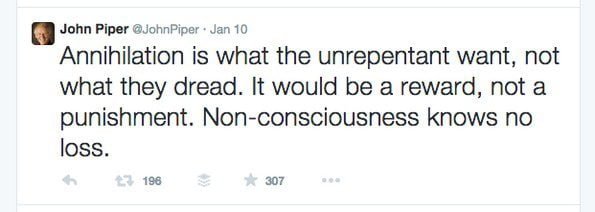
Many Christians — especially those of a liberal/progressive bent — now believe that non-Christians will be annihilated after death. Queasy over the notion of their “Loving” God eternally torturing unbelievers in Hell, these Christians say that God will instead obliterate non-Christians, wiping them from the pages of human existence. Some Protestant Christians think unbelievers will be tortured for a certain amount of time, and then, having satisfied God’s torture-lust, will be burned up and remembered no more.
While it is certainly possible to selectively read and interpret the Bible and conclude that God will annihilate non-Christians, the historic Christian position remains this: God torturing conscious people for eternity. In recent years, thanks to authors such as Greg Boyd, Clark Pinnock, and John Stott, Evangelicals have become more sympathetic towards annihilationism. The question I want to raise in this post is WHY they have become more sympathetic to this view.
What causes staunch, Bible-believing Evangelicals to abandon the doctrine of endless punishment? Have they changed their view as a result of diligently studying the Bible? While I am sure that some Evangelicals have abandoned this doctrine for intellectual reasons, the real reason is more emotional in nature. By carefully examining increasing Evangelical support for same-sex marriage, I think we can understand why many Evangelicals no longer think non-believers will be eternally tortured in Hell (actually the Lake of Fire). Younger Evangelicals — having watched their parents and grandparents turn Evangelicalism into one of the most hated American religions — want to put a kinder, gentler face on Christianity. Many of them — deeply affected by postmodern thinking — have moved leftward, away from the culture war and the endless battles over doctrine. No longer wanting to be viewed in a negative light, younger Evangelicals strive to be accepted by the world. More accepting of evolution and science, tolerant, temperate Evangelicals genuinely want to be liked by others — bristling when lumped in with culture warriors and Fundamentalists.
These worldly Evangelicals know and associate with people older Evangelicals have, in times past, consigned to the flames of Hell. It is hard for them to look at Lesbian Angela, Gay Harper, and Atheist Laura and think these friends of theirs will be endlessly tortured by God. As in the case of LGBTQ people and same-sex marriage, once people actually meet and know people who are happy unbelievers, their viewpoint often changes as well. Their parents and grandparents — fearing contamination by the “world” — walled themselves off from the influences of non-Christians. Younger Evangelicals — often educated at secular colleges — are more comfortable among non-Christians. Once exposed to the “world,” it is unlikely they will return to the Fundamentalism of their Evangelical forefathers.
As atheists, should we be appreciative of the fact that some Evangelicals think God will annihilate us some day, and not endlessly torture us? Ponder for a moment the fact that many annihilationists think God will — for a time — torture unbelievers before turning them into ash heaps. How is this really any better than eternal hellfire and damnation? The fact remains that the Christian God will reward or punish people based on their beliefs. Believe the right things and a home in Heaven awaits. Believe the wrong things and God will erase your name from the book of the living. I get it . . . many Evangelicals are tired of being viewed as mean and hateful, and liberal and progressive Christians are weary of being lumped together with Fundamentalists. However, the fact remains that annihilation is a form of punishment reserved for those who are members of the wrong religious club. This means that good people will be burnt to a crisp for no other reason than that their God was some other deity but Jesus. Forgive me if I don’t find such beliefs “comforting.”
Here’s the good news. Many Christians, having tried on annihilationism for a time, eventually realize that it is just endless-punishment-lite. Once annihilationism is abandoned, universalism awaits. All paths now lead to eternal bliss, so there is no need to evangelize or argue doctrine. Imagine a world without theocratic demands of fealty, arguments over theology, or threats of God’s judgment. Why, such a world would be Heaven on earth — a Heaven where even atheists are welcome.
Bruce Gerencser, 66, lives in rural Northwest Ohio with his wife of 45 years. He and his wife have six grown children and thirteen grandchildren. Bruce pastored Evangelical churches for twenty-five years in Ohio, Texas, and Michigan. Bruce left the ministry in 2005, and in 2008 he left Christianity. Bruce is now a humanist and an atheist.
I put out the call to readers, asking them for questions they would like me to answer. If you have a question, please leave it here or email me. All questions will be answered in the order in which they are received.
Astreja asked:
I have a question, Bruce: What were your (and your congregants’) relationships like with more liberal churches in the towns where you preached?
My relationships with non-Evangelical churches/pastors changed from the time I entered the ministry until I preached my last sermon in 2005. I came of age in the Independent Fundamentalist Baptist (IFB) church movement, attended an IFB college, and worked for and pastored three IFB churches from 1979 to1989. During my tenure as pastor of Somerset Baptist Church in Mt. Perry, Ohio (1983-1994), I left the IFB church movement I was raised in and embraced Evangelical Calvinism. By the time I pastored my last church in 2003, my theology had moved leftward, as did my politics. A parishioner who heard me preach in the 1990s and then again in 2003, was astounded by how much my preaching had changed. He believed I had left Calvinism and embraced works-based salvation (social gospel). He was right. I was still in the Evangelical tent, but I had moved from the extreme right to the liberalism found on the left.
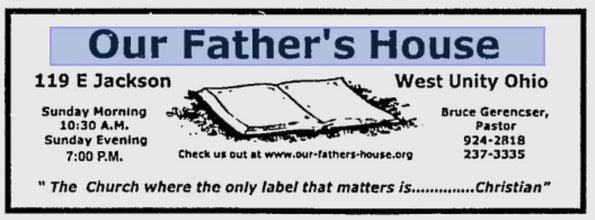
Bryan Times Advertisement for Our Father’s House, West Unity, Ohio
As a Fundamentalist Baptist pastor, I only fellowshipped with my own kind. In the late 1980s, I received a letter inviting me to attend the monthly ministerial meetings for Somerset area pastors. I responded with a letter of my own, stating that I was a separatist, that I did not fellowship with liberals. Besides, the meetings were held at a local restaurant that served alcohol — a definite “sin” in the eyes of IFB preachers. I received a kind, thoughtful reply from the local Lutheran minister. He reminded me that even Jesus fellowshipped with sinners. Smack! 🙂 It would be years later before I dropped my exclusionary practices and adopted the tag line for my church that stated: “the church where the only label that matters is . . . Christian.” In the late 1990s, I joined the local ministerial association, embracing all those who called themselves Christians. At the end of my time in the ministry, my Fundamentalist colleagues in the ministry considered me an ecumenist and a liberal — two labels I wore proudly.
Bruce Gerencser, 66, lives in rural Northwest Ohio with his wife of 45 years. He and his wife have six grown children and thirteen grandchildren. Bruce pastored Evangelical churches for twenty-five years in Ohio, Texas, and Michigan. Bruce left the ministry in 2005, and in 2008 he left Christianity. Bruce is now a humanist and an atheist.
The greatest moral failing of the liberal Christian church was its refusal, justified in the name of tolerance and dialogue, to denounce the followers of the Christian right as heretics. By tolerating the intolerant it ceded religious legitimacy to an array of con artists, charlatans and demagogues and their cultish supporters. It stood by as the core Gospel message—concern for the poor and the oppressed—was perverted into a magical world where God and Jesus showered believers with material wealth and power. The white race, especially in the United States, became God’s chosen agent. Imperialism and war became divine instruments for purging the world of infidels and barbarians, evil itself. Capitalism, because God blessed the righteous with wealth and power and condemned the immoral to poverty and suffering, became shorn of its inherent cruelty and exploitation. The iconography and symbols of American nationalism became intertwined with the iconography and symbols of the Christian faith. The mega-pastors, narcissists who rule despotic, cult-like fiefdoms, make millions of dollars by using this heretical belief system to prey on the mounting despair and desperation of their congregations, victims of neoliberalism and deindustrialization. These believers find in Donald Trump a reflection of themselves, a champion of the unfettered greed, cult of masculinity, lust for violence, white supremacy, bigotry, American chauvinism, religious intolerance, anger, racism and conspiracy theories that define the central beliefs of the Christian right. When I wrote “American Fascists: The Christian Right and the War on America” I was deadly serious about the term “fascists.”
….
Tens of millions of Americans live hermetically sealed inside the vast media and educational edifice controlled by Christian fascists. In this world, miracles are real, Satan, allied with secular humanists and Muslims, is seeking to destroy America, and Trump is God’s anointed vessel to build the Christian nation and cement into place a government that instills “biblical values.” These “biblical values” include banning abortion, protecting the traditional family, turning the Ten Commandments into secular law, crushing “infidels,” especially Muslims, indoctrinating children in schools with “biblical” teachings and thwarting sexual license, which includes any sexual relationship other than in a marriage between a man and a woman. Trump is routinely compared by evangelical leaders to the biblical king Cyrus, who rebuilt the temple in Jerusalem and restored the Jews to the city.
….
The ideology of the Christian fascists panders in our decline to the primitive yearnings for the vengeance, new glory and moral renewal that are found among those pushed aside by deindustrialization and austerity. Reason, facts and verifiable truth are impotent weapons against this belief system. The Christian right is a “crisis cult.” Crisis cults arise in most collapsing societies. They promise, through magic, to recover the lost grandeur and power of a mythologized past. This magical thinking banishes doubt, anxiety and feelings of disempowerment. Traditional social hierarchies and rules, including an unapologetic white, male supremacy, will be restored. Rituals and behaviors including an unquestioning submission to authority and acts of violence to cleanse the society of evil will vanquish malevolent forces.
….
Christian fascism is an emotional life raft for tens of millions. It is impervious to the education, dialogue and discourse the liberal class naively believes can blunt or domesticate the movement. The Christian fascists, by choice, have severed themselves from rational thought. We will not placate or disarm this movement, bent on our destruction, by attempting to claim that we too have Christian “values.” This appeal only strengthens the legitimacy of the Christian fascists and weakens our own. We will transform American society to a socialist system that provides meaning, dignity and hope to all citizens, that cares and nurtures the most vulnerable among us, or we will become the victims of the Christian fascists we created.
I put out the call to readers, asking them for questions they would like me to answer. If you have a question, please leave it here or email me. All questions will be answered in the order in which they are received.
Emersonian asked:
I suppose, not to assume that I understood Steve’s question better than he does (especially since he’s commented above) — the follow-up question is this: was there a line for you between rejecting biblical inerrancy/Christ’s divinity and embracing atheism? Obviously there are many folks (myself included) who believe in a concept of “god” without the trappings of evangelical Christianity . . . so I’d say, even if this wasn’t the question Steve was really asking, do you feel that you went through multiple stages of detachment from religion (rejecting evangelical Christianity, then Christianity as a whole upon further examination, then rejection of the concept of a God of any kind) or was it all a package deal — if the evangelical view isn’t true then all of it must be BS? I know that you and Polly did attend non-evangelical churches of various types after your departure from your former congregation: how did that inform your eventual acceptance of your own atheism?
Perhaps what Emersonian wants to know is whether I think I threw out the proverbial baby with the bathwater; that in abandoning Evangelicalism (the bathwater), I threw out God (the baby) altogether. I certainly understand how someone might read my story, miss a few of the connecting dots, and come to this conclusion. However, this is not what happened, as I shall explain below.
I have been asked on several occasions if I thought I would still be a Christian had I begun life in liberal Christianity instead of Evangelicalism? This is a good question, but one, of course, that I cannot answer. Playing the “what might have been” game is an interesting endeavor, but it is impossible to know how things might have turned out had I walked through door number one instead of door number three. I am sixty-two years old. The sum of my life is a long string of choices. Each choice sent me down a certain path. A different decision along the way would have sent me in a different direction. Maybe I would have married a different woman, gone to a different college, chosen a different profession, or lived in a different state. The fact remains, however, that I made certain choices that resulted in certain outcomes. So it is with me being an Evangelical Christian for 50 years of my life. I was born to Evangelical parents, grew up in an Evangelical home, attended Evangelical churches, went to an Evangelical college, and married an Evangelical woman. We spent the next twenty-five years ministering in Evangelical congregations, gave birth to six Evangelical children, and had numerous Evangelical cats and dogs.
My life was so deeply immersed in the Way, Truth, and Life of Evangelical Christianity that even today, eleven years removed from the day I walked out the Ney United Methodist Church for the last time, I wrestle with the vestigial remains of Evangelicalism. Now, this does not mean that I, deep down in my heart of hearts, still yearn to be a Christian. I don’t. What it does mean, however, is that five decades of Evangelical training and indoctrination left a deep scar upon my life; a scar that is fading with time, but will likely never totally fade away.
It is certainly true that coming to understand that the Bible was not an inspired, inerrant, infallible text shook my religious foundation. “If the Bible is NOT what Evangelicals claim it is,” I asked myself, “are any of its teachings true?” Answering this question forced me to re-study the central claims of Christianity; especially beliefs that were supernatural in nature. From creation to apocalypse, I took a careful look at the doctrines I once held dear. I painfully concluded that the central claims of Christianity could not be rationally and intellectually sustained.
I have always been the type of person who follows the evidence wherever it leads. This is why my theological foundation shifted several times when I was a Christian. I entered the ministry as an Independent Fundamentalist Baptist (IFB) preacher. Over time, I abandoned cheap grace, one-two-three, repeat-after-me soteriology and embraced Calvinism. A decade or so later I abandoned Calvinism. When I left the ministry in 2005, I was preaching what some of my critics called a social, works-based gospel. I was a far different preacher and man in 2005 from the one I was when I enrolled in classes at Midwestern Baptist College in 1976. Time changes all of us, and I am no exception.
Take my eschatological beliefs. For many years, I held to a dispensational, pretribulational, premillennial eschatology. Once I embraced Calvinism, I adopted a posttribulational, amillennial eschatology. Countless other beliefs changed over the years. The more I read, the more my beliefs evolved. This approach to gaining knowledge continued as I contemplated leaving Christianity. The goal has always been the same: to know the truth.
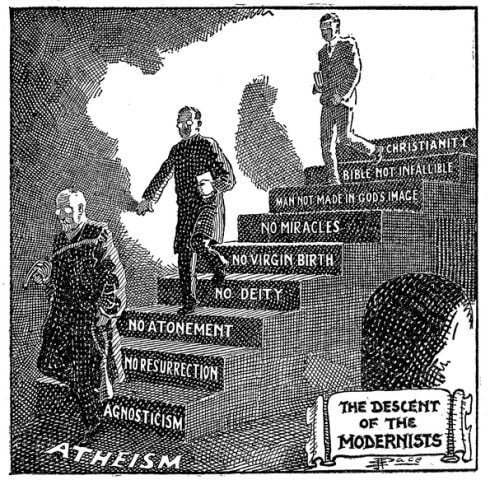
“Why didn’t I become a liberal Christian?” you might ask. Surely, I could have abandoned Evangelicalism, yet held on to the Christian God. Maybe, but I doubt it. I value truth more than many liberal/progressive Christians do. Liberals seem willing to jettison virtually every Christian belief save believing in the existence of Jesus/God. Their beliefs can fit on the front side of a 3×5 card. I find myself asking, “why bother?” Such people are usually universalists, so there’s no concern about unbelief landing anyone in Hell. I suppose there is value in the social aspects of belonging to a church, but I enjoy sleeping in on Sundays far more than I do listening to terrible, lifeless sermons and attempting to sing songs best suited for the Vienna Boys Choir.
After I left the ministry and before I deconverted, our family visited over 100 churches in Ohio, Michigan, Indiana, Arizona, and California. (Please see But Our Church is DIFFERENT!) We attended churches across the sectarian Christian spectrum. The only churches we avoided were IFB congregations. Our goal was to find a church to call home that took seriously the teachings of Jesus. After three years of searching, we concluded that all the churches we visited were pretty much the same. Sure, we experienced different liturgies, different worship/preaching styles, etc., but at a foundational level, these churches differed very little from each other. I know, I know, every church thinks theirs is “special.” Every church thinks their buffet is better than those of other churches. Every church thinks their flavor of ice cream (please see My Heart Goes Out to You or Please Try my Flavor of Ice Cream) is better than any other flavor. That’s what happens when you spend your life in inbred relationships; when you spend your life in religious bubbles that give the appearance of rightness. Ultimately, it was exposure to the “world” that led me down the path of deconversion. Once freed from the authoritarian hold of the inerrant Word of God, I was free to read and study whatever I wanted. I was no longer walled in by Evangelical beliefs. I was free to follow the path wherever it went. This led to where I am today.
About Bruce Gerencser
Bruce Gerencser, 62, lives in rural Northwest Ohio with his wife of 41 years. He and his wife have six grown children and twelve grandchildren. Bruce pastored Evangelical churches for twenty-five years in Ohio, Texas, and Michigan. Bruce left the ministry in 2005, and in 2008 he left Christianity. Bruce is now a humanist and an atheist. For more information about Bruce, please read the About page.
Are you on Social Media? Follow Bruce on Facebook and Twitter.
Thank you for reading this post. Please share your thoughts in the comment section. If you are a first-time commenter, please read the commenting policy before wowing readers with your words. All first-time comments are moderated. If you would like to contact Bruce directly, please use the contact form to do so.
Donations are always appreciated. Donations on a monthly basis can be made through Patreon. One-time donations can be made through PayPal.
We also know the Holy Bible is not infallible—and neither are many of the fundies who read and study it. The main purpose of the Bible is to point all people toward faith in Jesus Christ and invite people into reconciled discipleship and fellowship with God the Father, Jesus Christ, and the Holy Spirit. However, millions of Americans read the Bible, put it down, and reject the Holy Trinity, reconciliation, and discipleship.
The sentiment expressed by this man about the Bible and its purpose is quite common among liberal Christians. In their minds, the Bible was written for the purpose of pointing “all people toward faith in Jesus Christ and invite people into reconciled discipleship and fellowship with God the Father, Jesus Christ, and Holy Spirit.” Everything else found in the Bible is minutiae that can be ignored or disregarded without a second thought. When asked how they come to this hermeneutic, rarely, if ever, do liberal Christians give a cogent, rational answer. As with their Fundamentalist brethren, liberals just believe. The only difference between them theologically is WHAT each of them believes; which foods they put on their plates from the Christian Buffet and which foods they leave behind. (Please see Is Liberal Christianity the Answer for Disaffected Evangelicals?)
While the author of the above quote despises Christian Fundamentalists, he fails to see that he is, to some degree, a theological Fundamentalist too. While he rejects much of what Evangelicals believe and practice, he does have infallible, non-negotiable beliefs, starting with the belief that the Christian God is three-in-one — what he calls the “Holy Trinity.” He also must believe that humans are sinners. If not, there’s no need for reconciliation or restored fellowship with God. So, he does have theological beliefs in common with Evangelicals.
Christians, regardless of their labels, have cardinal, infallible beliefs that are foundational to their faith. From an atheistic perspective, I find this man’s Christianity just as intellectually lacking as that of the most ardent of Baptist Fundamentalists. Both groups operate under a certain set of presuppositions. That’s not to say that both are equally harmful — they are not. But, those of us who are skeptical, rational non-believers find the entire spectrum of Christianity intellectually lacking.
One question I have often pondered is what the outcome of my life might have been had I been exposed to liberal Christianity instead of Evangelicalism. Would I have still entered the ministry? Would I still have given myself to the service of others? Maybe, but then maybe not. Evangelicalism presented a very narrow path for my life, so my conversion at age fifteen, call to the ministry, and the twenty-five years I spent pastoring Evangelical churches is unsurprising. Liberal Christianity would have, I believe, presented me with a wide-open path career-wise. Instead of a pastor, I might have become a social worker, high school teacher, or a college professor — all of which I have thought I would have liked to do had I been raised differently.
I am in no way trying to disparage the liberal Christian readers of this blog. I appreciate your support and all that you have done to make this site a friendly place to hang out. But we both can be honest, can we not, that we love and respect one another, not because of our beliefs, but because of how we live our day-to-day lives. Atheist or Christian, we both try to live meaningful lives and help others. Is that not all any of us can do?
About Bruce Gerencser
Bruce Gerencser, 62, lives in rural Northwest Ohio with his wife of 41 years. He and his wife have six grown children and twelve grandchildren. Bruce pastored Evangelical churches for twenty-five years in Ohio, Texas, and Michigan. Bruce left the ministry in 2005, and in 2008 he left Christianity. Bruce is now a humanist and an atheist. For more information about Bruce, please read the About page.
Are you on Social Media? Follow Bruce on Facebook and Twitter.
Thank you for reading this post. Please share your thoughts in the comment section. If you are a first-time commenter, please read the commenting policy before wowing readers with your words. All first-time comments are moderated. If you would like to contact Bruce directly, please use the contact form to do so.
Donations are always appreciated. Donations on a monthly basis can be made through Patreon. One-time donations can be made through PayPal.
An increasing number of Evangelicals find themselves emotionally, theologically, and politically at odds with Evangelical Christianity. And it’s not just people in the pews either. Evangelical pastors, evangelists, missionaries, and college professors also find themselves in opposition to Evangelical beliefs and practice. Skewered by keepers of the book of life (discernment ministries and Fundamentalist zealots) as Christ-denying apostates who likely never were Christians, these servants of God find themselves increasingly attacked and discredited over their willingness to verbalize and share their doubts and questions about the “faith once delivered to the saints.” I know firsthand the savagery of those who believe God has called them to seek out disloyal Evangelicals. I know firsthand their attacks on your character and family. I know firsthand the lengths to which they will go to discredit your story — even saying that you were never a pastor and or your story is a complete fabrication. Yet, despite the increasing violence against doubters who dare to go public with their doubts, questioning congregants and clergymen continue to tell their stories.
Many of these doubters eventually turn to atheism or agnosticism. My journey from Evangelicalism to atheism was one of a slow slide down the proverbial slippery slope. (Please see the From Evangelicalism to Atheism series) I knew that Evangelicalism was a charade, a religious house built on a faulty foundation, but I desperately wanted to keep believing in Jesus. It was all I knew. So, for a time I tried to make intellectual peace with liberal Christianity, but in the end, I found its arguments intellectually lacking. From there, I thought, maybe Unitarian-Universalism (UU) is the answer. While I met a number of wonderful UU people, I came to the conclusion that UU was just a religion of sorts for atheists and agnostics; a religion for people who loved liturgy and spirituality, but rejected dogma. I found myself asking, why bother?
I have noticed in recent years that supposedly non-judgmental, loving liberal Christians have taken to attacking atheists, suggesting that atheists are no different from Fundamentalists who say that if you can find one error in the Bible then Christianity is false. Atheists are accused of attacking a straw man Christianity, instead of engaging “real” Christianity. While I certainly agree that some atheists are every bit as Fundamentalist as Christian zealots, most of them are not. In fact, many of the atheists I know, myself included, have given Christianity a fair shake. We have weighed Christianity — including its liberal flavor — in the balance and found it wanting.
Liberal Christians rightly condemn Evangelicals for their rigid literalism and commitment to Bible inerrancy. To liberals, only country hicks and intellectually challenged people believe the Bible is literally true, without error, and infallible in all that it teaches. Who in their right mind thinks the earth was created by the Christian God 6,024 years ago? Who in their right mind believes in Noah’s worldwide flood? Who in their right mind believes all those Old Testament stories are true? Who in their right mind believes Jesus actually worked all the miracles attributed to him in the Gospel? Who in their right mind believes in a literal Hell where non-Christians are tormented day and night forever? Who in their right mind believes that Jesus was the virgin-born son of God who came to earth to die for sinners and resurrected from the dead three days later? Uh, wait a minute Bruce, I agree with you on everything except what you said about Jesus’ birth, death, and resurrection, liberal Christians say. Jesus is real! Jesus died for my sins! Jesus resurrected from the dead! Jesus promised me a home in Heaven when I die! (This is best said jumping up and down.) And therein is the fundamental problem I have with liberal Christianity. While the Evangelical holds on to rigid literalism and inerrancy, the liberal Christian jettisons virtually everything except the Jesus of the gospels. Liberal Christians believe most of the stories and teachings in the Bible are allegorical or metaphorical, yet when they read the Bible verses about Jesus’ birth, death, and resurrection, all of a sudden they become rigid literalists and can be every bit as Fundamentalist as Evangelicals. All of a sudden, the words of the Bible matter and are to be taken literally, thus proving at some point along the inerrancy spectrum, Evangelicals and liberals alike believe these Bible verses really, really, I mean R-E-A-L-L-Y are true!
Over the past decade, I’ve engaged in heated discussions with countless Evangelical apologists. Years ago, these discussions (and personal attacks) became so emotionally draining that I quit blogging, vowing never to write again. Yet, months later I would arise from the ashes and try again. All told, I went through this process at least three times. Long-time readers sensed a pattern, knowing that, yes, Bruce will crash and burn, but eventually he will rise again from the dead. June 2014 was one of those times. I thought, at the time, I am really done with this! Time to move on! However, in December 2014, I opened up shop again, calling my venture The Life and Times of Bruce Gerencser. Come December, I will have been successfully open and serving up either bullshit or gourmet meals depending on your view of Evangelical Christianity, for five years. What changed? Why have I been able to keep writing week after week, year after year?
Four things stand out, and yes, I am going to bring this post back around to its subject.
First, I began seeing a secular counselor on a regular basis. He literally saved my life. I still see him every few weeks.
Second, I developed close relationships with a handful of readers who knew the warning signs of an impending Bruce crash and burn. They took on the burden of engaging Evangelicals in the comment section, and were willing to warn me when they saw me getting wound up and ready to explode.
Third, Loki brought a woman by the name of Carolyn into my life. When Carolyn first contacted me, she told that she loved my writing, but my grammar really needed some work. At first, I was offended, but I can tell you today, she was absolutely right. Carolyn not only edits my writing, but she has also become a dear friend. She knows me well enough to sense when I am deep in the valley of depression and despair, and sometimes all I need from her is a text that says, Are you okay? And, after 50 texts back and forth, I start feeling better! Don’t let anyone tell you that online friendships are of little value. I know better.
Fourth, I learned that it was okay to NOT engage Christian zealots in discussions; that my target audience was Christians who had doubts or questions about their faith or people who had already left Christianity. I decided to let Evangelical apologists have their say in the comment section and then send them packing. I wanted this blog to be a haven safe and free from Evangelical bullies and trolls — a la Jim Wright’s recent comments. All in all, I think I have succeeded.
Every year, scores of commenters end up banned from commenting. Banning works this way. Run afoul of the commenting guidelines or act like an asshole, and your commenting privileges are revoked. Come the start of each year, however, I clear the ban list, giving everyone banned a fresh start, an opportunity to show me and the readers of this blog that they can play well with others. Sadly, many un-banned commenters quickly find themselves banned again — thus proving that a leopard can’t change its spots.
What might be surprising to readers is this: only one commenter is permanently banned. Wow, she must have really been a Fundamentalist! Actually, she is a liberal Christian, one of the most irritating commenters I have ever known. Why, you ask, does she irritate me? When pressed on what it is that she actually believes, she always dodges my questions or attempts to muddy the waters. When asked to give me a list of what were her non-negotiable beliefs — silence. When asked to state her cardinal, must-believe theological beliefs — silence. When asked if she believed atheists such as myself go to Hell when they die — silence. I found her obfuscation to be akin to attempting to nail Jell-O to a wall. One time, we got into a discussion about her belief that God is Love. While certainly, the Bible teaches God is love, it also teaches that God is angry with the wicked every day, hates sinners, and can and does act in vindictive, capricious, violent ways. This woman wanted the God of love, but not the God of wrath. She made much of all the places in the Bible that spoke of God’s wonderful grace and love. I replied, “let’s talk about Genesis 6-9; you know Noah’s flood; you know where God killed every man, woman, child, infant, and unborn fetus save eight people. By all means, from this passage of Scripture, show me the God of Love.” Of course, she had no answer for me.
A lot of liberal Christians read this blog. They love my frontal assaults on Evangelical Christianity. They love my liberal politics and progressive social values. And I love them too. I am all for ANY religious belief — including worshipping Bruce Almighty — that moves people away from religious fundamentalism — especially Christian Fundamentalism. That said, I truly don’t understand, from a belief perspective, liberal Christians. What beliefs really matter? How can one dismiss, reinterpret, or spiritualize most of the Bible, yet believe in a literal born of a virgin, crucified, resurrected from the dead Jesus? How does someone determine what’s to be taken literal, and what’s not? Liberals accuse Evangelicals of having wooden literalism only when it suits them or when it validates their theology, but how is this any different from what Liberal Christians do? Isn’t this buffet approach to faith just a matter of degree? Why is it laughable when Evangelicals say they believe every word of the Bible, yet dismiss certain verses when it’s convenient or expedient to do so, but when Liberal Christians do the same, it’s somehow different? Different how? Aren’t both groups picking and choosing what it is they really believe and ignoring the rest?
I also wonder if Liberal Christians are, deep-down in their heart-of-hearts, universalists; people of faith who believe all roads lead to Heaven. If this is so, then why try to rescue disaffected Evangelicals from the jaws of atheism and agnosticism? Shouldn’t freeing people from the Evangelical cult be all that matters? If there’s no Hell, no final judgment, no accounts to be settled between God and man, why bother? Or at the very least, why not just admit that you go to church for social and cultural reasons, and your faith gives you a sense of purpose and meaning? You see, I suspect there are more than a few atheists and agnostics hiding in plain sight in liberal Christian churches. I also suspect that a number of liberal Christians are closer theologically to their Evangelical brethren than they are willing to publicly admit; that in the end Christians are going to win the grand prize of eternal life, and atheists are going to be annihilated by God, snuffed out of existence for all eternity — as if somehow that’s loving.
Liberal Christianity remains a conundrum to me. I have asked before for Liberal Christians to explain to me their view of the Bible and how and why they determine which parts of the Bible to believe and which parts, in Thomas Jefferson-style, to excise. So far, I have yet to hear a cogent explanation and defense of liberal Christianity. I can see its effect on the world through its good works and love for others, but intellectually, at least for me, Liberal Christianity remains Jell-O nailed to a wall.
About Bruce Gerencser
Bruce Gerencser, 62, lives in rural Northwest Ohio with his wife of 41 years. He and his wife have six grown children and twelve grandchildren. Bruce pastored Evangelical churches for twenty-five years in Ohio, Texas, and Michigan. Bruce left the ministry in 2005, and in 2008 he left Christianity. Bruce is now a humanist and an atheist. For more information about Bruce, please read the About page.
Are you on Social Media? Follow Bruce on Facebook and Twitter.
Thank you for reading this post. Please share your thoughts in the comment section. If you are a first-time commenter, please read the commenting policy before wowing readers with your words. All first-time comments are moderated. If you would like to contact Bruce directly, please use the contact form to do so.
Donations are always appreciated. Donations on a monthly basis can be made through Patreon. One-time donations can be made through PayPal.
In response to my request for guest posts from liberal/progressive Christians, a reader I’ll call John Calvin submitted a thoughtful post detailing why he still, to some degree, “believes.” John is currently a minister in a mainline Calvinistic denomination. John feared his words would be seen as blatant hypocrisy, but I hope readers will listen carefully to what John is trying to say, and consider the deep emotional andpsychological struggles he faces every day. I know more than a few liberal/progressive ministers read this blog, including some who are atheists/agnostics and still preaching on Sundays. I appreciate John’s willingness to be honest about where he is in his life, and how he struggles with the existence of God. May his words be instructive and helpful.
I grew up in fundamentalism, the holiness variety, and was caught by all the claws of its well-designed trap. In my culturally deprived southern working-class environment, the church was essentially all I had. There was music — bad music, but it was music. There was poetry — bad poetry, but it was poetry. There was literature — bad literature, but it was literature. There was community, and it wasn’t bad. In a childhood of some moving around, the church became my hometown. It seemed full of warm, loving people. Now, though, after all these years, I greatly resent the fact that my spiritual life was entrusted to them. They should not have been in charge of it. Was the warmth and loving just one more tooth in the trap?
I’m sure I thought it was God’s will that I attend a denominational college; that I take a degree in Biblical Literature. I also married into the family of a pastor who used his fundamentalist conservatism as a weapon. Marriage among undergraduates in that school, especially for ministerial students, was almost expected. If you didn’t get married, you would probably end up having pre-marital sex, and there was nothing God hated more than that. After college, I went to the denominational seminary.
I never remember wanting or planning to be a pastor. You might say I didn’t take career planning nearly seriously enough. What I wanted was to understand the religion I found myself struggling to swim in. Being more of a seeker than was warmly welcomed at that seminary — where the truth, having once been delivered unto the saints, was already fully known, I transferred to an old, Eastern establishment seminary. The intellectual freedom I felt there was a wonderful breath of fresh air. By the time I graduated with my M.Div. I had departed my holiness denomination and become a pastor in a large, so-called “mainline” denomination. Frankly, I was worn out, had a family, was in debt, and didn’t know what else to do. (I was twenty-nine years old. I had started school at age four. I had taken a year off, twice, at different times, but essentially I had been going to school for twenty-five years. My diploma was written in Latin. I couldn’t read it. I still have no idea what the damn thing says. But it had better be good.)
A lot happened in subsequent decades. That large denomination I joined is a lot smaller now, partially, I’m sure, because of my feeble efforts. That cute little holiness preacher’s daughter I married, who could play the piano and sing like a bird (good one, not some crow or red-winged blackbird), told me she was embarrassed to tell people she was married to a minister, had a string of affairs, and finally left my sorry ass flopping in the dust.
I got out of the ministry for a while. Then I remarried, this time to a woman with no apparent pride and who didn’t mind being married to a minister, so I got back in. Now I am supposed to be retired, but I am still a part-time pastor, having the best time I ever had in the ministry. I wouldn’t have wanted to miss it. Most of the time I found being a pastor a painful and uncomfortable experience. (Hey, I never wanted to do it anyway, but the hooks were well set.)
Now, as to why I am still doing what I do. I guess I fit the definition of a progressive, liberal Christian, I prefer the term “cultural Christian,” which to me is analogous to someone being a cultural Jew rather than being a religious Jew. Some people might call me an atheist. I have called myself that on occasion, but only to myself. Whatever is left of my Christianity is bereft of any supernatural elements.
I understand the Bible to be the product of human beings, at its best a record of peoples’ interpretations of how God had worked among them. The Bible is clearly full of errors, contradictions, and outrageous mythological constructions. The idea of a perfect, inerrant Bible delivered by the hand of God is ludicrous.
While I believe it is possible that Jesus of Nazareth was not a historical person, I also believe it is possible that he was. If the things the New Testament says happened, it is amazing that none of Jesus’ contemporaries felt them important enough to mention, not even the matter of Jewish saints coming out of their tombs on the day of Jesus’ crucifixion. Seriously? No one thought to jot that down? “Hey! Guess what happened!” Still, it seems to me probable that there was a guy back there somewhere to build the legends around. Much of the New Testament is no doubt fiction, designed to present him as a divine prophesy-fulfilling miracle worker. Even so, I find the core of his teachings to be inspiring and, even if they are not totally original, potentially revolutionary. I think his teachings of love and compassion are especially needed in a world that is increasingly violent and hateful, most especially when so many of those who call themselves Christ-followers are enabling the hatred and violence. (“Christians have to keep telling people they’re Christians, otherwise no one would notice.”)
The Church that says it follows him is a humiliation and an embarrassment. It has done some good in the world, but it has done some horrendous things too. I am not convinced that Christianity is a net positive force in the world. If nothing else it is guilty of diverting peoples’ attention from important issues such as living with love and compassion, to minor ones. What the church most demonstrates is that humans are institution-building animals.
So, again, why do I keep doing what I do, and why would I have any hope of being anything other than a blatant hypocrite?
It does not take much to reach the realization that there is no big man in the sky, that the earth and its creatures were not zapped into existence 6,000 years ago. Still, almost every human culture has tried in some way to grasp something beyond itself. Some have called it “God.” That “something beyond” has had a powerful impact on humans and their histories. As it happens, more humans identify with Christianity than any other single religion, as they have been doing for 2,000 years. I think that’s significant. Even if it is an amazing shared delusion, is it not something that can be honored for what good it does contain, for what good it has done? Are we right when we say, “Well, all those people were idiots?” “Thank God, our intellect is so much better than theirs that we have it all figured out and can toss it all aside like ideas of a flat Earth or the belief that some chickens have lips.” Does not the tradition, if nothing else, deserve some honor?
Maybe none of that works. Honestly, I was at least a little uncomfortable writing it. But, as I said, I am a cultural Christian. This is where I was born. This is where my people are. We share history and ritual and community. I sit with them as they die. I pray with them then and there. Not because I am challenging God to alter the laws of the universe, but because I hope and think the prayer might help them. It is not about me. It is an act of service on my part, because the whole thing is so much bigger than me, and I am willing to accept the reality of mystery. I see no benefit in standing by a bed in a hospice and saying, “Well, I’m sorry you’re dying, but don’t expect God to hold your hand through this. You’re just gonna slip back into the darkness forever, so get over it.” I expect to slip back into the darkness forever, sooner rather than later, and I’m fine with that, but I don’t think I have a right to impose that on them, at least at that point. That work needed to be done a long time before that.
I do strive for authenticity in my preaching. I do not lie to people. I do not present the Bible as a magic book, but as a book written by real flesh and blood human beings. I do not pretend that Adam and Eve were real people. I straightforwardly acknowledge that evolution is true. At the same time, even though my cultural Christianity has lost its supernatural elements, I will never stand up on Easter morning and say, “Look folks, we know this never happened. Dead people don’t come back to life. If this was true we could at least expect the Gospels to get their stories straight.” I think of it as being respectful of people.
I do not encourage peoples’ belief in their mythological Father-God “up there” somewhere, and that the instant they die they’ll be reunited with their dead loved ones at Jesus’ feet by the crystal sea. Maybe I leave people to assume that I believe much of that just like they do, and maybe that all by itself makes me that blatant hypocrite. On the other hand, maybe that is what gives me the opportunity to move them along, little by little.
I genuinely care for the people in my parish. I embrace them with love. I try to educate them to have a better understanding of the Bible and what it means to be a Christian in these days, and I know that to some extent I succeed. I try, as gently as I can, to challenge their assumptions and presuppositions. I try to lead them to what I would like to believe is a more mature faith.
Sometimes, I think I must sound like a broken record, saying over and over, “Come on! Let’s live as Jesus said! With love and compassion.” I also feel like the voice of one crying in the wilderness when the vast majority of American Christians seem to be saying, “Screw that!”
I do not care about maintaining the institution of the church, which is too bad, because ultimately I believe that’s what parish ministry is all about.
I admit to being conflicted. Sometimes I think I would like to turn in my resignation and run out the door yelling, “Freedom!” I haven’t yet, and it is not because I’m getting paid. I do take the money, but if I stopped getting those big church bucks it wouldn’t change my life one bit. I guess I do it because for whatever reason it still matters to me. I’ve never been able to get those hooks out of me. I once asked a friend who seemed to have the same ambivalence about ministry that I had, after he had been fired as president of a seminary, “Would you do it again?” He said, “I would have to. It’s my curse.” I understood completely.
One thing for sure has happened. Here in my Calvinistic denomination, I have finally proved the truth of Arminianism. I have definitely lost my salvation. But, hey, heaven for the climate and hell for the company. Am I right?
This blog attracts all sorts of readers, from ardent Fundamentalists to atheists. I long ago stopped trying to figure out why this or that group reads my writing. I am just happy that ANYONE does. Most of my focus is on Evangelical Christianity. Liberal and progressive Christians, along with fringe Evangelicals, enjoy my critiques and takedowns of religious beliefs they consider insane. Such people will often leave comments that say, “Those Christians are crazy. I’m glad I am not that kind of Christian!” In their minds, Fundamentalists are crazy, and real Christians would never believe such things. Rejecting the God of wrath, liberal and progressive Christians assert that “God is love.” (1 John 4:8) Any belief that’s not consistent with “God is love” is wrong — regardless of what the Bible says. Thus, when Fundamentalists thunder and rage against sin, consigning billions of people to the flames of Hell, liberal and progressive Christians say, God is love! While I certainly appreciate the love and kindness injected into Christianity by such a view, I find it intellectually lacking. Only by dismissing or reinterpreting vast portions of the Bible can one come to the singular conclusion that God is love. God is “love,” but he is also a vindictive, mean, capricious son-of-a-bitch. Both Gods are in the Bible, but liberal and progressive Christians choose to ignore the latter. (And it could be argued that Christian Fundamentalists have lost all sense of God’s love.)
When Fundamentalists preach creationism or claim the earth is flat, liberal and progressive Christians rightly say, “those” Christians are crazy. Yet, when pressed on their own beliefs, most of them admit that they are to some degree or another theistic evolutionists. Seventy-five percent of the people of the United States believe that God, either by direct action or guided evolution, created the universe. (Please see Jerry Coyne’s post, Secularism on the rise: new Gallup poll shows that 40% of Americans are young-earth creationists, 33% are theistic evolutionists, and 22% are naturalistic evolutionists) So, then, it seems that “crazy” is just a matter of degree. Sure, theistic evolution as a belief is better than nonsensically believing that the universe is 6,024 years old, but it is hardly a scientifically rigorous system of thought.
Fundamentalists are known for being literalists — people of the Book. They aren’t, but that’s how they perceive themselves. Fundamentalists, much like liberal and progressive believers, are cafeteria Christians. Down the Bible line they go, picking and choosing what they want to believe. This is why we have millions of Christianities and Jesuses. Each believer makes and molds Jesus in his or her own image. The only difference, really, between Fundamentalists and liberal/progressive Christians is the foods they put on their trays — each believing that their food choices best represent Jesus and historic Christianity. Good luck trying to figure out which group is right. While I prefer liberal and progressive Christianity due to its harmlessness, I find Christianity, in general, irrationally and intellectually stupefying. (Please see The Michael Mock Rule: It Just Doesn’t Make Sense.) I am convinced that more than a few liberal and progressive Christians are actually atheists/agnostics. Many liberal and progressive believers have jettisoned more of the Bible than did Thomas Jefferson, yet, for some reason, they hang on to Christianity. Fear? Family connections? The need for spirituality? I don’t know. I can’t speak to the reasons why people refuse to let go of the bones of faith. What I do wish they would do is at least be honest about their beliefs, hermeneutics, and how they rationalize the teachings of the Bible — rejecting literalism when it’s embarrassing, yet clinging to it when it comes to Jesus, saving faith, and life after death. And perhaps therein lies the crux of their faith: the need to believe that there is more to life than the here and now; that death is not the end.
Liberal and progressive Christians think Evangelicals are nuts. Who in their right minds believes as Fundamentalists do? liberals and progressives think. But, to those of us who are no longer Christians, we see craziness in Evangelicalism and liberal/progressive Christianity alike: a virgin teenager being impregnated by the Holy Ghost and giving birth to a God-man, that God-man working countless science-defying miracles, dying on a Roman cross, resurrecting from the dead, and ascending to Heaven. Every liberal and progressive Christian I know, along with every Evangelical, believes that Jesus was the Son of God, died for human sin, and resurrected from the dead. These three claims alone are, to unbelievers, absurd. So, when liberal and progressive believers say, “those” Christians are crazy, what atheists, agnostics, and unbelievers see is a matter of degree. We recognize the world is a better place the more liberal and progressive religions become, but we can’t ignore the “craziness” that is found in every system of faith.
To my liberal and progressive Christian readers, I say this: I would love to have you explain your worldview, how you understand the Bible, and what hermeneutics you use to interpret the Bible. I would love for you to explain to readers how you make Christianity work for you. I mean it. I am more than willing to grant you the floor and let you explain why you still believe. I am certain that the unbelievers who frequent this blog will give you a fair hearing and treat you with love and respect. We fight a common enemy — Fundamentalism. On that, we can agree. All I am asking for is for liberal and progressive Christians who are willing to do so, to explain “why” they continue to put their faith and trust in Jesus — and by extension Christianity. If you would like to write a guest post, please send your submission to me via the Contact form.
About Bruce Gerencser
Bruce Gerencser, 62, lives in rural Northwest Ohio with his wife of 41 years. He and his wife have six grown children and twelve grandchildren. Bruce pastored Evangelical churches for twenty-five years in Ohio, Texas, and Michigan. Bruce left the ministry in 2005, and in 2008 he left Christianity. Bruce is now a humanist and an atheist. For more information about Bruce, please read the About page.
Are you on Social Media? Follow Bruce on Facebook and Twitter.
Thank you for reading this post. Please share your thoughts in the comment section. If you are a first-time commenter, please read the commenting policy before wowing readers with your words. All first-time comments are moderated. If you would like to contact Bruce directly, please use the contact form to do so.
Donations are always appreciated. Donations on a monthly basis can be made through Patreon. One-time donations can be made through PayPal.