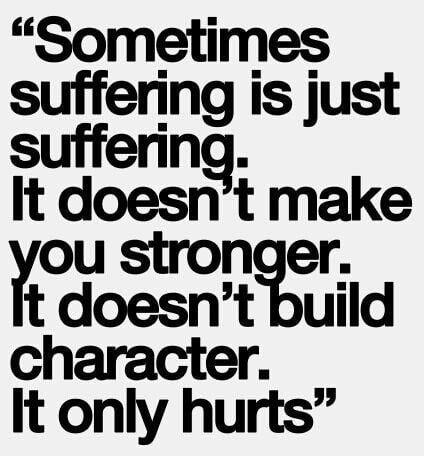
According to the Bible, pain and suffering are tests, trials, and punishments from God. God punished Adam and Eve for eating fruit off a forbidden tree:
And to the man he [God] said, Because you have listened to the voice of your wife and have eaten of the tree about which I commanded you,‘You shall not eat of it,’ cursed is the ground because of you; in toil you shall eat of it all the days of your life; thorns and thistles it shall bring forth for you; and you shall eat the plants of the field. By the sweat of your face you shall eat bread until you return to the ground, for out of it you were taken you are dust, and to dust you shall return. (Genesis 3:17-19 NRSV)
While Evangelicals love to protect God’s honor, the Bible is clear: all pain and suffering comes from God himself. I have firsthand experience with pain and suffering. All of us, if we live long enough, will have similar experiences, though the reason, degree, and length will vary from person to person. Most of us have experienced acute pain:
Acute pain is a sudden, short-term pain that signals a specific injury or illness and typically goes away once the cause is treated or healed.
Acute pain comes and goes once the source of the pain is resolved. Chronic pain is different:
Chronic pain is pain that lasts for over three months. You may feel the pain all the time or it may come and go. It can happen anywhere in your body and has countless causes.
Chronic pain is pain that doesn’t do away. It may get better or worse, but this sort of pain never goes away. This is the kind of pain I have had since the late 1990s. There’s not been a day since I was forty years old that I have been pain-free. What started with fibromyalgia has grown like a brushfire with osteoarthritis, degenerative spine disease, gastroparesis, and exocrine pancreatic insufficiency. Today, my life is one long, exhausting struggle with pain. My goal every day has been to control my pain well enough that I have enough energy to write and do work around the house. Some days, it is impossible for me to do anything more than survive; to live to face another day. And other days, all I want to do is die. I love my family, but sometimes my pain is so severe that all I want, in the moment, is for the pain to stop.
Chronic pain sufferers know that pain medications become less effective over time. That’s the case for me. I’ve been taking narcotic drugs for twenty years. Over this time, I have unnecessarily suffered because of the government’s and Parkview Hospital’s war on chronic pain sufferers. I take fifty percent less morphine load today than I did five years ago. I have largely found that local pain doctors are worthless; more concerned with doing injections and procedures than they are managing the suffering of chronic pain sufferers. And even worse, local pain doctors, to the person, oppose cannabis use. Figure that one out.
If the goal of medicine is to lessen suffering, why don’t doctors do more to help their chronic pain patients? My primary care doctor plans to retire in four years. He told me it is unlikely, due to clinic policies, that another doctor will write my narcotic scripts. I replied, “No problem. I plan to be dead by then.” My doctor thought I was being funny, but I most certainly was not. Without narcotic pain medications — yes, many people really need them — I will not survive. “But, Bruce, aren’t you worried about becoming a drug addict?” Are you kidding? Of course not. I have CHRONIC pain. It never, ever goes away. I suspect my pain will only get worse with time. How could it be otherwise? My spine — from neck to coccyx — shoulders, and hands continue to structurally deteriorate. I can easily see a time when I can no longer type or walk. As it stands now, I use a cane, walker, or a wheelchair to get around.
If I am a chronic pain sufferer, why does it matter if I become “addicted”? If I was in hospice with terminal pancreatic cancer, would I be given narcotics for pain control? Would the goal be to ease my suffering? Of course, it would. Why, then, is it any different for chronic pain sufferers? Just because we are dying “slowly” doesn’t mean we aren’t in just as much pain as those who have terminal illnesses.
I do all I can on any given day to manage and control my pain: heating pads, steaming hot baths, Tylenol/aspirin, TENS unit, stretching exercises, massage, cannabis, and, yes, narcotic pain medications. I also take medications to manage symptoms from gastroparesis and exocrine pancreatic insufficiency. Cannabis has reduced my nausea and vomiting, so there’s that, for which I am grateful.
I see a neurosurgeon later this week; the same surgeon who did my surgery a year ago. Hopefully, he will provide an answer for my lower back pain and awful neuropathic leg pain. If so, I will have surgery again, though I am hesitant to do so. All I know to do to is gather information and decide accordingly.
Are you a chronic pain sufferer? Is your pain well-managed? Please share your experiences in the comment section.
Bruce Gerencser, 69, lives in rural Northwest Ohio with his wife of 48 years. He and his wife have six grown children and thirteen grandchildren. Bruce pastored Evangelical churches for twenty-five years in Ohio, Texas, and Michigan. Bruce left the ministry in 2005, and in 2008 he left Christianity. Bruce is now a humanist and an atheist.
Your comments are welcome and appreciated. All first-time comments are moderated. Please read the commenting rules before commenting.
You can email Bruce via the Contact Form.



Want to Respond to Bruce? Fire Away! If You Are a First Time Commenter, Please Read the Comment Policy Located at the Top of the Page.