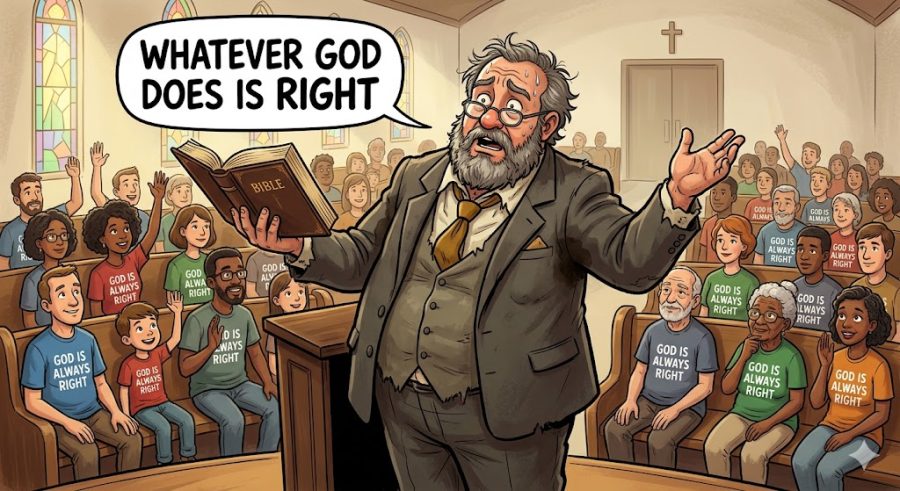
Whatever God Does is Right

god is always right

I listen to a plethora of YouTube channels, particularly call-in shows whose hosts attempt to engage and debate Evangelicals, Catholics, Muslims, and Jews. Evangelicals, in particular, often appeal to “divine command theory” to justify their God’s behavior.

The Internet Encyclopedia of Philosophy defines divine command theory as:

the view that morality is somehow dependent upon God, and that moral obligation consists in obedience to God’s commands.

In other words, whatever God does is right. And I mean whatever . . . I have listened to countless Evangelicals defend everything from owning people as property (slavery) to rape to genocide. From philosophical arguments to appeals to the supremacy of “God’s ways,” God is vociferously defended by Evangelical apologists. No quarter is given. God’s holy name must be defended at all costs. And defend it they do, with justifications, excuses, and bizarre interpretations.

Underlying the notion of divine command theory is the claim that God is ALWAYS good; that whatever God does is, without exception, good. This means that when God ordered the genocide of the Amalekite people, it was a moral, just, and good command. When God ordered the slaughter of infants, no fault can be found in what followed.

Sensitive to being accused of promoting and justifying genocide, Evangelicals often cook up all sorts of explanations that allegedly protect God’s name against accusations of immorality. “God knew all those babies were going to go to Heaven anyway, so babies having their heads dashed upon the rocks is “good.” Of course, this means Evangelicals should be pro-abortion, killing fetuses before they are old enough to know the difference between right and wrong. Most Evangelicals believe fetuses and babies go to Heaven when they die. so it stands to reason that abortion (or slaughter by the Jews) is good as the result is eternity in Heaven. In other words, the end justifies the means. Wait a minute, I thought Evangelicals oppose situational ethics? Oh that’s what they say, but when defending God, absolute morality becomes an ever-moving target. The Ten Commandments say “Thou shalt not kill (murder).” Yet, it seems that when God is doing the killing, the supposedly “moral law of God” is massaged or ignored. Just remember, God’s ways are not our ways. In the minds of Evangelicals, whatever God does is moral and right, even when it seems that what he is doing is immoral. Just because rape, slavery, genocide, and murder are “sins” to fallen sinners, it doesn’t follow that those same acts committed by God are just, moral, and right. The Evangelical deity is never held accountable for his actions. How can mere mortals judge God? Evangelicals say, carving out an exception for God. This means that despite claims of having objective morals, Evangelicals, as do all of us, actually have subjective morals

Most Evangelicals believe the Bible was written by God, inerrant and infallible in all it says. This core belief forces Evangelicals to commit to defending the Bible regardless of what it says. No evil is beyond justification if God did it. Remember, this is the same God who created Hell/Lake of Fire, the final resting place for all non-Evangelicals. As eternity rolls on, unbelievers will be tortured by God for one simple reason: they didn’t believe in Jesus.

Here’s the thing, belief isn’t a choice. Either you believe or you don’t. We cannot genuinely believe if we are not convinced that a claim is true (I speak generally). Yes, this is a complex issue, especially when you consider human free will. Do we have free will? I’m inclined to think that we don’t; that our lives give the appearance of free will without actually being “free.” The notion that we have libertarian free will cannot be rationally sustained, though I am sure that some commenters want to disabuse me of this notion.

The Christian God is neither just, moral, nor good. I have seen no evidence in the Bible that would suggest I am wrong. If you disagree with me, please defend your God or divine command theory in the comment section. I await your defense of a “good” God.

Bruce Gerencser, 69, lives in rural Northwest Ohio with his wife of 48 years. He and his wife have six grown children and thirteen grandchildren. Bruce pastored Evangelical churches for twenty-five years in Ohio, Texas, and Michigan. Bruce left the ministry in 2005, and in 2008 he left Christianity. Bruce is now a humanist and an atheist.

Your comments are welcome and appreciated. All first-time comments are moderated. Please read the commenting rules before commenting.

You can email Bruce via the Contact Form.

Comments

24 responses to “Whatever God Does is Right”

  1. The idea that without God, humans would lack a sense of morality is an argument whereby Evangelicals (and for that matter, devout followers of any faith) betray themselves. They are basically admitting that without divine proclamations, they would be dangerous.

    1. Avatar
      Asphalt-Type Person

      Or, you could go to the other extreme and say, “Because God does it, I Can too!”

  2. Avatar
    GeoffT

    Good old Euthyphro dilemma, first coined by Plato in his exchanges with Socrates. The original refers to pious but we’ve taken it to mean good, and roughly goes “If goodness is good because God commands it, morality seems arbitrary. If God commands it because it is good, then goodness exists independent of God.” Which means what everyone outside of a religious bubble can see for themselves, we determine right from wrong because of our own sense of morality, not because it is imposed from above.

    I’ve noticed a recent theme in phone in shows recently on the subject of ‘choosing’ to believe, and it seems to have caught apologists on the hop. If we can’t choose to believe what we believe then it presents a monumental problem for apologists, because it would mean that non believers are unfairly disadvantaged. Even believers can see that there are limits on what they can ‘choose’ to believe, when presented with clearly ridiculous propositions, which they are then asked to believe. Even the term ‘choose’ in this context is misplaced. I can ‘choose’ to believe that the moon landings were faked, or that Trump won the 2020 election, but I also know that both are untrue. So I’m not really choosing to believe, I’m simply saying the words.

  3. Avatar
    Levi

    If I may offer a respectful pushback, it seems to me that much of the argument turns on a particular framing of “divine command theory”—namely, that morality is arbitrary and whatever God does is labeled good simply because He does it. And here, if I’m being candid, I think the discussion may be starting one step too far down the road.

    Historically, that hasn’t been the classical Christian position. Thinkers like Thomas Aquinas rooted morality not in arbitrary commands but in God’s nature itself (Summa Theologiae, I.6). In other words, God is not merely declaring things good as they come up. Instead, historic Christianity believes that He is the standard of goodness because He is perfectly good in His being. Now, I get that’s a more demanding claim philosophically, but also a more coherent one.

    On the issue of judgment, texts like the Amalekites are difficult. I don’t think thoughtful Christians should pretend otherwise or wave them away with a quick “mystery solved.” But I do think there’s a category distinction that often gets smushed in these discussions: the difference between divine authority over life and human authority.

    If God is the giver and sustainer of life, then His relationship to life and death isn’t identical to ours. That may not make the passages emotionally satisfying (they aren’t), but it does shift the philosophical ground a bit. Otherwise, we end up assuming that God must operate under the exact same moral constraints as His creation. By what standard are we holding Him to account, and where does that standard come from?

    Similarly, the argument about infants and abortion seems to lean heavily on outcomes determining morality. But most moral frameworks (secular ones included) recognize that authority, intention, and moral agency matter just as much as outcomes. If we remove those categories, it’s not just Christian ethics that struggle—all ethics start to wobble. At that point, it’s hard to see how we avoid sliding into a kind of moral arithmetic where ends quietly justify means (which, ironically, is usually the very thing being criticized).

    On belief and free will, I’d suggest belief may not be quite as passive as it’s often presented. People revise their beliefs all the time—sometimes gradually, sometimes abruptly—based on evidence, arguments, and reflection. Speaking personally, I once adhered to LaVeyan Satanism (which, in hindsight, is not exactly the sort of thing you put on a résumé). I read the material, adopted the framework, and saw the world through that lens.

    And yet, over time, my convictions changed from a nihilistic outlook to something far more hopeful. It involved reconsideration, evaluation, and ultimately a shift in what I found convincing. So, I find myself wondering, if belief is entirely non-volitional, how do we account for those kinds of changes? What exactly is happening in that process?

    The New Testament, at least, frames unbelief not merely as inability, but as a kind of resistance. That may not settle the issue, but it does complicate the claim that belief is simply outside our control.

    I don’t expect to resolve any of this in a comment thread (if we could, entire libraries would be out of a job). But I do think the questions you’re raising deserve engagement at their strongest level.

    Appreciate the conversation as always, Mr. Gerencser. Be well.

    1. Avatar
      GeoffT

      Hi Levi, there’s some interesting points you make that could definitely be the subject of a lengthy exchange, but allow me to comment on just one thing you say regarding belief. You say that you have changed your beliefs over time, as new evidence comes to you, and understanding that your perspectives can change over time. That’s exactly why, I would argue, beliefs are not a choice. If the new evidence adduced were not persuasive then you wouldn’t change your view, but having seen the evidence and realised it is compelling you then change your mind. Now, try and ‘unconvince’ yourself as to the evidence. Decide that you are going to continue to believe what you believed previously, and which evidence persuaded you was wrong, then tell your rational mind that you are going to ignore it!

      1. Avatar
        Levi

        Hi Geoff,

        I appreciate the way you’ve framed this. It’s a much more careful version of the argument than we usually see, and I agree that there’s something true in what you’re saying. We don’t simply “flip a switch” and choose to believe something in the way we might choose what to have for lunch. Conviction does play a real role.

        That being said, I’m not sure your conclusion follows as cleanly as it might seem. You’re absolutely right that I can’t simply decide, on command, to “unconvince” myself of something I now find persuasive. But I do think there’s a middle layer here that often gets overlooked. To wit, how we arrive at what we find persuasive in the first place.

        We don’t control belief directly, but we do have some influence over things like what evidence we expose ourselves to, how seriously we entertain competing viewpoints, whether we’re willing to revisit settled conclusions, and even how honestly we assess arguments that challenge us. In other words, while belief may not be a direct act of the will, it’s not entirely detached from it either.

        To use your example, I can’t instantly “unbelieve” something I’m convinced of, but I can choose whether to revisit the question, whether to engage opposing arguments, or whether to dismiss them out of hand. Over time, those choices shape what I come to find convincing.

        So perhaps the better question is not, “Can I choose my beliefs in a single moment?” but rather, “Do I have any responsibility in the process that leads to those beliefs?” Because if the answer is “no,” then it becomes difficult to explain why we hold people accountable for beliefs at all, whether they be religious, political, or otherwise. Yet in practice, we clearly do.

        I think that’s where the New Testament’s framing becomes interesting. It doesn’t present belief as a simple on/off switch, but neither does it treat it as entirely outside our agency. It speaks in terms of response—of openness, resistance, willingness—which seems to sit somewhere between pure choice and pure inevitability.

        Not a simple issue by any means, but I appreciate you raising it. It’s a worthwhile tension to wrestle with.

  4. Avatar

    “What ever God does is right.”

    Zoe: Including his mistakes?

    1. God makes a mistake. I won tell, I promise 😉

  5. A human male impregnates a woman and is a Deadbeat Dad. Hit-and-Run father or whatever epithet you choose. But when God did it to Mary…

    1. Avatar
      GeoffT

      I always say at some point around Christmas “Christmas, that time of year when we celebrate the impregnating of a young girl by a superior being”. For those who say she consented – a) she didn’t, she was told and b) she was too young to consent.

  6. Avatar
    Revival “I Lie for Jesus” Fire

    The days coming when the agags [Amalekites] here will wish they had never been conceived.

  7. Burr Deming

    On free will, I am reminded of the late Isaac Singer.

    Paraphrasing:
    We must believe in free will.
    We have no choice!

    That isn’t much, I’m afraid, but it’s about all I can add to your own compelling observations.

    You lead an interesting discussion as to where morality originates, or even whether it exists.

    I sense a Biblical transition somewhere around Isaiah, where we begin a shift from stern external imposition to God the placement of a sense of right and wrong into each human heart. I can’t quote a chapter and verse, and I might be wrong.

    The obvious problem with an internal source, of course, is the varying degree of sociopathy that can be found in humankind.

    Parallel problems with which, it seems to me, thoughtful Christians have to wrestle are evil we see in the world and evil we find within ourselves. How do we reconcile that with a benevolent and all-powerful God?

    Doesn’t pull me out of the faith, but it does lend me some empathy with those who feel compelled to leave for that reason.

    As always, Bruce, thank you for a thoughtful and thought provoking piece.
    You are a gem, and I hope you are with us for a very long time.

    1. Avatar
      Levi

      Hi Burr,

      I appreciate the tone of your comment. It’s a refreshing change of pace in a discussion like this. That line from Isaac B. Singer always gets a smile out of me. It captures something real, even if it leaves the philosophical question hanging in the air.

      Your observation about a shift in Scripture is an interesting one, and I think you’re circling something genuinely biblical. The prophets—especially in places like Jeremiah—do speak of a movement from external law toward something more internal (e.g., Jeremiah 31:33). So you’re not imagining that trajectory. But I’d frame it less as a transition away from external authority and more as a deepening of it—what was written on stone being internalized, not replaced.

      And as you rightly note, that raises its own problem. To wit, if morality is internal, why is it so unevenly expressed? I think that’s where the Christian framework actually leans into the difficulty rather than away from it. It doesn’t assume that the human heart is a reliable moral compass left to itself. Quite the opposite, actually. It acknowledges that something is misaligned at a fundamental level. Or, to put it less theologically and more plainly, we don’t just disagree about right and wrong; we often fail to live up to what we already know.

      Which ties into your final question about evil.

      You’re right that this is the pressure point. Not just the evil “out there,” but the quieter, more inconvenient kind “in here.” Any worldview that takes both seriously is going to feel the weight of that tension. The Christian answer isn’t that the tension disappears, but that it’s explained and ultimately addressed through something outside ourselves, rather than resolved purely from within. That may not remove all the difficulty (if anything, it sharpens it in places), but I think it does offer a more coherent account than simply locating morality entirely inside us and hoping it behaves.

      At the very least, I appreciate the way you’ve framed the question. It’s the kind of framing that keeps the conversation honest and fruitful. 🙂

      1. Avatar
        Trace

        Hi Levi,

        I would consider myself agnostic after leaving the evangelical faith. I did not leave with confidence that Christianity was untrue, but I certainly am no longer convinced as I used to be. I find your nuance thoughtful and very articulate about how we have some responsibility as to what we are convinced of/believe in, yet simultaneously are unable to simply flip a switch on or off to believe something. It is interesting. I would like to say that I am open to belief, open to christianity. I left not because I wanted to reject the truth-I left because I was no longer convinced that I had it. I still want to believe what is true, whether that’s christianity or not. I have sought to distance myself a bit as I have a tendency to overthink and obsess about things. That being said-I am curious as to what your theological positions are and with what level of confidence you hold them and your subsequent reasoning for those beliefs. I’m happy to exchange emails if you’re open to further conversation.

        Cheers. Appreciate your gracious tone and demeanor-it is noticeably absent from many who interact with those who are ‘apostate’ yet absolutely necessary for healthy and respectful dialogue.

        1. Avatar
          Levi

          Hi Trace,

          Thank you for your comment. What you said about not leaving because you wanted to reject truth, but because you were no longer convinced you had it, is both honest and, I think, more common than people tend to admit. Most people just don’t say it that plainly.

          I also appreciate your self-awareness about needing some distance. If you’re someone who tends to think deeply and maybe a bit relentlessly, you’re in good company. I’ve had more than a few moments where stepping back was less about avoidance and more about preserving what little sanity I had left.

          As for your question, I’d describe my current theological position as classical, orthodox, and broadly evangelical. I try to hold that with a distinction between confidence and finality. I have a fairly high level of confidence in the core claims of Christianity, such as the existence of God, the Person and claims of Christ, and the general reliability of the New Testament. At the same time, that confidence doesn’t mean I’ve run out of questions or tensions. If anything, I seem to collect those along the way.

          Part of what keeps me where I am is that Christianity does not really sidestep the harder questions. It tends to bring them to the surface whether we like it or not. Questions about evil, human nature, belief, and doubt are all addressed, even if not always wrapped up as neatly as we might prefer.

          As for my reasoning, it is less about one decisive argument and more about a cumulative case. There are philosophical considerations about the existence of God, historical arguments surrounding the life and resurrection of Jesus, and some personal reflection on how well the Christian framework accounts for things like moral intuition, human brokenness, and the sense that meaning is not entirely something we invent for ourselves.

          None of those pieces force belief on their own. But taken together, I’ve found them compelling enough to stay where I am. It’s less like flipping a switch and more like realizing over time that the lights are already on, even if a few bulbs still flicker.

          That said, I do understand the position you’re describing. There’s a real difference between rejecting something and simply no longer being convinced by it. I think that distinction deserves to be taken seriously.

          I’d be glad to continue the conversation, whether here or over email. No pressure either way. I appreciate the thoughtful tone you brought to the discussion. It’s rarer than it should be.

          1. Avatar
            GeoffT

            Levi, the reason the conversations here are so polite is because we’re simply circling the swamp, doing little more than sniff the air, and personally that’s fine with me. In comments sections where there are more substantive exchanges, however, then pretty well every point made will be torn apart, with frustration on both sides, and ultimately people come away feeling battered and bruised, but with little to nothing achieved. I quite enjoy that in its time and place, but generally that’s not what Bruce’s forum is about so I’m content just to listen and learn, and wait for some gem of wisdom that will change my views.

  8. Avatar

    A testy owner tests the comment section.

  9. Avatar
    Imposter

    Humans do not have a free will. At best, the human will is only partially free

    1. Avatar
      Revival “I Lie for Jesus” Fires

      Did someone force you to leave this comment?

      1. Avatar

        Even the Bible says humans don’t have free will. Have you ever read the Bible, Genius?

  10. Avatar
    Joel Labonte

    What? It does not say that. Calvin said that. Even in O.T., it says, “choose this day whom you will serve” and ” choose life”.

    1. Avatar

      Sigh.

      Augustine was a predestinarian 1,200 hundred years before Calvin.

      The sovereignty of God, predestination. and election are clearly taught in the Bible, so, at best, what we have is a contradiction between verses that suggest free will and those that don’t.

      1. Avatar
        JT

        Hey Bruce. I spent years denying that while I was in church… Then I got out and am reading everything in the Bible with no outside influence… I don’t want to list the verses here, but Romans 9 kind of seals the deal on everyone not having free will.

        Did pharaoh have a choice? Romans 9 says no…

        1. Avatar

          I guess I need to write ✍️ a post on free will and choice. There are verses that support the Ariminian position on free will, but far more that don’t. Romans 9 is clear on predestination. God chooses.

          So, at best there is a contradiction between verses these verses — which is my position. I have long believed to can use the Bible to prove almost anything. 😜❤️

Want to Respond to Bruce? Fire Away! If You Are a First Time Commenter, Please Read the Comment Policy Located at the Top of the Page.

This site uses Akismet to reduce spam. Learn how your comment data is processed.

Discover more from The Life and Times of Bruce Gerencser

Subscribe now to keep reading and get access to the full archive.

Continue reading