Category: Local

  • It’s Time for Free Lunches in Ohio Public Schools

    girls sitting by the table eating
    Photo by Yan Krukau on Pexels.com

    I have firsthand experience with poverty and lacking food or money for lunch at school. Neither of my parents were all that concerned about whether I had lunch at school. Some days, I didn’t eat lunch. Other days, I either packed a lunch (if food was available), stole money from my dad to pay for lunch, or “borrowed ” money from my wealthy friends whose fathers worked for Marathon Oil. What follows is an article by Marty Schladen about the push to make lunch FREE for all Ohio students.

    — begin article

    Many people might not be aware of this, but a big majority of Ohio’s public-school students already receive free breakfast and lunch at school.

    Making free meals available to all students wouldn’t only produce benefits equal to the costs, it would produce social benefits with a net worth of about $520 million a year, according to an economic analysis released last Monday.

    Lower-income Americans have lost significant ground over the past 40 years. In some ways, that trend might be accelerating.

    More than 1 in 4 Ohioans are now poor enough to be on Medicaid, for example, and their access to education is diminishing.

    Even adjusting for inflation, college tuition has tripled. Meanwhile, when also adjusted for inflation, the maximum available Pell Grant hasn’t budged.

    Education is a powerful predictor of future earnings. Yet even after the pandemic, chronic absenteeism in Ohio schools sits at 25.6% — up nine percentage points from its pre-pandemic level in 2018-2019.

    And more than half a million Ohio kids — 1 in 5 — are dealing with food insecurity.

    And the state’s schools reported that in the 2021-2022 school year, more than 26,000 of their kids “lacked a fixed, regular, and adequate place to sleep,” the Ohio Housing Finance Agency reported. 

    The Columbus firm Scioto Analysis examined what would happen if a relatively modest step were taken to help the state’s children.

    Already, more than 60% of students whose schools participate in the national school lunch program are getting free meals.

    What would happen if the state just paid so all students could get them?

    State Sens. Louis Blessing III, R-Colerain Township, and Kent Smith, D-Euclid, earlier this year introduced a bill that would extend free meals to all Ohio school kids. But it was assigned to a committee and died. 

    At $300 million a year, the program was relatively inexpensive — given that the legislature’s Republican leadership found twice that amount to give the billionaire Haslam family to move the hapless Browns outside Cleveland city limits.

    Three days after receiving the gift, the Tennessee-based moguls bought a $25 million mansion — in Florida.

    The Scioto Analysis study used the projected cost of the Blessing bill as a starting point and tried to compare the costs to the benefits.

    An obvious benefit would be to ensure that more kids had access to healthy meals.

    “… a study comparing schools that offered universal free school meals… to similar schools that did not offer universal free school meals found that children in schools with universal free school meals had lower household food insecurity,” the report said.

    “U.S. data found that universal free school meals provided through the Community Eligibility Provision would make 3% of previously food-insecure children in participating schools food-secure.”

    Another benefit would be that if all kids got free meals, then no one would be stigmatized as poor for getting them. 

    That one might be hard to measure, but anybody who’s been to school knows how cruel children can be.

    With a quarter of kids already chronically absent, the last thing they need is another reason to want to avoid school.

    Other potential benefits are easier to quantify: Money and time saved by families, reductions in obesity, greater administrative efficiency for schools that don’t have to keep track of whose meal bills are paid, and improved lifetime earnings by kids who are well nourished and ready to learn.

    The analysis said that last benefit would by far be the most valuable, determining it would create $552 million in annual economic benefit. 

    In all, it said, universal school meals would create $52o million more in annual benefits than the program would cost.

    “Based on the available research about the health, educational, and economic benefits of universal free school meals for students of all incomes — even those who are already eligible for free meals through existing programs — I believe universal free school meals are a worthwhile investment for Ohio,” Emily Cantrell, the policy analyst who wrote the report, said in an accompanying blog post. 

    Bruce Gerencser, 69, lives in rural Northwest Ohio with his wife of 48 years. He and his wife have six grown children and thirteen grandchildren. Bruce pastored Evangelical churches for twenty-five years in Ohio, Texas, and Michigan. Bruce left the ministry in 2005, and in 2008 he left Christianity. Bruce is now a humanist and an atheist.

    Your comments are welcome and appreciated. All first-time comments are moderated. Please read the commenting rules before commenting.

    You can email Bruce via the Contact Form.
  • Local News: Campbell Soup in Napoleon, Ohio Pollutes Local Waterway with Industrial Discharges

    lake erie waterkeeper

    WTOL-11 reports:

    Campbell Soup Supply Co. has admitted to thousands of violations of the federal Clean Water Act at its canning plant in Napoleon, Ohio.

    In a court filing released Monday, the company acknowledged its part in years of illegal discharges into the Maumee River, which feeds into Lake Erie.

    In the filing, which listed the plaintiffs as the U.S. Environmental Protection Agency (EPA) and environmental groups Environment Ohio and Lake Erie Waterkeeper, Campbell conceded it is legally liable for at least 5,400 violations between April 2018 and December 2024. The wastewater contained phosphorus, ammonia, E. coli bacteria, oil and grease, suspended solids, and other pollutants.

    The case stemmed from a lawsuit filed in March 2024 by environmental advocates, who alleged the factory’s discharges were fueling toxic algae blooms in western Lake Erie. Blooms that could threaten drinking water supplies and harm wildlife.

    “Campbell’s admission that it committed these violations will speed this case toward a trial that will decide what steps the company must take to curb its pollution and how large a civil penalty should be imposed,” said John Rumpler, Clean Water Program director for Environment Ohio. “That’s great news for the people who live along the Maumee River and Lake Erie.”

    Lake Erie Waterkeeper Sandy Bihn said the outcome could mark a turning point in efforts to restore the watershed. 

    “Bringing an end to Campbell’s violations will help water quality in the river and Lake Erie, and demonstrates the power citizen enforcement suits have to drive meaningful environmental progress,” Bihn stated.

    Under federal law, citizens can sue to enforce the Clean Water Act when polluters fail to comply. In this case, Campbell agreed not to contest liability and acknowledged that residents suffered harm from the violations.

    The U.S. District Court for the Northern District of Ohio will now move toward a trial, expected next year, to determine penalties and remediation measures.

    Bruce Gerencser, 69, lives in rural Northwest Ohio with his wife of 48 years. He and his wife have six grown children and thirteen grandchildren. Bruce pastored Evangelical churches for twenty-five years in Ohio, Texas, and Michigan. Bruce left the ministry in 2005, and in 2008 he left Christianity. Bruce is now a humanist and an atheist.

    Your comments are welcome and appreciated. All first-time comments are moderated. Please read the commenting rules before commenting.

    You can email Bruce via the Contact Form.

  • OMG! Local Woman Demands Violent Justice After Teen Boys do THIS to Her!

    I don’t know how it is where you live, but around here, every local town has a community group on Facebook. While these groups can be a good source of information, they are also hotbeds for gossip and complaints. I find such conversations entertaining. (I also wonder if public schools have stopped teaching English.)

    Yesterday, a woman took to the Bryan community page to whine, gripe, and complain about three teen boys on bicycles who gave her the middle finger as she drove by. She hoped that a big man would teach them a lesson by beating them up. Yikes! Talk about overkill.

    Other offended commenters added their complaints about being flipped off to the discussion, concluding that modern youths are more disrespectful than they were back in the day; that they never would have given a stranger the middle finger. I tend to roll my eyes when boomers delusively talk about how good life was in the “good old days.” The 60s and 70s were different, to be sure, but better than today? I have my doubts. Teenagers have always been disrespectful. It is part of their rite of passage. Three boys, under the age of sixteen, flipping off someone as they drive by? Not an issue. Older man beating them up for doing so? That’s a felony.

    Bruce Gerencser, 69, lives in rural Northwest Ohio with his wife of 48 years. He and his wife have six grown children and thirteen grandchildren. Bruce pastored Evangelical churches for twenty-five years in Ohio, Texas, and Michigan. Bruce left the ministry in 2005, and in 2008 he left Christianity. Bruce is now a humanist and an atheist.

    Your comments are welcome and appreciated. All first-time comments are moderated. Please read the commenting rules before commenting.

    You can email Bruce via the Contact Form.

  • God Forbid that a Poor Ohioan Drinks a Coke on a Hot Summer Day

    mike dewine eating healthy
    Mike DeWine Eating Healthy

    I have lived in rural Ohio most of my sixty-eight years of life, living in communities such as Bryan, Farmer, Ney, Deshler, Mt. Blanchard, Mt. Perry, New Lexington, Junction City, Alvordton, Glenford, and Newark. I spent most of my life in northwest and southeast Ohio. I spent almost three decades pastoring poor people; people on government assistance, Medicaid, and food stamps. Most of these people had at least one adult family member who held a full-time job. I spent eleven years pastoring a Baptist church in Perry County, a notoriously poor county. One year, unemployment was over twenty percent. In its heyday, the church ran over 200 in attendance. Total offerings for that year? $40,000. Most years, offerings were closer to $20,000. While I grew up poor, this church gave me an intimate look at how the poor lived their day-to-day lives trying to make it to tomorrow.

    WKBN reported recently that the Republican Governor Mike DeWine is trying to ban poor people on food stamps (actually SNAP) from drinking an ice-cold Coke (or Pepsi) on a hot summer day:

    Ohio has formed a group to see which beverages should be banned from purchase using SNAP benefits.

    Ohio Governor Mike DeWine announced Tuesday who the members of the group looking into the issue will be: 

    Matt Damschroder, Director, Ohio Department of Job and Family Services (ODJFS) (or designee)

    Maureen Corcoran, Director, Ohio Department of Medicaid (or designee)

    Dr. Bruce Vanderhoff, Director, Ohio Department of Health (or designee)

    Rachel Cahill, Visiting Fellow, The Center for Community Solutions

    Douglas Lumpkin, former director of ODJFS

    Kimberly McConville, Executive Director, Ohio Beverage Association

    Lora Miller, Director of Governmental Affairs & Public Relations, Ohio Council of Retail Merchants

    Kristin Mullins, President/CEO, Ohio Grocers Association

    Dr. Jonathan Thackeray, Dayton Children’s Hospital

    Lexi Tindall, Clinical Manager for the Center for Healthy Weight and Nutrition, Nationwide Children’s Hospital

    Pat Tiberi, President & CEO, Ohio Business Roundtable

    The group will make recommendations that would prevent Ohio SNAP benefits from being used to purchase certain beverages that how minimal nutritional value and contribute to medical conditions such as obesity, type 2 diabetes and hypertension. 

    Any ban would require approval from the U.S. Department of Agriculture.

    Did you notice who Governor DeWine didn’t put on the group? Poor people. Shouldn’t the people this policy will affect have a say on the matter? Or is this more about self-righteous, arrogant Republicans thinking they have a right to tell the poor what they should eat and drink? They are just looking out for poor people, right?

    Of all the things Governor DeWine and Republican legislators could focus on, they choose to focus on “pop.” (Or “soda” for you who live in other places.) This obsession with controlling the behavior of the poor has been a common problem for years. Republicans see a poor person using food stamps and they notice what’s in their cart. OMG! They bought pop and candy. God forbid they reward themselves with sweets after a long week at work. God forbid poor children enjoy the same food and drink as people of means.

    I wonder if we paid close attention to the grocery shopping carts of the middle class and the rich. Does anyone doubt that we will find pop, candy, and “junk food” in their carts? If this is really all about “health,” why not ban all sugary foods and drinks? Surely that’s best for rich folk, right? Imagine the outrage from the financially secure if they can’t drink a Coke or eat a Snickers?

    On behalf of poor Ohioans, let me say this to Governor DeWine and Ohio Republicans: Go fuck yourself!

    Bruce Gerencser, 69, lives in rural Northwest Ohio with his wife of 48 years. He and his wife have six grown children and thirteen grandchildren. Bruce pastored Evangelical churches for twenty-five years in Ohio, Texas, and Michigan. Bruce left the ministry in 2005, and in 2008 he left Christianity. Bruce is now a humanist and an atheist.

    Your comments are welcome and appreciated. All first-time comments are moderated. Please read the commenting rules before commenting.

    You can email Bruce via the Contact Form.
  • Letter to the Editor: Will Americans Ever See Beyond Trump’s Lies?

    letter to the editor

    Letter to the editor of the Defiance Crescent-News submitted on July 23, 2025

    Dear Editor,

    President Donald Trump is a psychopath who has no empathy for anyone but himself. Trump does no wrong. He even said he hasn’t done anything worthy of asking forgiveness from God. In his eyes, he sees himself as one of the greatest American presidents, ever, worthy of his spray-tanned face being chiseled into Mount Rushmore. Trump’s visions of grandeur know no bounds. He delusionally thinks he deserves the Nobel Peace Prize. A liar and a braggart, he spins lies into stories about everything from his prowess with women to being the greatest negotiator who ever lived.

    Whatever Trump might think about himself, in the real world we continue to judge politicians by their works. The Bible tells us to judge people by the fruit they produce. What, if anything, has Trump done for everyday Americans? Not much. So far, all he has done is foment chaos and fear. Financial markets are having a hard time figuring out what the “stable genius” is doing. Trump’s handlers tell us to trust him, saying he is a master businessman and financier, all the while ignoring that he has gone bankrupt numerous times. A reckoning is coming for Trump. Not today, but once he is out of office and lacks the power of the state, business leaders will be free to ignore his insanity. Of course, until that glorious day, we have to live with Trump’s ignorance about how the world really works, hoping he doesn’t drag us into another war or burn our world to the ground. This should come as no surprise since Trump doesn’t read. He even avoids reading security briefings, preferring pictures or summaries. He is the most illiterate man to ever be president. Regrettably, millions of Americans are fine with Trump’s apathy towards learning new things, especially things that challenge his racist, fascist, misogynistic beliefs.

    Trump now faces questions about his relationship with sexual predator Jeffrey Epstein. Extant evidence suggests that the men were best buds who had a sickening obsession with underage girls. Trump, of course, denies everything. Instead, he blames Barack “Hussein” Obama, “Sleepy” Joe Biden, and arch nemesis, Hilary Clinton. Take his whopper of a lie about his uncle, John Trump, teaching Ted Kaczynski at MIT. From stem to stern, this was a lie. Are we so numb to his lies that we ignore them? I hope not. The future of our republic is at stake.

    Bruce Gerencser
    Ney, Ohio

    Bruce Gerencser, 69, lives in rural Northwest Ohio with his wife of 48 years. He and his wife have six grown children and thirteen grandchildren. Bruce pastored Evangelical churches for twenty-five years in Ohio, Texas, and Michigan. Bruce left the ministry in 2005, and in 2008 he left Christianity. Bruce is now a humanist and an atheist.

    Your comments are welcome and appreciated. All first-time comments are moderated. Please read the commenting rules before commenting.

    You can email Bruce via the Contact Form.

  • Why So Many American Children Don’t Know How to Read at Grade Level

    illiteracy

    By Robbie Sequeira, Used with Permission from Ohio Capital Journal

    As states rush to address falling literacy scores, a new kind of education debate in state legislatures is taking hold: not whether reading instruction needs fixing, but how to fix it.

    More than a dozen states have enacted laws banning public school educators from teaching youngsters to read using an approach that’s been popular for decades. The method, known as “three-cueing,” encourages kids to figure out unfamiliar words using context clues such as meaning, sentence structure, and visual hints.

    In the past two years, several states have instead embraced instruction rooted in what’s known as the “science of reading.” That approach leans heavily on phonics — relying on letter and rhyming sounds to read words such as cat, hat, and rat.

    The policy discussions on early literacy are unfolding against a backdrop of alarming national reading proficiency levels. The 2024 Nation’s Report Card revealed that 40% of fourth graders and 33% of eighth graders scored below the basic reading level — the highest percentages in decades.

    No state improved in fourth- or eighth-grade reading in 2024. Eight states — Alaska, Arizona, Delaware, Florida, Nebraska, Nevada, Utah, and Vermont — scored worse than they did a year or two prior in eighth-grade reading.

    Five states — Arizona, Florida, Nebraska, South Dakota, and Vermont — saw dips in their fourth-grade reading scores.

    In response to these troubling trends, a growing number of states are moving beyond localized efforts and tackling literacy through statewide legislation.

    New Jersey last year mandated universal K-3 literacy screenings. Indiana lawmakers this month passed a bill that would allow some students to retake required reading tests before being held back in third grade; that bill is en route to the governor’s desk.

    Oregon and Washington are weighing statewide literacy coaching and training models, while lawmakers in Montana introduced a bill to allow literacy interventions to cover broader reading and academic skills, not just early reading basics.

    Mississippi, a state seen as a model for turnaround in literacy rates over the past decade, seeks to expand and require evidence-based reading interventions, mandatory literacy screenings and targeted teacher training, and to explicitly ban the use of three-cueing methods in reading instruction in grades 4-8.

    Together, these efforts signal a national shift: States are treating literacy not as a local initiative, but as the foundation of public education policy.

    “Literacy is the lever,” said Tafshier Cosby, the senior director of the Center for Organizing and Partnerships at the National Parents Union, an advocacy group. “If states focus on that, we see bipartisan wins. But the challenge is making that a statewide priority, not just a district-by-district hope.”

    Before he was even sworn in, first-term Georgia Democratic state Sen. RaShaun Kemp, a former teacher and principal, had already drafted a bill to end the use of the three-cueing system in Georgia classrooms.

    This month, the final version passed the state legislature without a single “no” vote. GOP Gov. Brian Kemp signed it into law Monday.

    Sen. Kemp said his passion for literacy reform stretches back decades, shaped by experiences tutoring children at a local church as a college student in the early 2000s. It was there, he said, that he began noticing patterns in how students struggled with foundational reading.

    “In my experience, I saw kids struggle to identify the word they were reading. I saw how some kids were guessing what the word was instead of decoding,” Kemp recalled. “And it’s not technology or screens that’s the problem. It’s what teachers are being instructed on how to teach reading. It’s the system that needs fixing, not the teachers.”

    The new law requires the Professional Standards Commission — a state agency that oversees teacher prep and certification — to adopt rules mandating evidence-based reading instruction aligned with the science of reading, a set of practices rooted in decades of cognitive research on how children best learn to read.

    “Current strategies used to teach literacy include methods that teach students to guess rather than read, preventing them from reaching their full potential,” Sen. Kemp said in a public statement following the bill’s legislative passage. “I know we can be better, and I’m proud to see our legislative body take much-needed steps to help make Georgia the number one state for literacy.”

    In West Virginia, lawmakers have introduced similar bills that would require the state’s teachers to be certified in the science of reading.

    Cosby, of the National Parents Union, said local policy changes can be driven by parents even before legislatures act.

    “All politics are local,” Cosby said. “Parents don’t need to wait for statewide mandates — they can ask school boards for universal screeners and structured literacy now.”

    Still, some parents worry their states are simply funding more studies on early literacy rather than taking direct action to address it.

    A Portland, Oregon, parent of three — one of whom has dyslexia — sent written testimony this year urging lawmakers to skip further studies and immediately implement structured literacy statewide.

    “We do not need another study to tell us what we already know — structured literacy is the most effective way to teach all children to read, particularly those with dyslexia and other reading challenges,” wrote Katherine Hoffman.

    Unlike in Georgia, the “science of reading” has met resistance in other states.

    In California, legislation that would require phonics-based reading instruction statewide has faced opposition from English learner advocates who argue that a one-size-fits-all approach may not effectively serve multilingual students.

    In opposition to the bill, the California Teachers Association argued that by codifying a rigid definition of the “science of reading,” lawmakers ignore the evolving nature of reading research and undermine teachers’ ability to meet the diverse needs of their students.

    “Placing a definition for ‘science of reading’ in statute is problematic,” wrote Seth Bramble, a legislative advocate for the California Teachers Association in a March letter addressed to the state’s Assembly Education Committee. “This bill would carve into stone scientific knowledge that by its very nature is constantly being tested, validated, refuted, revised, and improved.”

    Similarly, in Wisconsin, Democratic Gov. Tony Evers in March vetoed a bill that would have reversed changes to the state’s scoring system to align the state’s benchmarks with the National Assessment of Educational Progress, a federal assessment tool that has recently been hit with funding cuts and layoffs under the Trump administration. Evers said in his veto that Republican lawmakers were stepping on the state superintendent’s independence.

    That veto is another step in the evolution of a broader constitutional fight over literacy policy and how literacy funds are appropriated and released. In 2023, Wisconsin lawmakers set aside $50 million for a new statewide literacy initiative, but disagreements over legislative versus executive control have stalled its disbursement.

    Indiana’s legislature faced criticism from educators over a 2024 mandate requiring 80 hours of literacy training for pre-K to sixth-grade teachers before they can renew their licenses. Teachers argued that the additional requirements were burdensome and did not account for their professional expertise.

    In Illinois, literacy struggles have been building for more than a decade, according to Mailee Smith, senior director of policy at the Illinois Policy Institute. Today, only 3 in 10 Illinois third- and fourth-graders can read at grade level, based on state and national assessments.

    Although Illinois lawmakers amended the school code in 2023 to create a state literacy plan, Smith noted the plan is only guidance and does not require districts to adopt evidence-based reading instruction. She urged local school boards to act on their own.

    “If students can’t read by third grade, half of the fourth-grade curriculum becomes incomprehensible,” she said. “A student’s likelihood to graduate high school can be predicted by their reading skill at the end of third grade.”

    Despite the challenges, Smith said even small steps can make a real difference.

    “Screening, intervention, parental notice, science-based instruction, and thoughtful grade promotion — those are the five pillars, and Illinois and even local school districts can implement some of these steps right away,” she said.

    “It doesn’t have to be daunting.”

    Bruce Gerencser, 69, lives in rural Northwest Ohio with his wife of 48 years. He and his wife have six grown children and thirteen grandchildren. Bruce pastored Evangelical churches for twenty-five years in Ohio, Texas, and Michigan. Bruce left the ministry in 2005, and in 2008 he left Christianity. Bruce is now a humanist and an atheist.

    Your comments are welcome and appreciated. All first-time comments are moderated. Please read the commenting rules before commenting.

    You can email Bruce via the Contact Form.

  • Trump Dump: Vivek Ramaswamy Wants to Rename Lake Erie to Lake Ohio

    donald trump dump truck

    This series, titled Trump Dump, features outlandish, untrue quotes from Donald Trump, MAGA supporters, and Right Wing media. If you come across a quote for this series, please send it to me with a link to the news story that contains the relevant quote.

    Anybody think if there’s a Lake Michigan, maybe there should be a Lake Ohio around here? I’m feeling that. We’ll talk about that a little bit more as this campaign progresses.

    — Vivek Ramaswamy, 2026 Republican Candidate for Ohio Governor, as reported by Cleveland.com

    Bruce Gerencser, 69, lives in rural Northwest Ohio with his wife of 48 years. He and his wife have six grown children and thirteen grandchildren. Bruce pastored Evangelical churches for twenty-five years in Ohio, Texas, and Michigan. Bruce left the ministry in 2005, and in 2008 he left Christianity. Bruce is now a humanist and an atheist.

    Your comments are welcome and appreciated. All first-time comments are moderated. Please read the commenting rules before commenting.

    You can email Bruce via the Contact Form.

  • Letter to the Editor: Is the GOP God’s Only Party?

    letter to the editor

    Letter to the editor of the Defiance Crescent-News

    Dear Editor,

    Jesus summed up God’s laws by commanding Christians to love God and love their neighbor. Jesus had much to say about how to treat others, especially the poor — whom the Bible calls “the least of these.” Allegedly, Republicans are God’s Only Party, and President Donald Trump is Christian in Chief. Evangelical Christians hold numerous cabinet-level positions, and others hold lesser positions in the Trump Administration. Yet, a cursory review of President Trump’s first month in office reveals a Republican administration disconnected from the teachings of Christ in the gospels.

    Sadly, many Evangelicals think they will one day be judged based on having the right beliefs; that what’s important to God is certain doctrines and social beliefs. However, the gospels reveal that God will judge everyone based on how they live, not what they believe. Matthew 25 makes clear that God will judge people, not on their beliefs, but on how they treated poor, marginalized people.

    While I am no longer a Christian, I was a follower of Jesus for fifty years. I pastored Evangelical churches in three states for twenty-five years. If there’s one thing I learned, it is that how we treat other people matters to God; and, more importantly, how we love, care, and minister to the least of these reveals what matters to us.

    With these things in mind, what do we make of the Trump administration’s treatment of undocumented immigrants, legal immigrants, non-Christians, people of color, transgender people, pregnant women, government employees, and poor people? Just today, Jesus-loving Republicans voted to cut $1 trillion from Medicaid, with cuts to Social Security and Medicaid to follow. Millions of Americans will lose medical insurance, child care, and food stamps. It is impossible to square these draconian, immoral cuts with the teachings of Jesus. Local Evangelicals send weekly letters to the editor preaching right doctrine and political affiliation. I have yet to read one letter in the Crescent News from Evangelicals preaching the importance of helping the least of these. I am grateful that a handful of local churches take seriously the teachings of Christ, providing food, utilities, rent, car repairs, and clothing to the poor. However, most churches are more concerned about political and theological fidelity than they are about a beaten, half-dead man along a dirt road. What we need are more Good Samaritans — Christian or not, Republican or Democrat — who love their neighbors as themselves.

    Bruce Gerencser
    Ney, Ohio

    Bruce Gerencser, 69, lives in rural Northwest Ohio with his wife of 48 years. He and his wife have six grown children and thirteen grandchildren. Bruce pastored Evangelical churches for twenty-five years in Ohio, Texas, and Michigan. Bruce left the ministry in 2005, and in 2008 he left Christianity. Bruce is now a humanist and an atheist.

    Your comments are welcome and appreciated. All first-time comments are moderated. Please read the commenting rules before commenting.

    You can email Bruce via the Contact Form.
  • Ohio House Speaker Matt Huffman and His Fellow Republicans Plan to Financially Harm Public Schools

    ohio school funding

    By David DeWitt, Ohio Capital Journal, Used with Permission

    Does Ohio House Speaker Matt Huffman hate public schools?

    He very well might not hate public schools. I doubt that he would ever use those words. But as an observer, it just really comes off like Matt Huffman hates public schools.

    Or maybe he has some sort of grudge against them and thinks they should struggle and suffer more than they already are.

    Maybe hate is too strong a word. Maybe he’s just callously indifferent to public schools. Or maybe it’s not hatred or indifference; it’s a kind of gristle-chewing contempt for public schools combined with a deep, warm, abiding love and affection for private, for-profit, and religious schools.

    I really don’t know.

    What I do know is that since Ohio’s system for funding public education was declared unconstitutional more than 25 years ago, Ohioans have only seen two brief periods of time when anything resembling a constitutional school funding formula has been in place: the evidence-based model passed and signed under Gov. Ted Strickland in 2009 and then quickly overturned by Gov. John Kasich in 2011, and the bipartisan Cupp-Patterson Fair School Funding Plan that was put in place in 2021.

    Now the future of Cupp-Patterson is in jeopardy as Huffman has declared it “unsustainable.”

    Huffman, who starts the year as Ohio House Speaker after being term-limited out as Ohio Senate President, enjoys enormous influence in the Ohio Statehouse amid Republican supermajorities in both chambers.

    The Cupp-Patterson Fair School Funding Plan included a phasing-in schedule over six years, or three budget cycles in Ohio. Now that the first two phases have been implemented, Huffman is signaling he’s ready to call the thing off.

    “I don’t think there is a third phase to Cupp-Patterson,” Huffman told reporters Monday. “I guess the clear statement I can say is I think those increases in spending are unsustainable.”

    Unsustainable. Fair School Funding in Ohio is “unsustainable.”

    Meanwhile, this past school year, Ohio lawmakers funneled nearly $1 billion in taxpayer dollars toward private schools after passing near-universal vouchers the year before. The vast majority of new private school voucher money from Ohio taxpayers went to families with their kids already in private schools.

    In Ohio, 90% of students attend public schools, while only 10% attend private schools. But according to Huffman, shoveling nearly $1 billion per year to private schools to help families who were already using private schools is definitely, absolutely, no doubt sustainable, while funding Ohio’s Fair School Funding plan for 90% of students is not.

    Even under Cupp-Patterson, school districts across Ohio are facing enormous difficulties.

    Here are some headlines about Ohio school districts around the state from 2024:

    • ‘Can’t survive’: Greater Cincinnati school district will have to make $1M in cuts (WKRC)

    • Perrysburg schools considering cuts after levy failed in November (WTOL)

    • Princeton City Schools announce hiring freeze, other cuts after tax levy failure (WCPO)

    • Local school district to move forward with approved cuts after levy failure (WKRC)

    • Ashtabula Area City Schools superintendent updates board on $1.7 million budget reduction plan (Star Beacon)

    • Ravenna City Schools making cuts to busing, staffing, extra-curriculars as state places district in ‘fiscal caution’ (WKYC)

    • Financial health of local school districts varies considerably, driving levy debates (Dayton Daily News)

    • Akron Public Schools proposes cutting 285 positions to contend with budget deficit (Ideastream)

    • Federal Hocking School District plans to reduce deficit through attrition (Athens County Independent)

    • This school district is facing an $81 million deficit. It hopes voters will help. (WEWS)

    • Cuts and budget reductions expected for Youngstown City School District due to projected deficit (WFMJ)

    • Youngstown schools to cut 20 positions to deal with budget deficit (Ideastream)

    • Cleveland Municipal School District plans to cut $168 million from budget over two years (Cleveland.com)

    • Local school district forced to cut jobs due to budget deficit (WHIO)

    • Tri-State school districts are making cuts, financial changes after levies failed in November’s election (WCPO)

    • Mansfield City Schools faces $3.9 million deficit next school year (Richland Source)

    • Reynoldsburg school levy fails, budget cuts likely (WCMH)

    • Milford Schools approves over $5 million in budget cuts contingent on Election Day income tax levy failure (WLWT)

    • Milford School District tax levy fails (WCPO)

    I’m going to stop here because I could go on and on with these.

    I read an abnormal amount of local news from all around Ohio, so I know this all is happening because I see these headlines all the time. I don’t expect most Ohioans to be aware that school districts everywhere across the state are facing such terrible trouble, but I do expect the Ohio House Speaker to know it, because, well, that’s his job.

    What I can’t understand is this: If you know that public school districts across Ohio are facing awful budget hardship, teacher shortages, morale problems, busing problems and driver shortages, an extremely hostile public, a complete unwillingness in many communities to pass local levies, would you, as Ohio House Speaker, try to find ways to help schools give 90% of students the absolute best education possible? Or would you rip away more resources and make their problems worse?

    I would try to help.

    I hope most people would try to help.

    But Matt Huffman is signaling he intends to cause them more pain. And that’s why I wonder, does he hate public schools? Or, does he not care about them? Or does he just love private, for-profit, and religious schools so much that it doesn’t matter to him what happens to the 90% of students in public schools?

    I don’t know. But if state lawmakers cut even more from public schools, all these headlines will keep getting worse, and Ohio communities, schools, teachers, students and families will all suffer the consequences.

    Bruce Gerencser, 69, lives in rural Northwest Ohio with his wife of 48 years. He and his wife have six grown children and thirteen grandchildren. Bruce pastored Evangelical churches for twenty-five years in Ohio, Texas, and Michigan. Bruce left the ministry in 2005, and in 2008 he left Christianity. Bruce is now a humanist and an atheist.

    Your comments are welcome and appreciated. All first-time comments are moderated. Please read the commenting rules before commenting.

    You can email Bruce via the Contact Form.

  • OMG! I Have Proof That the Rapture is Imminent!

    hicksville ohio earthquake

    For 2,000 years, Christian preachers have been saying Jesus is coming to Earth soon. As the 1976 gospel song by Andre Crouch goes:

    Soon and very soon
    We are going to see the King
    Soon and very soon
    We are going to see the King
    Soon and very soon
    We are going to see the King
    Hallelujah, Hallelujah
    We’re going to see the king

    Soon and very soon? Every generation of believers believed that Jesus would return to Earth while they were still alive. And every generation of believers died without seeing Jesus face-to-face. In the 1970s and 1980s, in particular, Evangelicals were certain that Jesus was going to rapture them away, safe from the wrath and judgment God planned to pour on the Earth, as recorded in the book of Revelation. Alas, most preachers who prophesied that the rapture was nigh died, proving themselves to be false prophets. Hal Lindsey, Jack Van Impe, Harold Camping, Herbert W. Armstrong, Edgar Whisenant, Jerry Falwell, and Ed Dobson — all pushing up daisies in the cemetery — predicted Jesus’s return in their lifetime.

    These days, Evangelicals have largely given up on making predictions about the second coming of Jesus. Tired of waiting for Jesus to show up again, Evangelicals have taken to building a kingdom on earth through raw political power. They do not need Jesus; Trump is their Lord.

    Earlier today, Defiance County, Ohio residents experienced an earth-shaking event that I hope will change their minds about the rapture. I spent fifty years of my life hearing Evangelical preachers preach passionate sermons about the imminent return of Jesus. Countless sermons were preached from Matthew 24:

    And as he [Jesus] sat upon the mount of Olives, the disciples came unto him privately, saying, Tell us, when shall these things be? and what shall be the sign of thy coming, and of the end of the world?

    ….

    And ye shall hear of wars and rumours of wars: see that ye be not troubled: for all these things must come to pass, but the end is not yet. For nation shall rise against nation, and kingdom against kingdom: and there shall be famines, and pestilences, and earthquakes, in divers places. All these are the beginning of sorrows. Then shall they deliver you up to be afflicted, and shall kill you: and ye shall be hated of all nations for my name’s sake.

    ….

    And then shall appear the sign of the Son of man in heaven: and then shall all the tribes of the earth mourn, and they shall see the Son of man coming in the clouds of heaven with power and great glory.

    Astute readers of the Bible will notice that I have skipped a number of Bible verses. I did this because that is exactly what many, if not most Evangelical preachers do. Their goal is to make a point or advance an agenda instead of properly exegeting the Word of God. If that was their plan, they would preach this passage of Scripture in context, and in doing so, teach their congregations that Matthew 24 has nothing to do with the rapture.

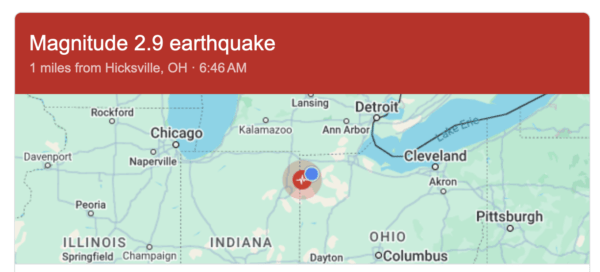
    At 6:48 AM, Defiance County, Ohio, specifically the community of Hicksville (a few miles from our home), felt a magnitude 2.9 earthquake. This is the first recorded earthquake in Defiance County history. No fault lines lie nearby, so experts wonder what caused the earthquake. I suspect some local Evangelical preachers won’t wonder about what happened. Nope, these prophets of the Almighty will turn to Matthew 24, rip out the verses necessary to prove their point, and say that this earthquake is an irrefutable sign of the second coming of Jesus. Yes, siree bob, Jesus is coming soon! What other explanation could there be, right?

    In time, scientists will posit likely explanations for the Defiance Earthquake®. And sure as Jesus is still lying in an unmarked Judean grave, these very same preachers will conveniently forget their earthquake predictions and move on to other newspaper auguries, sure, that this time, they will be right.

    Bruce Gerencser, 69, lives in rural Northwest Ohio with his wife of 48 years. He and his wife have six grown children and thirteen grandchildren. Bruce pastored Evangelical churches for twenty-five years in Ohio, Texas, and Michigan. Bruce left the ministry in 2005, and in 2008 he left Christianity. Bruce is now a humanist and an atheist.

    Your comments are welcome and appreciated. All first-time comments are moderated. Please read the commenting rules before commenting.

    You can email Bruce via the Contact Form.