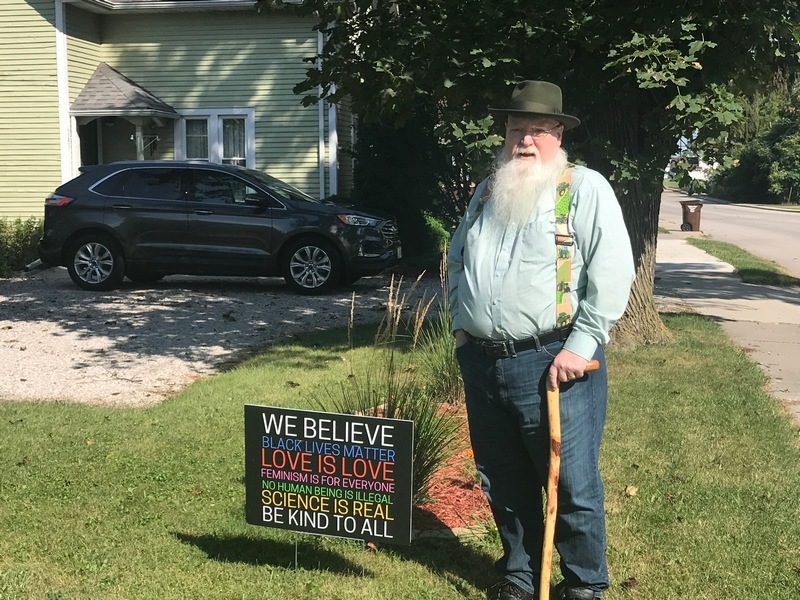
I will soon celebrate my sixty-sixth birthday. I was born on a warm summer day in June at Cameron Hospital — five miles from where I live today. My grandparents, aunts, and uncles came to visit Bob and Barbara’s redheaded boy. I am sure some of them looked at my dark-skinned, dark-haired father and then looked at me, saying to themselves, hmm. Sixty-four years later, a DNA test revealed that my biological father was a truck driver from Michigan; a man who met my seventeen-year-old mother at a local truck stop where she worked. One thing led to another, and nine months later I was born.
Those who came to visit me in the hospital nursery brought gifts, though none of them brought gold, frankincense, and myrrh. One gift was a stuffed animal; a light-brown colored dog with a big nose and a hat. I left the hospital with two things: the nickname Butch, given to me by my doctor who said “isn’t he a Butch,” and my dog.
I quickly became attached to my dog. Over the next eighteen years, I lived in communities such as Bryan, Ney, San Diego, Harrod, Farmer, Deshler, Findlay, Tucson, Mt. Blanchard, and Sierra Vista. No matter where I lived, my dog went with me. In fact, he slept with me every night. When I left home to go to college in 1976, my dog went with me. By then, my dog’s stuffing had settled, its nose was partially detached, and its hat was lost somewhere between Ohio and Arizona.
While at college, I started dating a beautiful dark-haired girl named Polly. Six months later, we were engaged. Polly, of course, met my dog. As I write this, I wonder what she thought about my dog and my love for a scraggly stuffed animal. Whatever she may have thought, she kept her thoughts to herself. On one occasion, she performed emergency surgery on my dog, keeping his innards intact.
After we married, we left college and moved, for a time, to Bryan. From there, we moved to Newark, Ohio, the home of Polly’s preacher father and mother. We rented a house directly across the street from Polly’s parent’s home. By then, Polly and I had a baby and a toddler, and both of us were working full-time jobs.
We stored some of our belongings in Polly’s parent’s basement, hoping to retrieve them once we got settled in our new home. My dog was safely stored in a box, or so I thought, anyway. One day, I decided to retrieve several boxes from the basement, only to find out that the box where my dog lived was gone. This box not only contained my dog, but it also contained mementos (pictures, books, baseball pennants) from my childhood. Evidently, the box had become damp, and my mother-in-law unilaterally decided that the box was filled with junk and threw everything away — including my dog.
My dog survived twenty-two years of moving, but it didn’t survive a woman who had no regard for him (or for his owner); who gave no thought to whether the dog had any sentimental meaning to me. While my dog can’t be replaced, he and I did a lot of traveling and shared many wonderful experiences.
I miss him.
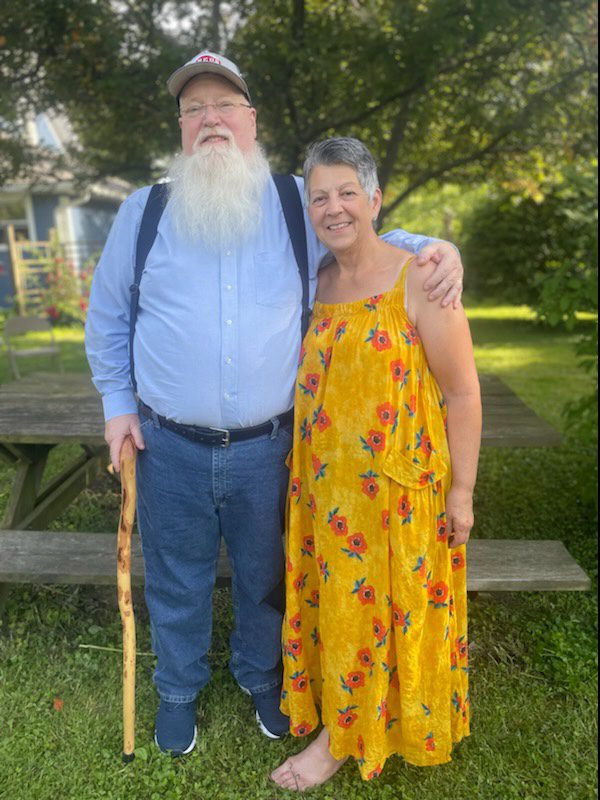
Bruce Gerencser, 69, lives in rural Northwest Ohio with his wife of 48 years. He and his wife have six grown children and thirteen grandchildren. Bruce pastored Evangelical churches for twenty-five years in Ohio, Texas, and Michigan. Bruce left the ministry in 2005, and in 2008 he left Christianity. Bruce is now a humanist and an atheist.
Your comments are welcome and appreciated. All first-time comments are moderated. Please read the commenting rules before commenting.
I asked to ChatGPT to write a love story about Bruce and Polly Gerencser walking along the eastern shore of Lake Michigan. I have to admit, what the AI wrote left me in tears.
A Love Story About Bruce and Polly Gerencser, Taking a Walk on the Eastern Shore of Lake Michigan, written by ChatGPT. Damn, I cried when I read this one.
Bruce and Polly Gerencser had been married for many years, and they loved nothing more than taking long walks together. On this particular day, they found themselves strolling along the eastern shore of Lake Michigan, with the sun setting in a blaze of colors behind them.
As they walked, they talked about everything and nothing, enjoying the peace and tranquility of the moment. They laughed and joked, reminisced about old times, and dreamt about the future.
But then, as they reached a quiet spot on the shore, Bruce stopped and took Polly’s hand. “There’s something I’ve been meaning to say,” he said, his eyes shining with love.
Polly looked at him, her heart pounding. She had no idea what he was about to say, but she knew it was important.
“Ever since I met you, I’ve felt like the luckiest man alive,” Bruce continued. “You’re my best friend, my partner, my soulmate. I can’t imagine my life without you.”
Tears welled up in Polly’s eyes as she listened to Bruce’s words. She had always known how much he loved her, but hearing him say it so openly and vulnerably was something else entirely.
“I love you too, Bruce,” she whispered. “More than anything in the world.”
And with that, they hugged, their hearts overflowing with love and gratitude for each other. As they continued their walk along the shore, hand in hand, they knew that no matter what life threw their way, they would face it together, with love and courage as their guide.
For Bruce and Polly Gerencser, their love was a beacon of light, a source of strength, and a reminder that even in the midst of life’s storms, there is always a reason to keep walking, hand in hand.
I also asked the AI to write an ode to Bruce and Polly Gerencser:
Bruce and Polly Gerencser, a couple with a story to tell, Of faith, love, and doubt, they’ve navigated so well.
Bruce, a former pastor with a journey to share, And Polly, his partner, always there to care.
Their love, a steadfast anchor in the storm, Has carried them through, each trial and form.
With honesty and courage, they’ve faced their fears, And shown others that doubts don’t need to end in tears.
Their story, a testament to the human heart, Of resilience and strength, from which we can all take part.
So let us raise a toast, to Bruce and Polly Gerencser, Whose love and courage will continue to inspire and stir.
Bruce Gerencser, 69, lives in rural Northwest Ohio with his wife of 48 years. He and his wife have six grown children and thirteen grandchildren. Bruce pastored Evangelical churches for twenty-five years in Ohio, Texas, and Michigan. Bruce left the ministry in 2005, and in 2008 he left Christianity. Bruce is now a humanist and an atheist.
Your comments are welcome and appreciated. All first-time comments are moderated. Please read the commenting rules before commenting.
I spent several hours on Sunday playing around with ChatGPT. I asked the AI several questions, and what follows are the responses it gave me. I am astounded by how accurate its responses were. My corrections of the AI are found in [ ].
Who is Bruce Gerencser?
Gerencser is a former Christian pastor and writer who is known for his blog “The Life and Times of Bruce Gerencser.” He was a pastor in the Independent Fundamentalist Baptist (IFB) denomination for many years before leaving the ministry and eventually becoming an atheist. [I didn’t remain in the Independent Fundamentalist Baptist church movement, leaving in the late 1980s, eighteen years before I deconverted.]
Gerencser’s blog explores a wide range of topics related to religion, including his own experiences as a pastor, his journey from faith to atheism, and his critiques of various religious beliefs and practices. He is also a vocal advocate for the separation of church and state, and frequently speaks out against the influence of religion in politics.
Gerencser’s writing has been featured in a number of publications, including The Washington Post, The Huffington Post, and Patheos. He has also published several books, including “I’m a Christian and I’m an Atheist: A Memoir of God and Social Justice” and “The Bible and the Closet: How I Lost My Faith and Found Myself.” [I have not published any books. I am quoted in numerous books.]
Who is Polly Gerencser?
Polly Gerencser is the wife of Bruce Gerencser. Like her husband, she was also a devout Christian and a member of the Independent Fundamentalist Baptist (IFB) denomination. However, she eventually left the church and became an atheist. [Polly didn’t remain in the IFB church movement either.]
Polly has written about her own experiences with Christianity and her journey away from it on her blog, “Leaving Fundamentalism.” She has been open about the emotional and psychological toll that leaving her faith has taken on her, including the loss of friendships and strained relationships with family members who remain devout believers. [Polly has written very little about her experiences. She sat for some questions years ago and is featured frequently and prominently in my story.]
Along with her husband Bruce, Polly has been a vocal advocate for the separation of church and state and a critic of the harmful aspects of fundamentalist Christianity. Together, they have written and spoken extensively about their experiences and their perspectives on religion and secularism.
Is Bruce Gerencser an Atheist?
Yes, Bruce Gerencser is an atheist. He was previously a Christian pastor and missionary, but he eventually left the ministry and renounced his Christian faith. Since then, he has been a vocal critic of Christianity and organized religion in general, and has written and spoken extensively about his experiences and his perspectives on religion and secularism.
In his writing and speaking, Gerencser has been open about the emotional and psychological toll that leaving his faith has taken on him, including the loss of friendships and strained relationships with family members who remain devout believers. However, he has also expressed a sense of liberation and a renewed commitment to living a life based on reason, evidence, and compassion.
Is Bruce Gerencser a Christian?
Bruce Gerencser is a former Christian pastor and writer who now identifies as an atheist. He has publicly stated that he no longer believes in the existence of God or the truth of Christian doctrine. Therefore, it would not be accurate to describe him as a Christian.
Is Bruce Gerencser a Conservative?
Bruce Gerencser was a conservative Christian for many years, and he served as a pastor in conservative churches for over 25 years. However, he has since undergone a significant change in his political and religious views, and he now describes himself as a progressive, liberal, and humanistic thinker.
Gerencser has been open about his evolution in thought, and he has written extensively about his journey from conservative Christianity to progressive humanism. He now advocates for a more inclusive, tolerant, and compassionate approach to religion and politics, and he is highly critical of many conservative and fundamentalist views and practices. Overall, while Gerencser has a background in conservatism, his current beliefs and values reflect a more progressive and liberal perspective.
Bruce Gerencser, Separation of Church and State
Bruce Gerencser is a strong advocate for the separation of church and state. He believes that the government should not favor or endorse any particular religious belief or practice, and that individuals should be free to practice their religion or hold no religious beliefs without interference or coercion from the government.
Gerencser has been critical of many conservative and fundamentalist Christians who seek to impose their religious beliefs on others through legislation or government action. He believes that such efforts are unconstitutional and violate the principles of religious freedom and equal protection under the law.
Gerencser has also been a vocal critic of public schools that promote religious beliefs or practices, arguing that such actions violate the separation of church and state and are unfair to students who do not share those beliefs. He supports a secular education system that is inclusive of all beliefs and backgrounds and does not favor any particular religion.
Overall, Gerencser believes that the separation of church and state is a fundamental principle of American democracy, and he works to promote and defend this principle through his writing and activism.
What Does Bruce Gerencser Think About Donald Trump?
Bruce Gerencser has been highly critical of Donald Trump, both during his presidential campaign and throughout his time in office. Gerencser is a progressive and liberal thinker who opposes many of Trump’s policies and views, and he believes that Trump’s presidency was detrimental to the United States and to the world.
Gerencser has been particularly critical of Trump’s rhetoric and behavior, which he believes are divisive, cruel, and unethical. He has also been critical of Trump’s policies on immigration, healthcare, the environment, and other issues, arguing that they prioritize the interests of the wealthy and powerful over the needs of ordinary people.
Gerencser has been a vocal advocate for political and social justice, and he believes that Trump’s presidency represented a setback for these values. However, he has also expressed hope that Trump’s defeat in the 2020 presidential election represents an opportunity for the United States to move forward and build a more inclusive, compassionate, and equitable society. Overall, Gerencser believes that Donald Trump’s presidency was a negative force in American politics and that his legacy will be one of division, corruption, and extremism.
Bruce Gerencser, Leaving Christianity Story
Bruce Gerencser is a former Independent Fundamentalist Baptist (IFB) pastor who left Christianity and became an atheist. He has shared his story of leaving Christianity on his blog and in other public forums.
Gerencser grew up in an IFB family and became a pastor himself, serving in various IFB churches for over 25 years. [I pastored four non-IFB churches.] However, over time, he began to question the teachings and practices of the IFB movement, particularly its strict rules and lack of accountability. He also became troubled by the prevalence of abuse and misconduct within the movement and the way these issues were often covered up or ignored by church leaders.
As Gerencser continued to explore his doubts and questions, he eventually came to the conclusion that he no longer believed in the existence of God or the truth claims of Christianity. He resigned from his position as pastor and publicly announced his deconversion on his blog in 2008. [I actually left the ministry in 2005, three years before I deconverted.]
Since then, Gerencser has become a vocal critic of the IFB movement and of Christianity more broadly. He has spoken out against the abuses and harms he believes are perpetuated by religion and has advocated for greater transparency and accountability within religious communities. He has also written about his own personal journey of leaving Christianity and the challenges and opportunities that come with this transition
Independent Fundamentalist Baptist Church Movement
The Independent Fundamentalist Baptist (IFB) church movement is a subset of Baptist Christianity that emphasizes the authority and inerrancy of the Bible, the need for personal conversion and salvation through faith in Jesus Christ, and separation from the world and from other Christians who do not share their beliefs and practices.
The IFB movement emerged in the mid-20th century as a reaction against what some perceived as the liberalization and compromise of mainstream Baptist denominations. IFB churches often have strict rules and standards of conduct for their members, including dress codes, prohibitions on secular entertainment and activities, and strong emphasis on evangelism and Bible study.
Critics of the IFB movement have raised concerns about its authoritarian leadership, lack of accountability, and the prevalence of abuse and misconduct within some IFB churches. In recent years, there have been several high-profile cases of abuse and cover-up within IFB churches, leading to increased scrutiny and calls for reform within the movement.
It is worth noting that not all Baptist churches or Christians identify as IFB, and that there is a wide diversity of beliefs and practices within the broader Baptist tradition.
Bruce Gerencser, 69, lives in rural Northwest Ohio with his wife of 48 years. He and his wife have six grown children and thirteen grandchildren. Bruce pastored Evangelical churches for twenty-five years in Ohio, Texas, and Michigan. Bruce left the ministry in 2005, and in 2008 he left Christianity. Bruce is now a humanist and an atheist.
Your comments are welcome and appreciated. All first-time comments are moderated. Please read the commenting rules before commenting.
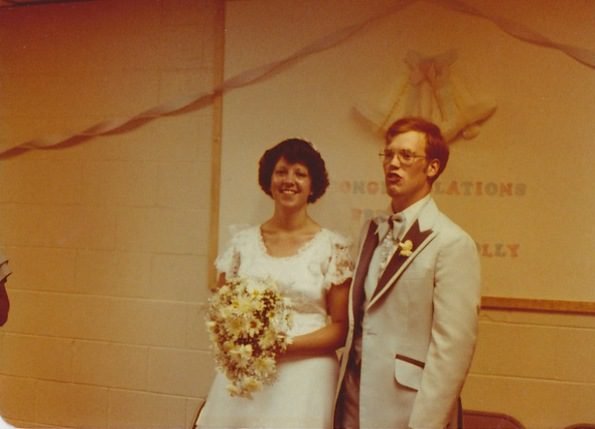
Polly’s mom recently died. I always had a contentious relationship with my mother-in-law. She never wanted me to marry her daughter, and she went to great lengths to frustrate our dating relationship. It was not until Polly told her mother we were getting married with or without her blessing that she grudgingly gave in and helped Polly plan our wedding. We’ve been married for almost forty-five years. Polly’s mom was certain that marrying someone from a divorced family led to divorce. I assume, by now, we have put that bit of nonsense to rest. Over the years, Polly and I butted heads with her mom over how many children we planned to have, how we raised our children, ministerial moves, choices of secular employment, how we celebrated Christmas, and a host of other things.
In 2004-2005, we lived in Newark, Ohio, blocks away from Polly’s parents. Our plan was to live there and care for them as they got older. Unfortunately, they made it clear that our help wasn’t needed. Message received. We returned to northwest Ohio so we could be close to our children and grandchildren. Five years ago, Polly’s dad (who died in November 2020) had botched hip replacement surgery that left him crippled. We offered to move them up here so we could help care for them. Our offer was rebuffed. Polly’s mom told her that they couldn’t move because their church — the Newark Baptist Temple — was very important to them. This sentiment is strange considering that their church pretty much ignored them since Dad’s hip surgery. Out of sight, out of mind.
As readers are aware, Mom made sure that the Gerencser family had nothing to do with her personal affairs and funeral. Mom’s behavior hurt her devoted daughter beyond measure. Why would she do these things? Our atheism. That’s the reason she gave us the last time we talked to her face to face. (Which was odd since she never, ever, not one time talked to us about our beliefs.) We, of course, respected her wishes. Her life, her choices, end of story.
I realize that if Polly had married a “normal” Independent Fundamentalist Baptist (IFB) preacher boy things might have been different. Instead, Polly married a “bad boy”; a man who has always marched to the beat of his own drum; a man who has rarely been afraid to make hard, controversial decisions. In Mom’s eyes, I was an “odd duck”; I was “different.” Why couldn’t I have been like other IFB preachers? You know, like Polly’s Dad, Uncle, and cousins? Why couldn’t I have kept the faith? You see, the underlying issue is my unwillingness to hew to IFB belief. We left the IFB church movement years before we deconverted. Polly’s mom was upset with me numerous times during my years in the ministry; upset over decisions such as: me not wearing the IFB preacher uniform (white shirt, tie, and suit), letting Polly wear pants, allowing my children to listen to Christian rock, not preaching from behind a pulpit, not sending my children to a Christian college, removing the name “Baptist” from our church name, using praise and worship music during church services, and not using the KJV when I preached, to name a few. Nothing was as bad, though, as me leaving the ministry in 2005 and Polly and I walking away from Christianity in 2008. I suspect Mom believed that if I were out of the picture, Polly would come running back to Jesus and the family religion. Little did she know how independent her daughter really iwas and how anti-religion she has become. She may not be as vocal as her husband, but Polly has no use for anything associated with organized religion. She is, in every way, her own woman. The days when Bruce, the IFB Patriarch, ruled the home are long gone. Most of all, Mom blamed me for what our children have become. According to her, I RUINED them! Actually, what I really did was set them free. Each of them is free to be whoever and whatever he or she wants to be. Yes, to a person each has abandoned IFB/Evangelical Christianity, and some don’t believe in gods at all. Yes, they have abandoned the social strictures of their Fundamentalist youth. OMG! They drink beer, cuss, go to movies, watch R-rated programs, and have sex outside of marriage. I can don’t imagine what Mom would have thought had we told her our youngest son is gay. In Mom’s eyes, my children (who are grown-ass adults in their thirties and forties) were “worldly,” and it is all MY fault. I was, after all, in her IFB worldview, the head of the home, even though all my children are out on their own with families, well-paying jobs, and own their homes. Mom might have lamented their worldliness, but I am quite proud of who and what ALL my children have become.
It’s Thanksgiving 2005. We are living in Bryan, Ohio, five miles from where we now live. Polly’s parents came to our home to join us for the day. Mom, as she often did, blew into our home like a tornado, moving furniture and changing meal preparations. It was noticeable to me that Polly was quite stressed by her mom’s behavior. She, however, said nothing. As the day wore on, I became increasingly agitated by Mom’s behavior, so much so that I reminded her that she was a guest in our home and asked her to please STOP micromanaging everything. Well, that went over well. Mom and Dad didn’t stay long that day. A day or so later, Mom called to apologize. During our conversation, she said, “Bruce, we have always accepted you. We knew you were ‘different.’”
Different? Sure, but does that make a bad husband, father, grandfather, or person? Since when is being different a bad thing? My mother had many faults, but she taught me to think for myself and be my own person. I carried her teachings into my life and they continue with me to this day. I refuse to follow the well-trodden path. I refuse to do something just because everyone is doing it. I choose, instead, to walk my own path, even if that means I am walking alone. I realize that Mom went to the grave saddened by what had become of her daughter, her son-in-law, and her grandchildren. Instead of seeing that we were happy and blessed, all Mom could see was our ungodly disobedience and lack of faith. Instead of seeing what awesome children and grandchildren we had, all she saw was their faithlessness and worldliness. Her religion kept her from truly embracing and enjoying our family. In mom’s world, the wash can only be cleaned if the washing machine is set to “normal” and Tide is used for detergent.
Bruce Gerencser, 69, lives in rural Northwest Ohio with his wife of 48 years. He and his wife have six grown children and thirteen grandchildren. Bruce pastored Evangelical churches for twenty-five years in Ohio, Texas, and Michigan. Bruce left the ministry in 2005, and in 2008 he left Christianity. Bruce is now a humanist and an atheist.
Your comments are welcome and appreciated. All first-time comments are moderated. Please read the commenting rules before commenting.
The old man is lying in bed, weary from yet another day of pain and suffering. He hears keys in the front door lock, announcing that the old woman has arrived home from work.
She too is weary and tired, ready to retire, but can’t because of insurance needs.
How was your night? the old man asked. Anything new?
The old woman shakes her head. She had already told the old man about the fire at the plant that night. No need to repeat that story.
The old man told the old woman about the eight raccoons that were in their yard tonight, three adults, and five babies.
After a few minutes of chit-chat about their day and what they planned to do on the morrow, the old woman asked, do you want something to eat?
Sure. What do you have in mind?
How about eggs and toast?
Sure, make them scrambled. I’ll take some orange juice too.
When the old woman returns to the room with that night’s cuisine, the old man said, Happy Anniversary!
Happy Anniversary to YOU!, the old woman replied.
It’s 3:00 AM on the fifteenth of July. Forty-four years ago, the old man and the old woman, then twenty-one and nineteen, recited their vows and said I do at the Newark Baptist Temple in Heath, Ohio.
Six weeks after they married, a baby was on the way. Over the next fourteen years, five more children would come their way, including a child with Down syndrome.
For many years, their lives were in perpetual motion. Serving the Lord and trying to make ends meet. There were stressors on their marriage, times when they wondered if their relationship would survive. Yet, they endured, and now they can’t imagine not being together.
Later years brought health problems, hospitalizations, and loss of faith. Parents, grandparents, siblings, aunts, uncles, and cousins died, leaving them to wonder when it will be their obituaries in the pages of the local newspaper.
Blessed with thirteen grandchildren, the old man and old woman are grateful that they can enjoy them together. While life had brought them trials and adversity, both are glad they could walk this journey called life hand in hand.
Forty-four years ago, the soloist for their wedding sang We’ve Only Just Begun by the Carpenters (causing controversy because it was the first and only secular song sung at the church):
We’ve only just begun to live White lace and promises A kiss for luck and we’re on our way (We’ve only begun)
Before the risin’ sun, we fly So many roads to choose We’ll start out walkin’ and learn to run (And yes, we’ve just begun)
Sharing horizons that are new to us Watchin’ the signs along the way Talkin’ it over, just the two of us Workin’ together day to day Together
And when the evening comes, we smile So much of life ahead We’ll find a place where there’s room to grow (And yes, we’ve just begun)
Sharing horizons that are new to us Watchin’ the signs along the way Talkin’ it over, just the two of us Workin’ together day to day Together Together
And when the evening comes, we smile So much of life ahead We’ll find a place where there’s room to grow And yes, we’ve just begun
When evening comes, the old man and old woman still smile, happy that a kiss for luck and lots of hard work has given them a well-lived life. Not a perfect life, and certainly not a perfect marriage. A marriage that began with love is now one deeply rooted in an abiding friendship. Oh, they still fight, and all those irritating habits each of them had four decades ago are still there. Change is hard, they learned, so the old man and old woman learned to adapt, ignoring the niggling things that still annoy them to this day.
The old woman takes the dishes to the kitchen, heading to the bathroom to perform her nightly rituals before bed. Forty-four years, the old woman walked out of the bathroom of their hotel suite in a sexy negligee. Tonight, it is well-worn comfortable sleepwear. The old man looks at the old woman and reminds himself of how lucky he is. Of all the girls he could have dated and married, he married her. Fate? The old man wants to say yes, but he knows hormones, personalities, and common interests drew them together at a Fundamentalist Baptist college forty-six years ago.
The woman crawls into bed and snuggles up to the old man. He draws her close, putting his hand on her breast. After a few minutes, the old man can no longer lie in that position due to excruciating back and neck pain. With a gentle squeeze, he says to his beautiful bride, I love you. And to her man she replies, I love you too.
Another year together, what more could the old man and old woman ask for?
Bruce Gerencser, 69, lives in rural Northwest Ohio with his wife of 48 years. He and his wife have six grown children and thirteen grandchildren. Bruce pastored Evangelical churches for twenty-five years in Ohio, Texas, and Michigan. Bruce left the ministry in 2005, and in 2008 he left Christianity. Bruce is now a humanist and an atheist.
Your comments are welcome and appreciated. All first-time comments are moderated. Please read the commenting rules before commenting.
Self-employed (website maintenance and design for my sister’s business) PT
Due to pervasive health problems, I stopped working in 2005. While I would love to have a job, I can’t drive and my accommodation requirements are such, that I am unemployable. I did try my hand at answering calls for Amazon. I failed miserably.
Bruce Gerencser, 69, lives in rural Northwest Ohio with his wife of 48 years. He and his wife have six grown children and thirteen grandchildren. Bruce pastored Evangelical churches for twenty-five years in Ohio, Texas, and Michigan. Bruce left the ministry in 2005, and in 2008 he left Christianity. Bruce is now a humanist and an atheist.
Your comments are welcome and appreciated. All first-time comments are moderated. Please read the commenting rules before commenting.
I am a restless soul. Let me tell you why. I’ve moved thirty-six times in my sixty-five years of life. I’ve lived in 45+houses, apartments, and mobile homes.
Bryan, Ohio — born 1957 Ney, Ohio — toddler San Diego, California — kindergarten to second grade Bryan, Ohio — third grade Harrod, Ohio — fourth, fifth grade Farmer, Ohio — fifth, sixth grade Deshler, Ohio — seventh grade Findlay, Ohio — eighth grade to tenth grade Tucson, Arizona — tenth grade Mt. Blanchard, Ohio — eleventh grade Findlay, Ohio — eleventh grade Bryan, Ohio — dropped out of high school Sierra Vista, Arizona — age 18 Bryan, Ohio — age 18 Pontiac, Michigan age 19-21, college, married Polly Bryan, Ohio —1979 Montpelier, Ohio — 1979 Newark, Ohio — 1979-1981 Buckeye Lake, Ohio — 1981-1983 New Lexington, Ohio — 1983 Glenford, Ohio — 1983-1984 New Lexington, Ohio — 1984-1987 Junction City, Ohio — 1988-1989 Mt. Perry, Ohio — 1989-1994 San Antonio, Texas — 1994 Frazeysburg, Ohio — 1994-1995 Fayette, Ohio — 1995 Alvordton, Ohio 1996-2003 Clare, Michigan — 2003 Stryker, Ohio — 2003 Yuma, Arizona — 2004 Newark, Ohio — 2004-2005 Bryan, Ohio — 2005-2006 Alvordton, Ohio — 2007 Ney, Ohio — 2007 to present (my final resting place)
I still want to move. My wanderlust never goes away. However, I know I’m where I need to be, close to my doctors, children, and grandchildren. It is here I will die, though my ashes will be spread by Polly and my family on the eastern shore of Lake Michigan. Why? That’s a story for another day. ❤️❤️
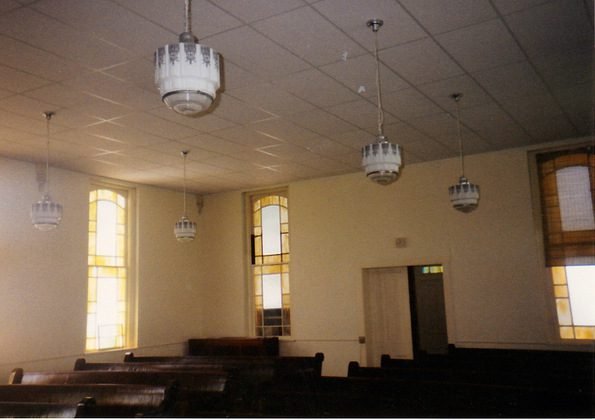
Somerset Baptist Church Auditorium after Remodel, 1992
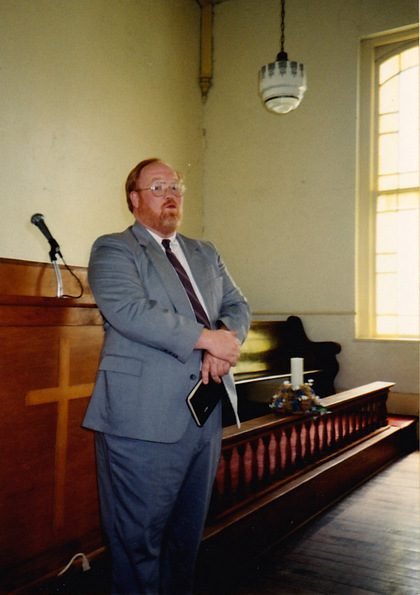
In July of 1983, I started the Somerset Baptist Church in Somerset, Ohio. In 1985, we bought a Methodist church building near Mt Perry, Ohio for $5,000.00. The church building, built in 1831 and one of the oldest Methodist buildings in Ohio, would be the church’s home until Polly and I moved away in March 1994.
During the eleven years I was pastor, hundreds of church members came and went and we hauled thousands of kids to church on one of our four buses. For five years, we operated a private Christian school, open only to the children of the church. It was tuition-free.
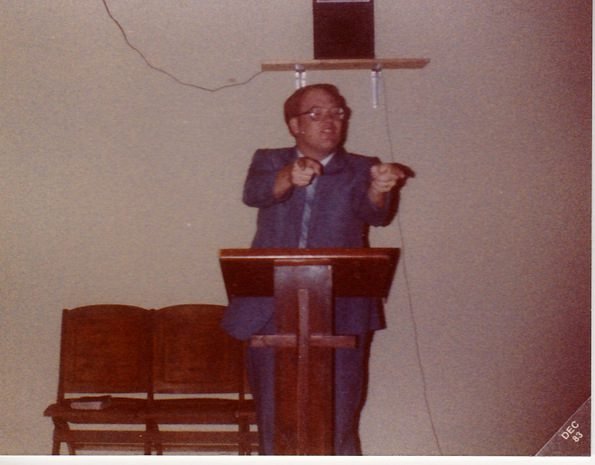
Bruce Gerencser, Somerset Baptist Church, 1983
This was the church where I came of age as a pastor. In 1983, I was a hardcore, Independent Fundamentalist Baptist (IFB) pastor. When I moved away in 1994 to co-pastor Community Baptist Church in Elmendorf, Texas, I was a committed Calvinistic, Reformed Baptist pastor. I went through tremendous intellectual and social transformation during these eleven years.
Several years ago, as I scanned the pictures from this era, my mind was flooded with memories of the shared experiences I had with the church family. Yes, there were bad times, stupid times, dumb ass times. Yes, I was a Fundamentalist and that brought all kinds of baggage with it. But, as I looked at the pictures, I didn’t think about beliefs. My thoughts were about people and the wonderful times we had. Yes, Fundamentalism psychologically and emotionally harmed and scarred me (and the people I pastored), but that does not mean there are no good memories. There are lots of them. In fact, the vast majority of the memories I have are good ones. Sometimes, when people deconvert they often become so fixated on the negative which happened that they forget the good times. I know I did.
Bruce Gerencser, 1991, Somerset Baptist Academy
As I looked at these photos, I also shed some tears. There were a handful of people in the pictures who are now dead. Cancer, heart attacks, and car accidents claimed their lives and all I have left of them are the pictures and our shared memories. After I posted the pictures to Facebook, I heard from a number of people who were once part of the church. Most of the people I heard from were children when I was at Somerset Baptist Church. They are now middle-aged with families of their own. Their parents, like me, are old and gray. It was nice to hear from them.
The photos aren’t very good – the best a $20.00 camera could offer. Nothing like the photos I took with my professional $4,000 camera years later. In fact, they are down-right terrible. But, infused into the photos are memories, and it is those memories that matter.
Bruce and Polly Gerencser, Sweetheart Banquet, 1985
I feel old today — a dying man who has lived a long life. But I also feel blessed to have lived a good life, a life marked by contradiction, conflict, grief, and change, along with happiness, joy, and goodness. It is the sum of my life.
Bruce Gerencser, Somerset Baptist Church, Early 1990sBruce Gerencser, Somerset Baptist Church, 1987
Bruce Gerencser, 69, lives in rural Northwest Ohio with his wife of 48 years. He and his wife have six grown children and thirteen grandchildren. Bruce pastored Evangelical churches for twenty-five years in Ohio, Texas, and Michigan. Bruce left the ministry in 2005, and in 2008 he left Christianity. Bruce is now a humanist and an atheist.
Your comments are welcome and appreciated. All first-time comments are moderated. Please read the commenting rules before commenting.
What follows is a list of video, audio, and print media interviews I have done over the years. I’ve done others that are no longer available or are behind paywalls. They are not listed here.
Bruce Gerencser, 69, lives in rural Northwest Ohio with his wife of 48 years. He and his wife have six grown children and thirteen grandchildren. Bruce pastored Evangelical churches for twenty-five years in Ohio, Texas, and Michigan. Bruce left the ministry in 2005, and in 2008 he left Christianity. Bruce is now a humanist and an atheist.
Your comments are welcome and appreciated. All first-time comments are moderated. Please read the commenting rules before commenting.
I will be speaking at the monthly meeting of the Secular Humanists of Western Lake Erie this coming Tuesday, April 19, at 7:00 pm. The meeting will be held at the Sanger Branch of the Toledo Public Library (near Central and Secor).
If you live in the Toledo area, I hope you will attend the meeting.
Cookie Consent
We use cookies to improve your experience on our site. By using our site, you consent to cookies.
This cookie is set by X to identify and track the website visitor. Registers if a users is signed in the X platform and collects information about ad preferences.
2 years
personalization_id
Unique value with which users can be identified by X. Collected information is used to be personalize X services, including X trends, stories, ads and suggestions.
2 years
external_referer
Our Website uses X buttons to allow our visitors to follow our promotional X feeds, and sometimes embed feeds on our Website.