Tag: Divine Command Theory

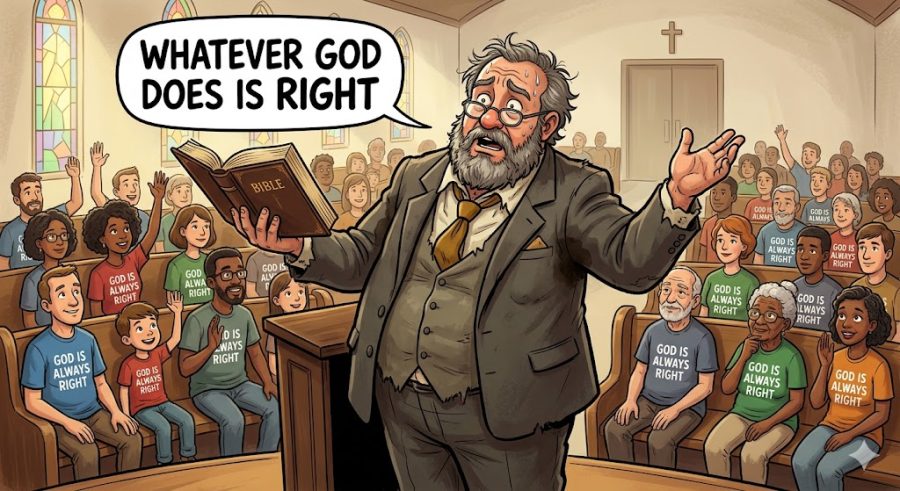
  • Whatever God Does is Right

    god is always right

    I listen to a plethora of YouTube channels, particularly call-in shows whose hosts attempt to engage and debate Evangelicals, Catholics, Muslims, and Jews. Evangelicals, in particular, often appeal to “divine command theory” to justify their God’s behavior.

    The Internet Encyclopedia of Philosophy defines divine command theory as:

    the view that morality is somehow dependent upon God, and that moral obligation consists in obedience to God’s commands.

    In other words, whatever God does is right. And I mean whatever . . . I have listened to countless Evangelicals defend everything from owning people as property (slavery) to rape to genocide. From philosophical arguments to appeals to the supremacy of “God’s ways,” God is vociferously defended by Evangelical apologists. No quarter is given. God’s holy name must be defended at all costs. And defend it they do, with justifications, excuses, and bizarre interpretations.

    Underlying the notion of divine command theory is the claim that God is ALWAYS good; that whatever God does is, without exception, good. This means that when God ordered the genocide of the Amalekite people, it was a moral, just, and good command. When God ordered the slaughter of infants, no fault can be found in what followed.

    Sensitive to being accused of promoting and justifying genocide, Evangelicals often cook up all sorts of explanations that allegedly protect God’s name against accusations of immorality. “God knew all those babies were going to go to Heaven anyway, so babies having their heads dashed upon the rocks is “good.” Of course, this means Evangelicals should be pro-abortion, killing fetuses before they are old enough to know the difference between right and wrong. Most Evangelicals believe fetuses and babies go to Heaven when they die. so it stands to reason that abortion (or slaughter by the Jews) is good as the result is eternity in Heaven. In other words, the end justifies the means. Wait a minute, I thought Evangelicals oppose situational ethics? Oh that’s what they say, but when defending God, absolute morality becomes an ever-moving target. The Ten Commandments say “Thou shalt not kill (murder).” Yet, it seems that when God is doing the killing, the supposedly “moral law of God” is massaged or ignored. Just remember, God’s ways are not our ways. In the minds of Evangelicals, whatever God does is moral and right, even when it seems that what he is doing is immoral. Just because rape, slavery, genocide, and murder are “sins” to fallen sinners, it doesn’t follow that those same acts committed by God are just, moral, and right. The Evangelical deity is never held accountable for his actions. How can mere mortals judge God? Evangelicals say, carving out an exception for God. This means that despite claims of having objective morals, Evangelicals, as do all of us, actually have subjective morals

    Most Evangelicals believe the Bible was written by God, inerrant and infallible in all it says. This core belief forces Evangelicals to commit to defending the Bible regardless of what it says. No evil is beyond justification if God did it. Remember, this is the same God who created Hell/Lake of Fire, the final resting place for all non-Evangelicals. As eternity rolls on, unbelievers will be tortured by God for one simple reason: they didn’t believe in Jesus.

    Here’s the thing, belief isn’t a choice. Either you believe or you don’t. We cannot genuinely believe if we are not convinced that a claim is true (I speak generally). Yes, this is a complex issue, especially when you consider human free will. Do we have free will? I’m inclined to think that we don’t; that our lives give the appearance of free will without actually being “free.” The notion that we have libertarian free will cannot be rationally sustained, though I am sure that some commenters want to disabuse me of this notion.

    The Christian God is neither just, moral, nor good. I have seen no evidence in the Bible that would suggest I am wrong. If you disagree with me, please defend your God or divine command theory in the comment section. I await your defense of a “good” God.

    Bruce Gerencser, 69, lives in rural Northwest Ohio with his wife of 48 years. He and his wife have six grown children and thirteen grandchildren. Bruce pastored Evangelical churches for twenty-five years in Ohio, Texas, and Michigan. Bruce left the ministry in 2005, and in 2008 he left Christianity. Bruce is now a humanist and an atheist.

    Your comments are welcome and appreciated. All first-time comments are moderated. Please read the commenting rules before commenting.

    You can email Bruce via the Contact Form.

  • Was it Just to Stone a Man for Picking Up Sticks on the Sabbath?

    ice arrests man picking up sticks

    Imagine you lived in an arid climate where you had to daily gather sticks to cook and provide heat. Every day you dutifully collected sticks for your fire needs. There was a law that prohibited picking up sticks on Saturdays, but you ignored it. One Saturday, you were arrested for picking up sticks on Saturdays. On your court date, the judge, based on consultation with God, decided to sentence you to death. And with that you were dragged outside the city and stoned.

    Is this a just sentence? Most of us would say no; that the punishment doesn’t fit the crime. An infinite punishment for a finite crime.

    A similar story appears in Numbers 15:

    When the Israelites were in the wilderness, they found a man gathering sticks on the Sabbath day. Those who found him gathering sticks brought him to Moses, Aaron, and the whole congregation. They put him in custody because it was not clear what should be done to him. Then the Lord said to Moses, “The man shall be put to death; all the congregation shall stone him outside the camp.” The whole congregation brought him outside the camp and stoned him to death, just as the Lord had commanded Moses.

    Again, is this a just sentence?

    Most atheists, agnostics, humanists, and liberal Christians would say NO! However, many Evangelicals will call the first story unjust, but the second story — because God commanded Moses to execute the man — is just. When God does something, it is always right. His actions are always just. One nearby Evangelical church has emblazoned on the outside of their building, “God is Good All the Time.” This cheap, poorly thought-out cliche informs the thinking of most Evangelicals. Of course, God is good all the time. He is the sum of, the essence of goodness. Is this not what they have heard from the pulpit their entire lives? Even when tragedy strikes, Evangelicals refuse to move away from their indoctrination and conditioning. A tornado levels their town? “God is good all the time. Look Preacher Bob’s Bible survived the tornado unscathed. Ain’t God good?”

    When we turn to the Bible, we find not only a good God, but an evil one. It is impossible to read the Bible and not conclude that God can be, at times, an evil son of a bitch. Admitting this, of course, is fatal to the Evangelical claim that God is good all the time. Enter apologetics, a tool used by Evangelicals to explain away clear readings of Scripture. The goal of apologetics is not to teach and instruct as much as it is to defend and protect. And when their defenses come up short, as they always do, what do they say? “God is good all the time.” And now the circle jerk is complete. When arguments for the goodness of God fail, Evangelicals typically offer up faith claims to justify their refusal to actually believe what the Bible says. “God’s ways are not our ways, and his thoughts are not our thoughts.” No shit, Sherlock. Most of us wouldn’t execute a man for picking up sticks on the wrong day.” We would have given him a slap in the wrist, a fine, and maybe some community service. Not God. He demands the man be killed. Talk about overkill.

    No, God is not just, neither in this story nor countless others in the Bible. Evangelicals are forced to call evil good because of their adherence to divine command theory — moral values and duties are solely grounded in the commands of God. In other words, the goodness of an action is determined by whether it was commanded by God. This leads to all sorts of crazy thinking. I listen to a number of atheist call-in shows: Allegedly Ian, Dr. Blitz, The Deconstruction Zone, and various programs produced by The Line and the Atheist Community of Austin. It is not uncommon to have Evangelicals (and Muslims and Catholics) call in to defend God’s character, especially his goodness. It is quite easy to prove from the Bible that God is NOT good all the time. Yet, when confronted with overwhelming evidence for a not-good God, Evangelicals recoil, retreat, and scream, No! No! No! GOD IS GOOD ALL THE TIME! This forces Evangelicals to justify slaughter, murder, rape, and genocide. If God did or commanded an act, then it is, by default, good. These apologists call the killing of the unborn murder, yet when God kills fetuses, it is good.

    Is it ever just to execute someone for picking up sticks? No. But, for Evangelicals, they must hang their heads in shame and say, Yes. God is good all the time. and because he is, whatever God does is just. It is impossible to combat such thinking until they are willing to admit that God is not as good as they were taught he was. The evidence is overwhelming, that is if Evangelicals are willing to accept a clear, unambiguous reading of the Bible — even if if means making God look bad.

    Did you believe God was good all the time; that his actions were always just? How did you explain Bible stories that reveal that God is neither of these things? Please share your erudite thoughts in the comment section.

    Note: This post should help you understand why some of your Evangelical family, friends, and neighbors justify the violent, murderous actions of ICE and other federal agencies in Minnesota. The Bible commands us to obey the laws of the land, and when you don’t this is what happens, the thinking goes, Of course, such people rarely use their shriveled brains to ask, what laws were broken? Isn’t protest and civil disobedience part of our civic DNA — a duty? If Evangelicals cannot honestly look at the evidence and conclude that the federal government murdered two non-violent, non-threatening protestors, they have lost their moral compass. This is disgusting thinking, to say the least.

    Bruce Gerencser, 69, lives in rural Northwest Ohio with his wife of 48 years. He and his wife have six grown children and thirteen grandchildren. Bruce pastored Evangelical churches for twenty-five years in Ohio, Texas, and Michigan. Bruce left the ministry in 2005, and in 2008 he left Christianity. Bruce is now a humanist and an atheist.

    Your comments are welcome and appreciated. All first-time comments are moderated. Please read the commenting rules before commenting.

    You can email Bruce via the Contact Form.