Most people would agree that they desire purpose, meaning, and happiness in their lives. While these terms can and are defined and used in various ways, I think it is safe to say that most of us want to live a good life while on this mortal coil.
Sadly, millions of Evangelicals believe that only Jesus gives them meaning, purpose, and happiness in their lives. Without Jesus, their lives have no value. Without Jesus, they are but brute sinners deserving eternal punishment and suffering in a lake filled with fire and brimstone. This is what they are told by Evangelical preachers, anyway. Congregants are reminded that their existence depends on Jesus — the second person in the Godhead. They are reminded that most humans are headed for a Christless Hell; that atheists, agnostics, humanists, Buddhists, Muslims, pagans, and others live aimless, helpless, hopeless lives on their slog towards eternity. Never mind the fact that how these people live their lives are repudiations of Evangelical lies about them. Evidence suggests that unbelievers can and do have happy, fulfilling lives without Jesus. Making their own purpose and meaning in life, non-Evangelicals live life on their own terms, often understanding that the journey is far more important than the destination. When gaining Heaven or avoiding Hell is no longer the grand objective, it’s amazing how much more satisfying life can become.
As a certified atheist and humanist, I struggle greatly every day of my life. There’s no escaping pain, suffering, and death, so while I am among the living, I intend to live life to its fullest, even if “fullest” means some days brushing my teeth, eating a bit, and resting. Every day I hope to write, but all the hope in the world doesn’t change the suffering that often keeps my pen in the proverbial inkwell. Thus, living life to its fullest, for me, is on any given day, is doing what I can. Anyone who struggles with chronic pain and suffering understands where I am coming from. To loosely quote the Bible, “The spirit is willing, but the flesh is weak.” Years ago, my Independent Fundamentalist Baptist mother-in-law would tell me that I just needed to put mind over matter. I would bristle when she said such nonsense. My partner eventually got her mother to understand that when I said things like “I can’t” or “I need to rest” or “my pain is off the charts today” or “I’m too nauseous to eat” I was stating the fact of the matter. When I can’t, I can’t. That should be enough for people, but sometimes the people closest to you think if they just cheer you up or encourage you to do more, that you will suddenly arise from near death and clear your to-do list. This, of course, is fanciful, and, at times, hurtful thinking.
At whatever point I find myself in life, I try to live a meaningful life. I recognize and understand that I am on the short side of life. Death stalks me, reminding me that before I know it, I will be his. I long ago determined that I would not quietly go into the dark night. I will do what I can, write what I can, trying to be the best possible person I can possibly be. It matters how we die, so I want to die openly and honestly. cherishing every moment until that day comes. To suggest that my life has no meaning, purpose, or happiness is not only absurd, it’s offensive. I have never said such a thing to a person. If you need Jesus, religion, or the church to make it through life, fine. I don’t give a shit. Just leave me alone. I don’t need Jesus, your religion, and or your club. Why is it that Evangelicals rarely, if ever, grant me the same space to freely live my life? Instead, they feel obligated to tell me how worthless I am or how I will soon spend eternity being tortured by God.To what end, I ask? I know all I need to know about Evangelical Christianity. I know what the Bible says about me. I don’t need believers to remind me of these things. Few Evangelicals seem willing to live and let people live, content to let non-Christians live their lives on their own terms. Surely, this is not too much to ask.
Bruce Gerencser, 69, lives in rural Northwest Ohio with his wife of 48 years. He and his wife have six grown children and thirteen grandchildren. Bruce pastored Evangelical churches for twenty-five years in Ohio, Texas, and Michigan. Bruce left the ministry in 2005, and in 2008 he left Christianity. Bruce is now a humanist and an atheist.
Your comments are welcome and appreciated. All first-time comments are moderated. Please read the commenting rules before commenting.
For those of us raised in Evangelical churches, we are acutely familiar with a song titled Happiness is the Lord:
Happiness is to know the Saviour, Living a life within His favour, Having a change in my behaviour, Happiness is the Lord. Happiness is a new creation, Jesus and me in close relation, Having a part in His salvation, Happiness is the Lord.
Real joy is mine, No matter if the teardrops start, I’ve found a secret, It’s Jesus in my heart.
Happiness is to be forgiven, Living a life that’s worth the livin’, Taking a trip that leads to Heaven, Happiness is the Lord.
Real joy is mine, No matter if the teardrops start, I’ve found a secret, It’s Jesus in my heart, Jesus in my heart. Happiness is to be forgiven, Living a life that’s worth the livin’, Taking a trip that leads to Heaven, Happiness is the Lord, Happiness is the Lord, Happiness is the Lord.
If you dare, watch the following video. You will immediately have an earworm that you can’t get rid of.
Released in 1972, Happiness is the Lord is a song that children sing over and over and over again in Evangelical churches. I was in ninth grade when this song came out, and it quickly became a hit among the church’s teens.
What is this song teaching children about happiness?
Happiness is Jesus
Happiness is living a life in Jesus’ favor
Happiness is changed behavior
Happiness is a new creation (in Christ)
Happiness is a close relationship with Jesus
Happiness is having a part in Jesus’ salvation
Happiness is to be forgiven
Happiness is living a life worth living
Happiness is a trip to Heaven
From their nursery years forward, Evangelical children are indoctrinated and conditioned to believe that happiness only comes through Jesus. Without Jesus, children live meaningless lives. Want a life worth living? Want to have your sins (and don’t worry, kids, we will tell you all the behaviors that are sins and affronts to Jesus) forgiven? Want to go to Heaven when you die? Who doesn’t, right? According to Evangelicals, Jesus is the answer to every one of these questions.
Of course, what naturally follows is the idea that without Jesus, you can’t be happy. Your life isn’t worth living, and when you die, you will go to Hell. When life is framed in this manner, is it any wonder that the majority of Evangelical children make salvation decisions by the time they are out of elementary school?
Is happiness possible without Jesus? Of course it is. People were happy for thousands of years before Jesus arrived on the scene, and countless people have been happy since then, all without believing in and worshipping a dead Jew.
Google defines happiness this way:
Happiness is a state of well-being and contentment, often described as experiencing joy, satisfaction, and fulfillment. It’s a subjective experience, meaning what brings happiness to one person might not be the same for another. Happiness can be found in both fleeting moments and overall life satisfaction.
Note that the definition doesn’t mention Jesus as the source of happiness. Millions of Evangelicals lustily sing Happiness is the Lord, but their lives reveal that these words mean little to them. I pastored lots of unhappy believers; people who sang Happiness is the Lord on Sundays, and lived miserable, unhappy lives the rest of the week.
I deconverted seventeen years ago. Did unhappiness overwhelm me after I divorced Jesus? Nope. What changed was the locus of my happiness. As a Christian, my happiness was rooted in Jesus. As an atheist, my happiness is found in the simple things of life: Polly, our six children, our sixteen grandchildren, and four cats. Lots of happiness to go around for the Gerencser family. I also find happiness in nature and observing the lives of others. We did some shopping tonight at the Aldi store in Auburn, Indiana. I was in a good mood, even though I was in a lot of pain. I chatted with several shoppers. One Amish woman (we have a large Amish community near where we live) was shopping with her teen daughters and a toddler. I watched as the toddler ran down the aisles, evading her older sisters. I briefly talked to the mother, commenting on her daughter’s energy. We both laughed, traded a few pleasantries, and continued shopping. You know what I felt in that moment? Happiness.
None of us needs God/Jesus to be happy. If you think you do, you have been indoctrinated and conditioned. Life is what you make it, and even in the midst of suffering and loss, happiness can be found. We bought some hot dogs for the feral/stray cats that frequent our yard. Tonight, there were four adult cats and five kittens at our back door. I cut up hot dogs and put them on the porch. It was every cat for herself. I was delighted to see the kittens eating solid food. Again, how did I feel? Happy. Later tonight, four coons that have been visiting us at night will make an appearance. Their antics provide loads of entertainment. How will I feel? Happy. Happy for the sake of being happy, and happy that the coons made to our yard without getting hit on the highway in front of our home.
None of us needs Jesus to find happiness. Even if you are a Christian, Jesus is not the sum of your happiness. Expand your horizons and embrace life. You will find all the happiness you will ever need.
Bruce Gerencser, 69, lives in rural Northwest Ohio with his wife of 48 years. He and his wife have six grown children and thirteen grandchildren. Bruce pastored Evangelical churches for twenty-five years in Ohio, Texas, and Michigan. Bruce left the ministry in 2005, and in 2008 he left Christianity. Bruce is now a humanist and an atheist.
Your comments are welcome and appreciated. All first-time comments are moderated. Please read the commenting rules before commenting.
Calvinists are fond of claiming the Sovereign God of John Calvin is the first cause, the source of everything. Everything we atheists say, do, and have comes from the Christian God. There’s no aspect of our lives which are not created and controlled by the thrice holy God. No matter how vivaciously we object to such stupid claims, Calvinists say that we know in our hearts of hearts that this is true.
Supposedly, everywhere we look there is evidence for the existence of God. And not just any God either. Oh no, all the evidence points to John Piper’s God. Only those who are deliberately blind or reprobates deny what is clear to all who have eyes to see. Or so the Calvinist say, anyhow.
Take Greg Morse, a graduate of Bethlehem College & Seminary and a staff writer for John Piper’s Calvin-24/7 website Desiring God. Morse writes about his interaction with a man who told him that he was happy without God.
“I know you don’t believe me, but I do not need Christianity to be happy. I am happier than most Christians I know.” Looking up from his coffee, he smiled and assured me, “I am glad you found happiness in Jesus, but I am quite content without him. I have found my path to happiness, and I am glad you have found a different one. We stand at the same end, it would appear.”
I did not know what to say.
I knew how to share the Joy of the world to the discontent, the miserable, the downcast, but I stood perplexed at this man who told me, in no uncertain terms, “I do not need Christ to be happy.” Wasn’t his heart restless until it found its rest in him? He assured me it wasn’t. Didn’t he have a God-shaped hole in his heart? He swore that he didn’t. And what was more, he truly seemed to be, as far as I could tell, happy.
Most atheists would likely agree with the happy man’s sentiment. We don’t need God/Jesus/Christianity for our lives to have meaning, purpose, and happiness. Many of us were, at one time, Greg Morse. We believed that the Christian God was the sole source of all that was good in our lives. Our joy and happiness came from God alone, not anything we ourselves did. We believed, that without Jesus, our lives were steaming piles of worthless shit. This is especially true for those of us who were Calvinists. There’s no better theological system than Calvinism for destroying human value, purpose, and self-worth.
Morse wants atheists and other believers to know that despite their claims, everything they have comes from the Calvinistic God.
God allows those who ignore him, reject him, despise his glory, and belittle his name to breathe his air, feast on his food, swim in his waters, hike in his forests, ski on his mountains, laugh, sing, and dance on his lands. He has not yet evicted them. He has not taken back his bread from their plates nor his air from their lungs. Rather — and note the benevolence of the God of the universe — he “gives to all mankind life and breath and everything.”
….
The man that I spoke with took these gifts from God, enjoyed them, and refused to say thank you.
Man is the only creature other than fallen angels to pay God back so basely. God opens his hand and satisfies the desire of every living thing.
How dare unbelievers believe that the good in their lives comes from their own efforts and that of their fellow homo-sapiens. How dare we think we don’t need God/Jesus/Christianity.
This seems like a good place to interject my all-time favorite TV prayer.
The character played by Jimmy Stewart believes in giving credit to whom creThe character played by Jimmy Stewart believes in giving credit to whom credit is due. As an atheist, I don’t pray and thank God for the meals prepared by my wife. Why should I? What, exactly, did God do? Every aspect of the meal, from its raw ingredients to the finish product, can be attributed to things other than a deity. Over the weekend, I made fried chicken. It turned out well, although Polly might have something to say about Tornado Bruce’s cooking behavior. 🙂 If Polly said to me about all my hard work, All praise be to Jesus for this wonderful fried chicken, I would be more than a bit upset.
Morse, on the other hand, has never cooked a meal, or done anything else for that matter, without at least thinking that Jesus was worthy of all praise, honor and glory.
Morse concludes his post by telling readers what he would say to the aforementioned godless happy man if given the opportunity to do so again:
The Christian faith is not merely about man’s happiness, although God gives more joy than you can now imagine. Christianity addresses how sinful men, women, and children can be reconciled to their Creator and live happy lives for his glory. God has placed good gifts to summon you to see God’s ultimate gift: his Son, Jesus Christ. He came to save a people he didn’t have to save. To live a life we couldn’t live. To die the death we deserved to die. And to rise, summoning all everywhere to turn away from their sin, and trust in his finished work on the cross for sinners.
The smartphone in your pocket has everything to do with this God. The music massaging your ears, the colors jumping before your eyes, the gladness of heart and the love you feel are kindnesses from God with one message upon their lips: “Repent and believe.”
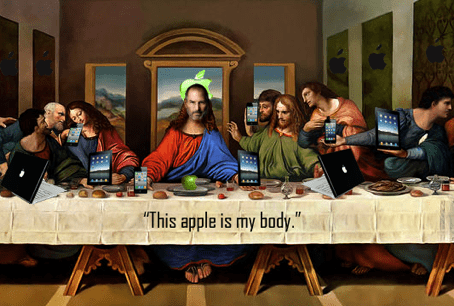
With a straight face with Morse asserts without one whit of evidence, “The smartphone in your pocket has everything to do with this [the Calvinistic] God.” In other words, if I carefully peer into the screen of my iPhone I will see “God.” That’s right, iPhones lead us to Jesus. Android phones? Straight to Satan and Hell! Only iPhones lead to the straight and narrow way.
That Morse would dare to utter such nonsense out loud is quite amusing. If we listen carefully, we can hear Steve Jobs hollering from Hell, Dammit! How dare God take credit for my creation, and that of Apple.
Nothing Morse writes is new. As a devout Calvinistic Evangelical, I heard countless sermons, and preached more than a few myself, that promoted the notion that we humans are helpless; that everything we have physically and materially comes from God; that without Jesus our lives are n-o-t-h-i-n-g.
How has your life changed since deconverting? Did you find it hard to give up giving all praises and blessing to God from whom all things flow? Do you now give credit to whom credit is due? Do you have Christian family who steals the credit for your happiness and success and gives it to their God? Please share your thoughts and experiences in the comment section.
Bruce Gerencser, 69, lives in rural Northwest Ohio with his wife of 48 years. He and his wife have six grown children and thirteen grandchildren. Bruce pastored Evangelical churches for twenty-five years in Ohio, Texas, and Michigan. Bruce left the ministry in 2005, and in 2008 he left Christianity. Bruce is now a humanist and an atheist.
Your comments are welcome and appreciated. All first-time comments are moderated. Please read the commenting rules before commenting.
“I don’t think most of us realize how centered around feelings we are. Every day, we make decisions and evaluate our circumstances based on how we feel at the time. Plus, our culture is constantly telling us to “follow our hearts” and do whatever feels good because we deserve it. We are amazing and wonderful, and we deserve happiness (often in the form of a new hair care product or prime rib sandwich or shiny SUV or whatever that billboard on the side of the street is trying to sell us).
Well, sorry, culture, but we don’t deserve happiness. We’re human beings who lie and cheat and steal and fight and hold grudges and hurt our loved ones, and we don’t actually deserve anything. I strive to be a good, caring person, but I still make mistakes and end up hurting people. However, God gives us the opportunity for a beautiful, pain-free future with Him because of this amazing thing called grace.”
Allison Barron is a Calvinist, so her beliefs about original sin and total depravity color her thinking when she says that we humans not only don’t deserve happiness, we don’t deserve ANYTHING! That’s right, saved or lost, all of us are worms, undeserving of any of good things that come our way. If we experience blessings and happiness, we mustn’t think that we deserve these things. We don’t. Unregenerate sinners deserve the wrath of God and, after death, unrelenting torture in the Lake of Fire. God might be the creator of everything, but because Adam and Eve ate some fruit they shouldn’t have, God has turned away from humanity, judging them unworthy of his love, grace, mercy, and compassion. During the days of Noah and the flood (Genesis 6-9), God determined that the human race was so vile the he had to destroy every living thing, save Noah and his family, the animals on the ark, birds in the air, and fishes in the sea. God slaughtered men, women, children, and the unborn. (So much for God being pro-life.) Why? Because he could; because he deemed the entire human race unworthy of redemption. Think of all the animals that were killed during the flood. What did they do to deserve such an ignoble end? At best, they were props in an object lesson: mess with God and he will kill you.
Even the elect, those whom God chose to save from before the foundation of the world, are, apart from Christ, viewed in the same light as the non-elect. According to the substitutionary atonement theory, Jesus stands between God the Father and the saved. When Jesus died on the cross, his Father brutally tortured him because of the sins of the elect. All that Jesus suffered on the cross was because of the sinfulness of the elect. (According to Calvinism, Jesus only died for the elect. The non-elect have never been a part of God’s redemptive plan.) If it weren’t for Jesus reconciling the elect to God the father, they too would be under the wrath of the Almighty.
Calvinists such as Barron go groveling through life, believing that they are unworthy of any kindness, goodness, or blessing that comes their way. These things indeed come their way, but only because of God’s grace, not because of their good works, effort, or luck. Calvinists spend their lives tamping down any thoughts they have of worth, of deserving that which they worked for, or stumbled upon out of luck. All that is good comes from God, and God alone. Any thoughts of self-worth or self-esteem are viewed as affronts to the righteousness and holiness of God. This thinking is what drives the self-deprecating speeches and interviews given by athletes, musicians, and actors. All the glory, praise, and honor go to Jesus/God, they say, ignoring the fact that who and what they are is due to many factors, the greatest of which is their personal effort and hard work. If all the glory truly belongs to God, why bother to work at one’s craft?
Surely Lebron James and Stephen Curry and Peyton Manning and Tom Brady and Clayton Kershaw and Joey Votto — all-stars and future hall of famers the lot of them — are good at what they do because of God’s grace, right? Why spend hours a day, virtually every day of the year working on their skill set? If their greatness is due to God alone, then no practice is needed. Or, perhaps Barron’s God is a work of fiction, and those who achieve much in this life do so primarily because of their diligent, hard work. Certainly genetics, environment, social status, education, and a healthy dose of luck play a part too, but without committing themselves to excellence they would never have become household names. Again, exactly what part did the Christian God play in their development?
As most Christians do, Barron looks to a time after death when she will have a wonderful, beautiful pain-free life with God. For now, she and fellow predestinarians must endure life, awaiting that day when Jesus will return to earth, resurrect and judge humanity — sending the saved (elect) to God’s Trump Tower® and the lost (non-elect) to the Lake of Fire — and then God, with his mighty power, will make ALL things new. The redeemed will spend eternity loving and praising the God who took credit for all the good things they did while on fallen earth. Imagine spending eternity with a husband who never worked a day in his life, but took credit for your hard work. That’s God.
Calvinism is a dour religion, one that demands its adherents endure to the end if they hope to have any chance of getting a room in Heaven. Even then, there will be Calvinists who will diligently persevere to the end, only to find out that the joke is on them, they never were among the elect. No Calvinists can never know for sure that they are saved. They hope so. They hope they are among the elect. They hope they will persevere to the end. They hope on judgment day to hear God say, well done, thou good and faithful servant, enter into the joy of the Lord.
Count me as one person who is glad he walked away from Christianity and its denial of self and personal worth. None of us is perfect, and when we cause harm to others, we need to make things right. As much as lies within us, we should be at peace with all men. If we live long enough, we will meet people who don’t deserve love, kindness, or respect from us. There be assholes in this land of ours — unworthy of one moment of our time. For the people we call family, friends, and colleagues — those who make our lives richer in every way — I hope we all can say that they deserve the goodness, kindness, and blessing that comes their way. While life certainly isn’t fair, and bad things far too often happen to good people, in general we reap what we sow. If I want to reap a life filled with love, mercy, and kindness, then I must be willing to sow the same. What goes around, comes around, no God needed.
Unlike Barron, I know a number of amazing, wonderful people. Barron might object, saying that she does know such people, but they are amazing and wonderful because of God and not their own inherent goodness. And therein lies the problem. God clouds Barron’s view of others to such a degree, that all she sees is J-e-s-u-s (what boring view). For the uncircumcised, unwashed Philistines of the world, we have no need of a God blocking our view.
As an atheist, I can clearly see those who deserve goodness and blessing; those who deserve good jobs, nice cars, wonderful houses, fancy clothing, and big-ass 60 inch LED televisions. My dear wife endured a life of self-denial as a pastor’s wife, living in a 12×60 foot trailer with six children and a workaholic husband. She did without nice clothing, shoes, and the finer things of life, all for the sake of the ministry. Both of us sacrificed financial security and health, believing that our poverty was a sign of our devotion to Calvin’s God. There’s is not enough life left for me to shower my wife with all that she deserves — all that SHE deserves, not God.
Now that we are free from a God who demanded absolute fealty and servitude — a God who demanded all the praise, worship, and glory — Polly and I are free to reward not only each other, but our family and friends, with all the kindness, goodness, and love they so richly deserve — all that THEY deserve, not God. We are also free to spread the gospel of a God-free, sin-free, judgment-free, hell-free, heaven-free life. Live each day to its fullest. Enjoy each and every day. Pour your life into those who matter. Eat, drink and be merry, and make sure you have a designated driver. Work hard, doing the best you can. Strive to be a better person tomorrow than you were today. Life is all about living. To riff on an Evangelical cliché: only one life, twill soon be past, only what’s done now will last.
Let me leave you with the words of Wendell Berry in the Manifesto: The Mad Farmer Liberation Front
Love the quick profit, the annual raise,
vacation with pay. Want more
of everything ready-made. Be afraid
to know your neighbors and to die.
And you will have a window in your head.
Not even your future will be a mystery
any more. Your mind will be punched in a card
and shut away in a little drawer.
When they want you to buy something
they will call you. When they want you
to die for profit they will let you know.
So, friends, every day do something
that won’t compute. Love the Lord.
Love the world. Work for nothing.
Take all that you have and be poor.
Love someone who does not deserve it.
Denounce the government and embrace
the flag. Hope to live in that free
republic for which it stands.
Give your approval to all you cannot
understand. Praise ignorance, for what man
has not encountered he has not destroyed.
Ask the questions that have no answers.
Invest in the millennium. Plant sequoias.
Say that your main crop is the forest
that you did not plant,
that you will not live to harvest.
Say that the leaves are harvested
when they have rotted into the mold.
Call that profit. Prophesy such returns.
Put your faith in the two inches of humus
that will build under the trees
every thousand years.
Listen to carrion — put your ear
close, and hear the faint chattering
of the songs that are to come.
Expect the end of the world. Laugh.
Laughter is immeasurable. Be joyful
though you have considered all the facts.
So long as women do not go cheap
for power, please women more than men.
Ask yourself: Will this satisfy
a woman satisfied to bear a child?
Will this disturb the sleep
of a woman near to giving birth?
Go with your love to the fields.
Lie down in the shade. Rest your head
in her lap. Swear allegiance
to what is nighest your thoughts.
As soon as the generals and the politicos
can predict the motions of your mind,
lose it. Leave it as a sign
to mark the false trail, the way
you didn’t go.
Be like the fox
who makes more tracks than necessary,
some in the wrong direction.
Practice resurrection.
…First, explanations that rely on the inexplicable are not explanations at all. They have the form of explanations, but they do not have the content. Yet, psychology experiments reveal that people are often satisfied by empty form. For instance, when experimenters approached people who were standing in line at a photocopy machine and said, “Can I get ahead of you?” the typical answer was no. But when they added to the end of this request the words “because I need to make some copies,” the typical answer was yes. The second request used the word “because” and hence sounded like an explanation, and the fact that this explanation told them nothing that they didn’t already know was oddly irrelevant.
In another study, experimenters approached people in a library, handed them a card with a $1 coin attached, and then walked away. Some people received the card on the top, and some received the card on the bottom:
Although the two extra questions on the bottom card —- “Who are we?” and “Why do we do this?” — provide no information whatsoever, they do give one the sense that puzzling questions have been posed and then answered. The results of the study showed that the people who received the bottom card were, in fact, less curious and less delighted twenty minutes after receiving it than were people who received the top card because only the latter felt that something wonderful and inexplicable had happened. In short, what William Paley did not realize is that statements such as “God made it” can satiate the appetite for explanation without providing any nutritional value.
Read the full article for additional examples of how our brain sees agency in random events.
Why are We Happy?
Another example of how many of our projections of how we would react to events turn out to be wildly wrong is a TED talk by Gilbert titled The Surprising Science of Happiness:
Or, for those that prefer reading, there is an interactive script of Gilbert’s speech. (If you click on any phrase, it takes you to that part of the video):
From field studies to laboratory studies, we see that winning or losing an election, gaining or losing a romantic partner, getting or not getting a promotion, passing or not passing a college test, on and on, have far less impact, less intensity and much less duration than people expect them to have. This almost floors me — a recent study showing how major life traumas affect people suggests that if it happened over three months ago, with only a few exceptions, it has no impact whatsoever on your happiness.
And of course, in psychological studies, there is the infamous Milgram Experiment, and the Stanford Prison Experiment, neither of which I’ll get in to, but you’re welcome to follow the hot links for more information
The overall point though is this: how our brains actually work and make decisions is not nearly as logical as we’d like to think it is. We’re all subject to these strange decision processes, and are largely unaware of them.
Cookie Consent
We use cookies to improve your experience on our site. By using our site, you consent to cookies.
This cookie is set by X to identify and track the website visitor. Registers if a users is signed in the X platform and collects information about ad preferences.
2 years
personalization_id
Unique value with which users can be identified by X. Collected information is used to be personalize X services, including X trends, stories, ads and suggestions.
2 years
external_referer
Our Website uses X buttons to allow our visitors to follow our promotional X feeds, and sometimes embed feeds on our Website.