Tag Archives: Christopher Hitchens

Fundamentalist Atheism

bridging_the_gap

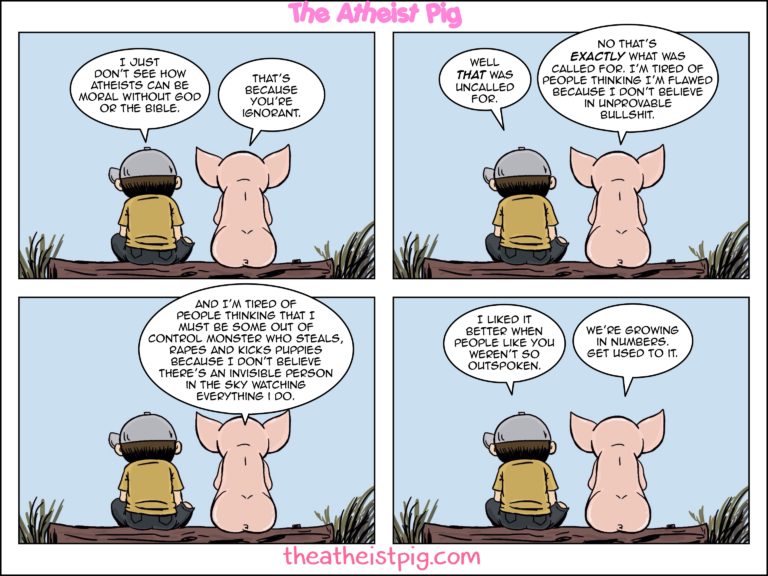
Atheists pride themselves in being people of reason. They think of themselves as superior to the religious, untainted by delusion. Is this really true?

By and large, most atheists are decent people who just want to live their life without being bothered and harassed by  Christians. They want the United States to live up to its secular ideals and keep Fundamentalist Christianity from infiltrating the schools and  government policy. These kind of atheists take a live and let live approach to life and other people.

There’s another type of atheist that unfortunately has become the stereotype for religious people when they think of atheism. This is the Fundamentalist atheist.

My friend Geds left an insightful comment on a previous post. He wrote:

…The first and last atheist book I read was Hitchens’ god is not Great. I found it awful, shallow, and judgmental. I’ve been fighting his stupid “religion poisons everything” formulation ever since, especially because a certain stripe of fundamentalist atheist (which is totally possible, might I add, any belief can have fundamentalists) seems to think that it’s the answer to any and every positive statement about religion and the religious. It’s just begging the question, though. Define “religion” as “superstition,” define “superstition” as an impediment to all things good and positive, and then define “poisons” as “introducing the possibility of rejecting appropriate thinking in favor of superstition” and you’ve got yourself a begged question.

I followed PZ Myers’ blog for a long time and was totally anti-accomodationist for a bit. In the back of my mind it never sat well, though. I remembered all the fights about the right way to be a Christian and who was or wasn’t in the tribe and I knew that it was exhausting and pointless. I also didn’t think of “Christians.” If someone mentioned Christianity in conjunction with a behavior I could usually think of several people I knew who represented that behavior or belief. I also realized that my decision to leave Christianity didn’t come because I was argued out of it. I had friends who weren’t Christians and knowing that I wouldn’t be alone if I left Christianity helped immensely.

The mistake that the confrontational atheist types make is exactly the same mistake that the confrontational Evangelists make. They imagine that there’s a Platonic ideal of a Christian out there who strives to live up to all their negative stereotypes: hates gays, stockpiles guns, blows up abortion clinics, etc. Then they say that since that Christian could exist that means that all Christians are like or want to be like or will inevitably become like that Christian, so it’s totally okay to hate on and argue with every Christian they meet.

But it doesn’t work that way. And, as Nietzsche said, if you spend too much time fighting the monster you become the monster. So they become that atheist Bryan Fischer or Pat Robertson or Fred Phelps and whenever someone tries to tell them they’re doing it wrong they say, “No, that”s impossible, I can’t be like that guy because he’s wrong and I’m right.” It’s annoying and it’s stupid, but it’s also incredibly human.

I couldn’t have said it better myself.

For those of us who came from Evangelicalism, we are quite sensitive to Fundamentalist thinking wherever it might be found. Personally, I think Fundamentalist thinking lies at the root of MOST of the problems we face in the world today.

A Fundamentalist is unable to see a person as a real flesh and blood human being. They see them as either being for or opposed to their ideology. They see them as a statistic, a demographic. They see them as part of a collective whole and not as an individual.

Look at what is going on in Washington now. Fundamentalist Tea Party members have successfully brought the U.S. government to a halt. A 4 million member club, the NRA, has successfully stopped background check legislation that 90% of Americans, and most NRA members, support. This is what Fundamentalist thinking does…it stifles debate, discussion, and working for the common good.

Our common humanity demands that we see each other as we are. Yes, I am an atheist, an agnostic, a humanist, a liberal, at times a socialist, and at times a libertarian. I am ALL these things and more, but these are only the labels I wear.  They are not the sum of who I am.

Part of the problem is the internet.  People read blogs and they think that they “know” a person by reading their writing. They think they “know” all about me. In fact, several Christians have told me that they know me better than I know myself.

When we read a person’s blog or book, we are only catching a glimpse of who and what they are. We only get to read what they decide to share with readers. I don’t know of one writer who shares every intimate detail of their life. For those of us who write about  our past, we know that our memories are selective and may even be wrong at times.  The story we present to the reading public about our past is the past as we “remember” it. (I have caught myself more than once writing something about the past that I later had to correct)

what_is_your_name

Many Christians want to divide the world into two neat categories: Christian and non-Christian.  Either you worship the Christian God, who is the true and living God, or you don’t.

Some atheists do the same. They divide the world into two groups: Religious and atheist.  Either a person believes in a God or they don’t. End of story…

Both of these  views lack nuance. Christians and atheists who think like this have tunnel vision and are unable to see degrees or shades. Their thinking is black and white. Both are guilty of Fundamentalist thinking.

Over the past six years, through this blog, I have met countless Christians who I admire and respect.  Yes, their beliefs are antithetical to mine, yet they are decent people who I know I would love to be friends with in the “real” world.

I have to be careful that I do not let the nasty, hateful Christians that frequent this blog and attack me in the local newspaper keep me from seeing the good in religion and those who practice it.

Christians need to do the same. Not all atheists are the same. Yes, there are nasty, hateful, mean-spirited atheists. (and don’t bother telling me I am tone trolling) They love attacking the religious, ridiculing them for their stone-age beliefs.

When I began questioning my faith, I wrote a post that was cross posted on exchristian.net.  I thought that on a site called exchristian, that my story would be embraced and understood.  Boy, was I wrong. The Fundamentalist atheists eviscerated me for not being as atheistic as them. They attacked the words I used and even went so far as to suggest I was still a Christian.

Their treatment of me caused me to run in full-scale retreat from atheism/agnosticism. I thought, these guys are just like a bunch of Independent Fundamentalist Baptist preachers. Even the moderator of exchristian thought their treatment was excessive and my post was removed. (he was, by the way, very kind to me)

A few years ago, my friend Jim Schoch and I drove to Fort Wayne to hear Robert Price speak. After his lecture, a young man stood up and challenged Price’s comment about the “good” religion has done in the world. This young man refused to allow that Christianity had done one good thing in 2,000 years. He badgered and berated Price to the point where a flustered Price gave him a quick answer and moved on.

Now, I am not suggesting that we never need vocal atheist Evangelists to use their rhetoric to spur the faithful on. I recognize the value of the people like Richard Dawkins, Christopher Hitchens, PZ Myers, and company. However, I also know that the real work of advancing the humanist cause will be done by people who patiently engage the religious, treating them with decency and respect.

Confrontationalism has its place, but it is not the approach that will elicit the greatest gain. It may make us feel good to put the religious zealot in their place, but what have we really gained? I know it feels good to get in shit-throwing contests with Christians on Facebook and Twitter, but, ask yourself, what have you really accomplished?

Now, many atheists don’t care what others think about atheism in general. They take the, fuck them, approach. While I certainly understand this sentiment, I must always remind myself of what my real objective is….to advance the humanist ideal.

We must find ways to productively work with the religious to bring about a more just society.  This requires both sides to accept each other at face value. Take the issue of abortion. One side takes a life begins at fertilization position and the other side takes an unrestricted right to abortion position.  Neither side is willing to work with the other to actually reduce the number of abortions. Far too often, this is the same thing that happens when atheists and Christians battle one another. Neither side can see the value of what the other believes.

I realize that hard-core, dare I say, Fundamentalist atheists despise my accommodationist approach. They think of me as a compromiser, a facilitator of superstition. They see me as a coddler of the religious, a person who is hindering progress.

They are certainly entitled to think what they will about me. I can’t control how people view me and the things I write. All I can do is stay true to my objective:

  • To help those who are considering leaving  Christianity
  • To help those who have already left Christianity
  • To promote and advance the humanist ideal

If these are my objectives, then I know being an in-your-face confrontationalist is not the approach I should take with the religious. That does not mean, however, that I should not be pointed and direct in what I write or in the discussions I have with Christians. Frankness should not be confused for confrontationalism. Directness should not be viewed as an attack.

When beliefs are brought to the public square they should be discussed, challenged, critiqued, and debated. If a person is unwilling to have their beliefs challenged or questioned, then they need to stay out of the public square.

Let me end with this. There is a time and place for ridicule. When people like Sarah Palin, Bryan Fischer, Sean Hannity, David Barton, and Ken Ham attempt to spread utter foolishness, they deserve to be laughed at and ridiculed. But, remember these talking-heads don’t speak for every Christian. (as a Christian, it upset me when people assumed when Jerry Falwell said something, he was speaking for me)

And to my Christian readers let me say, when Richard Dawkins, Sam Harris, Daniel Dennett, John Loftus, Dan Barker, Jerry Dewitt…or GEDS or Bruce Gerencser, for that matter, speak or write, they do not represent all atheists.

As I have often said, I am one man with a story to tell. I do not represent any organization or group. I am not a spokesman for atheism. I am one man trying to flesh out on this blog what he thinks and believes. I hope that you can see beyond the words and see the man.  If you cannot  see the man behind the words then I have failed as a writer. If all you see is sterile words and beliefs and cannot  see my humanity, then I must do better.

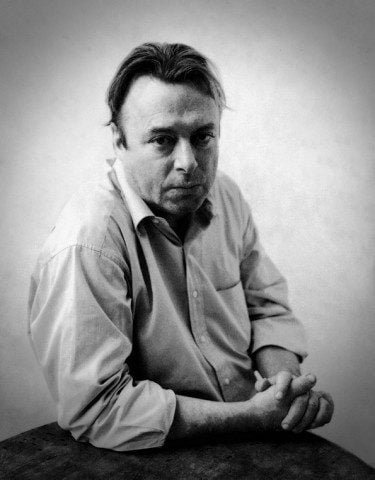
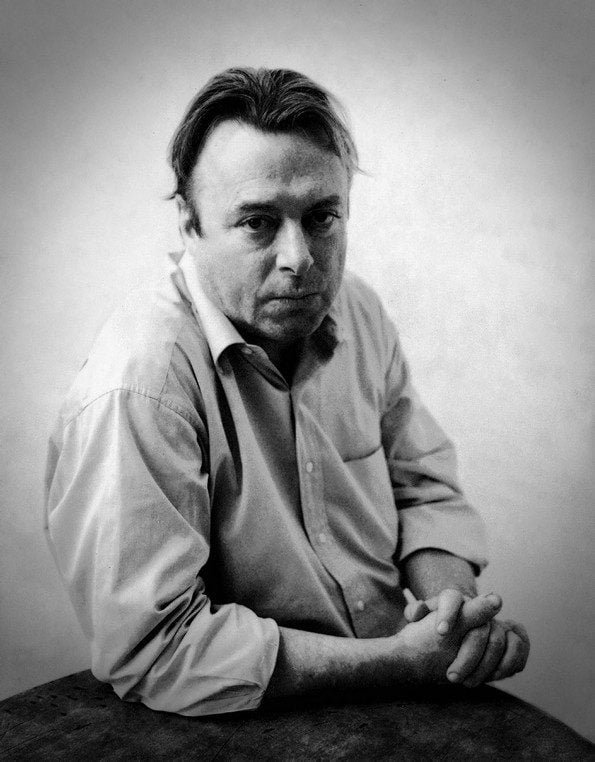
Christopher Hitchens is in Hell

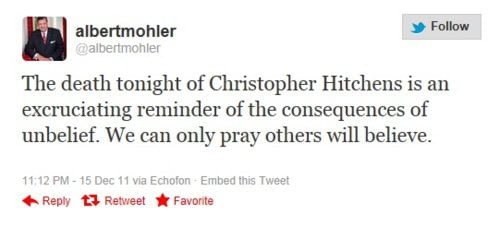
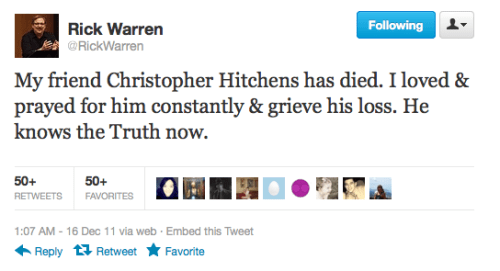
According to those who KNOW the mind of God and KNOW the names written in the Book of Life, Christopher Hitchens is in hell.

Al Mohler, fundamentalist president of Southern Baptist Theological Seminary had this to say:

Rick Warren, fundamentalist pastor of Saddleback Church had this to say:

Doug Wilson, fundamentalist pastor of Christ Church in Moscow, Idaho had this to say:

We have no indication that Christopher ever called on the Lord before he died, and if he did not, then Scriptures plainly teach that he is lost forever.

The Defending Contending blog takes the pious approach and says that Hitchens lived his life as a hater of God, but since no human can know the true spiritual state of any person, they can not say whether or not Hitchens is in hell. Chris Hohnholz writes:

The question that stands before us today of course, is where is Christopher Hitchens today. According to Mr. Hitchens, he simply ceased to exist, nothing more. But for the Christian, we know that we exist for eternity once this mortal body ceases functioning. There are only two possibilities as to where, Heaven or Hell. As Mr. Hitchens was created by God, and was bound to God’s laws, as we all are, he can only be in one of those two places. At first, it may seem quite easy to figure it out. He denied God, spoke vehemently against the Christian faith, and was often hateful and vitriolic in his speech regarding it. Considering that he made the statement there would be no deathbed conversion, it would be a simple thing to declare God sent him to hell. However, the truth is, we simply do not, and cannot know.

It is clear that Mr. Hitchens made a career of hating the very idea of God. But it is also clear that he was a common sinner just like the rest of us. He had a conscience, he was aware of right and wrong. He, like the rest of us, committed acts that were in violation of that conscience. We know that our consciences are God’s laws written upon our hearts. When we violate our conscience, we are violating God’s laws. Additionally, Mr. Hitchens debated with many Christians, he had heard the gospel presentation many times. There is little question that by the time of his death, Mr. Hitchens knew what God required of him. It is that time just prior to his death that we cannot know about. Is it at least possible, that as he faced those last moments, knowing death was coming that he considered those sins he committed, that he contemplated the gospel he had denied so many times, that he just might have repented and trusted Christ. If we are intellectually honest, we must say that it is possible. And since we cannot know, we hope that is what happened. We hope that we will find Mr. Hitchens in Heaven one day, for we do not wish the wrath of God on any man.

But we must also be honest say that he may not have repented. It is entirely possible that Mr. Hitchens held on to his rejection of God all the way into death. If so, Mr. Hitchens now stands before God in judgment for his sins. And not just for his atheism. As said before, our consciences are merely God’s law written on our hearts. When any man or woman breaks those laws, through lying, stealing, coveting, lusting, or blaspheming, they have sinned against a holy and righteous God. It is not just because he was an atheist that Mr. Hitchens may have stood condemned, it is because, as we all are, he was a sinner against the God who created him. And if that indeed is what occurred, even we Christians must mourn his death, for we do not wish Hell on any man. But we also rejoice that God is glorified, because His justice is perfect.

So what does that mean for the Christian? First, let us not run around proclaiming we know where Christopher Hitchens is, only God knows that. Let us share with people the truth, that if he repented and trusted Christ (which is our hope), he is in Heaven. But if he remained in his sins, he was condemned (as we all deserve). Let us not rejoice that another atheist voice is silent, that presents us as unkind and unloving. But let us not ignore that what he taught was blasphemous. As we engage in conversation with others on this, let us remember that, whatever Mr. Hitchens fate was, all of us face the same date with death.

This “sounds” nice but don’t be deceived…..I have heard these words many, many times……..They are words uttered by people who don’t want to look bad before the world so they refrain from saying in public what they proclaim every week in the pulpit.

There is NOTHING, I repeat NOTHING in the life of Christopher Hitchens that remotely suggests he is now with God and the angels. He is in hell and Hohnholz knows it! At least own the abominable doctrine you preach.

Bud, at Dead-Logic pretty well sums up my feelings on people like Mohler, Warren,Wilson and Hohnholz:

I feel even more sadness for those who are so blinded by religious prejudice that they see the death of Hitchens as an opportunity to peddle their religious wares. I’ve already expressed what I think about Albert Mohler’s recent comment on Twitter. Turns out that “purpose-driven” Rick Warren is just as classy as Mohler. Warren had his own douchebag moment on Twitter when he wrote: “Hitchens has died. I loved & prayed for him & grieve his loss. He knows the Truth now.” Yes, Rick, use a man’s death as a tool in your propaganda machine. If Warren truly “loved” Hitch, he would be honoring his memory instead of disgracing Hitchens for the sake of “the Truth” with a capital T.

How did Christopher Hitchens spend the final days of his life? Ian McEwan of the New York Times writes:

The place where Christopher Hitchens spent his last few weeks was hardly bookish, but he made it his own. Close to downtown Houston is the Medical Center, a cluster of high-rises like La Défense of Paris, or London’s City, a financial district of a sort, where the common currency is illness…..

….. While I was with him another celebration took place in far away London, with Stephen Fry as host in the Festival Hall to reflect on the life and times of Christopher Hitchens. We helped him out of bed and into a chair and set my laptop in front of him. Alexander delved into the Internet with special passwords to get us linked to the event. He also plugged in his own portable stereo speakers. We had the sound connection well before the vision and what we heard was astounding, and for Christopher, uplifting. It was the noise of 2,000 voices small-talking before the event. Then we had a view from the stage of the audience, packed into their rows.

They all looked so young. I would have guessed that nearly all of them would have opposed Christopher strongly over Iraq. But here they were, and in cinemas all over the country, turning out for him. Christopher grinned and raised a thin arm in salute. Close family and friends may be in the room with you, but dying is lonely, the confinement is total. He could see for himself that the life outside this small room had not forgotten him. For a moment, pace Larkin, it was by way of the Internet that the world stretched a hand toward him.

The next morning, at Christopher’s request, Alexander and I set up a desk for him under a window. We helped him and his pole with its feed-lines across the room, arranged pillows on his chair, adjusted the height of his laptop. Talking and dozing were all very well, but Christopher had only a few days to produce 3,000 words on Ian Ker’s biography of Chesterton.

Whenever people talk of Christopher’s journalism, I will always think of this moment.

Consider the mix. Constant pain, weak as a kitten, morphine dragging him down, then the tangle of Reformation theology and politics, Chesterton’s romantic, imagined England suffused with the kind of Catholicism that mediated his brush with fascism and his taste for paradox, which Christopher wanted to debunk. At intervals, Christopher’s head would droop, his eyes close, then with superhuman effort he would drag himself awake to type another line. His long memory served him well, for he didn’t have the usual books on hand for this kind of thing. When it’s available, read the review. His unworldly fluency never deserted him, his commitment was passionate, and he never deserted his trade. He was the consummate writer, the brilliant friend. In Walter Pater’s famous phrase, he burned “with this hard gem-like flame.” Right to the end. 

Christopher Hitchens will be missed. I always appreciated his sharp tongue and pointed critique of religion. He made the religious fuss, fume, and squirm as he attacked their beliefs and practices.

Some day I will die. I have thought a lot about this……While I am no Christopher Hitchens, I can only imagine how my demise will be played in the blogosphere and in the pulpit.

According to my critics when death comes hell awaits me. Good. If I have a choice between the Heaven of Mohler, Warren, Wilson and Hohnholz and the Hell of Hitchens……Give me Hitch and hell every time.

The world is richer because a man named Christopher Hitchens lived among us. While his body rots in the grave…….his words remain. May his words continue to inspire people to consider a life and world without the oppression of religion. There can be a better tomorrow without God.

The Divinity of Doubt by Vincent Bugliosi, A Book Review

This entry is part 3 of 12 in the seriesBook Reviews

divinity_of_doubt

The publisher, Vanguard Press,  sent me a  review copy of  Vincent Bugliosi’s latest book Divinity of Doubt, The God Question. Divinity of Doubt is 272 pages (338 pages with chapter notes and index) long and is Bugliosi’s attempt to establish agnosticism as the only valid choice in the God debate. Bugliosi neatly divides views about God into three categories: organized religion, agnosticism, and atheism.

Bugliosi spends significant time, in fact the entire book save 3 chapters, dismantling and shredding Christianity. He makes it clear that he does not believe the Christian God exists. He dismisses the rest of the major religions of the world in a chapter titled Hey ,Look at Us. We are Just as Silly as They Are. Bugliosi makes it clear that the world would be far better off if much of organized religion died a quick death.

Bugliosi’s critique of Christianity is standard atheistic fare. Long time atheists and agnostics will bore quickly when reading  Divinity of Doubt. I found myself saying yeah,, yeah , yeah I agree. Ok, next.  That said Bugliosi’s book is a great primer on the theological and textual issues the Christian church faces.  This would be a great book to give to someone who is considering leaving Christianity.

Bugliosi is rightly critical of those who believe in certainty but he himself often appeals to theological certainty when he writes about  what  bible scholars believe concerning this or that theological or historical issue.  He often makes it sound like bible scholars are unified when it comes to the textual and historical problems of the Christian bible, when, in fact, unity is a word rarely used to describe bible scholarship. Proof? Consult the true God of this world Google and you will quickly find out that virtually every aspect of the Christian religion is endlessly debated. Christians can’t even agree on basic things like God, communion, baptism, or how a person becomes a Christian.

I was astounded that Bugliosi did not mention Bart Ehrman one time. (I did not read the chapter notes so there is a small possibility Ehrman makes an honorary appearance there) Ehrman is clearly the most popular and most read theologian of the 21st century. His books are a devastating critique of Christianity and Bugliosi not mentioning Ehrman’s books is troubling. (not that Ehrman would have necessarily added anything to the book. Bugliosi comes to many of the same conclusions as Ehrman.)  In passing I  should note that Bugliosi incorrectly states that William Lane Craig is a Catholic apologist. Craig is actually an Evangelical Christian apologist. .

Bugliosi spends several chapters on the subject of evolution, creationism, and intelligent design. He admits he is not a scientist but this does not keep Bugliosi from diving right in anyway.  Bugliosi writes:

But apart from science, I have problems with the Big Bang theory. For one thing, I simply cannot even begin to imagine how at some tiny point in time and space, some microorganism, or what have you, self exploded and created the universe, though I obviously am in no position to challenge this theory…But I do know that whatever they are, they are something, and that is the big problem. It would seem that no one can actually believe that the Big Bang exploded out of nothing, completely empty space, which would be an impossibility. It had to have exploded out of something. And no matter how small or subatomic that something is, the question is who put that something there? If it wasn’t the creator, and how did it come into existence? Remember, nothing can create itself because if it did, it would proceed itself, an impossibility.

Unlike Bugliosi, I confess not only am I quite deficient when it comes to matters of science, I also have no intentions of exposing my ignorance to those who are experts in science. I will leave it to my readers who are well-schooled in science to deal with Bugliosi’s claims. I will stick to  the Bible and theology.

In a chapter titled Atheism and Its Current Leading Prolocutors Bugliosi deals with the subject of atheism. Bugliosi  focuses only on  the writings of Richard Dawkins, Sam Harris, and Christopher Hitchens. For some unexplainable reason Bugliosi assumes that if he reads the books of  Big Three of the Atheist movement (he ignores Daniel Dennett)  he has adequately surveyed the necessary material to make a proper judgment concerning atheism.  As a result Bugliosi paints a truncated, incomplete picture of atheism. His book would carry far more weight with atheists IF he had broadened his horizons and referenced books written by atheists, agnostics, humanists, and skeptics who offer a different viewpoint than Harris/Hitchens/Dawkins.

Bugliosi hates the certainty he sees in the writings of Harris/Dawkins/Hitchens. Bugliosi wrongly assumes that these thee authors are the face of atheism and that their beliefs are the beliefs of all atheists. Bugliosi rightly contends that no one can know for certain whether or not there is a God yet he discounts atheists who say just that. Dawkins admits that a person can not with certainly know whether or not a God exists. Dawkins states “God almost certainly does not exist” and Bugliosi takes this to be a disingenuous statement. Why?

Atheism is all about probabilities. Does God exist? I don’t know. Is it probable God exists? No. Is it likely God exists? No. Does the Christian God, as taught in the Bible, exist? No.  Rare is the atheist who says with certainty that no God exists. In fact Bugliosi proves in his book that he is every bit as much an atheist as most of the atheists I know. Bugliosi would have been better informed about atheism if he would have, at a bare minimum read the WIKI on atheism.

In the future, I hope Bugliosi will broaden his horizons when it comes to atheism.I have profited greatly from  the books of Richard Dawkins, Sam Harris, and Christopher Hitchens. That said,   there are many other authors like Michael Shermer, Richard Carrier, Hector Avalos, David Eller, S.T. Joshi, A.C. Grayling, Paul Kurtz, Bart Ehrman, and Scott Aiken/Robert Talisse who have written significant books about atheism and humanism that I have found quite helpful, books, it seems, that Bugliosi paid no attention to. Bugliosi also fails to mention the books by John Loftus, Why I Became an Atheist and The Christian Delusion, two books that are very helpful in laying the foundation of modern atheism.

If you are a confirmed atheist or agnostic Divinity of Doubt will not plow any new ground for you and it certainly does a poor job at surveying the current, popular atheist scene. The book is bombastic at times and the biggest defect in the book is how Vincent Bugliosi views himself.

Bugliosi says this about himself:

I seem to naturally—and not as a result, I can assure you , of any special intelligence at all—see what’s in front of me completely uninfluenced by the trappings of reputation, hoopla, conventional wisdom, and so on, put on it by others.

I suspect some readers of Divinity of Doubt will not be able to get beyond Bugliosi’s naïve view of himself. As I read what Bugliosi said about himself I found myself wanting to toss the book in the corner where I store all the books I have read by authors filled with self-importance.(Granted my sensitivity to this stems from a lifetime in a religious movement dominated by arrogant, self important preachers) I didn’t toss the book and I am glad I didn’t.  I had to remind myself that sometimes you have to get beyond the messenger and listen to the message. Forget Bugliosi’s character flaws. Is what he preaches the truth? The answer is Yes, especially when dealing with Christianity.

I  heartily  recommend Divinity of Doubt, especially for people who considering leaving the Christian faith. The book should be helpful to Christians who are questioning the tenets of the Christian faith. Divinity of Doubt answers many of the questions pastor’s hope their members never ask.

I close this review with Bugliosi’s own words concerning religion:

I can say with relative confidence (because what I’m saying, at least it would seem, has to be true) that there is only one necessary religion that has any merit to the people who inhabit this earth, and that’s the Golden Rule: “Do unto others what you would want them to do unto you” (from the Beatitudes of the Sermon on the Mount [Matthew 7:12]). To treat others as you would want them to treat you is the highest, most noble form of human behavior and the basis of all morality. No matter what some papal encyclical says; no matter what some bishops’ conference says; no matter how many sacraments of the Catholic church there are, or chapters and verses in the bible, or thick and complex books by theologians, or Sunday school classes and sermons by pastors; no matter how many heated arguments there are about God, Jesus, and religion; no matter how many pilgrimages there are to Mecca, Jerusalem, and other holy places; no matter how many thousands of hours Jewish scholars struggle over the meaning of the Torah; no matter how many multimillion-dollar churches and synagogues and grand cathedrals to Christ are constructed, nothing can ever change that simple reality…..

If we must have religion, the seminal test as to the value and merit of any religion worth its salt has to be not what you believe, but what you do—that is, how you treat your fellow man. Yet in the thousands upon thousands of books, and billions upon billions of words that have been written, particularly about Christianity and the bible, what percentage of these books do you think are devoted to the only thing that counts—the Golden Rule?

To these words this atheist says Amen.

Search for other books written by Vincent Bugliosi

Pastor Adkins and THE Agnostic

This entry is part 1 of 22 in the seriesLetters to the Editor

The Sunday edition of the Defiance Crescent-News has the first, of what I am sure will be many more, letters to the Editor concerning my recently published rebuttal letter.

My youngest son asked me today if anyone has ever written a letter to the editor in support of my views about religion. I laughed and said No. As far as I know, I am the only person who has  written to the newspaper and said “I am an agnostic.” (Some days I wonder, “what was I thinking”?) I hope my willingness to stand up and be counted will encourage others to do so. I know I am not alone. I have received their letters and email. They fear what might happen to them socially or economically if their agnosticism or atheism were made public. Their fears are well-grounded and I would not encourage anyone to take the same path as I have.

My children have to live with the fact that their dad is “the man who writes in the newspaper”. They have to field questions like “are you related to Bruce Gerencser”? If they answer yes, what often follows is a queer look, a look that says I want to tell you what I think or I want to ask you a question or two. Usually, once my children affirm their connection to me a nervous silence ensues,. It’s like, the questioner, all of a sudden, finds out he has been working along side a spawn of Satan.

The first letter to the editor response I want to deal with is written by none other than Rev. Ron Adkins, pastor of the Ney and Farmer United Methodist Churches. I know Ron personally. Our family attended the Ney Church for a number of months and it was the last Church we ever attended. One might say our last experience proved to be the proverbial straw that broke the camel’s back. (though we met many wonderful people in the Church)

Ron is a young man. This is his first pastorate. Prior to this he was a professor at Ohio Christian University. Ohio Christian University is a fundamentalist institution affiliated with the Churches of Christ in Christian Union. (I am sure Ron will chafe at the fundamentalist label but he also knows what my response is to that)

Ron has pastored the Ney/Farmer Churches for about 2 years. When I asked him what his philosophy of ministry was he told me it was “loving on people”. Evidently, as you shall see from his letter, that doesn’t include me. Some of what Ron writes in his letter reflects personal, private discussions he and  I had during the time we attended the Ney Church. One could object saying “I told you that in private” but one thing I know about preachers, “don’t tell them anything you don’t want others to know.” (I take privacy far more seriously NOW than I did when I was a pastor)

From reading Ron’s letter to the editor it is safe to assume that my rebuttal letter upset some people in his Church. Here I am, almost two years removed from attending Church, and I am still causing trouble. I realize my letter put Ron in a no-win situation. He is a great guy and he doesn’t like conflict. He has a wonderful wife and great kids. The last thing he needs is to tangle with Bruce. But, my heresy demands an answer, so Ron penned typed a reply to my letter.

As you shall see in a moment, Ron tries to avoid making this personal. He never calls me by name. Instead he calls me THE agnostic. Since the is a definite article and I am the only agnostic that has written to the paper, it is safe to assume that THE agnostic=Bruce Gerencser.

Now to Pastor Adkin’s letter. Ron’s letter appears as normal type. My response appears as bold italics.

To the Editor:

I have been averse to reading the latest letter to the editor from the agnostic because I personally find agnosticism trite for two major reasons.

Let’s get one thing out of the way right away. Ron is writing about my letter, and since I am the only agnostic who has written to the newspaper, he is directing his response to me and what I have written. Of course, his greater objective is to cheer on the faithful.

My response is personal. I guess I could hide my response target by saying I am responding to THE pastor, but, I am not one known for such subterfuge so I want to make it clear that my response is directed to Pastor Adkins and his letter to the editor. I do hope that the faithful will be challenged and forced to ask hard questions about Christianity, the Bible, and their certainty that what they say they believe is the truth is really the truth. I also hope my fellow atheists and agnostics will be encouraged to continue on the path of intellectual freedom.

I am amused somewhat that Ron considers agnosticism trite, yet he expends quite a bit of verbiage in his attack of the agnostic view. Perhaps it was not as trite as he thought is was.

First, agnosticism is predicated on the premise of skepticism concerning the existence of God. The agnostic doubts the absolute truth about God (although some may believe in a First Cause), yet states an absolute truth by claiming God does not exist and that the answer is a humanistic worldview. If consistent, the agnostic would doubt his own statements, and furthermore, would doubt his own doubt that God does not exist, thus resulting in the probability that God could exist.

I don’t believe I have ever said God does not exist.  I am, after all, an agnostic. In fact, Ron might be surprised to know that I have quite a bit of room in my agnostic worldview for a god (or gods). (much to the consternation of some hard-core atheists) I am fairly certain that the gods that man has created so far are not gods at all. I can not state categorically or infallibly (I’ll leave that to the Pope) there is NO God. Even Christopher Hitchens does not say There is No God.

The best answer,the best philosophy of living, in my humble opinion, is humanism. With humanism the focus is on reality, the here and now. Surely, Ron, the history major that he is, knows that many humanists have a spiritual or religious dimension to their beliefs. But, the humanist always comes back to what they can see. The humanist does not have time to spend on pining about a future in heaven, the rapture, and the many other events in the eternal future that preoccupy and keep Christians from engaging a suffering, hurting, and dying world.

What is humanism? The best statement I have found comes from the Humanist magazine. “Humanism is a rational philosophy informed by science, inspired by art, and motivated by compassion. Affirming the dignity of each human being, it supports liberty and opportunity consonant with social and planetary responsibility. Free of theism and other supernatural beliefs, humanism thus derives the goals of life from human need and interest rather than from theological or ideological abstractions, and asserts that humanity must take responsibility for its own destiny.”

Christians often prop up the straw man of absolute truth. Everyone believes in absolute truth, they claim.  Evidently Ron needs to meet a few real agnostics and atheists before he claims such a thing.

Personally, there are many things I believe to be truth or factual. Based on what knowledge and information I have at hand I have concluded that certain things are factual and true. I know that the earth revolves around the sun and that the earth is not flat. I am relatively certain the science behind these claims is true. If I was left with only the absolute truth of the Bible I would have to ignore what science teaches and I would be forced to accept that the sun revolves around the earth and the earth is flat. (among countless other incredible, yet false claims found in the Bible)

Ron writes of the absolute truth of God, and by God, lets be clear, Ron means the Christian God. Where does one find this absolute truth? The Bible? Ah, finally a concrete piece of information we can weigh in the balances. And that is exactly what I have done. I have weighed the claims of the Bible in the balances and found it wanting.

I find the claims made by academics like Bart Ehrman and Robert Price to be compelling. I find Richard Wright’s book The Evolution of God to be a fascinating  alternative story to the monotheism of orthodox Christianity.

My agnosticism rests squarely on the belief that the Bible is not what it claims to be and that it is not inspired, divine truth. At the end of the day it all boils down to the Bible. If I do not accept the claims of the Bible, or the claims of what Churches, denominations,popes or pastors say the Bible says, then I can not believe in the God that the Bible presents.  I may still believe in a god  but not the god of the Christian Bible.

Ron, I am sure, will appeal to nature and conscience as proof of God but I would counter  how can one necessarily conclude that the God who gave us nature and a conscience is necessarily the Christian God? Would a person not initiated in Christian thinking come to the conclusion, by looking at nature, that there is a God and that that God is the triune God of the Christian religion? Doubtful. In fact I can say impossible. Such a faith requires the Bible to give it structure.

Second, if then, the agnostic is not a true agnostic,because of the self-defeating premise, then there is another motivation behind his self-proclaimed agnosticism.

Answered above, so I assume this makes mute the next point Ron makes. But, Ron gets personal (divulging a bit of inside information about me) in what follows so I want to deal with it.

I have found that agnostics, who are not true agnostics,typically are angry at God because God does not operate the way they think God should operate. At other times they are angry because they have not received what they wanted from God. Like the undisciplined child who is angry at a parent using their only means of power, knowing they are powerless, will proclaim, “I hate you!” Nothing could hurt a parent more, and they know this.

The agnostic stands before God and proclaims in anger,‘”You don’t exist!” Isn’t it interesting then that humans, created beings, desire God to act the way they perceive God should act? Furthermore, I find it pathetic to claim a humanistic worldview in which there is nothing, or no one, greater than ourselves to rely.

Anger. Ron, is right about my anger but he is wrong about the focus of my anger.

The Christian God, the God of Ron Adkins does not exist. Why would I be angry at a fictional being?

No, my anger is directed towards organized religion.  My anger is directed at Evangelical Christianity. I am angry over what was taken from me over the 25 years I spent in the ministry.  I am angry over the wasted time and effort spent “doing  Church”. I am angry over my own selfish ambitions and my attempts at building a kingdom in my own name. (as all pastors do, after all why is their name on the Church sign?)

I am angry over what the ministry and the Church did to my wonderful wife and children. I am angry over countless parishioners whose lives are now shipwrecked because they drank from the well of organized religion.

Yes, I am angry and it feels good. For 33 years I lived in denial of my emotions, serving a God who was no god at all, a god that demanded self-sacrifice and self-denial. It feels good to be out from under such a burdensome weight.

Ron may consider humanism pathetic, and I might be tempted to say back at ya, but what humanism provides for me is reality. It is rooted in the common humanity we all share. I no longer have need to pray, fast, tithe, and attend. What humanism demands of me is doing, It demands of me the very things Jesus spoke of in the Sermon on the Mount. Humanism calls me to be fully human, in an imperfect, marred world. It calls me to use what talents I have for the betterment of my fellow man.

Becoming an agnostic and a humanist has forced me to admit that most of the supposed altruistic works I did as a pastor had an ulterior motive. I didn’t love people  for who they were. I loved them because I wanted Jesus to change them . If Jesus changed them then they would become a part of the Church I pastored . End result? Bigger attendance and bigger offerings. (Trying to get a pastor to admit this is nigh impossible.)

It is an exhilarating experience to truly love people as they are.

Last, I would like to briefly answer the question which became the title for the agnostic’s editorial, “Writers espoused different views.”

I am glad of one thing……..Ron used the word last. I despise the use of the word lastly. Ron gets 1 brownie point for using last instead of lastly.

I hope Ron is aware that the newspaper determines what the letter title is. I have been writing letters to the editor, op-ed pieces, etc for over 28 years and I have yet been allowed to write my own title.

First, let me give some advice to all of those wonderful Christians who have been troubled by the agnostic.Remember an agnostic on] asks questions based on skepticism. Don’t feel as though you are in a corner. The quote at hand read, “Every letter writer has their own version of God and what constitutes a right, saving relationship with that God. This shows me that there is no such thing as Christianity (singular) in America”.

Truth is an objective fact expressed in a subjective way. It is obvious that one comes to the truth of Christianity or more generally religious truth, differently than one would come to scientific truth. God is not an object to be observed. God has made himself known. Faith, therefore, is a response in obedience, the thing agnostics hate.

I find Ron’s statement here astounding. Ron writes “Truth is an objective fact expressed in a subjective way”. Ron certainly believes the Bible to be absolute truth.  I would love to  know if he really, really, believes the Bible is absolute truth. (I have my doubts) Ron, without any evidence, believes that what the Bible teaches is objective fact.

How does one know this? By a subjective experience with God. God has made himself known. How do we know that? Because the Christian says so. Because Ron says so. Ultimately, it is a matter of faith.

If it is a matter of faith why  do so many Christians try and prove the truth of Christianity? Why do they attempt to use scientific methods to prove the veracity of the claims the Bible makes?

If it is a matter of faith then why write letters to the editor attempting to discredit and refute my rebuttal letter? Would it not be better to rest in the belief that the God of faith, through the holy Spirit will take care of things? Surely God can take care of one lowly, insignificant, pimple on the ass, agnostic named Bruce?

Ron might be surprised to know that I still have faith. I have faith in the gods I can see, my fellow human beings. In my Christian days I put my faith in a God who I said was always there, but quite honestly I never really could find him. God was all-knowing and all powerful. He was supposedly intimately involved in the minutia of my life, yet when it came to things that mattered, matters of life and death, God was nowhere to be found.

I would assume that Ron considers his weekly sermons to be subjective? After all he is preaching absolute truth in a subjective manner, yes? I don’t know of any preacher that would embrace such a claim, especially  Evangelical preachers. After all, the preacher is the man of God who speaks the word of God to the people of God. Not much subjectivity  here.

I find no conflict in the different responses to the agnostic because the different individuals have expressed their belief and experience (“Pascal’s Wager”) in the one, absolute God in different ways. Faith in Jesus Christ as the Son of God and the Savior of the world is truth and is experienced by individuals.

Ron is being disingenuous here OR his two years in the Methodist Church has worn down his Evangelical resolve. I realize he is preaching to the choir here but any cursory reading of the letters written in reply to either of my recent letters will reveal full-blown heresy. Is Ron suggesting that subjective heresy is fine as long as it is done with the right intention? If so, it is time to give all the heretics of the past a place at the orthodox table once again. Each of them had sincere intentions. They loved their version of Jesus. Welcome Brother Pelagius!

It is clear for all  who are willing to see……….no two Christians have the same version of Christianity. Christianity  for most Christians is akin to going to a buffet, taking what you want and leaving the rest. I don’t have a problem with this approach but I would, at least, like Christians to admit it. They speak of orthodoxy and common belief, but such singularity does not exist except in  denominational or Church confessions or theological texts. Real world experience tells me that every Christian believes what they want to believe and ignores the rest. (any righteous men out there that want to offer their virgin daughter to the men of the city as righteous Lot did?)

This is why all Christians can describe some kind of personal experience, or relationship, with God through the Holy Spirit. Christian faith is an assent and obedience to the revelation of God.

On  this point  I  agree with Ron. It is all about the revelation of God. In other words it is ALL about the Bible. As I have said time and time again there is no Christianity without the Bible. I am an agnostic because I reject the truth claims of the Bible. I reject its claim that it is a supernatural, divine book that reveals God to humankind. It is  a spiritual book written by men thousands of years ago.  Certainly the Bible has much to offer in way of personal spiritual guidance, but it is just a  book and it has no authority in my life. It has as much authority, and is just as inspired, as the writings of Mark Twain. (And no Christian can prove other wise because the doctrine of inspiration is presupposed and can not be empirically proved.)

Ron knew I was heading down the slippery slope towards agnosticism. Surely he can recall our discussions about the Bible. He, at one time, read my blog. Yet, when I stopped attending his Church that ended our interaction. Evidently time was better spent rescuing those who wanted rescued.

Yet, one would think that over the course of two years, in a town of 325 people, Ron or someone from the Church would have stopped by and looked in on us. As I have struggled with debilitating neurological problems, problems Ron was well aware of, one would think that a visit might be in order. How can we help? Is there anything you need? One never knows what love and kindness might accomplish.

As is always the case……….why spend time helping people who have no intentions of joining the happy band. If their ass is not in the seat why bother?

This is my subjective experience of the objective truth called the Church.

There are six Churches within a few miles of the home where my family and I reside. Prior to my recent coming out as an agnostic our family would have been a great catch for any Church. We are clean-cut, clean-livers. We look like Christians. We are talented. We have skills that any Church would be grateful to use. We are loyal, faithful people. We are loving and kind. We are great non-Christian Christians.

But, not one pastor, one Church leader, one Church member, ever knocked on our door to invite us to their Church. Even after we visited four of the six Churches, no one bothered to try and befriend us and love us as Jesus would.

No the truth is……..no one gave a shit.

And then one day………neither did we.

Ron Adkins
Ney

Bruce Gerencser
Ney