I spent the first fifty years of my life in the Evangelical church. I was taught and later preached as a pastor young earth creationism. Parents, preachers, Sunday school teachers, and Bible college professors taught me the universe was 6,000 years old, created out of nothing by the triune God of the Bible in six literal 24 hour days. Most importantly, I was taught that the earth and its human inhabitants are the pinnacle of God’s creative work. In other words, we are s-p-e-c-i-a-l. Not the other animals on earth, just us. Further, I was taught that we humans had dominion and control of the earth.God is the owner of the earth and we are its caretakers.
Sadly tens of millions of Americans believe the creation myths — yes, plural — recorded in Genesis 1-3. The blame for this rests solely on the shoulders on Evangelicals. and now, through subversive programs such as Lifewise Academy, public school students are being taught young earth creationism, including trips to the Creation Museum and the Ark Encounter — Ken Ham’s monuments of ignorance.
After I deconverted in 2008, it became clear to me that I didn’t know much of anything about science. My entire understanding of science was based on what I learned in high school biology and a college biology class without a lab or a qualified teacher. As a pastor, I believed that only science book I needed was the King James Bible. This led to me saying all sorts of absurd things about science — embarrassingly so. Fortunately, my congregant were as ignorant as I was about science, so we all shouted AMEN together when I mentioned the creative acts of God.
I have spent the last twenty years educating myself not only about science, but also about logic and philosophy. Over time, reason, skepticism, and common sense delivered me from some of my ignorance, but I will admit that I still have a lot to learn.
Science has taught me that the Evangelical worldview is false. The earth and its human dwellers are not the center of universe, nor are they unique. Special, we are not. We are itty-bitty people with itty-bitty brains on an itty-bitty planet in a vast, mostly unexplored universe. In other words, we are a planet of nobodies; people who will live and die, never to be remembered again. A harsh reality, to be sure — and why so many stay irrationally attached to religious faith — but knowing and understanding this can and does help us focus on the here and now. No Heaven. No Hell. No Purgatory. No afterlife. No second chances. This is it. What will we do with this life of ours? I, for one, want to live every day to its fullest. I suspect you do too. When I look at Voyager One’s pale blue dot, I am reminded of how lucky I am to be alive in this corner of the Milky Way.
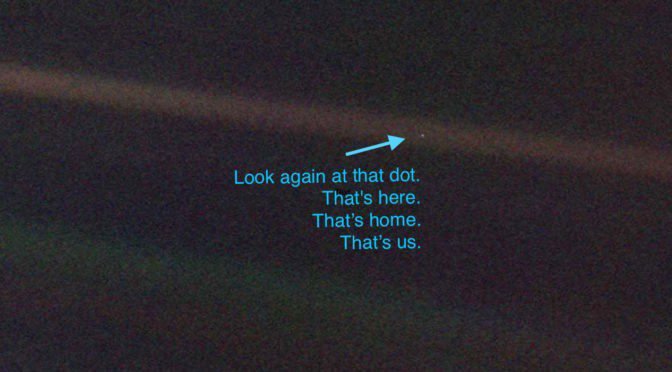
Dr. Carl Sagan said at the time,
“Look again at that dot. That’s here. That’s home. That’s us. On it everyone you love, everyone you know, everyone you ever heard of, every human being who ever was, lived out their lives… Our posturings, our imagined self-importance, the delusion that we have some privileged position in the Universe, are challenged by this point of pale light. (Google)
I continue to be amazed as I observe the skies and biological world. What a wonderful, yet dangerous, world we live in. Beautiful, to be sure, but the universe will kill us if we aren’t careful. And even it we are careful, the universe will someday likely kill off the human race. Death and extinction await, not Heaven and the sweet-by-and-by. Again, a somber thought, but also a reminder that we only have one life and it will soon be past.
Bruce Gerencser, 69, lives in rural Northwest Ohio with his wife of 48 years. He and his wife have six grown children and thirteen grandchildren. Bruce pastored Evangelical churches for twenty-five years in Ohio, Texas, and Michigan. Bruce left the ministry in 2005, and in 2008 he left Christianity. Bruce is now a humanist and an atheist.
Your comments are welcome and appreciated. All first-time comments are moderated. Please read the commenting rules before commenting.
You can email Bruce via the Contact Form.