Welcome

  • Bruce, Were You Happy in the Ministry? — Part One

    bruce and polly gerencser 1978
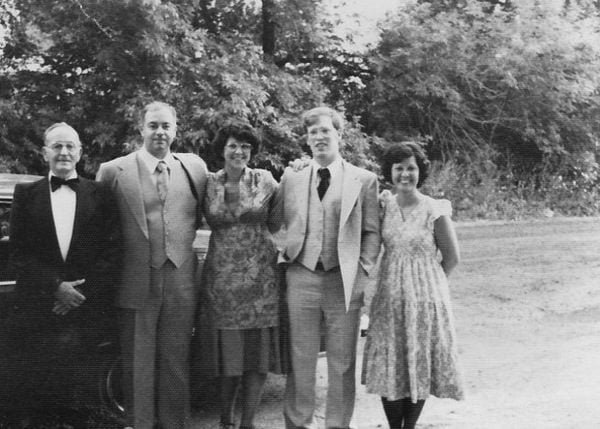
    Bruce and Polly Gerencser, in front of our first apartment in Pontiac, Michigan, Fall 1978, with Polly’s grandfather and parents.

    When I write posts like Leaving the Ministry: Dealing with Guilt and Regret, I am always concerned that someone might conclude that I was unhappy while I was in the ministry or that I felt I was trapped in a job I didn’t want to be in. Neither of these conclusions would be an accurate assessment of the twenty-five years I spent in the ministry.

    I was fifteen years old when I went forward at Trinity Baptist Church, Findlay, Ohio, and informed the church that I thought God was calling me to the ministry. A few weeks before, I had made a public profession of faith and was baptized. I had no doubts about God’s call on my life. In fact, my desire to be a preacher went all the way back to when I was a five-year-old boy in San Diego, California. My mother asked me what I wanted to be when I grew up. I told her I wanted to be a preacher. Not a baseball player, not a trash truck driver, or a fireman. I wanted to be a preacher. Unlike many people, I never wondered about what I wanted to do with my life. God called-preacher, end of story.

    In the fall of 1976, I enrolled at Midwestern Baptist College, a small Fundamentalist college in Pontiac, Michigan. Polly Shope, my wife to be, started taking classes at Midwestern in the spring of 1976 while she was finishing her senior year at Oakland Christian School. At the age of fourteen, Polly went forward at the Kawkawlin River Baptist Church, Bay City, Michigan, and let the church know that she believed God was calling her to be a preacher’s wife. When Polly enrolled at Midwestern, she had one goal in mind: to marry a preacher.

    polly gerencser, pontiac, michigan 1978
    Polly in front of our apartment, Fall 1978

    Polly and I were immediately drawn to one another. She was quiet, reserved, and very beautiful. I was outspoken, brash, with a rebellious spirit. According to Polly, I was her bad boy. We started dating in September of 1976, and by Christmas, we were certain that we were a match made in Heaven. Unfortunately, Polly’s parents thought we were a match made in Hell. My parents were divorced, and Polly’s mom thought that divorce was hereditary. Though she did her best to quash our love, in the spring of 1978, we issued an ultimatum: give us your blessing or we will get married without it (a few weeks earlier, we had seriously considered eloping). On a hot July day in 1978, Polly and I exchanged vows at the Newark Baptist Temple, Heath, Ohio. As Mark Bullock, the soloist for our wedding, sang the Carpenter’s hit, We’ve Only Just Begun, Polly and I had thoughts of the wonderful life that awaited us in the ministry. Little did we know how naïve we were about what being in the ministry really entailed.

    Polly’s idea of the ministry was quite idealistic. In her mind, we would have two children, a boy named Jason and a girl named Bethany, and live in a beautiful two-story house with a white picket fence. She saw herself as the quiet helpmeet of her preacher husband.  My idea of the ministry was a bit more realistic. Preaching, teaching, winning souls, visiting the sick, all in a church filled with peace, joy, and harmony. No one had prepared us for what the ministry would really be like. I still remember a time when I was standing in a three-foot deep hole partly filled with sewage trying to repair a broken septic line. Polly came out to see what I was doing, and I said to her, Well, they certainly didn’t teach me this in college. No one told us that the ministry would be far different from our idealistic expectations.

    Two months after we were married, Polly informed me that our use of contraceptive foam had failed and she was pregnant. Not long after her announcement, I lost my job at a Detroit-area production machine shop. Financially, things quickly fell apart for us. We went to see Levy Corey, the dean at Midwestern, and told him that we needed to drop out of college. He told us we just needed to trust God and everything would work out. While I was able to find new employment, it was not enough for us to keep our heads above water. In February of 1979, we dropped all of our classes and prepared to move to Bryan, Ohio. Several of our friends stopped by before we moved to berate us for not having faith in God. One friend told us that we would never amount to anything because God doesn’t bless quitters. Years later, at a preacher’s conference hosted by Newark Baptist Temple, Dr. Tom Malone, the president of Midwestern, mentioned that I was in the crowd. He said that I had left Midwestern before graduating, but if I had stayed, they (the college) probably would have ruined me. He meant it as a joke, but I took his comment as a vindication of our decision to leave college.

    polly bruce gerencser cranbrook gardens bloomfield hills michigan 1978
    Polly and Bruce Gerencser, Cranbrook Gardens, Bloomfield Hills, Michigan, Spring 1978, two months before wedding.

    In February of 1979, we moved to Bryan, Ohio, the place of my birth and the home of my sister Robin. After living with my sister for a short while, we found a house to rent on Hamilton Street. I began working at ARO, a large local manufacturer of pumps and air tools. ARO paid well, but I still desired to be a pastor. As with every job, I viewed secular work as just a means to an end — me pastoring a church. My sister attended the Montpelier Baptist Church in Montpelier, Ohio. When we first moved to Bryan, we thought that we would attend First Baptist Church, the church I had attended before enrolling at Midwestern. Though I knew everyone at First Baptist, we decided to go to Montpelier Baptist, a young, growing GARBC church pastored by Jay Stuckey. This decision did not sit well with the people at First Baptist. One of the matriarchs of the church told me, “Bruce, you know you belong at First Baptist!”  At the time, First Baptist was pastored by Jack Bennett. Jack was married to my uncle’s sister Creta.

    I had previously preached at Montpelier Baptist, so I knew a bit about Stuckey and his ministry philosophy. Stuckey was a graduate of Toledo Bible College, which later moved to Newburgh, Indiana, and became Trinity Theological Seminary. After attending the church for a few weeks, Stuckey asked me to help him at the church by becoming the bus pastor and helping with church visitation.

    The church had one bus route. It brought in a handful of children every week, and little was being done to increase ridership numbers. Enter hot-shot, get–it-done, Bruce Gerencser. In less than a month, on Easter Sunday, the bus was jammed with eighty-eight riders. I vividly remember arriving at the church with all these kids and the junior church director running out to the bus and frantically asking me what I expected him to do with all the children. I replied, That’s your problem, I just bring them in. Needless to say, this man was never very fond of me.

    A short time later, the church bought a second bus. I recruited bus workers to run the new route, and before long, this bus was also filled with riders. On the first Sunday in October 1979, Montpelier Baptist held its morning service at the Williams County Fairgrounds. A quartet provided special music, and Ron English from the Sword of the Lord preached the sermon. Five hundred people attended this service, and about 150 of them had come in on the buses. Less than two weeks later, I was gone. Polly and I, along with our newborn son Jason, packed up our meager household goods and moved to Newark, Ohio.

    Bruce Gerencser, 69, lives in rural Northwest Ohio with his wife of 48 years. He and his wife have six grown children and thirteen grandchildren. Bruce pastored Evangelical churches for twenty-five years in Ohio, Texas, and Michigan. Bruce left the ministry in 2005, and in 2008 he left Christianity. Bruce is now a humanist and an atheist.

    Your comments are welcome and appreciated. All first-time comments are moderated. Please read the commenting rules before commenting.

    You can email Bruce via the Contact Form.

  • Quote of the Day: Dr. Carl Sagan Accurately Predicted the Future of the United States

    carl sagan

    I have a foreboding of America in my children’s or grandchildren’s time–when the United States is a service and information economy; when nearly all of the manufacturing industries have slipped away to other countries; when awesome technological powers are in the hands of a very few, and no one representing the public interest can even grasp the issues; when the people have lost the ability to set their own agendas or knowledgeably question those in authority; with our critical faculties in decline, unable to distinguish between what feels good and what’s true, we slide almost without noticing, back into superstition and darkness. 

    And when the dumbing down of America is most evident in the slow decay of substantive content in the enormously influential media, the 30-second sound bites now down to 10 seconds or less, lowest-common-denominator programming, credulous presentations on pseudoscience and superstition, but especially a kind of celebration of ignorance.”

    ― Carl Sagan, The Demon-Haunted World: Science as a Candle in the Dark

  • Bruce, Is Polly Your Soulmate?

    soulmate

    Bruce, do you have a “soulmate”? The short answer is “no.”

    First, I don’t don’t have a “soul” and neither does Polly, my partner of forty-seven years. There’s no evidence for the existence of the soul, and without one, I can’t have a “soulmate” and neither can Polly.

    Second, there are millions of females on planet Earth I could have married and been happy with. Am I really expected to believe that Polly was the only person for me; that if I had never married her, I wouldn’t be happy? This is absurd, to say the least.

    That said, I am happily married. By all accounts, we have a good marriage, and we get along with each other 98.9% of the time. All I am saying is that had I met a different woman and married her, it is possible we could have been happily married too. Of course, we also could have had the marriage from hell. Life is a crapshoot, and that includes marriage.

    Do you have a soulmate? How do you know that person is the only person out of eight billion people just for you? Please share your thoughts in the comment section.

    Bruce Gerencser, 69, lives in rural Northwest Ohio with his wife of 48 years. He and his wife have six grown children and thirteen grandchildren. Bruce pastored Evangelical churches for twenty-five years in Ohio, Texas, and Michigan. Bruce left the ministry in 2005, and in 2008 he left Christianity. Bruce is now a humanist and an atheist.

    Your comments are welcome and appreciated. All first-time comments are moderated. Please read the commenting rules before commenting.

    You can email Bruce via the Contact Form.

  • How Does One Become a Christian?

    good question

    Jack, who blogs at Atheist Revolution, recently wrote:

    Suppose I woke up tomorrow morning and decided that I wanted to be a Christian. I realize that seems unlikely, but that’s not the point here. And because it isn’t the case that I want to be a Christian, we can set aside the “why” questions. What I’d like us to consider is the far more intriguing “how” questions. How would I become a Christian? Is there a series of steps I could go through that would get me there? If I got there, how would I know I was there? And if I thought I was there, would most Christians accept me as one of them?

    What might be a good first step if I wanted to be a Christian?

    Jack asks an excellent question, one I hope Christian readers will answer.

    There are thousands of Christian sects, each with their own beliefs and plans of salvation. How can an unbeliever possibly know with certainty how to become a Christian? As a pastor, my understanding of Christian salvation changed over the years. As my theology evolved, so did my soteriological beliefs.

    If you profess to be a Christian, how does one become a follower of Jesus? If you are a former Christian, what did you believe about salvation? Did your soteriological beliefs change over the years? Please share your experiences in the comment section.

    Bruce Gerencser, 69, lives in rural Northwest Ohio with his wife of 48 years. He and his wife have six grown children and thirteen grandchildren. Bruce pastored Evangelical churches for twenty-five years in Ohio, Texas, and Michigan. Bruce left the ministry in 2005, and in 2008 he left Christianity. Bruce is now a humanist and an atheist.

    Your comments are welcome and appreciated. All first-time comments are moderated. Please read the commenting rules before commenting.

    You can email Bruce via the Contact Form.

  • Disposable Diapers: An Environmental Threat, a Convenience, or Both?

    huggies

    By Saabira Chaudhuri, excerpted from The New York Times:

    In 1957, 92 percent of American children were potty-trained by 18 months of age. Four decades later, that number had dropped to just 4 percent. Why are we potty-training our children so much later than our grandparents did? In large part because of disposable diapers. Made from plastic and cellulose, these products have been refined over several decades to be more absorbent, slimmer, and less leaky.

    What was marketed as a tool for convenience by the Pampers maker Procter & Gamble in the 1960s eroded the incentives to start potty training early, freeing children from the feeling of wetness that comes from cloth and freeing parents from the inconvenience of washing used diapers or sending them out to be professionally cleaned.

    Such convenience comes at a heavy environmental price. Between 2011 and 2018, disposable diapers were among the top 25 most littered items on the seafloor and among the 40 most littered items on land, one study found. In the United States alone, more than 18 billion diapers are discarded every year, creating an enormous drain on natural resources.

    Over the course of the past century, disposable plastics undeniably have made our lives easier in many ways. They have also quietly and profoundly reshaped the ways we eat, shop, raise children and understand hygiene and progress.

    ….

    Procter & Gamble funded a study showing that cloth was more likely to cause diaper rash and increased the spread of infection in day care centers. It hired a renowned American pediatrician to star in TV ads warning parents against trying to “rush” their children into potty training. In China, where parents historically began potty training babies as young as a few months old, Procter & Gamble ran ad campaigns telling worried parents that disposable diapers enabled better sleep and hence better cognitive development. By 2015, over half of parents in China reported that they used disposable diapers for their babies at home during the day, and 77 percent reported using them at night, an industry study found.

    My partner, Polly, and I were blessed to have six children. Due to cost, Polly used cloth diapers with all of our children. Disposable diapers were reserved for trips. Used diapers were put in a pail. Once the pail was full, the diapers were put in the washing machine. Over and over the diapers were washed until they were so dingy and worn out that they were moved to the rag pile. And then there’s that slight diaper pail smell. Who can forget that?

    Polly never complained. We both believed cloth diapers were better for children and the environment, so it was not hard to use only cloth diapers. That said, I am sure there were times when Polly longed for a box of Pampers. Our children grew up and got married. None of them used cloth diapers with their children.

    These days, our opposition to disposable diapers flows from environmental concerns. I was shocked to learn how many diapers end up in oceans and other bodies of water. We live in a throw-away society, and disposable diapers play a part in filling landfills and polluting our waterways.

    Did you use cloth, disposable, or both with your babies? Please share your experiences in the comment section.

    Bruce Gerencser, 69, lives in rural Northwest Ohio with his wife of 48 years. He and his wife have six grown children and thirteen grandchildren. Bruce pastored Evangelical churches for twenty-five years in Ohio, Texas, and Michigan. Bruce left the ministry in 2005, and in 2008 he left Christianity. Bruce is now a humanist and an atheist.

    Your comments are welcome and appreciated. All first-time comments are moderated. Please read the commenting rules before commenting.

    You can email Bruce via the Contact Form.

  • Black Collar Crime: Presbyterian Pastor Stephen Melton Pleads Guilty to Paying Prostitutes for Sex

    pastor stephen melton

    The Black Collar Crime Series relies on public news stories and publicly available information for its content. If any incorrect information is found, please contact Bruce Gerencser. Nothing in this post should be construed as an accusation of guilt. Those accused of crimes are innocent until proven guilty.

    Stephen Melton, former pastor of Big Spring Presbyterian Church in Newville, Pennsylvania, recently pleaded guilty to paying prostitutes for sex.

    Channel 21 reports:

    A former Newville pastor is awaiting sentencing after pleading guilty Monday to charges that stemmed from a human trafficking investigation at GL Massage in November.

    Officials said Stephen Melton worked as a pastor at the Big Spring Presbyterian Church, during which he met up with a prostitute multiple times a week for over a year.

    These visits occurred starting in April of 2023, court records showed.

    An affidavit for Melton stated he recognized women at the business as possibly trafficked individuals, but continued visiting the parlor for sexual services.

    The reason he chose GL in particular, was reportedly because of its location being on his way home from church.

    During an interview with the pastor, police stated Melton admitted to giving some of the prostitutes flowers, food, and clothing.

    Melton’s arrest was also part of a large scale operation by the Cumberland County Human Trafficking Task Force named “Closed2Trafficking”, which started in 2023.

    CBS 21 confirmed with the Cumberland County District Attorney’s Office that Melton pleaded guilty Sept. 8 of 2025 to patronizing prostitutes.

    Bruce Gerencser, 69, lives in rural Northwest Ohio with his wife of 48 years. He and his wife have six grown children and thirteen grandchildren. Bruce pastored Evangelical churches for twenty-five years in Ohio, Texas, and Michigan. Bruce left the ministry in 2005, and in 2008 he left Christianity. Bruce is now a humanist and an atheist.

    Your comments are welcome and appreciated. All first-time comments are moderated. Please read the commenting rules before commenting.

    You can email Bruce via the Contact Form.

  • Black Collar Crime: Evangelical Pastor Aaron Williams Accused of Having Sex in an SUV with a Woman Not His Wife

    pastor aaron williams jr

    The Black Collar Crime Series relies on public news stories and publicly available information for its content. If any incorrect information is found, please contact Bruce Gerencser. Nothing in this post should be construed as an accusation of guilt. Those accused of crimes are innocent until proven guilty.

    Aaron Williams, Jr., pastor of Maddox Memorial Church of God in Christ in Mansfield, Ohio, stands accused of having sex in an SUV with a woman who is not his wife.

    The Christian Post reports:

    Aaron Williams Jr., an aspiring politician and pastor of Maddox Memorial Church of God in Christ in Mansfield, Ohio, is set to be arraigned in Mansfield Municipal Court on Tuesday after he was arrested in late August for allegedly engaging in a sex act with a woman who is not his wife in the back of an SUV at the Clearfork Reservoir Park.

    The Mansfield Police Department confirmed with The Christian Post on Monday that Williams was arrested for public indecency. But when contacted by CP, Williams denied he was arrested and alleged he was dealing with political persecution.

    “I wasn’t arrested. It’s politically motivated,” Williams told CP before clamming up and insisting he would make no further comment.

    ….

    On his church’s website, Williams is presented as the son of the church’s late pastor, a “devoted husband,” “proud father of three beautiful daughters” and a Gulf War veteran who is deeply committed to his community.

    “Above all,” states the church, “Pastor Williams lives to please God, serve His people, and inspire transformation in everyone he encounters.”

    Records provided by the Mansfield Police Department show that at about 1:32 p.m. on Aug. 30, a patrol officer saw a grey 2022 Land Rover in Picnic Area #1 at Clearfork Reservoir Park. The officer saw Williams and a woman, CP has chosen not to identify because she is not a public figure, in the back seat of the vehicle, engaging in a sex act. Both of them were charged with public indecency.

    ….

    Williams took over the leadership of the church in September 2016 from his late father. Online broadcasts from the church on Sunday did not show him at his pulpit.

    When asked if he was still the pastor of the church, the 56-year-old said he had no further comment. 

    In an earlier interview with The Roys Report, Williams said he never told anyone he was perfect and argued that his misconduct was being “blown out of proportion.”

    “I’m not a villain. … I know people jump on stuff like this because they always want to look for something that the church is wrong about,” he told the news outlet. “I never said I was better than anybody or higher and mightier than anybody. I’ve never said I was holier than anybody.”

    Williams told CP that he regrets making those comments to The Roys Report, insisting his words were being taken out of context, and questioned why the story was being covered by CP.

    When informed that the role of pastor is in a high public office in the context of the Church, he ended the interview after stating that: “Nobody can hold me more accountable than the Father, myself or my family.”

    Bruce Gerencser, 69, lives in rural Northwest Ohio with his wife of 48 years. He and his wife have six grown children and thirteen grandchildren. Bruce pastored Evangelical churches for twenty-five years in Ohio, Texas, and Michigan. Bruce left the ministry in 2005, and in 2008 he left Christianity. Bruce is now a humanist and an atheist.

    Your comments are welcome and appreciated. All first-time comments are moderated. Please read the commenting rules before commenting.

    You can email Bruce via the Contact Form.

  • Black Collar Crime: IFB Pastor Albert Wharton Sentenced to Eight Years in Prison for Child Sex Crimes

    arrested

    The Black Collar Crime Series relies on public news stories and publicly available information for its content. If any incorrect information is found, please contact Bruce Gerencser. Nothing in this post should be construed as an accusation of guilt. Those accused of crimes are innocent until proven guilty.

    In 2023, Albert Wharton, former pastor of Victory Baptist Church in Warsaw, Virginia, was accused of 22 felony counts of taking indecent liberties with a child under the age of 13 while in a custodial position and eight felony counts of aggravated sexual assault. Victory Baptist is an Independent Fundamentalist Baptist (IFB) congregation.

    ABC-8 reported:

    A former pastor of an independent Baptist church in the town of Warsaw in Richmond County is facing 30 felony charges relating to multiple incidents the Richmond County Sheriff’s Office alleges occurred at the church between 1981 and 1997.

    Albert Benjamin Wharton, 86, of South Carolina, was arrested in South Carolina at 8:42 a.m. on Friday, Dec. 8 by investigators from the Richmond County Sheriff’s Office, the Federal Bureau of Investigations, and South Carolina’s Pickens County Sheriff’s Department.

    On the same day, Wharton was extradited to the Northern Neck Regional Jail in Richmond County.

    Sheriff Steve Smith of the Richmond County Sheriff’s Office said Wharton’s arrest was the culmination of a 15-month investigation into more than two dozen alleged incidents that occurred while he was a preacher at Berachah Academy between 1981 and 1997. The academy has since closed.

    Wharton was charged with 22 felony counts of taking indecent liberties with a child under the age of 13 while in a custodial position and eight felony counts of aggravated sexual assault.

    “Wharton has lived and served seven churches in Virginia, South Carolina, Alabama and Florida over the past four decades,” Sheriff Smith said.

    Today, Wharton was sentenced to eight years in prison for his crimes.

    ABC-8 reports:

     A former Warsaw pastor at Victory Baptist Church in Richmond County will spend eight years behind bars for child sex crimes committed between 1981 and 1996.

    Dozens gathered inside of a Richmond County courthouse in the afternoon of Monday, Sept. 8 in the small town of Warsaw. The anticipated hearing was set to determine the sentence for 88-year-old Albert Wharton, a former pastor at Victory Baptist Church.

    In 2023, the Richmond County Sheriff’s Department arrested and charged Wharton with 22 felony counts of taking indecent liberties with a child under the age of 13 while in a custodial position and eight felony counts of aggravated sexual assault. 

    According to deputies, the crimes were committed at the church’s former school, Berachah Academy, where Wharton was a pastor.

    ….

    In June, Wharton entered an Alford plea for eight of those charges. Meaning he is maintaining his innocence while recognizing the Commonwealth’s evidence could find him guilty if this case were sent to trial. The remaining charges were nolle prosequi — meaning officials are declining to prosecute.

    ….

    Four victims shared impact statements during the sentencing hearing. Many were brought to tears as they recounted the sexual acts. Some shared that Wharton abused his role as a pastor and say they were beaten and touched inappropriately. Every victim shared the emotional and mental toll this has taken on their lives and said they wish Wharton would take accountability.

    Four of Wharton’s family and friends also spoke out during the hearing to share who they know Wharton to be. Many stated that the actions he was charged with was unlike the character they knew. Instead, they described Wharton as a caring, loving, man of God. Wharton’s daughter was among those to speak in Wharton’s character. She described Wharton as her hero and a great example for her kids.

    Wharton’s defense attorney shared during his argument to the judge that Wharton does not deserve to die in prison. He cited the 88-year-old’s health as a reason for the judge to suspend his sentence or give him a shortened or at home incarceration.

    The Richmond County Commonwealth’s Attorney, Elizabeth Trible, argued that Wharton’s age should not be a factor.

    “Mr. Wharton used the girls ages in order to commit these crimes against them and attempted today to use his own age to avoid responsibility for these crimes. I am pleased that the judge didn’t accept that argument,” Trible said.

    Bruce Gerencser, 69, lives in rural Northwest Ohio with his wife of 48 years. He and his wife have six grown children and thirteen grandchildren. Bruce pastored Evangelical churches for twenty-five years in Ohio, Texas, and Michigan. Bruce left the ministry in 2005, and in 2008 he left Christianity. Bruce is now a humanist and an atheist.

    Your comments are welcome and appreciated. All first-time comments are moderated. Please read the commenting rules before commenting.

    You can email Bruce via the Contact Form.

  • Christians Say the Darnedest Things: IFB Pastor John MacFarlane Explains Why Unsaved People are Murderous Heathens

    first baptist church bryan ohio

    Let me beat a soapbox for a moment.  I fully support the 2nd Amendment.  Guns are not the issue.  Lack of training isn’t even the issue.  As many have said, if guns kill people, then forks make us fat and pencils make mistakes.  The issue has always been with the person using the gun, fork, or pencil.  What makes the person do what they did?  If the gun was removed, they would just find some other way to enact the violence. [Note: Most school shootings are committed by Christians.]

    There will be a host of people in the world who will claim “mental illness” is to blame.  I’m not denouncing the fact that mental illness is a real thing.  However, in many situations like this, it seems to be an internal rage that finally explodes.

    Why are people so angry in our world?  Why does it seem that the rage is growing to the point where it cannot be contained? 

    ….

    When people reject God and His Lordship, they must have something to worship because we are created as worshipping beings.  Without God, there must be another god that is worshipped.  Whether it be self, nature, or some inanimate statue, those gods are colossal failures, disappointing all who worship them.  Disappointment heaped upon disappointment causes people to lash out in anger.  Couple that with the fact that the Lord “gave them up” to feel the full brunt of their emptiness without God, and disaster is sure to happen.

    Only God can temper the temper and contain the rage that builds in a person. 

    — John McFarlane, pastor of First Baptist Church in Bryan, Ohio, The Rage of the Unredeeemed

    Bruce Gerencser, 69, lives in rural Northwest Ohio with his wife of 48 years. He and his wife have six grown children and thirteen grandchildren. Bruce pastored Evangelical churches for twenty-five years in Ohio, Texas, and Michigan. Bruce left the ministry in 2005, and in 2008 he left Christianity. Bruce is now a humanist and an atheist.

    Your comments are welcome and appreciated. All first-time comments are moderated. Please read the commenting rules before commenting.

    You can email Bruce via the Contact Form.
  • Why is God Obsessed with Foreskin?

    circumcision

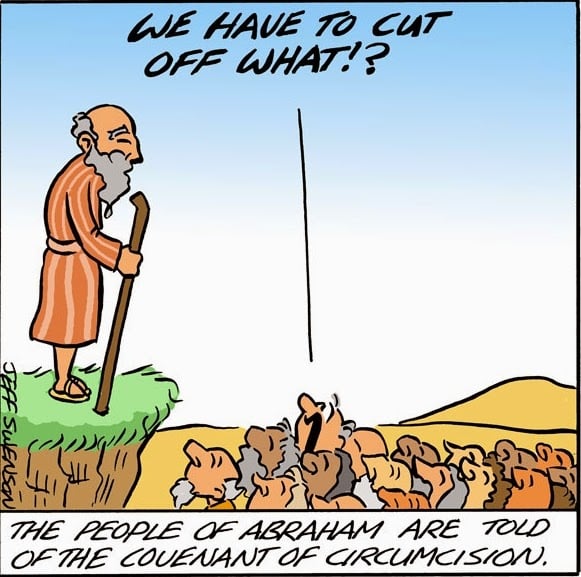
    In Genesis 17, we find God making an everlasting covenant with Abraham and his ancestors:

    When Abram was ninety-nine years old, the Lord appeared to Abram and said to him, “I am God Almighty; walk before me, and be blameless. And I will make my covenant between me and you and will make you exceedingly numerous.

    ….

     This is my covenant, which you shall keep, between me and you and your offspring after you: Every male among you shall be circumcised. You shall circumcise the flesh of your foreskins, and it shall be a sign of the covenant between me and you. Throughout your generations every male among you shall be circumcised when he is eight days old, including the slave born in your house and the one bought with your money from any foreigner who is not of your offspring. Both the slave born in your house and the one bought with your money must be circumcised. So shall my covenant be in your flesh an everlasting covenant. Any uncircumcised male who is not circumcised in the flesh of his foreskin shall be cut off from his people; he has broken my covenant.

    One sign of this covenant between God, Abraham, and future generations required all living males to have their foreskins — the retractable roll of skin covering the end of the penis — removed. Going forward, all male babies, including those of slaves, were to be circumcised on the eighth day. Anyone male not circumcised was cut off from “his people.”

    cicumcision 2

    I wonder if God, the Father, warned Jesus before sending him to earth to atone for human sin.

    God, the Father: Jesus, after we impregnate your mom, Mary, and you are born, you will have to have your foreskin cut off, without anesthesia, with a sharp rock.

    Jesus: What the fuck, Dad? Is that really necessary? That’s really going to hurt!

    God: Yes, my Son, your circumcision will be a sign of the covenant between Me, Abraham, and the Jewish people.

    Jesus: Dad, why can’t we just issue covenant certificates, signed by you, me, and Ghost?

    God: Absolutely not! Certificates will end up lost, but cut off a man’s foreskin? He will never forget that. Every time he pees, has sex, or takes a shower, he will be reminded of the covenant. Awesome, right?

    Jesus: Shakes his head, wondering if Dad has dementia.

    For thousands of years, countless Jewish, Christian, and Muslim male children have had their foreskins ritually and painfully removed. Why? Because God allegedly said to do so. It is 2025. Circumcision — which is genital mutilation — has no medical purpose, yet millions of boys are circumcised anyway. According to Google, over eighty percent of American males are circumcised, whereas only ten percent of male Europeans are. Anecdotally, this suggests that the more religious a culture is, the more likely they are to practice circumcision. For example, take Africa’s devoutly religious population. Over ninety percent of males are circumcised. That said, I suspect the practice is so deeply rooted in some countries that parents have their male babies circumcised, not out of religious conviction as much as conforming to societal norms.

    Let me be clear, mutilating the genitals of children is child abuse. The United States could end circumcision by banning the practice. Hospitals and doctors could stop performing unnecessary, elective surgery on male infants, and insurance companies could stop paying for the procedure. Overnight, parents would stop circumcising their boys. Bruce, but what if parents want to circumcise their son for religious reasons? Sorry, but that’s not a justification for having unnecessary elective surgery performed on your children. Female genital mutilation is often done for religious reasons, yet the practice is universally condemned. It is irrational, then, to support male genital mutilation, but condemn the same practice for females. Both practices need to come to an end immediately.

    What I want to know is why God didn’t create males without foreskins to start with? If his creation is intelligently designed and finely tuned, why is it necessary for practitioners of the three Abrahamic religions to have their male babies’ foreskin removed?

    Bruce Gerencser, 69, lives in rural Northwest Ohio with his wife of 48 years. He and his wife have six grown children and thirteen grandchildren. Bruce pastored Evangelical churches for twenty-five years in Ohio, Texas, and Michigan. Bruce left the ministry in 2005, and in 2008 he left Christianity. Bruce is now a humanist and an atheist.

    Your comments are welcome and appreciated. All first-time comments are moderated. Please read the commenting rules before commenting.

    You can email Bruce via the Contact Form.