President Biden says we must hold Russia, Iran, and Hamas “accountable.” No one bothers to ask who will hold the United States accountable.
Biden continues to say Hamas doesn’t represent Palestinians. Are we sure about that?
Biden says the United States opposes all forms of hate. Really? What about our own hate; hate that left hundreds of thousands of people dead in Iraq and Afghanistan.
Americans are building the “arsenal of democracy,” Biden says. Evidently, democracy comes through violence and bloodshed.
American leaders wrongly assume that our form of democracy, with its commitment to militarism and capitalism, is the cure for what ails the world.
Why can’t the U.S. military pay with available funds for arming Ukraine and Israel? Instead billions will flow from our coffers to fund war as Republicans tirelessly work to cut Social Security, Medicare, Medicaid, and SNAP. American children will go hungry whileweapons manufacturers get rich.
When it comes to military weaponry, there’s no such thing as defensive weapons. Defensive bullets and bombs kill just like offensive ones do. Dead is dead.
If it is morally wrong to slaughter Jewish children, it is morally wrong to bomb, shoot, maim, and kill Palestinian children.
It’s disheartening to see Biden conflate the Ukraine War with the war between Israel and Palestine. And then throw in Iran to get an “axis of evil.”
Ron Klain, former Biden chief of staff, says there are a lot of weapons in the world. No shit, Sherlock. And who is the largest arms dealer in the world? The United States.
Bonus: Joe Biden might believe in a “two state solution,” but Israel doesn’t. It is the only solution, but seventy-five years later, we are no closer to a sovereign Palestine. In 1948, Britain gave Israel land that belonged to the Palestinians. Does anyone seriously think Israel will remove their illegal settlements from occupied Palestine, and allow the Palestinian people to chart their own future?
David Barsamian: American Justice Robert Jackson was the chief prosecutor at the Nuremberg trials. He made an opening statement to the Tribunal on November 21, 1945, because there was some concern at the time that it would be an example of victor’s justice. He said this: “If certain acts of violation of treaties are crimes, they are crimes whether the United States does them or whether Germany does them, and we are not prepared to lay down the rule of criminal conduct against others which we would not be willing to have invoked against us.”
Norman Solomon: It goes to the point that, unless we have a single standard of human rights, a single standard of international conduct and war, we end up with an Orwellian exercise at which government leaders are always quite adept but one that’s still intellectually, morally, and spiritually corrupt. Here we are, so long after the Nuremberg trials, and the supreme crime of aggression, the launching of a war, is not only widespread but has been sanitized, even glorified. We’ve had this experience in one decade after another in which the United States has attacked a country in violation of international law, committing (according to the Nuremberg Tribunal) “the supreme international crime,” and yet not only has there been a lack of remorse, but such acts have continued to be glorified.
The very first quote in my book War Made Invisible is from Aldous Huxley who, 10 years before the Nuremberg trials, said, “The propagandist’s purpose is to make one set of people forget that certain other sets of people are human.” Here we are in 2023 and it’s still a challenge to analyze, illuminate, and push back against that essential purpose of propagandists around the world and especially in our own country where, in an ostensible democracy, we should have the most capacity to change policy.
Right now, we’re in a situation where, unfortunately, across a lot of the political spectrum, including some of the left, folks think that you have to choose between aligning yourself with U.S. foreign policy and its acts of aggression or Russian foreign policy and its acts of aggression. Personally, I think it’s both appropriate and necessary to condemn war on Ukraine, and Washington’s hypocrisy doesn’t in any way let Russia off the hook. By the same token, Russia’s aggression shouldn’t let the United States off the hook for the tremendous carnage we’ve created in this century. I mean, if you add up the numbers, in the last nearly twenty-five years, the country by far the most responsible for slaughtering more people in more lands through wars of aggression is… yes, the United States of America.
….
Barsamian: At the White House Correspondents’ dinner President Biden said, “Journalism is not a crime. The free press is a pillar, maybe the pillar of a free society.” Great words from the White House.
Solomon: President Biden, like his predecessors in the Oval Office, loves to speak about the glories of the free press and say that journalism is a wonderful aspect of our society — until the journalists do something he and the government he runs really don’t like. A prime example is Julian Assange. He’s a journalist, a publisher, an editor, and he’s sitting in prison in Great Britain being hot-wired for transportation to the United States. I sat through the two-week trial in the federal district of northern Virginia of CIA whistleblower Jeffrey Sterling and I can tell you it was a kangaroo court. That’s the court Julian Assange has a ticket to if his extradition continues.
And what’s his so-called crime? It’s journalism. WikiLeaks committed journalism. It exposed the war crimes of the United States in Iraq through documents it released, through the now-notorious video that came to be called “Collateral Murder,” showing the wanton killing of a number of people on the ground in Iraq by a U.S. military helicopter. It provided a compendium of evidence that the United States had systemically engaged in war crimes under the rubric of the so-called War on Terror. So, naturally, the stance of the U.S. government remains: this man Assange is dangerous; he must be imprisoned.
The attitude of the corporate media, Congress, and the White House has traditionally been and continues to be that the U.S. stance in the world can be: do as we say, not as we do. So, the USA is good at pointing fingers at Russia or countries that invade some other nation, but when the U.S. does it, it’s another thing entirely. Such dynamics, while pernicious, especially among a nuclear-armed set of nations, are reflexes people in power have had for a long time.
More than a century ago, William Dean Howells wrote a short story called “Editha.” Keep in mind that this was after the United States had been slaughtering hundreds of thousands of people in the Philippines. In it, a character says, “What a thing it is to have a country that can’t be wrong, but if it is, is right, anyway!”
Now, here we are in 2023 and it’s not that different, except when it comes to the scale of communications, of a media that’s so much more pervasive. If you read the op-ed pages and editorial sections of the New York Times, Washington Post, and other outlets of the liberal media, you’ll find such doublethink well in place. Vladimir Putin, of course, is a war criminal. Well, I happen to think he is a war criminal. I also happen to think that George W. Bush is a war criminal, and we could go on to all too many other examples of high U.S. government officials where that description applies no less than to Vladimir Putin.
Can you find a single major newspaper that’s been willing to editorialize that George W. Bush — having ordered the invasion of Iraq, costing hundreds of thousands of lives based on a set of lies — was a war criminal? It just ain’t gonna happen. In fact, one of the things I was particularly pleased (in a grim sort of way) to explore in my book was the rehabilitation of that war criminal, providing a paradigm for the presidents who followed him and letting them off the hook, too.
I quote, for instance, President Obama speaking to troops in Afghanistan. You could take one sentence after another from his speeches there and find almost identical ones that President Lyndon Johnson used in speaking to American troops in Vietnam in 1966. They both talked about how U.S. soldiers were so compassionate, cared so much about human life, and were trying to help the suffering people of Vietnam or Afghanistan. That pernicious theme seems to accompany almost any U.S. war: that, with the best of intentions, the U.S. is seeking to help those in other countries. It’s a way of making the victims at the other end of U.S. firepower — to use a word from my book title — invisible.
Bruce Gerencser, 66, lives in rural Northwest Ohio with his wife of 45 years. He and his wife have six grown children and thirteen grandchildren. Bruce pastored Evangelical churches for twenty-five years in Ohio, Texas, and Michigan. Bruce left the ministry in 2005, and in 2008 he left Christianity. Bruce is now a humanist and an atheist.
America is a stratocracy, a form of government dominated by the military. It is axiomatic among the two ruling parties that there must be a constant preparation for war. The war machine’s massive budgets are sacrosanct. Its billions of dollars in waste and fraud are ignored. Its military fiascos in Southeast Asia, Central Asia, and the Middle East have disappeared into the vast cavern of historical amnesia. This amnesia, which means there is never accountability, licenses the war machine to economically disembowel the country and drive the Empire into one self-defeating conflict after another. The militarists win every election. They cannot lose. It is impossible to vote against them. The war state is a Götterdämmerung, as Dwight Macdonald writes, “without the gods.”
Since the end of the Second World War, the federal government has spent more than half its tax dollars on past, current, and future military operations. It is the largest single sustaining activity of the government. Military systems are sold before they are produced with guarantees that huge cost overruns will be covered. Foreign aid is contingent on buying U.S. weapons. Egypt, which receives some $1.3 billion in foreign military financing, is required to devote it to buying and maintaining U.S. weapons systems. Israel has received $158 billion in bilateral assistance from the U.S. since 1949, almost all of it since 1971 in the form of military aid, with most of it going towards arms purchases from U.S. weapons manufacturers. The American public funds the research, development, and building of weapons systems and then buys these same weapons systems on behalf of foreign governments. It is a circular system of corporate welfare.
Between October 2021 and September 2022, the U.S. spent $877 billion on the military, that’s more than the next 10 countries, including China, Russia, Germany, France, and the United Kingdom combined. These huge military expenditures, along with the rising costs of a for-profit healthcare system, have driven the U.S. national debt to over $31 trillion, nearly $5 trillion more than the U.S.’s entire Gross Domestic Product (GDP). This imbalance is not sustainable, especially once the dollar is no longer the world’s reserve currency. As of January 2023, the U.S. spent a record $213 billion servicing the interest on its national debt.
The public, bombarded with war propaganda, cheers on their self-immolation. It revels in the despicable beauty of our military prowess. It speaks in the thought-terminating clichés spewed out by mass culture and mass media. It imbibes the illusion of omnipotence and wallows in self-adulation.
The intoxication of war is a plague. It imparts an emotional high that is impervious to logic, reason, or fact. No nation is immune.
….
A society dominated by militarists distorts its social, cultural, economic, and political institutions to serve the interests of the war industry. The essence of the military is masked with subterfuges — using the military to carry out humanitarian relief missions, evacuating civilians in danger, as we see in the Sudan, defining military aggression as “humanitarian intervention” or a way to protect democracy and liberty, or lauding the military as carrying out a vital civic function by teaching leadership, responsibility, ethics, and skills to young recruits. The true face of the military — industrial slaughter — is hidden.
The mantra of the militarized state is national security. If every discussion begins with a question of national security, every answer includes force or the threat of force. The preoccupation with internal and external threats divides the world into friend and foe, good and evil. Militarized societies are fertile ground for demagogues. Militarists, like demagogues, see other nations and cultures in their own image – threatening and aggressive. They seek only domination.
It was not in our national interest to wage war for two decades across the Middle East. It is not in our national interest to go to war with Russia or China. But militarists need war the way a vampire needs blood.
Bruce Gerencser, 66, lives in rural Northwest Ohio with his wife of 45 years. He and his wife have six grown children and thirteen grandchildren. Bruce pastored Evangelical churches for twenty-five years in Ohio, Texas, and Michigan. Bruce left the ministry in 2005, and in 2008 he left Christianity. Bruce is now a humanist and an atheist.
For the United States to step forward as a defender of helpless countries matched its image in American high school history textbooks, but not its record in world affairs. It had opposed the Haitian revolution for independence from France at the start of the nineteenth century. It had instigated a war with Mexico and taken half of that country. It had pretended to help Cuba win freedom from Spain, and then planted itself in Cuba with a military base, investments, and rights of intervention. It had seized Hawaii, Puerto Rico, Guam, and fought a brutal war to subjugate the Filipinos. It had “opened” Japan to its trade with gunboats and threats. It had declared an Open Door Policy in China as a means of assuring that the United States would have opportunities equal to other imperial powers in exploiting China. It had sent troops to Peking with other nations, to assert Western supremacy in China, and kept them there for over thirty years.
While demanding an Open Door in China, it had insisted (with the Monroe Doctrine and many military interventions) on a Closed Door in Latin America—that is, closed to everyone but the United States. It had engineered a revolution against Colombia and created the “independent” state of Panama in order to build and control the Canal. It sent five thousand marines to Nicaragua in 1926 to counter a revolution, and kept a force there for seven years. It intervened in the Dominican Republic for the fourth time in 1916 and kept troops there for eight years. It intervened for the second time in Haiti in 1915 and kept troops there for nineteen years. Between 1900 and 1933, the United States intervened in Cuba four times, in Nicaragua twice, in Panama six times, in Guatemala once, in Honduras seven times. By 1924 the finances of half of the twenty Latin American states were being directed to some extent by the United States. By 1935, over half of U.S. steel and cotton exports were being sold in Latin America.
Just before World War I ended, in 1918, an American force of seven thousand landed at Vladivostok as part of an Allied intervention in Russia, and remained until early 1920. Five thousand more troops were landed at Archangel, another Russian port, also as part of an Allied expeditionary force, and stayed for almost a year. The State Department told Congress: “All these operations were to offset effects of the Bolshevik revolution in Russia.”
In short, if the entrance of the United States into World War II was (as so many Americans believed at the time, observing the Nazi invasions) to defend the principle of nonintervention in the affairs of other countries, the nation’s record cast doubt on its ability to uphold that principle.
Bruce Gerencser, 66, lives in rural Northwest Ohio with his wife of 45 years. He and his wife have six grown children and thirteen grandchildren. Bruce pastored Evangelical churches for twenty-five years in Ohio, Texas, and Michigan. Bruce left the ministry in 2005, and in 2008 he left Christianity. Bruce is now a humanist and an atheist.
Over the weekend, Merle asked me several thoughtful questions about what I think should be done about the war in Ukraine. Here’s what he had to say:
Bruce, can you let us know what you think Ukraine should do?
I share your concern with America’s emphasis on war. But I see there is also a time and place for legitimate defense. Is Ukraine in a place where defense is justified?
I see no way to describe the Russian attack on Ukraine as anything other than state-sponsored terrorism. Surely nations have the right to respond to most acts of terrorism. Do we come to the point where the terrorist actor is so powerful (Russia) that one is better off just stepping back and letting them ransack the country?
So what should Ukraine do? Should they fight back? Should they seek help from America? To what extent should America help?
I am a pacifist. I oppose all war on principle. I believe war never brings peace. At best, it brings a temporary cessation of hostilities. I can’t think of one war that brought permanent peace to a nation-state. Far too often, wars get recycled. The “War to End All Wars” gave birth to The “War to Really End All Wars — We Really Mean It This Time” in 1939. George H.W. Bush’s Iraq War gave birth to his son, George W. Bush’s Iraq War a decade later. The French War in Vietnam gave way to what Americans call Vietnam. The Soviets admitted defeat in Afghanistan, only to have the United States move in, thinking We’re #1, We’re Number #1, leaving twenty years later in defeat.
The United States has been at war with North Korea for seventy years. Currently, the U.S. is threatening China over Taiwan and threatening Iran over nuclear development. America has troops on the ground in numerous African countries, along with having tens of thousands of troops stationed in Europe, Japan, South Korea, and other countries. And thanks to the recent release of top-secret military documents, the American people now know that the U.S. has troops in Ukraine! Oh, they are just advisors, the Biden administration says. Oh where, or when, have I heard that before? Advisors on the ground in Vietnam turned into 500,000 American troops in Vietnam a few years later.
The United States is the world’s policeman, thanks to many countries across the globe abdicating their responsibility to provide for their own protection. The United States has the largest defense and security budget in the world. We give nation-states billions of dollars a year to protect themselves and sell other countries billions of dollars more of weaponry. The United States is in the war business. In 1961, President Dwight Eisenhower gave a nationally televised speech warning about the danger of the military-industrial complex:
As we peer into society’s future, we – you and I, and our government – must avoid the impulse to live only for today, plundering for our own ease and convenience the precious resources of tomorrow. We cannot mortgage the material assets of our grandchildren without risking the loss also of their political and spiritual heritage. We want democracy to survive for all generations to come, not to become the insolvent phantom of tomorrow.
….
Until the latest of our world conflicts, the United States had no armaments industry. American makers of plowshares could, with time and as required, make swords as well. But we can no longer risk emergency improvisation of national defense. We have been compelled to create a permanent armaments industry of vast proportions. Added to this, three and a half million men and women are directly engaged in the defense establishment. We annually spend on military security alone more than the net income of all United States corporations.
Now this conjunction of an immense military establishment and a large arms industry is new in the American experience. The total influence—economic, political, even spiritual—is felt in every city, every Statehouse, every office of the Federal government. We recognize the imperative need for this development. Yet, we must not fail to comprehend its grave implications. Our toil, resources, and livelihood are all involved. So is the very structure of our society.
In the councils of government, we must guard against the acquisition of unwarranted influence, whether sought or unsought, by the military-industrial complex. The potential for the disastrous rise of misplaced power exists and will persist. We must never let the weight of this combination endanger our liberties or democratic processes. We should take nothing for granted. Only an alert and knowledgeable citizenry can compel the proper meshing of the huge industrial and military machinery of defense with our peaceful methods and goals, so that security and liberty may prosper together.
The American people have been taken hostage by the Pentagon, NSA, CIA and the military-industrial complex. Convinced by both Republican and Democratic politicians, most Americans believe that bad actors on the world stage are trying to take away from them the “American Way of Life”; the mythical “American Dream.” This, of course, is a bald-faced lie, yet we believe it to be true. And with over a trillion dollars in tax money, we pay for our protection from a mythical enemy. We send American men and women to bleed and die “over there,” so we don’t have to fight them “over here.” We as a people have bought into the lie called “American Exceptionalism”; that we are a city on a hill, ordained by the Christian God to advance the cause of Western democracy to the ends of the earth, and now, to outer space too.
We can no longer afford the heroin addiction of the defense department and the various U.S. security organizations. The first thing I would do is cut the defense and security budget by twenty-five percent. Second, I would drastically reduce the number U.S. military bases and outposts. Third, I would put an end to the military’s use of private contractors and private soldiers. Fourth, I would cut our nuclear weapons stockpile from 3,700 to 1,000 — still enough missiles to destroy the world.
My goal would be to neuter the United States’ ability to engage in nation-building, regime change, and fighting offensive wars on multiple fronts. Doing so would force America to seek other means of conflict resolution besides violence, bloodshed, and slaughter. I would, in certain circumstances, support the defensive use of the military.
I would fully fund the State Department while firing all of the CIA and NSA agents who are currently manning Department stations. The State Department should be tasked with one thing: promoting global peace. We must stop thinking that our way of life must be the way of life for everyone; that every nation must be a democracy and have a capitalist economic system.
Until we make systemic changes such as the ones I have mentioned in this post, we will continue to involve ourselves in the affairs of sovereign states. My God, there are Republican legislators calling for the U.S. military to invade Mexico in the latest chapter of the war on drugs.What’s next, invading Canada because they are “socialists?” This is what happens when we have a government that thinks every problem can be solved at end of a rifle.
The United States is currently fighting a proxy war against Russia in Ukraine. The United States is more than happy to sacrifice Ukraine, its soldiers, and civilians to destroy Russia’s military capabilities. We have no interest in peace between the warring factions. We have convinced Ukrainian President Volodymyr Zelenskyy that the war can be won, with all contested lands remaining Ukraine’s. And this is true as long as the United States and NATO continue to send Ukraine billions of dollars of weaponry. If Ukraine had to fight this war on its own, Russia would have won by now.
Let me be clear, Russia’s invasion of Ukraine is immoral. I am not pro-Russia, I’m pro-peace. I also know the United States, NATO, and Ukraine are culpable in the war too. From NATO’s expansion to Ukraine’s refusal to address the concerns of ethnic Russians in Crimea and eastern Ukraine, Russia felt threatened. And when authoritarian leaders feel threatened, what do they do? They bite; they push back. Peace cannot be brokered in Ukraine without understanding its complex history. The United States paints the war as a fight between democracy and capitalism on the one hand, and authoritarianism and communism (communism) on the other. This picture distorts the complexities on the ground. It lacks historical context and nuance.
Peace can be had in Ukraine if the United States and NATO stop fueling Ukraine’s war machine. I am not suggesting that we stop helping Ukraine defend itself. Ukraine has a right to self-defense and to repel Russia’s aggression, but the countries paying for this war must draw a peace line in the sand, telling Ukraine they must broker peace with Russia, and if they don’t the flow of weaponry will be cut off. (The idea that dirt is more important than people is insane.) Further, NATO must swallow their pride and stop its expansion farther into Europe. Admit Sweden, but that’s it. What about Ukraine? Were they NATO-worthy before the war? If not, I would not admit them into NATO. Russia must also stop its expansionist tendencies. Further, the United States, along Russia, and other countries bordering the Arctic Sea must begin immediately to engage in negotiations and peace talks over the North Pole. If they don’t, the Arctic Sea could be the next place there’s a war between the United States and Russia. We must to everything in our power to keep Santa’s home safe (a little levity with a serious subject).
While I am a pacifist, I am also a pragmatist. I know there will be times when defensive wars are inevitable. That said, I believe world peace must be our top priority. This priority must be shown in our government’s spending and military use. We must show by our actions that we are a peaceful people. As it stands now, the United States is viewed as a bully; a people who use violence and slaughter to advance their agenda and gain their objectives. Eighty years ago, the world largely thought well of the United States. Those days are gone. Even in Europe, people have soured on America. We must rehabilitate our image, and the only way we can do that is to change our behavior. Most of all, we must see things as they are. Ask the average American who was behind 9-11, and they will tell you Afghanistan and Iraq. This, of course, is untrue. It was Saudi Arabia who was behind 9-11, a fact that the US government refuses to acknowledge to this day. Why? One word: oil.
If we want peace, we must stop lying to ourselves about our own history. I don’t think, for a moment, that the United States is evil, but I refuse to turn a blind eye to the bloody, violent, murderous history of the country I proudly call home. Merle used the word terrorism to describe Russia’s murderous actions in Ukraine. I wonder if he would use the same word to describe the United States’ actions in Yemen, Syria, Vietnam, Afghanistan, Iraq, Iran, and countless other countries.
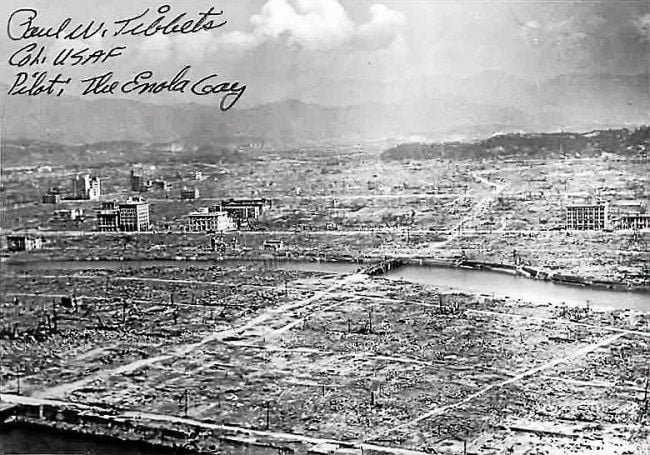
War is terrorism, period. Flying drones over civilian populations and killing men, women, and children is terrorism. Bombing Dresden and Tokyo is terrorism. Dropping atomic bombs on civilian populations in Nagasaki and Hiroshima is terrorism. Using napalm in southeast China is terrorism. The United States has slaughtered millions of non-combatants in its many wars. Aren’t these injuries, deaths, and property destruction terrorism too? As long as we call what other nations do in war terrorism, but call our violent actions “just war,” we will not truly understand the depravity and terror of war, and why peace must be our highest priority as a people.
When we fail to make peace our highest priority, we make war possible. The United States has largely given up on the United Nations ideal. We use the U.N. to advance our agenda, and when “peace” might cost us something, we bow out. We refuse to sign treaties that would reduce war in the world. Why does the United States refuse to participate in the International Court of Justice? It seems like we want one set of rules for the United States, and another set of rules for the rest of the world.
Peace in Ukraine is possible, but until the United States, Russia, Ukraine, and NATO choose a different path, the only thing that will happen is more bloodshed. A cessation of hostilities will happen sooner or later, but peace? I am not sure the warring parties have an appetite for real, lasting peace.
Bruce Gerencser, 66, lives in rural Northwest Ohio with his wife of 45 years. He and his wife have six grown children and thirteen grandchildren. Bruce pastored Evangelical churches for twenty-five years in Ohio, Texas, and Michigan. Bruce left the ministry in 2005, and in 2008 he left Christianity. Bruce is now a humanist and an atheist.
I turned on the news this afternoon to find out that the People’s Republic of China is conducting military training exercises in the Taiwan Strait — an international body of water separating China and Taiwan (officially the Republic of China). One hundred and ten miles wide, the Taiwan Strait is considered internal territorial waters by China.
China considers Taiwan part of its sovereign territory. Few Americans know much about Taiwan’s history and why China considers the 168 islands that make up Taiwan part of the mainland. All Americans hear is that Taiwan is a democracy and China is a communist state. Once the word “communist” is invoked, most Americans immediately think China is an existential threat. The great red-baiter Joseph McCarthy lives on. Sure enough, the news show I was watching made certain that viewers knew that China was communist. This, of course, had nothing to do with the story. It was an attempt by a Sinclair-owned news station to poison the news.
Sinclair’s “news” story included interviews with two right-wing Republican congressmen, one of whom was Lindsey Graham, the senior senator from South Carolina. Graham, known for getting the vapors and crying on TV, said it was imperative for the United States to immediately send additional troops to Japan and South Korea, and place nuclear weapons near China. Another Republican said the US needed to immediately send massive amounts of weapons to Taiwan so they can defend themselves. No Democrats were interviewed; neither were any anti-war congresspeople.
The majority of our political leaders in Washington D.C. are warmongers, including many Democrats. Fueled by fantasies such as American exceptionalism and manifest destiny, many of our leaders at all levels of government think the United States is a beacon of freedom (except for having the largest incarceration rate in the world) and democracy (except for gerrymandering, laws meant to restrict voting rights for people of color, and the recent expulsion of two Black representatives from the Tennessee House); that the God of the Christian Bible is on our side, and he will lead us to victory in every war we fight (even though we haven’t won a military conflict since 1945). With minds filled with American grandeur and supremacy, virtually everyone, from Democratic president Joe Biden to Republican lunatics too numerous to count, thinks the United States is an unassailable, impregnable fortress of good.
Even people who live in other Western countries have been charmed by America’s rhetoric and press releases. Recently, a commenter on a post titled The United States Advances “Democracy” One Bloody, Violent War at a Time had this to say: The USA has done bad things, but generally with the intention of trying to do good. Is the American prime directive try to do good? Is the United States a do-gooder on the world stage? Do our political leaders really put “good” above all else?
A cursory reading of American history suggests that we have never been a nation primarily motivated by good. Most people would agree that peace is good. So how do we square this ideal with the fact that the United States has been at war somewhere in the world for most of the twentieth and twenty-first centuries; that the US has troops and contractors deployed in virtually every corner of the world? War does not bring peace. All war does is bring a cessation of hostilities. Bloodshed and destruction happen until both sides agree to stop killing each other. Is this cessation “peace?” Of course not. The reasons for the hostilities remain, festering until coming to a head once again in the future. This is exactly what is happening in Ukraine. The United States (and NATO) is fighting a proxy war against Russia. Saber-rattling warmongers want to do the same with Taiwan, delusionally thinking that Taiwan can fight a war with China and win. All the United has to do is provide Taiwan with billions of dollars of fancy weaponry, just as we are currently doing in Ukraine. Further, many Americans think we can willy-nilly threaten sovereign states such as Iran, North Korea, Russia, and China with nuclear war without challenge. What happens when a country we have backed into a corner economically with embargoes, tariffs, and other punishments that only hurt the people in the street, decides that its only hope is the use of nuclear weapons against the US? What happens if these countries band together, much as Western nations have done with NATO? When economic and political survival is at stake, nation-states can and do use extreme measures to allegedly protect themselves. This is exactly what the United States did in World War II with the bombing of Dresden, the bombing of Tokyo, and the dropping of atomic bombs on Hiroshima and Nagasaki.
If and when the United States finds itself in a conventional war with a major world power; one where boots must be put on the ground, it is doubtful that the US would win such a conflict. As with all such wars, the willingness to use extreme measures to win only increases as time goes on. The unthinkable becomes possible, as was the case at the end of World War II. The US is losing its primacy in the world, and instead of evolving with the times, America is determined to use violence and death to maintain its power and economic superiority. And when the whole world is on fire someday? Americans will proudly wave foam fingers in the air, saying “We’re #1, we’re #1!” Finally, they will be right.
Bruce Gerencser, 66, lives in rural Northwest Ohio with his wife of 45 years. He and his wife have six grown children and thirteen grandchildren. Bruce pastored Evangelical churches for twenty-five years in Ohio, Texas, and Michigan. Bruce left the ministry in 2005, and in 2008 he left Christianity. Bruce is now a humanist and an atheist.
“The US is the most warlike nation in the history of the world.”
— Former U.S. President Jimmy Carter
Exporting wars, launching “color revolutions,” fomenting extremist ideologies, and promoting economic instability…the US has left countless trails of bloodshed and turmoil around the world.
….
“War is the American way of life,” said US historian Paul Atwood, noting that the US was born, grew, and became a superpower out of war, slavery, and human slaughter.
In its more than 240-year-long history since declaring independence on July 4, 1776, there have only been 16 years in which the US was not at war. From the end of World War II (WWII) to 2001, the US has initiated 201 of the 248 armed conflicts in 153 locations, accounting for over 80 percent of total wars fought. Since 2001, wars and military operations by the US have claimed more than 800,000 lives and displaced tens of millions of people.
Experts and observers reached by the Global Times said that the US, ignoring the objective reality of its own shambolic democratic record, instead attempts to use “democracy” as a pretext to wage war and as a cover for its numerous crimes such as causing humanitarian disasters and destroying sovereign order, is the real culprit threatening the world.
….
For a long time, the US war machine has rumbled across the world, leaving countries in disarray, and people’s livelihoods decimated.
The Korean War (1950-53) resulted in the deaths of more than 3 million civilians and approximately 3 million refugees. During the war, US forces strafed hordes of refugees due to fears that North Korean intelligence agents had infiltrated the refugees, and carried out notorious No Gun Ri and Sinchon Massacres resulting in the deaths of more than 30,000 innocent civilians.
The Vietnam War, which took place from the 1950s to the 1970s, was equally bloody and brutal. The Vietnamese government estimates that as many as two million civilians died in the war, many of whom were systematically slaughtered by US forces in the name of fighting Viet Cong communists.
Data show that US forces dropped more than three times as many bombs on Vietnam, Laos, and Cambodia as were dropped by all sides during WWII.
According to the New York Times, since the war officially ended in 1975, nearly 40,000 Vietnamese have been killed by land mines, cluster bombs, and other ordnances, and 67,000 have been maimed.
Worse still, 20 million gallons of Agent Orange which contained the deadly chemical dioxin, were dropped by the US army during the war, causing cancer or other diseases in much of the local population.
In the Middle East, the US’ flames of war also lasted for decades.
In 1991, US-led coalition forces attacked Iraq to start the Gulf War, directly leading to about 2,500 to 3,500 civilian deaths and the destruction of approximately 9,000 civilian homes in air strikes. The war-inflicted famine and damage to local infrastructure and medical facilities has caused a huge humanitarian crisis, even resulting in the deaths of about 500,000 children, according to United Nations Children’s Fund (UNICEF) estimates.
In 2001, the US sent troops to Afghanistan in the name of fighting terrorism. The war has not only killed at least 100,000 civilians and led to 2 million people becoming refugees, but has also left the country with difficulties in rebuilding its economy and political system.
….
In 2003, the US invaded Iraq on trumped-up charges, despite widespread international opposition, resulting in an estimated 200,000 to 250,000 civilian deaths, of which more than 16,000 were directly caused by US forces.
The US-led coalition also extensively used depleted uranium bombs, cluster bombs, and white phosphorus bombs in Iraq, and did nothing to reduce harm to civilians, Sun Degang, professor and director of the Center for Middle Eastern Studies at Fudan University, told the Global Times.
The United Nations estimates that Iraq still has about 25 million landmines and other explosive ordnances that need to be removed today.
Since 2001, the US has declared at least 91,340 strikes, including operations in Afghanistan, Iraq, and Syria, which may have directly killed at least 22,679 civilians and possibly as many as 48,308, according to a September report by a British investigative organization Airwars.
“War is one of the key means by which the US executes its foreign strategy and achieves global hegemony,” Li Haidong, a professor at the Institute of International Relations of China Foreign Affairs University, told the Global Times, noting that in the historical process of its rise, the US has always adhered to a militarization mentality and attached great importance to the joint machinations of military alliances in the diplomatic field, repeatedly relying on war to achieve the strategic need to consolidate the country’s sphere of influence.
“The US is the most warlike nation in the history of the world,” former US president Jimmy Carter once confessed. The Global Times found that, since WWII, almost all US presidents have waged or intervened in foreign wars during their terms of office, with a variety of reasons for waging wars.
Many countries believe that war is highly destructive and should be avoided, but in the US’ view, war can bring prosperity, and a war can sweep away the inertia of American society, thus keeping the US vital and dynamic, which is an inherent concept and tradition of the elite group formulated in the 240-year development history of the country, Li said.
Bruce Gerencser, 66, lives in rural Northwest Ohio with his wife of 45 years. He and his wife have six grown children and thirteen grandchildren. Bruce pastored Evangelical churches for twenty-five years in Ohio, Texas, and Michigan. Bruce left the ministry in 2005, and in 2008 he left Christianity. Bruce is now a humanist and an atheist.
Blessed are the peacemakers, for they shall be called the children of God. – Matthew 5:9
In a brilliant op-ed published in the New York Times, the Quincy Institute’s Trita Parsi explained how China, with help from Iraq, was able to mediate and resolve the deeply-rooted conflict between Iran and Saudi Arabia, whereas the United States was in no position to do so after siding with the Saudi kingdom against Iran for decades. The title of Parsi’s article, “The U.S. Is Not an Indispensable Peacemaker,” refers to former Secretary of State Madeleine Albright’s use of the term “indispensable nation” to describe the U.S. role in the post-Cold War world.
The irony in Parsi’s use of Albright’s term is that she generally used it to refer to U.S. war-making, not peacemaking. In 1998, Albright toured the Middle East and then the United States to rally support for President Clinton’s threat to bomb Iraq. After failing to win support in the Middle East, she wasconfronted by heckling and critical questions during a televised event at Ohio State University, and she appeared on the Today Show the next morning to respond to public opposition in a more controlled setting. Albright claimed, “if we have to use force, it is because we are America; we are the indispensable nation. We stand tall and we see further than other countries into the future, and we see here the danger to all of us. I know that the American men and women in uniform are always prepared to sacrifice for freedom, democracy, and the American way of life.”
Albright’s readiness to take the sacrifices of American troops for granted had already got her into trouble when she famously asked General Colin Powell, “What’s the use of having this superb military you’re always talking about if we can’t use it?” Powell wrote in his memoirs, “I thought I would have an aneurysm.”
But Powell himself later caved to the neocons, or the “fucking crazies” as he called them in private, and dutifully read the lies they made up to try to justify the illegal invasion of Iraq to the UN Security Council in February 2003.
For the past 25 years, administrations of both parties have caved to the “crazies” at every turn. Albright and the neocons’ exceptionalist rhetoric, now standard fare across the U.S. political spectrum, leads the United States into conflicts all over the world, in an unequivocal, Manichean way that defines the side it supports as the side of good and the other side as evil, foreclosing any chance that the United States can later play the role of an impartial or credible mediator.
Today, this is true in the war in Yemen, where the U.S. chose to join a Saudi-led alliance that committed systematic war crimes, instead of remaining neutral and preserving its credibility as a potential mediator. It also applies, most notoriously, to the U.S. blank check for endless Israeli aggression against the Palestinians, which doom its mediation efforts to failure. For China, however, it is precisely its policy of neutrality that has enabled it to mediate a peace agreement between Iran and Saudi Arabia, and the same applies to the African Union’s successful peace negotiations in Ethiopia, and to Turkey’s promising mediation between Russia and Ukraine, which might have ended the slaughter in Ukraine in its first two months but for American and British determination to keep trying to pressure and weaken Russia.
But neutrality has become anathema to U.S. policymakers. George W. Bush’s threat, “You are either with us or against us,” has become an established, if unspoken, core assumption of 21st-century U.S. foreign policy. The response of the American public to the cognitive dissonance between our wrong assumptions about the world and the real world they keep colliding with has been to turn inward and embrace an ethos of individualism. This can range from New Age spiritual disengagement to a chauvinistic America First attitude. Whatever form it takes for each of us, it allows us to persuade ourselves that the distant rumble of bombs, albeit mostly American ones, is not our problem.
The U.S. corporate media has validated and increased our ignorance by drastically reducing foreign news coverage and turning TV news into a profit-driven echo chamber peopled by pundits in studios who seem to know even less about the world than the rest of us.
Most U.S. politicians now rise through the legal bribery system from local to state to national politics, and arrive in Washington knowing next to nothing about foreign policy. This leaves them as vulnerable as the public to neocon cliches like the ten or twelve packed into Albright’s vague justification for bombing Iraq: freedom, democracy, the American way of life, stand tall, the danger to all of us, we are America, indispensable nation, sacrifice, American men and women in uniform, and “we have to use force.”
Faced with such a solid wall of nationalistic drivel, Republicans and Democrats alike have left foreign policy firmly in the experienced but deadly hands of the neocons, who have brought the world only chaos and violence for 25 years.
All but the most principled progressive or libertarian members of Congress go along to get along with policies so at odds with the real world that they risk destroying it, whether by ever-escalating warfare or by suicidal inaction on the climate crisis and other real-world problems that we must cooperate with other countries to solve if we are to survive.
It is no wonder that Americans think the world’s problems are insoluble and that peace is unattainable, because our country has so totally abused its unipolar moment of global dominance to persuade us that that is the case. But these policies are choices, and there are alternatives, as China and other countries are dramatically demonstrating. President Lula da Silva of Brazil is proposing to form a “peace club” of peacemaking nations to mediate an end to the war in Ukraine, and this offers new hope for peace.
During his election campaign and his first year in office, President Biden repeatedly promised to usher in a new era of American diplomacy, after decades of war and record military spending. Zach Vertin, now a senior adviser to UN Ambassador Linda Thomas-Greenfield, wrote in 2020 that Biden’s effort to “rebuild a decimated State Department” should include setting up a “mediation support unit… staffed by experts whose sole mandate is to ensure our diplomats have the tools they need to succeed in waging peace.”
Biden’s meager response to this call from Vertin and others was finally unveiled in March 2022, after he dismissed Russia’s diplomatic initiatives and Russia invaded Ukraine. The State Department’s new Negotiations Support Unit consists of three junior staffers quartered within the Bureau of Conflict and Stabilization Operations. This is the extent of Biden’s token commitment to peacemaking, as the barn door swings in the wind and the four horsemen of the apocalypse – War, Famine, Conquest and Death – run wild across the Earth.
As Zach Vertin wrote, “It is often assumed that mediation and negotiation are skills readily available to anyone engaged in politics or diplomacy, especially veteran diplomats and senior government appointees. But that is not the case: Professional mediation is a specialized, often highly technical, tradecraft in its own right.”
The mass destruction of war is also specialized and technical, and the United States now invests close to a trillion dollars per year in it. The appointment of three junior State Department staffers to try to make peace in a world threatened and intimidated by their own country’s trillion-dollar war machine only reaffirms that peace is not a priority for the U.S. government.
By contrast, the European Union created its Mediation Support Team in 2009 and now has 20 team members working with other teams from individual EU countries. The UN’s Department of Political and Peacebuilding Affairs has a staff of 4,500, spread all across the world.
The tragedy of American diplomacy today is that it is diplomacy for war, not for peace. The State Department’s top priorities are not to make peace, nor even to actually win wars, which the United States has failed to do since 1945, apart from the reconquest of small neocolonial outposts in Grenada, Panama, and Kuwait. Its actual priorities are to bully other countries to join U.S.-led war coalitions and buy U.S. weapons, to mute calls for peace in international fora, to enforce illegal and deadly coercive sanctions, and to manipulate other countries into sacrificing their people in U.S. proxy wars.
The result is to keep spreading violence and chaos across the world. If we want to stop our rulers from marching us toward nuclear war, climate catastrophe, and mass extinction, we had better take off our blinders and start insisting on policies that reflect our best instincts and our common interests, instead of the interests of the warmongers and merchants of death who profit from war.
Bruce Gerencser, 66, lives in rural Northwest Ohio with his wife of 45 years. He and his wife have six grown children and thirteen grandchildren. Bruce pastored Evangelical churches for twenty-five years in Ohio, Texas, and Michigan. Bruce left the ministry in 2005, and in 2008 he left Christianity. Bruce is now a humanist and an atheist.
By Jake Johnson, a staff writer for Common Dreams. Used by Permission
Progressive lawmakers on Thursday voiced dismay that President Joe Biden is requesting a nearly $30 billion increase in U.S. military spending just months after the Pentagon failed its fifth consecutive audit, admitting it could not properly account for more than half of its trillions of dollars in assets.
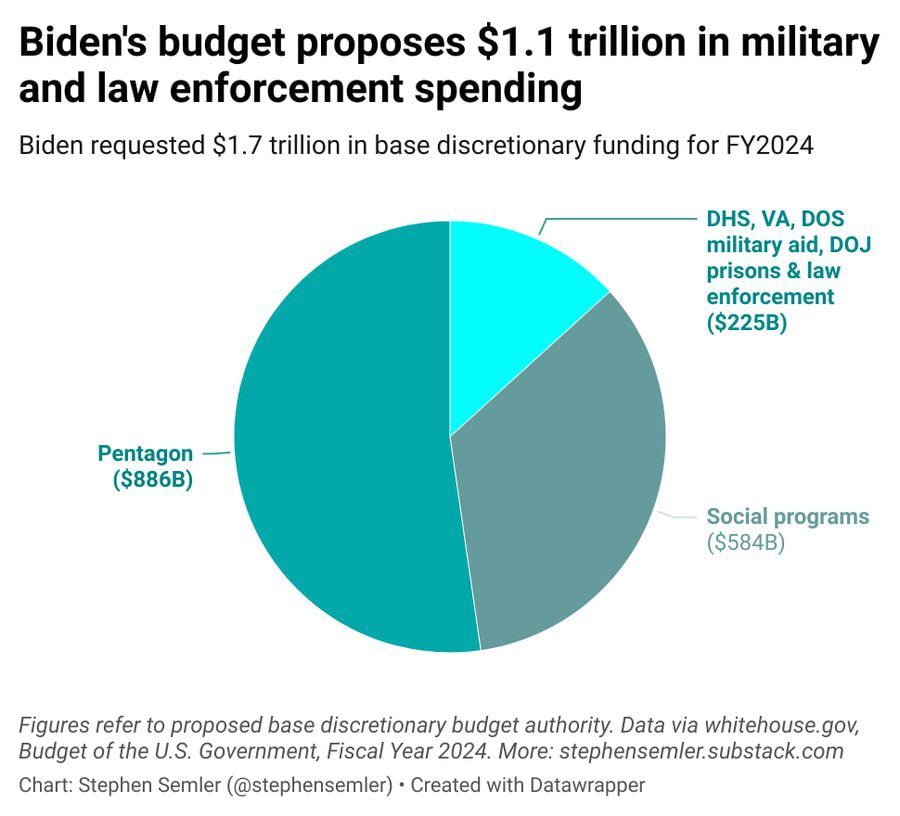
Biden’s budget framework for fiscal year 2024 calls for $886 billion in overall military spending—up from the current level of $858 billion—with $842 billion going to the Pentagon. More than half of the $1.7 trillion of discretionary spending in Biden’s proposal is reserved for the military, which would get $170 billion for weapons procurement and $38 billion for nuke modernization.
Defense Newsreported that the president’s budget would boost spending on “new drones, combat jets, hypersonic missiles, and submarines.”
Rep. Pramila Jayapal (D-Wash.), chair of the Congressional Progressive Caucus, said in a statement late Thursday that the president’s Pentagon blueprint requests “$26 billion more than Congress allocated in the previous budget—which itself was $63 billion more than the $773 billion the President requested for FY2023.”
“This is a never-ending cycle of increased funds without accountability,” said Jayapal. “There is simply no reason for taxpayers to continue to pay for outrageously high budgets rife with waste, fraud, and abuse. A recent CBO study confirmed that the Pentagon could cut $100 billion per year without compromising on national defense. This is long overdue. Progressives in Congress have been at the frontline of this fight for decades, and we will continue to push for sensible, targeted defense policy that prioritizes our national security over profit-hungry military contractors.”
Given that roughly half of the Pentagon’s annual budget has historically gone to military contractors such as Lockheed Martin and Raytheon, the National Priorities Project (NPP) noted Thursday that around 25% of Biden’s total discretionary budget would likely wind up in the coffers of private companies.
“This military budget represents a shameful status quo that the country can no longer afford,” said Lindsay Koshgarian, NPP’s program director. “Families are struggling to afford basics like housing, food, and medicine, and our last pandemic-era protections are ending, all while Pentagon contractors pay their CEOs millions straight from the public treasury.”
Led by Reps. Barbara Lee (D-Calif.) and Mark Pocan (D-Wis.), progressive lawmakers have been working for years to enact modest cuts to the Pentagon budget and redirect the savings toward healthcare, education, and other social investments.
But those efforts have repeatedly fallen short in the face of bipartisan opposition.
In 2022, Lee’s proposal to cut $100 billion off the military budget’s top line was defeated by an overwhelming vote of 78-350, with 141 House Democrats joining nearly every Republican in voting no. (NPP points out that $100 billion would be enough to send every U.S. household a $700 check or hire a million elementary school teachers.)
In a statement Thursday, Lee said she is “disappointed” that the president’s new budget “continues the regressive trend of increasing our bloated, wasteful defense budget year after year with little oversight.” Last month, Lee and Pocan reintroduced legislation that would reduce the U.S. military budget by $100 billion.
Top Republicans, meanwhile, signaled Thursday that they will try to pile more money on top of Biden’s historically large military budget request as they simultaneously pursue cuts to Medicaid and food benefits.
Rep. Mike Rogers (R-Ala.), chair of the House Armed Services Committee, lamented that Biden’s budget “proposes to increase non-defense spending at more than twice the rate of defense.”
“The president’s incredibly misplaced priorities send all the wrong messages to our adversaries,” said Rogers. “On the House Armed Services Committee, we are focused on building an NDAA that provides our warfighters with the capability and lethality to deter and, if necessary, defeat the grave threats facing our nation.”
Sen. Roger Wicker (R-Miss.) sent a similar message, calling Biden’s military budget request “woefully inadequate” and a “serious indication of President Biden’s failure to prioritize national security.”
But analysts argue that ballooning military spending does little to bolster U.S. national security. As William Hartung of the Quincy Institute for Responsible Statecraft wrote Thursday, “We can make America and its allies safer for far less money if we adopt a more realistic, restrained strategy and drive a harder bargain with weapons contractors that too often engage in price gouging and cost overruns while delivering dysfunctional systems that aren’t appropriate for addressing the biggest threats to our security.”
“The Congressional Budget Office has crafted three illustrative options that could ensure our security while spending $1 trillion less over the next decade,” Hartung noted. “A strategy that incorporates aspects of these plans and streamlines the Pentagon budget in other areas could be sustained at roughly $150 billion per year less than current levels.”
Bruce Gerencser, 66, lives in rural Northwest Ohio with his wife of 45 years. He and his wife have six grown children and thirteen grandchildren. Bruce pastored Evangelical churches for twenty-five years in Ohio, Texas, and Michigan. Bruce left the ministry in 2005, and in 2008 he left Christianity. Bruce is now a humanist and an atheist.
When it comes to how we should deal with evil doers, the Bible, in the book of Romans, is very clear: God has endowed rulers full power to use whatever means necessary — including war — to stop evil. In the case of North Korea, God has given Trump authority to take out Kim Jong-Un. I’m heartened to see that our president — contrary to what we’ve seen with past administrations who have taken, at best, a sheepish stance toward dictators and oppressors — will not tolerate any threat against the American people. When President Trump draws a red line, he will not erase it, move it, or back away from it. Thank God for a President who is serious about protecting our country.”
— Robert Jeffress, Southern Baptist megachurch pastor of First Baptist Church in Dallas, Texas
Jeffress holds typical Evangelical eschatological (end times) beliefs — that the rapture of Christians from the earth is imminent (any moment), as is the seven years of holy terror (The Great Tribulation) that God will rain down everyone left on earth after the rapture. Jeffress, a premillennial, pretribulational, dispensationalist Baptist believes the next must-see TV program will be when Jesus returns to earth a second time and wages war against Satan and his followers — Satanists, Humanists, Atheists, Agnostics, Pagans, Buddhists, Shintoists, Muslims, Roman Catholics, and anyone else who doesn’t embrace Jeffress’ soteriology (doctrine of salvation) — in the battle of Armageddon. Millions upon millions of Americans hold the same eschatological beliefs as Jeffress, and it is for this reason that Evangelical eschatology is so dangerous.
Evangelicals such as Jeffress believe that life on planet Earth will continue to spiritually and morally deteriorate until God has had enough and tells Gabriel to blow his trumpet, signaling to Jesus that it is time for him to return to earth and safely carry away all the True Christians®. For the Jeffresses of the world, the rapture will be the mother of all middle fingers, telling us God-haters that we are in for it now; that God is going to literally do to us what is recorded in the book of Revelation.
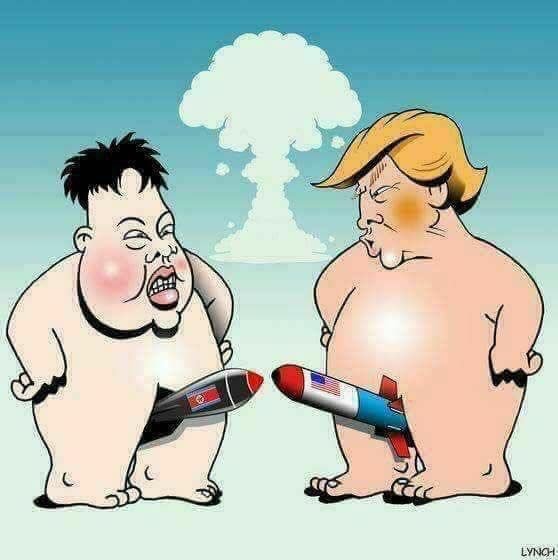
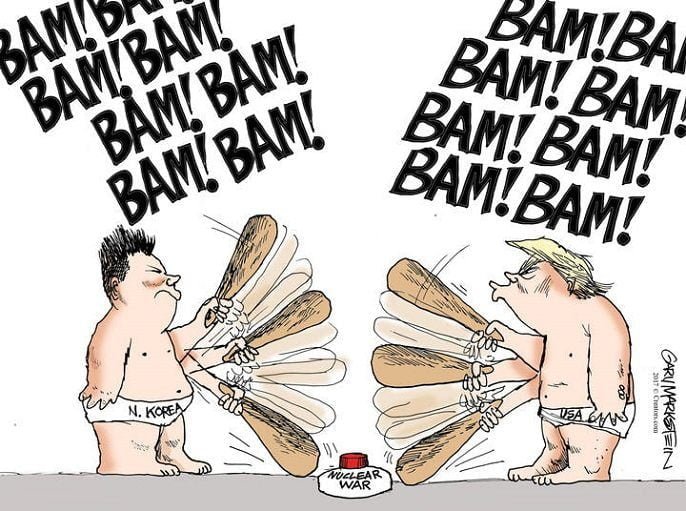
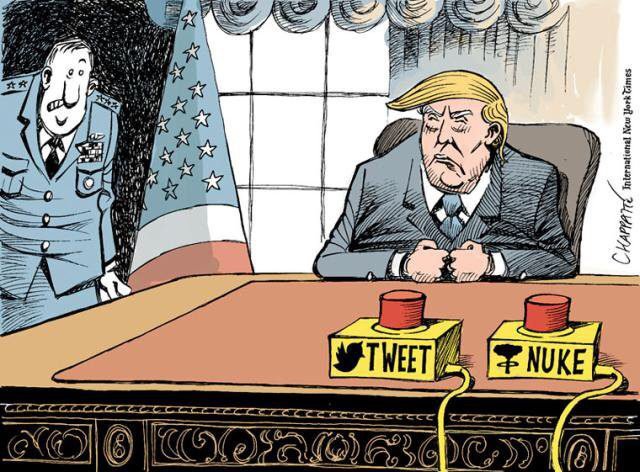
This kind of thinking should scare the shit out of rational people, not because Jesus is going to return to earth — he’s not — or that a mythical God is going to turn the earth into a dystopian novel of epic proportions — she’s not. What should scare us is that people who believe these things have the ear of the toddler-in-chief, Donald Trump. As anyone with an ounce of discernment knows, President Trump has no impulse control. He is megalomaniac who will go to any lengths — including destroying all life on our planet — to get his way. That the supreme leader of North Korea, Kim Jong-Un, a man who believes he is a god, is metaphorically waving his big dick in Trump’s face is sure to cause the President to throw caution to the wind and order a large-scale military strike on North Korea. Worse yet, Trump has even threatened to use nuclear weapons, answering a question he asked during the election: what good are nuclear weapons if you can’t use them? That the Evangelicals who have the President’s ear are encouraging him — using Biblical and theological justifications — to wage war against North Korea (and Iran, Iraq, Afghanistan, Russia and anyone else deemed a threat to God’s chosen nation, the United States) is truly frightening.
Threats of nuclear annihilation have only increased now that Joe Biden is president. During his first two years in office, North Korea, Iran, Russia, and China have all warned the United States to stop their military expansionism and threats — or else.
Atheists and other rational people dismiss Bible thumpers such as Jeffress as quaint relics from a bygone era. Silly Evangelicals. They believe the Bible is a supernatural book written by a supernatural God. Don’t they know that science has thoroughly discredited much of the Bible? However, despite scientific progress and the advancement of humanist principles, Evangelicals still hold fast to the belief that the Bible is an inspired, inerrant, infallible, never-been-proven-wrong religious text. Its word are true, and those who ignore the Bible, do so at their own peril. The fact that millions of Americans think just like Robert Jeffress means that we cannot, at such a dangerous, perilous time as this, ignore the pronouncements of Evangelical false prophets — especially when they have regular sleep-overs at the White House.
Like it or not, the Bible still matters, and how Evangelicals interpret it matters even more. We can augh all we want at their stone-age beliefs, but as long as Evangelicals have access to the highest levels of government, they are a threat that must be taken seriously. As long as we have a pussy-grabbing, lying “Christian” presidents and Evangelical congressmen, there is always a danger that theology will trump reason. Believing that God is on your side and will vindicate you is a sure recipe for disaster. No need to worry about consequences, right?God will take care of things. The most vocal climate change deniers in Congress are men and women who believe the Bible is the Word of God and worship at the feet of the Evangelical Jesus. In their minds, God is in control of e-v-e-r-y-t-h-i-n-g, so there is no need to worry about carbon emissions and rising temperatures. God has a divine plan —just read the Bible. According to Evangelicals, everything is going exactly going according to God’s perfect, unchanging plan, and if that plan includes nuking North Korea, so be it.
Evangelicals wrongly believe that God will protect his people — as he supposedly did when the Israelites were slaves in Egypt. No need to worry about nuclear fallout. God will make sure it doesn’t affect his chosen ones. And if he doesn’t? Well, that just means that God has a better plan and Evangelicals just need to “trust” him. Lost in all their “trust” of Jehovah is the fact that the overwhelming majority of earthlings do not worship the Evangelical God. We are being dragged into a murderous drama that is not of our own making. There is not much we can do about it except working to remove theocrats from office and flushing from Congress anyone who puts God, the Bible, and theology over the safety and welfare of the American people. As of today, the theocrats are winning and Jesus is the speaker of the House.
In short, the Myth of Redemptive Violence is the story of the victory of order over chaos by means of violence. It is the ideology of conquest, the original religion of the status quo. The gods favour those who conquer. Conversely, whoever conquers must have the favour of the gods. The common people exist to perpetuate the advantage that the gods have conferred upon the king, the aristocracy, and the priesthood.
Religion exists to legitimate power and privilege. Life is combat. Any form of order is preferable to chaos, according to this myth. Ours is neither a perfect nor perfectible world; it is theatre of perpetual conflict in which the prize goes to the strong. Peace through war, security through strength: these are the core convictions that arise from this ancient historical religion, and they form the solid bedrock on which the Domination System is founded in every society.
Long before the ascension of The Donald to the throne, Evangelicals embraced the false notion that the United States is a city on a hill overlooking the earth, ever vigilant, seeking to advance God’s kingdom on earth. Believing that the United States is “special” and has some sort of manifest destiny has led Americans to commit all sorts of atrocities — beginning with the genocidal destruction of Native Americans and reaching its zenith with the firebombings of Germany and the dropping of atomic bombs on Hiroshima and Nagasaki. Our elected leaders and military have shown that they will do whatever is necessary to preserve America’s capitalistic way of life. Buying into the most horrific lie ever told — that war brings peace — the United States has shown it is willing to maim, kill, and destroy to preserve the American dream.
The sanity of Eichmann is disturbing. We equate sanity with a sense of justice, with humaneness, with prudence, with the capacity to love and understand other people. We rely on the sane people of the world to preserve it from barbarism, madness, destruction. And now it begins to dawn on us that it is precisely the sane ones who are the most dangerous. It is the sane ones, the well-adapted ones, who can without qualms and without nausea aim the missile, and press the buttons that will initiate the great festival of destruction that they, the sane ones, have prepared… They will be obeying sane orders that have come sanely down the chain of command. And because of their sanity they will have no qualms at all. The ones who coolly estimate how many millions of victims can he considered expendable in a nuclear war, I presume they do all right with the Rorschach ink blots too.
….
Ponder for a moment Merton’s words:
It is the sane ones, the well-adapted ones, who can without qualms and without nausea aim the missile, and press the buttons that will initiate the great festival of destruction that they, the sane ones, have prepared. They will be obeying sane orders that have come sanely down the chain of command. And because of their sanity they will have no qualms at all. The ones who coolly estimate how many millions of victims can he considered expendable in a nuclear war…
We want to believe that the Joint Chiefs of Staff and Secretary of Defense will, when it comes to launching nuclear weapons, stand up to the President, refusing to obey his orders. Wishful thinking, as Merton makes clear. Soldiers obey. When our nation’s sovereignty and Christian way of life is threatened, history shows that the U.S. military can and will use any and every means necessary to preserve our republic.
Merton, in an essay on war that was not published until after his death, wrote:
The Romans, to speak generally, rely on force in all their enterprises and think it incumbent upon them to carry out their projects in spite of all, and that nothing is impossible when they have once decided upon it.
NOTHING is impossible when they — the powers that be — have decided to wage war. Once the United States commits to turning Iran into a parking lot or wiping North Korea off the face of the earth, NOTHING is impossible. Think that the United States would never use nuclear weapons again? Think again. There are most certainly statisticians and military “geniuses” holed up somewhere in the bowels of the Pentagon working on reports and charts detailing the likely outcomes of nuking a foreign adversary. There are sane, rational military and government leaders who really do think that nuclear war is winnable. Lunacy, to be sure, but so is believing, as Robert Jeffress does, that Jesus is coming soon. That many of our military leaders are card-carrying Evangelicals should cause rational people to fear for their lives. Just imagine for a moment, a general or two who believe that Jesus wants them to help usher in the Great Tribulation. No worries for us, they think. We will be raptured away.
Let me conclude this post with an excerpt from Thomas Merton’s essay: War and the Crisis of Language. Written during the Vietnam War, Merton shows how reason and the meaning of words are turned on their heads during times of war. Merton writes:
A classic example of the contamination of reason and speech by the inherent ambiguity of war is that of the U.S. major who, on February 7, 1968 shelled the South Vietnamese town of Bentre “regardless of civilian casualties . . . to rout the Vietcong.” As he calmly explained, “It became necessary to destroy the town in order to save it.” Here we see, again, an insatiable appetite for the tautological, the definitive, the final. It is the same kind of language and logic that Hitler used for his notorious “final solution.” The symbol of this perfect finality is the circle. An argument turns upon itself, and the beginning and end get lost: it just goes round and round its own circumference. A message comes in that someone thinks there might be some Vietcong in a certain village. Planes are sent, the village is destroyed, many of the people are killed. The destruction of the village and the killing of the people earn for them a final and official identity. The burned huts become “enemy structures”; the dead men, women, and children become “Vietcong,” thus adding to a “kill ratio” that can be interpreted as “favorable.” They were thought to be Vietcong and were therefore destroyed. By being destroyed they became Vietcong for keeps; they entered “history,” definitively as our enemies, because we wanted to be on the “safe side,” and “save American lives”–as well as Vietnam.
The logic of “Red or dead” has long since urged us to identify destruction with rescue–to be “dead” is to be saved from being “Red.” In the language of melodrama, our grandparents became accustomed to the idea of a “fate worse than death.” A schematic morality concluded that if such and such is a fate worse than death, then to prefer it to death would surely be a heinous sin. The logic of war-makers has extended this not only to the preservation of one’s own moral integrity but to the fate of others, even of people on the other side of the earth, whom we do not always bother to consult personally on the subject. We weigh the arguments that they are not able to understand (perhaps they have not even heard that arguments exist!) And we decide, in their place, that it is better for them to be dead–killed by us–than Red, living under our enemies.
The Asian whose future we are about to decide is either a bad guy or a good guy. If he is a bad guy, he obviously has to be killed. If he is a good guy, he is on our side and he ought to be ready to die for freedom. We will provide an opportunity for him to do so: we will kill him to prevent him falling under the tyranny of a demonic enemy. Thus we not only defend his interests together with our own, but we protect his virtue along with our own. Think what might happen if he fell under Communist rule and liked it!
The advantages of this kind of logic are no exclusive possession of the United States. This is purely and simply the logic shared by all war-makers. It is the logic of power. Possibly American generals are naive enough to push this logic, without realizing, to absurd conclusions. But all who love power tend to think in some such way. Remember Hitler weeping over the ruins of Warsaw after it had been demolished by the Luftwaffe: “How wicked these people must have been,” he sobbed, “to make me do this to them!”
….
So much for the practical language of the battlefield. Let us now attend to the much more pompous and sinister jargon of the war mandarins in government offices and military think-tanks. Here we have a whole community of intellectuals, scholars who spend their time playing out “scenarios” and considering “acceptable levels” in megadeaths. Their language and their thought are as esoteric, as self-enclosed, as tautologous as the advertisement we have just discussed. But instead of being “coiffed” in a sweet smell, they are scientifically antiseptic, businesslike, uncontaminated with sentimental concern for life–other than their own. It is the same basic narcissism, but in a masculine, that is managerial, mode. One proves one’s realism along with one’s virility by toughness in playing statistically with global death. It is this playing with death, however, that brings into the players’ language itself the corruption of death: not physical but mental and moral extinction. And the corruption spreads from their talk, their thinking, to the words and minds of everybody. What happens then is that the political and moral values they claim to be defending are destroyed by the contempt that is more and more evident in the language in which they talk about such things. Technological strategy becomes an end in itself and leads the fascinated players into a maze where finally the very purpose strategy was supposed to serve is itself destroyed. The ambiguity of official war talk has one purpose above all: to mask this ultimate unreason and permit the game to go on.
Of special importance is the style of these nuclear mandarins. The technological puckishness of Herman Kahn is perhaps the classic of this genre. He excels in the sly understatement of the inhuman, the apocalyptic, enormity. His style is esoteric, allusive, yet confidential. The reader has the sense of being a privileged eavesdropper in the councils of the mighty. He knows enough to realize that things are going to happen about which he can do nothing, though perhaps he can save his skin in a properly equipped shelter where he may consider at leisure the rationality of survival in an unlivable world. Meanwhile, the cool tone of the author and the reassuring solemnity of his jargon seem to suggest that those in power, those who turn loose these instruments of destruction, have no intention of perishing themselves, that consequently survival must have a point. The point is not revealed, except that nuclear war is somehow implied to be good business. Nor are H-bombs necessarily a sign of cruel intentions. They enable one to enter into communication with the high priests in the enemy camp. They permit the decision-makers on both sides to engage in a ritual “test of nerves.” In any case, the language of escalation is the language of naked power, a language that is all the more persuasive because it is proud of being ethically illiterate and because it accepts, as realistic, the basic irrationality of its own tactics. The language of escalation, in its superb mixture of banality and apocalypse, science and unreason, is the expression of a massive death wish. We can only hope that this death wish is only that of a decaying Western civilization, and that it is not common to the entire race. Yet the language itself is given universal currency by the mass media. It can quickly contaminate the thinking of everybody.
Listen closely in the days ahead as our political leaders and Evangelical preachers turn language and decency on its head in their justifications of annihilating Russia, China, North Korea, Iran, and anyone else who dares to “threaten” the mighty US of A. There will be hell to pay, Kim Jong-Un, but just remember we are killing your people because we love you and God has a wonderful plan for your life. And when hellfire and brimstone rain down on defenseless Americans, the Evangelical warmongers among us will learn — right before they are vaporized — that the God they thought was on their side is actually Korean.
Bruce Gerencser, 66, lives in rural Northwest Ohio with his wife of 45 years. He and his wife have six grown children and thirteen grandchildren. Bruce pastored Evangelical churches for twenty-five years in Ohio, Texas, and Michigan. Bruce left the ministry in 2005, and in 2008 he left Christianity. Bruce is now a humanist and an atheist.