Tag: Questions

  • What Part Did the Internet Play in Your Loss of Faith?

    porn leads to loss of faith

    I am of the opinion that the advent of the internet is hastening America’s march towards secularism and unbelief. Prior to Al Gore inventing the internet, knowledge was controlled by academic institutions, libraries, churches, and mainstream media outlets. Today, Americans are exposed to dizzying amount of data. Thanks to Google, known as GOD at our house, the answers to every question are but a search away.

    Before the internet, Evangelicals relied on their pastors and Sunday school teachers to tell them the “truth” about God, Jesus, church history, and the Bible. Questions and doubts were taken to pastors for resolution. These men of God were expected to speak authoritatively and put church members’ doubts to rest. Doubt is a tool used by Satan to rob Christians of their joy, peace, and happiness, countless Evangelical pastors told their congregations. If in doubt, just BELIEVE! The problem, of course, is that most people, Christians included, do have doubts and questions. Now that three-fourths of American homes have broadband internet access, doubting and questioning Evangelicals no longer have to rely on their pastors for answers.

    I started blogging in 2007. At the time, I was still a Christian. On the last Sunday of 2008, I attended church for the last time. Filled with questions and doubts that had been percolating for years, I came to the realization that I was no longer a Christian. The internet played a crucial part in my deconversion. It connected me with like-minded people, those with similar doubts, questions, and fears. Thanks to internet (and search engines), hundreds of thousands of people have come to this blog (or one of its previous iterations) seeking answers to their questions and interaction with like-minded people. I have been blessed to meet countless people from the vast corners of the world. I have hundreds of what I call digital friends, people I likely will never meet, but who play an important and helpful part in my life. And I hope that in some small way, telling my story and critiquing Evangelical Christianity has been a help to those who visit this site.

    Recently, I stumbled upon a post by Joel Miller. Miller’s blog is hosted by Patheos on the Evangelical channel. In April of 2014, Miller wrote a post titled, Is Internet Porn to Blame for the Rise of the Nones? He later changed the title to How Internet Porn Explains the Decline of American Faith. Miller, who is vice president of acquisitions for Nelson Books at Thomas Nelson, doesn’t think the internet plays an instrumental part in the rapid rise of the NONES, those who self-identify as atheists, agnostics, or indifferent towards religion. Instead, Miller blames porn. That’s right. It is not doubts and questions that have caused a loss of faith; it is easy access to internet pornography.

    Miller writes:

    Since the early 1990s, there has been a significant uptick in Americans abandoning their faith. After crunching the numbers, one researcher says contributing factors such as upbringing and education only explain part of the increase. What about the rest?

    After controlling for variables like income, environment, and so on, computer scientist Allen Downey of Olin College of Engineering in Massachusetts found 25 percent of the decline can be correlated with Internet access. More Web, less faith.

    Why? Here’s Downey’s stab at an answer: “For people living in homogeneous communities, the Internet provides opportunities to find information about people of other religions (and none), and to interact with them personally.” So increased exposure leads to doubt, disagreement, disenchantment, and ultimately to discarding your faith.

    ….

    Disaffiliation should come as no surprise. We’ve already seen that porn makes prayer and beneficial contemplation impossible. Given the Christian understanding of the spiritual life, we’re not capable of simultaneously pursuing our lusts and sanctification. Such a pursuit causes internal dissonance, and the only resolution involves eventually conceding to the pull of one or the other.

    ….

    If the rise of the internet has anything to do with a loss of faith — and it’s an interesting thought — the role of ideas is likely minimal. Arguments don’t cool many hearts, but sin surely does.

    While I certainly agree that the internet gives us ready access to a wide array of eroticism and pornography, I seriously doubt that the road out of Christianity is paved with YouPorn videos and JPEGs of naked men and women. Miller, a committed purveyor of endless books that are meant to answer Christian doubts and questions, dares not admit that the real problem is one of knowledge. Doing so would put the blame for the NONES squarely back on Christian sects, churches, and pastors. Doing so would open pastors up to charges of deceit and promoting ignorance. We can’t have that, so those who have exited the Evangelical church stage left and found purpose and meaning elsewhere, are doing so because they are lustful.

    Is this your experience too? Are you an unbeliever today due to your insatiable desire for porn? Or did the internet and sites like this one play an instrumental part in your deconversion? Please share your experiences in the comment section. I am certain that Miller is far afield in his assertion about the NONES, and I ask that readers educate him about the real reasons people leave Christianity.

    I plan to pin this post to the top of the front page for a few weeks, giving infrequent readers a chance to share their stories.

    Bruce Gerencser, 69, lives in rural Northwest Ohio with his wife of 48 years. He and his wife have six grown children and thirteen grandchildren. Bruce pastored Evangelical churches for twenty-five years in Ohio, Texas, and Michigan. Bruce left the ministry in 2005, and in 2008 he left Christianity. Bruce is now a humanist and an atheist.

    Your comments are welcome and appreciated. All first-time comments are moderated. Please read the commenting rules before commenting.

    You can email Bruce via the Contact Form.

  • Bruce, Would You Pray if Asked To?

    atheist prayer

    Andre asked:

    Suppose you were at a dinner party and the host puts you on the spot to pray for the meal in front of 10-20 guests. Do you be a good sport and make up a prayer or politely decline, creating an awkward situation.

    This is a great question, one that can be answered several different ways. Since all of my family and friends know I am no longer a Christian, I doubt any of them would ask me to pray. I can’t think of any social setting where I would now be asked to pray. Everyone knows I am an atheist, so I doubt they would want a godless heathen blessing their food.

    Each of us must determine how we would respond when asked to pray. If a person is an atheist or an unbeliever, but hasn’t come out yet, then it might be appropriate for them to pray if asked. No harm will be done since the God they are praying to is a fictional being. Their prayer, like every other prayer, will hit the ceiling and bounce right back. No harm, no foul.

    A dinner party is not a good place to declare to the world that you are an atheist or that you are no longer a Christian. Such a pronouncement will surely dampen the spirit and you will be blamed for ruining the party. The best advice I can give is to size up who is there and act accordingly.

    Please see Count the Cost Before You Say I am an Atheist

  • Charles Attempts to Understand the Fundamentalist Mind

    god and knowledge

    Several months back, I asked readers to submit questions they would like me to answer. If you would like to ask a question, please leave your question here.

    Charles asked:

    I know you are probably going to slam me for asking this, but it really is something I have noticed time and time and time again across my nearly 63 years of life—and I am at a bit of a loss to understand it. So, here goes:

    Why do Christian fundamentalists and conservative evangelicals believe that the sole purpose of communications media (books, magazines, newspapers, movies, television shows, blogs, etc.) is to “teach me how I should live my life” in this world. All of my semi-fundie aunts are dead now, but they grew up in rural Tennessee in the period 1910-1930. In later years, (1930s onward), they would scrape up enough money to go to a movie, and they would go with the apparent notion that Joan Crawford will today on the movie screen “teach me how I should live my life if I move to the city.”

    Whenever a fundie wants to banish a book from the public library, ban a movie, or whatever, the excuse is always something along the lines of: “Well, I’m afraid this book (or this movie) is going to teach people wrong things about…”

    I gotta be honest with you Bruce. I think these people are just plain nuts. For example, I saw a DVD of the movie “Lucy” recently. At no time did I insert it into the DVD player, kick back in my easy chair, and say, “Scarlett is gonna teach me how I should live my life with this movie.” If I pick up the newest Superman comic book, I never say, “Superman is going to teach me a lesson on how I should live my life.”

    I am a professional anthropologist. Human culture and society are my business, but this one is a little hard to understand. On occasion, I have wondered if this is a uniquely American disease of the mind with religious roots. For example, when the first pioneers pushed westward across the Appalachian Mountains into Ohio, Kentucky, and Tennessee, the Bible was often the only book they owned. It was viewed as a book whose primary purpose was to “teach them how they should live their lives.” Historically, is it possible that they uncritically transferred this notion to every form of communications media that arrived on the scene?

    Even nowadays, you can here fundies say, “I don’t like that short story because it does not teach a good moral lesson.” I just want to say back, “Well, maybe the author did not want to teach you a good moral lesson because he was just writing a story that he wanted to tell.”

    What goes on in the minds of these people?

    Here’s what I know for sure, the Christian fundamentalist operates from six presuppositions:

    • Their God, as revealed through the Bible, creation, and conscience,  is the one true God
    • The Bible is God’s divine revelation to humanity and contains everything necessary for life and godliness
    • Every person is a sinner in need of salvation
    • There is eternal life beyond the grave
    • Heaven/eternal kingdom of God is where Christians will spend eternity and hell/lake of fire is where non-Christians will spend eternity
    • This life is preparation for eternal life after death

    Because Evangelicals believe the Bible is the inspired, inerrant, infallible Word of God, it becomes the foundation for how they view the world and live their lives (in theory anyway). This thinking permeates every aspect of their lives. It is not uncommon for Evangelicals to label themselves as “people of the book.” The Bible becomes a written oracle that speaks infallibly pertaining to life and godliness. It becomes THE truth above all others. Throw in the notion that the Holy Spirit lives inside Evangelicals as their teacher and guide, and is it any surprise that Evangelicals think the way they do?

    Everything in the Evangelicals’ lives is filtered through the pages of the Bible. When they see something in the media that lines up with their beliefs, this is viewed as God giving them a life lesson or reinforcing their beliefs. Since most Evangelicals think homosexuality is a sin, they can turn to Romans 1, 2 and see that their view of the world is going to hell in a hand basket is affirmed by the Bible and recent events such as the legalization of same-sex marriage and the persecution of Christian wedding cake bakers.

    Evangelicals often equate the smallest of things to God. From finding their keys to discovering a $20 bill in a pair of pants, every unexpected “blessing” is a sure sign of the truthfulness of the Bible. These “God sightings” are proof that they are on the right track and that their beliefs are true. So, when a Tim Tebow or some other sports star praises Jesus, they see the star’s words as an affirmation of their beliefs. Same goes for utterances about God at the Grammy Awards, Country Music Awards, and other show-biz award shows. Never mind that many of the singers are praising God for songs that promote debauchery and sin. All that matters is that they thanked God or their Lord and Savior Jesus Christ. Woo Hoo! Another God sighting!!

    Evangelicals are also obsessed with eschatology. Always on the lookout for Jesus coming to rapture them away, they look for signs of his soon return (even though they are commanded not to do so). Again, this kind of thinking leads them to “see” God and signs everywhere they look. From RFID chips being the mark of the beast to mathematical formulas that predict the exact date of the rapture, Evangelicals seek out “evidence” for their eschatological beliefs. In doing so, they overlook the obvious; first century Christian expected the second coming of Jesus in their lifetime, yet here we are 2,000 years later, no Jesus. Perhaps Jesus likes his digs in heaven and is not coming back or his body lies silent in an unmarked grave outside of Jerusalem.

    Evangelicals also believe God speaks to them, either through the Bible or through the still small voice of the Holy Spirit. When a person has God speaking directly to him, it is possible to see almost anything as a lesson or message from God. Spend some time on the CHARISMA website and you will come away thinking that Evangelicalism is actually an insane asylum. No belief is so far-fetched that it cannot be attributed to God. Years ago, a woman stood up in one of the churches I pastored and told a story about God appearing to her. A devout Evangelical Christian, she said God came in the night and spoke to her. Wanting to make sure it was God and not the devil, she asked for a sign. All of a sudden, she saw a blue light and she knew it was God. I thought then, as I do now, that she was confusing a blue light special at K-Mart with a visitation from God. (Note also the number of Republican candidates for President who say the Christian God TOLD them to run.)

    Throw all these things in a bag and shake them up and what you end up with is a Christian version of McCarthyism. Everywhere Evangelicals look they see their God. When they pray for Grandma and she gets better they think God did it. When God doesn’t answer their prayer and Grandma dies? It’s God’s will. Either way, everything traces back to God. He is the Alpha and Omega, the first and the last, the beginning and the end.

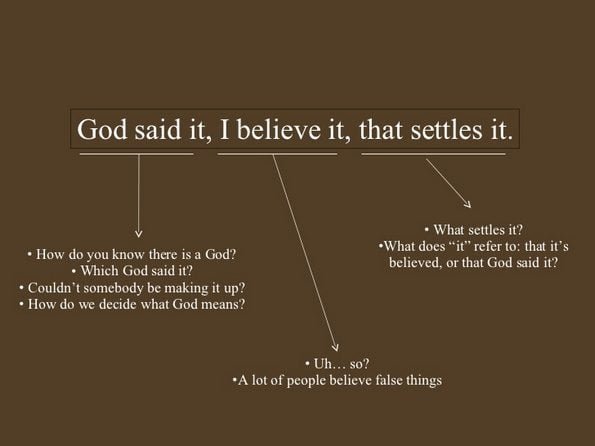
    god said it

    Understanding this explains why their thinking drives you nuts. As a man of science, you value evidence and facts. While you are still a believer, you do not check your brain at the door and ignorantly view the world as the Evangelical does. Evangelicals will likely say that they too value evidence and facts, but their evidence is the Bible, not what can be understood through reason, healthy skepticism, and the scientific method. When confronted with a challenge to their beliefs, the Bible and faith always win.

    This is why I do not get into arguments and lengthy discussions with Evangelicals. The path always leads back to faith and THE BIBLE SAYS!  Once the Evangelical appeals to faith, there is no hope of a meaningful discussion. Just today, an Evangelical preacher “proved” to me that Jesus resurrected from the dead. How?  He quoted the Bible. In his mind, God said it and that settles it.

    101716

  • Question: Was My Deconversion Gradual or Instantaneous?

    atheist dan piraro

    Several weeks back, I asked readers to submit questions they would like me to answer. If you would like to ask a question, please leave your question here.

    Suzanne asked:

    What was the thing or moment where it all started to unravel horribly, the pulling the first thread away moment, when you said ‘screw all of this’ and walked away? Was it one thing or a gradual buildup of stuff?

    This is a great question, one that is not easy to answer.

    My story drives Evangelicals crazy, especially those who are hardcore, never change their beliefs, fundamentalists. What they see in my story is a lifetime of theological change, and this is a sure sign to them that I never had a surefooted theological foundation. After all, the Bible does say that the double minded man is unstable in all his ways.  In their mind, it’s no wonder I deconverted. Look at my ever-evolving theology.

    However, I view my change of beliefs in a different light. For those of us raised in the Evangelical church, we grew up with a borrowed theology. Our theology was that of our parents, pastor, and church. When I enrolled at Midwestern Baptist College, I had a borrowed theology and when I left three years later I still had a borrowed theology. I believed what I had been taught.

    Over the course of 25 years in the ministry, I diligently studied the Bible. I read over a thousand theological books and prided myself in working hard to give parishioners with exactly what the Bible taught. Over time, I encountered teachings and beliefs that were new to me, and after thoroughly studying the matter my beliefs either stayed the same or changed. Over  the years, my soteriology and eschatology changed, as did my view on inerrancy the law of God, faith vs works, and Bible translations. These new beliefs led to changes in practice. I like to think that my changing beliefs were simply an intellectual response to new information.

    Over this same 25 year period my politics evolved and changed. I entered the ministry as a right-wing Republican culture warrior. I left the ministry as a progressive/liberal Democrat.  It is likely that my changing political beliefs affected how I read and interpreted the Bible.

    I left the ministry in 2005 and left Christianity in 2008.  In the three years between these two events, I went back to the Bible and restudied what I believed about God, Jesus, creation, salvation, and the Bible. I read numerous books written by authors like Bart Ehrman, Robert Price, Robert Wright, Jerry Coyne, John Loftus, Rob Bell, Wendell Berry, Thomas Merton, Brian McLaren, John Shelby Spong, Henri Nouwen, Marcus Borg, Elaine Pagels, Hector Avalos, Soren Kierkegaard, John Dominic Crossan, N.T. Wright, Paul Tillich, and a number of other authors. I was doing everything I could to hang on to some sort of faith.

    I went through what I call the stages of deconversion: Evangelical Christianity to Liberal/Progressive Christianity to Universalism to Agnosticism to Atheism. This path was painful, arduous, contradictory, and tiring. I spent many a day and night not only reading and studying, but having long discussions with Polly about what I had read. In November of 2008, I concluded, based on my beliefs, that I could no longer honestly call myself a Christian. Since I no longer believed the Bible was an inspired, inerrant, infallible text, nor did I believe that Jesus was God, rose again from the dead or worked miracles, there was no possible way for me to remain a Christian.  At that moment, I went from believer to unbeliever. I call this my born again atheist experience.

    Evangelicals will read this post and point out what they see as a fatal flaw in my deconversion; I didn’t read any Evangelical theologians. I didn’t read any of the shallow apologetic works that are bandied about as surefire faith fixers. The reason I didn’t is because I had already read them. I can recite Christian theology, in all its forms, frontwards and backwards. Since there hasn’t been an original thought in Christianity since Moses got off the ark, I had no need of rereading Christian theological books. The few Christian authors I did read, were new authors that I hoped would tell me something I had not heard before.  I read their books in hopes of getting a new perspective on Christianity, hoping that they would knot a rope and throw it to me so I could hang on. In the end, the rope had no knot, and down the slippery slope I slid until I hit bottom.

    So, my deconversion took a long time, but there was also a moment in time when I went from believer to nonbeliever.

    If I had to point to one thing that most affected my deconversion,  it would be learning that the Bible was not an inspired, infallible, inerrant text. I suspect this is the case for many Evangelicals turned atheist. Bart Ehrman is a good example of this.  The belief that the Bible was a perfect text written by God and absolute truth from the hand of God himself, was the foundation of my system of belief. Remove this foundation and the whole house comes tumbling down.

    One unanswered question remains; if I had started out as a progressive/liberal Christian would I have still deconverted? I don’t know. Maybe, maybe not. Since I have a pastor’s heart and I love help people, I might have found a home in progressive/liberal Christianity. This is one of those would of/could of/should of questions. That’s not the path I took, so here I am. Unless a deity of some sort reveals itself to us, I remain a convinced atheist.

  • Question: What is the Difference Between Superstition and Religion?

    superstition

    Several weeks back, I asked readers to submit questions they would like me to answer. If you would like to ask a question, please leave your question here.

    Geoff asked:

    What’s the difference between superstition and religion?

    The short answer is nothing, Practically, an Evangelical would view the beliefs of non-Christians as superstition. The Evangelical looks at Catholics and their prayers to Mary and the saints and sees superstition. What the Evangelical can’t see is their own superstition. The Christian narrative is every bit as wacky as any of stories and beliefs that are labelled superstition. One man’s superstition is another man’s religion.

    The dictionary definition of superstition is:

    An irrational belief arising from ignorance or fear.

    The question I have is whether ALL religious belief arises from ignorance or fear? Most of it does, to be sure, but if someone tells me that they have some sort of deistic belief then I am inclined to say that their belief does NOT arise out of ignorance or fear. I have stated many times that I think one can look at the universe and conclude that a deity of some sort created the universe. This deity, after creating the universe, said, there ya go boys and girls, do with it what you will. Some readers of this blog  hold to this view. While I can not embrace this view, I do understand it.

    As far as Christianity is concerned, no matter what form one embraces, it arises from ignorance or fear. Some Evangelicals try to assert that their beliefs are rational, but I find their explanations laughable. Their explanations are little more than a class in probabilities. Let me explain.  Billions of people have lived and died. Every human dies. Even the Bible admits the  obvious: it is appointed unto men once to die.  There are no exceptions except for Jesus and Elijah, for which we have no proof that they are still alive. The Evangelical hangs on to the notion that it is “possible” for a person to resurrect from the dead or never die because the Bible says it is possible. (circular reasoning) Since all the evidence points to when you are dead you stay dead, I consider any other belief to be one born out of ignorance, faith, or hope.

    Liberal Christians are hard to nail down, belief wise. I tend to refrain from labeling their beliefs superstition because I appreciate what they are trying to accomplish. Most liberal Christians I know are de facto universalists. Atheists like me end up in heaven anyway, so there no fear factor involved. Do I think liberal Christianity is rational? No, but I do know the world would be a lot better place if every religious believer had progressive, liberal beliefs.

    I am sure hard-core atheists will not appreciate my conciliatory, accommodationist approach to deism, liberal Christianity, and universalism, but I recognize that most people are going to have some sort of religious belief, and if this is so, what would I prefer for them to believe? Fundamentalism, in all of its forms, remain the enemy.

  • Question: Please Explain the Eschatology of the IFB Church

    clarence larkin judgments
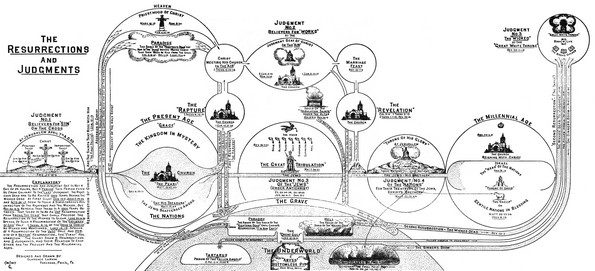
    Chart from Clarence Larkin’s book, Dispensational Truth. This chart shows the various judgments and resurrections.

    Charles asked:

    Bruce, you said “you said: “Christian orthodoxy teaches that when a person dies their body goes to the grave to await the resurrection of the just and unjust and the final judgment.” How then, could the rich man see and know Abraham and Lazarus and Abraham and Lazarus see the rich man?”

    Can you explain where this “Dual Judgement” theology comes from, who originated it, and why not all fundies espouse it—like you did not espouse it in your quote above.

    First, for those who may not know my entire story, I was not a Fundamentalist towards the latter part of my time in the ministry. I left the Independent Fundamentalist Baptist (IFB) church movement in the late 1980s. I then became an Evangelical Calvinist before becoming more liberal politically and theologically. When I left the ministry in 2005, I was aligned with the emergent church, red letter Christians, and Sojourners. My move leftward cost me almost all of my IFB friends and colleagues. When I became an agnostic/atheist/humanist, I lost all but two of my remaining Christian friends.

    Second, when I wrote “Christian orthodoxy teaches that when a person dies their body goes to the grave to await the resurrection of the just and unjust and the final judgment,” this was a reflection of my post-IFB theology. I held to a post-tribulational, amillennial eschatology. One resurrection, one judgment.

    Third, almost all IFB churches and pastors are dispensational, pre-tribulational, and premillennial. As such, they believe in multiple judgments. Lazarus and the rich man would have been judged before the death and resurrection of Jesus. Then there is a judgment after the rapture. This judgment is often called the Judgment (BEMA) Seat of Christ. At the end of the tribulation, there will be another judgment, and after the 1,000-year millennial reign of Christ on earth, there will be one more judgment, the final judgment of all who have not yet been judged.

    Make sense? Of course not. But, it is in the B-i-b-l-e. Much of dispensational teaching is implied and inferred.

    In recent years, I’ve noticed more eschatological diversity in the IFB church movement. I suspect this is due to the fact that all the prophecy preaching over the past 70 years has failed to materialize. After being theologically embarrassed and made out to be fear-mongering false prophets, many IFB preachers have turned to simpler eschatological systems. I’ve even met IFB preachers who are Calvinistic and hold to a post-tribulational, amillennial eschatology. Their eschatology and soteriology have evolved, but their social Fundamentalism has not. (please read Are Evangelicals Fundamentalists? to understand the terms social and theological Fundamentalism)

    Bruce Gerencser, 69, lives in rural Northwest Ohio with his wife of 48 years. He and his wife have six grown children and thirteen grandchildren. Bruce pastored Evangelical churches for twenty-five years in Ohio, Texas, and Michigan. Bruce left the ministry in 2005, and in 2008 he left Christianity. Bruce is now a humanist and an atheist.

    Your comments are welcome and appreciated. All first-time comments are moderated. Please read the commenting rules before commenting.

    You can email Bruce via the Contact Form.
  • Question: Will Christians Praying for Your Demise Have Their Prayers Answered?

    imprecatory prayer

    Several weeks back, I asked readers to submit questions they would like me to answer. If you would like to ask a question, please leave your question here.

    Steve asked:

    Yes sir, I have a question!

    Do you think the many Christian prayers for your demise will succeed?

    Many Christians believe that God should get all the praise for the good things that happen and Satan and sinners should get blamed for the bad things that happen. This fact poses a conundrum for those praying for my demise. If God kills me, this means it was a good thing, right?  But, if God is the giver of life, the fact that I am still alive is also a good thing.  Perhaps God wants me to live so the Holy Spirit can regenerate me, effectually call me, and impart to me his wonderful irresistible grace. Or perhaps I am not one of the elect, not in the Lamb’s Book of Life; then I am an unregenerate, apostate reprobate. If I were God, I would kill someone like me, seeing that I do so much damage to the faith of others.

    Some day, I will die. The way I am feeling as I write this post, it could be today. Or tomorrow. Or twenty years from now. Regardless of the date of my demise, there will a Christian somewhere who will see it as proof that their imprecatory prayer worked,;that God whacked me because they asked him to.