Over the past several weeks, local fundamentalist Christians have voiced their objection to my recent letter to the editor. While I cannot adequately answer all of their objections in the space of 500 words, I would like to address several issues.
I am not anti-religion. I know most people have some sort of religious belief they find beneficial. I am not the slightest bit interested in disabusing them of their belief. Yes, I am an atheist. I am also an agnostic, secularist, humanist, liberal, and Cincinnati Bengals fan. I am many things, but I am not one who wants to stop people from worshiping God.
My objection is to ignorance, especially the kind of ignorance that thinks ancient writings by unknown authors thousands of years ago make for good science. Fundamentalists are free to teach in church, private Christian schools, and home schools that the entire body of scientific evidence can be summed up by saying the Christian God did it. They are free to promote thoroughly discredited notions like the universe is 6,000 years old and was created in six days. They are free to deny all that science tells us about the world we live in. And yes, sadly, they are free to cripple their children intellectually. This is the price we pay for religious freedom.
However, when it comes to the public schools my 10 grandchildren attend or will some day attend, I expect them to be taught the scientific method. I expect them to be taught about facts and evidence without the taint of theology and fundamentalist ignorance.
The scientific method remains the best way for us to understand the universe. It is a method that relies on testing, verification, retesting and, if need be, admitting error. When is the last time that has happened at a local church? (That’s a rhetorical question) Fundamentalists think they have all the answers to all of life’s questions. Their view can be summed up this way, the Bible says, end of discussion. Do we really want local public school children being taught to think like this? Can we afford to cripple them intellectually, robbing them of the skills necessary to think rationally and critically? I think not.
Recent letter writers are like petulant children screaming for attention. For them it is not about science; it is about their belief system increasingly being marginalized and ignored. So when they gin up the non-controversy controversy over biological evolution, the age of the universe, or global climate change, I have no interest in giving their ignorance the air of respectability. After all, doesn’t the Bible say, don’t answer a fool according to his folly
There is, in the main, little controversy over biological evolution, the age of the universe, or global climate change. Denial is simply a refusal to see things as they are.
For the record, I was an Evangelical pastor for 25 years, pastoring churches in Ohio, Texas, and Michigan. I am not ignorant of what the Bible teaches.
What has happened to Ohio, a state once known for its progressive politics and values? In a few short decades, religious and political fundamentalists have taken over the state government and are now attempting to take over the state board of education. Ohio is now being compared to backwater states like North Carolina and Mississippi.
The Ohio House of Representatives is considering HB 351, a bill that would effectively make abortion and birth control difficult to obtain. This bill has no abortion exceptions for rape, incest, or the life of the mother. Evidently, women impregnated through rape or incest are supposed to realize their pregnancy is God’s wonderful plan for their life. Rep. John Becker, the sponsor of HB 351, made it clear that this bill is all about his personal religious convictions when he stated “This is just a personal view. I’m not a medical doctor.”
The Ohio Board of Education now has several Christian fundamentalists on its board. Mark Smith, the president of Ohio Christian University, is one such member. Smith, in a recent speech at the 2014 Road to Victory conference, made it clear that he is part of a movement that is determined to take the schools back for God. According to Smith, “it’s no secret that our educational system is full of teachers and professors who desire to obfuscate truth, and these individuals are effectively (deconstructing) our nation.”
Truth to Mark Smith and other Christian fundamentalists like him is the Bible. Smith stated “You see I’m excited to lead the cause for the rebirth of faith values in America, the rebirth of embracing a love for God, the love for family, and a love for our nation. I like traditional marriage. I’m for traditional marriage. Let’s embrace traditional marriage … .” Rather than focusing on education, Smith wants to focus on inculcating our children with his brand of Christianity. Our children may not learn to do algebra but at least they will know which God is the right one and which holy book is truth.
Sadly, most Ohioans are clueless about what goes on in Columbus. They continue to send Republicans to the state house without ever considering what they might do when they get there. The only way to stem the tide of religious extremism is to vote the extremists out of office. As it stands now, the Ohio Democratic party is weak and here in rural northwest Ohio it is almost non-existent.
The solution remains the same. We must stand up and fight. We must vote. We must support candidates that want to return Ohio to the days of its progressive greatness. We must be willing to make our voice heard. The editorial page of this newspaper is filled with letters from right-wing political and religious extremists. Surely there are Defiance County residents who are willing to stand up for the liberal/progressive values? Perhaps it is time to write a letter to the editor.
A recent letter to the editor stated that the main reason for global climate change and the escalation of global temperatures is that this is how the Christian God wants things to be. The letter writer is not concerned one bit about climate change because God is on the job. We can collectively take a big sigh of relief knowing that the Christian God is in complete charge of the weather.
I wonder if people who make an argument like this understand the implications of their argument. If God is in control of everything, if he is the first cause, if he is the sovereign ruler of all, if there is nothing that we can do to stop the Christian God from doing his thing, then God must then bear the responsibility for everything that goes on in the world.
Katrina, Sandy, every hurricane, every typhoon, every mudslide, every forest fire, every natural disaster, must be laid at the feet of this micromanaging God. Since God is perfectly working out his will in the affairs of the human race, he then is accountable for war, starvation, disease, and death. If God is as the letter writer says he is, then God is culpable for everything that happens.
Of course, most fundamentalist Christians will object to what I have written here. They will say that humans have free will and that the bad things that happen are the result of humans exercising their free will. Wait a minute, I thought God was in charge of everything? Isn’t it God that gave humans free will? There is no way for God to avoid culpability since all power, authority, and control, rests with him.
This kind of fatalism is of no consequence if it is kept in the church house. If someone wants to believe that there is some sort of divine puppet master controlling their life, I couldn’t care less. But, when this kind of thinking bleeds into public policy, the result can be catastrophic.
The world doesn’t have the luxury or the time to just sit back and let God do his thing. Global climate change, along with ever-increasing global temperatures, is the greatest threat we face today. Doing nothing is not an option. As temperatures and seas rise, costs are sure to soar as global climate change disrupts growing seasons and forces the mass relocation of millions of people. As competition for earth’s dwindling, finite resources increases, affluent nations will turn to war to maintain their standard of living.
Our best days may be behind us and thinking that God is going to deliver us or is working out his plan only makes things worse. Why? Because it breeds inaction. Why worry about global warming? The rapture is just around the corner. Most global climate change deniers are also right-wingers religiously and politically. What is it in right-wing ideology that keeps people from seeing the world as it is? Answering this question would take more words than the Crescent-News allows.
This is an election year, and in less than a month Ohio will have a primary election. As a voting, taxpaying citizen of Defiance County, I want to pass on some advice to the candidates running for office and those who write letters to the editor showing their support for a particular candidate.
Not every voter in Defiance County is a Christian. Not every voter attends church on a regular basis. A sizable number of voters do not claim the Christian moniker, and outside of weddings and funerals, they never darken the doors of any local church. We are the “nones”, made up of atheists, agnostics, humanists, pagans, secularists and those who are indifferent toward religion. In Defiance County, there are also Muslims, Jews and Buddhists. I know this is hard for the Christian majority to believe, but living near them are people who do not think like they do about God and religion.
So, trumpeting the fact that you are a Christian, teach Sunday School, are pro-life, or are a member of the NRA might play well with Evangelicals, but for those of us who are not religious or not an Evangelical Christian, we are wary of people who play the faith card.
Being a Christian or being pro-life has nothing to do with how a candidate will perform as a local/county/state officeholder. In fact, when a candidate for office plays the faith card I am inclined to not vote for them. Why should I vote for a candidate that considers one voter demographic more important than another? This is especially true at the local/county level. I want officeholders that will represent everyone, not just those who are a part of their particular religious sect.
Those running for office would do well to mimic John F. Kennedy’s approach to religion. Kennedy, a Roman Catholic, made it clear that his personal religious beliefs would not come into play when he made decisions. Kennedy understood that he represented every citizen not just those who happened to be Christian.
The United States is a secular nation, not just at the federal level, but at the state, county, and local level too. I realize the candidates need votes to win. I realize that Defiance County is ruled by Evangelical, conservative, Republican ideology. Maybe it is a fantasy on my part to think that what every citizen of Defiance County needs to hear is how a candidate for office will spend our tax money, repair our roads, care for our poor and sick, and care for what we have entrusted to our governmental leaders.
It is these issues that will determine how I vote. Sadly, far too many of my fellow Defiance County citizens will vote, not on the issues, but on the number of buzz words they hear a candidate use. To them, where a candidate goes to church or what his view is on abortion is far more important than how he effectively governs.
Every week readers of The Crescent-News are subjected to the rants of Bible quoting fundamentalist Christians. Perhaps it is time to rename the editorial page the sermon page. What do these letter writers hope to accomplish?
They seem oblivious to the fact that non-Christians, atheists, humanists, and secularists are immune to their sermonizing. The Bible has no power over us because we do not think it is an authoritative or supernatural book. At best, it is an ancient text written by unknown fallible men centuries ago.
As any student of the text of the Bible knows, the Bible has errors and contradictions. While it certainly has value as an inspirational text, it is no different of a book than any other book. Some of its teaching are now considered immoral, and anyone with a modicum of science training knows that the universe was not created in six literal twenty-four hour days. Most Christian sects accept evolution as the best explanation for the natural world; it is only fundamentalists that continue to hang on to a thoroughly disproved belief.
The United States is a peculiar country when it comes to religion and science. On one hand, we are known for scientific advancement, yet because of Christian fundamentalism, we continue to fight battles over creationism, global warming, and human sexuality.
I come into contact on my blog with people from all over the world. They are, at times, stunned by how scientifically backward the Unites States is. We continue to fight battles that were fought in their countries decades ago. Why is it we still fight these kind of battles in the United States?
One of the reasons is that we have a hands off approach to Christian beliefs. Driving this approach is the historically ignorant belief that the United States is a Christian nation and that the Bible was our “real” founding document. Because of this, Christianity is given preferential treatment and mustn’t be criticized.
It is time to end this hands off approach. Christianity has no right to special status. While I have no problem with people worshiping the Christian God, I do object to the notion that they should control our government and schools. The United States is a secular state, and a secular state should be governed by laws not the Bible. In a secular state, our children should be taught science not creationism or its gussied up sister intelligent design. We owe it to our children and grandchildren to make sure that they have facts and evidence. If their parents want them to have religious instruction they can take them to church or teach them at home. We must continue to make sure there is a wall of separation between church and state.
When this letter is printed, fundamentalists will be outraged and they will write letters expressing how wrong I am. They are certain that they are right. They have God’s inspired, inerrant Word to “prove” how right they are. And ’round and ’round we go.
At a recent board meeting, the Central Local Schools board spent a significant amount of time discussing the Sunday/Wednesday blackout policy that forbids the use of buildings for school use on these days. These days are called designated family days.
The use of the phrase family days hides the fact that these kind of policies are put in place to promote the activities and services of local Christian churches. I have lived in school districts where some of the local clergy would express outrage every time the school district violated their sacred time territory.
I suspect that the Central Local policy falls under the category of, we have always done it this way. Instead of calling this blackout policy family day, the board should call it what it is — no building use on the days Christians normally gather for public worship.
Setting aside, for a moment, the constitutional issue this policy raises, I would love to know if the Central Local school board has any data that suggests that students use Wednesdays or Sundays for church activities or family time? I suspect they don’t.
The American Christian landscape has changed greatly over the last few decades. Most churches no longer have a Wednesday service, and those who do battle declining attendance. I suspect that most of the students in the Central Local school district do not attend church on Wednesday night. Even on Sunday, I doubt that more than half of the students attend church. Again, confirming this will require an empirical study to be conducted.
The Central Local school board needs to remember that they are the governing authority for a secular school district. If they would like to claim that the Sunday/Wednesday blackout is not a tip of the hat to the local Christian community, then I suggest they move the blackout dates to other days, say Monday and Thursday. If the real issue is “family time,” then any two days would work, right?
Lost in the discussion is the fact that, especially at the junior high and high school level, most students don’t want to spend Wednesdays or Sundays hanging out with family. Teens generally want to spend time with their friends, playing sports, or attending school activities and functions. Thinking that if students are given Wednesday and Sunday off will result in students chilling out with mom and dad is not only humorous but naïve.
It is time to move Central Local Schools board policies into the 21st century. The agrarian, Christian church-centered culture of my youth is dying. We now live in a connected, seven-day-a-week world. We pay taxes to provide an education for our community’s children. It makes sense to allow the buildings to be used on every day of the week if that helps facilitate this education.
I am in no way criticizing the board itself. They do a great job. It is this particular policy that I object to.
This letter is my brief response to Daniel Gray’s recent letter to the editor.
Gray continues to paint me as a liar, a deceiver, immoral, and an all-round bad person. Gray does not know me personally, so I am not sure how he comes to the conclusions he does about me. I have never made one of my letters personal, yet Daniel Gray and a few other letter writers think it is okay to attack my character and suggest that I am not a good person.
As a public figure, I know I must endure such attacks, but I wish my critics would focus on the issues rather than the person. If they would like to have a public discussion on these issues, I am quite willing to participate in any public forum they put together.
For the third time Gray suggests that I am not legally able to marry people and that anyone married by me is in danger of having their marriage invalidated. Gray seems to not understand the legal requirements for being licensed to marry people in Ohio. I meet all the statutory requirements and I am duly licensed to marry people in Ohio. Anyone can verify this by doing a ministerial license search on the Ohio Secretary of state’s website.
The U.S. Supreme Court rightly determined that the Defense of Marriage Act (DOMA) is unconstitutional. Of course, those who oppose same-sex marriage are infuriated over the Court’s decision.
Mike Huckabee spoke for a number of people when he said the justices asserted that they were bigger than God. Huckabee, like others of similar persuasion, wrongly assumed that DOMA was all about what the Christian Bible said on the matter of same-sex marriage. According to Christian fundamentalists like Mike Huckabee, God and the Christian Bible condemn same-sex marriage and homosexuality.
What they fail to understand is that God and the Bible don’t matter when it comes to settling constitutional issues. The Supreme Court is God when it comes to determining what is constitutional. They have the final say. As citizens, we are free to amend the Constitution, but until we do, we must live according to the decisions handed down by the Supreme Court.
Jehovah, Allah, or Jesus have no say when it comes to what is the rule of law. The sooner people like Mike Huckabee understand that the United States is a secular state the better off it will be for our republic.
The Bible is not the standard by which we determine what our laws will be. We the people, through our elected officials and the ballot box, decide what our laws will be. Christians are free to live by the teachings of the Bible, but they have no right to demand that everyone live by those teachings.
For the past 40 years, evangelicals have been repeatedly told that the United States is a Christian nation, a nation that should follow the teachings of the Bible. As interpreted by evangelicals, no matter how many times historians correct their errant thinking, they continue to think that the United States is a Christian nation meant to be governed by the Bible.
I have come to the conclusion that trying to correct their errant thinking is a fool’s errand. Like those who deny global warming, think Obama is a Kenyan, think Ronald Reagan was a great president, and think Fox News is really a news channel, there is no remedy for their willful ignorance.
What matters is fairness and justice for all. Same-sex marriage is a matter of equal protection under the law. Gays have a right to expect to be treated equally when it comes to the law. In no way does this Supreme Court decision affect how evangelical Christians live their lives. They are free to practice their religion and get married just like they always have. Their ministers are free to not marry same-sex couples just like I am free to marry same-sex couples once same-sex marriage becomes legal in Ohio.
I applaud the Supreme Court for standing on the side of fairness, justice, and equal protection under the law. The battle now moves to the states and I suspect here in Ohio the battle will be long and bitter. I can only hope fairness and justice will ultimately prevail.
I am writing in response to Richard Mastin’s letter to the editor.
Mastin attempts to marginalize and discredit me by suggesting I am an immoral person. How does Mastin know I am an immoral person? He doesn’t know me personally. All he knows about me is what he reads on my blog and reads on the editorial page of this newspaper. His letter assumes a familiarity with me that he does not possess.
I am indifferent to what moral standard a person lives by. If a Christian wants to live by the moral precepts of the Bible I have no objection to them doing so. Personal morality is just that, personal.
What I object to is Christians trying to make their personal moral standard the law of the land. I object to any attempt to codify the teachings and commands of the Bible into the laws of the United States. The United States is a secular state and the wall of separation between church and state exists so no religion can force their beliefs on everyone.
I support lesbian, gay, bisexual and transgender (LGBT) rights because I think every person should have equal protection under the law. I think LGBT people should have the same civil rights as heterosexual people do. Christian morality has no claim in this debate since our civil rights are not dependent on believing in the Christian God.
If theocrats like Mastin get their way it will lead to a loss of freedom and liberty for anyone who doesn’t measure up to the fundamentalist Christian moral standard. As history clearly shows, this kind of thinking always leads to diminished civil rights, violence and bloodshed.
I would ask readers to consider when was the last time they saw a headline in this paper about an atheist being arrested for a crime? While there are certainly atheists who commit criminal acts, most criminal acts are perpetrated by people who believe in the Christian God and believe the Bible is God’s Word.
Each of us has the power to act morally and ethically. As an atheist, I live by the precept of not doing harm to others. As much as lies within me, I try to be a good man who is kind, respectful and loves others. I don’t need a god to be this kind of man.
Why is it so many local Christians think they need to paint me as an immoral, Satan-worshiping man? As a public figure, I accept that this kind of treatment goes with the territory, but, I wonder, why are they so intent on demeaning the character of a man they do not know?
I will state once again that those who know me know what kind of man I am. This is all that matters. My critics need a face to throw darts at, and I am that face. It is too bad they confuse the picture of my face with who I really am.
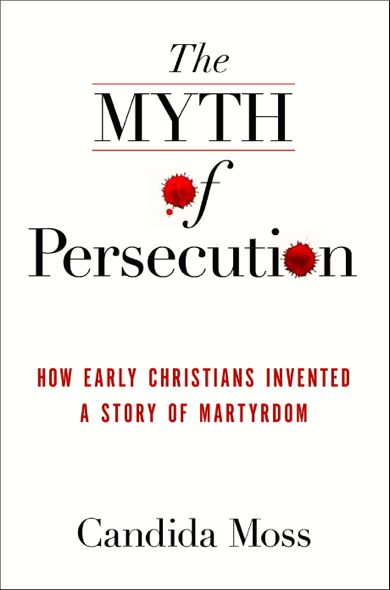
The author of the Myth of Persecution is Dr. Candida Moss, professor of New Testament and Early Christianity at the University of Notre Dame. She is a graduate of Oxford University and earned her doctorate from Yale University.
The Myth of Persecution deals with the persecution of Christians during the first 300 years of Christianity. Moss shows that she as an excellent grasp of Christian and non-Christian literature written during the early centuries of the Christian church.
While Moss admits that Christians were persecuted on and off throughout the first 300 years of church history, she thoroughly debunks the claim that Christians were always persecuted. In fact, many of the instances of persecution were actually prosecutions.
Moss writes:
The Sunday school narrative of a church of martyrs, of Christians huddled in catacombs out of fear, meeting in secret to avoid arrest, and mercilessly thrown to lions for their religious beliefs is a macabre fairy tale. When Christians appeared in Roman courtrooms, they were not tried as heretics, blasphemers, or even fools. Christians had a reputation for being socially reclusive, refusing to join the military, and refusing to swear oaths. Once in the courtroom Christians said things that sounded like sedition. They were rude, subversive, and disrespectful. Most important, they were threatening. Even if the actions of the Romans still seem unjust, we must admit that they had reasons for treating Christians the way they did. The fact that religion and politics were so intimately blended with one another means that it is difficult to parse the motivations of Roman administrators as either religious or political. But from a Roman perspective and from the perspective of members of most ancient religious groups and political organizations, the Romans had the moral high ground. They were protecting the Empire from the wrath of the gods and its effects. That Christians were executed should not surprise us, this is a world in which people paid the “ultimate price” for seemingly small offenses.
As we have seen in the past two chapters, a close look at the evidence shows that Christians were never the victims of sustained, targeted persecution. Even the so-called great persecutions under emperors Decius and Diocletian have been vastly exaggerated in our Christian sources. In general, when Christians were executed, it was for activities that were authentically politically and socially subversive. In the case of the emperor Decius , it seems that the so-called persecution of Christians wasn’t aimed at Christians of all. It was a way of bringing about social and political unity in the Empire, something more like a pledge of allegiance then religious persecution.
Throughout the book, Moss details how many of the source documents for the stories about Christian martyrs were embellished, and, at times, fabricated out of thin air. Even some the saints revered by the Catholic church have histories that call into question their authenticity. I was quite surprised and delighted that Moss, a professor at a Catholic university, did not shy away from the controversies surrounding the mythic stories of the Catholic church.
Moss also details how some of the ancient martyr stories were actually borrowed from other cultures and religious traditions. There were times when I thought Moss was stretching these connections a bit, but I found the chapter, Borrowing of Jewish and Pagan Traditions, to be quite fascinating.
Moss wrote:
Even a brief study of early Christian martyrdom literature reveals that Christians were influenced by ancient Greek, Roman, and Jewish traditions about death. The heroes of the classical world were reshaped into soldiers for Christ. When people admit that Christians were heirs to this legacy, they do so selectively. Many acknowledge the Christian martyrs inherit or at least claim to inherit the mantle of martyrdom from ancient Judaism. The references to and comparisons with the Maccabees provide incontrovertible evidence that Christians saw their martyrs as part of this tradition. This much is acknowledged or at least implicitly acknowledged in most scholarly and religious treatments of the subject.
When it comes to the Greek and Roman influences, however, things are very different. We would be hard-pressed to find any modern denomination of Christianity that admits Greek and Roman heroes and heroines in their canon of martyrs, even if Christians like Justin Martyr were willing to revere Socrates as a Christian before Christ. Why the difference? The distinction is not based on the evidence, but on the way that people think about the relationship between Christians and Jews. For Christians, the Old Testament is believed to contain a series of prophecies about Jesus and the church. If Christian martyrs seem to be like figures from the old and new Testaments, it is because their deaths are fulfillments of prophecies. They are seen as being part of a single unbroken tradition, a single witness to truth.
In the case of Greek and Roman examples, the connection between Christian and pagan martyrs is more problematic. There is no prophetic or divine time between Christianity and Greek and Roman religion and philosophy. On the contrary, the adaptation of paganism and Christianity threatens the idea that Christianity alone has the truth. Those who reject the classical tradition for religious reasons and hold Christian martyrs in high esteem tend to ignore Greek and Roman antecedents to martyrdom.
This is a game of cultural favorites. There’s a theological explanation for the fact the Christian martyrdom stories are similar to biblical narratives of persecution, but there is no such explanation for the similarities with pagan traditions. That Christianity might have borrowed from pluralistic, polytheistic religious traditions is difficult for those who conceive of themselves as part of an unbroken singular tradition. The problem is exacerbated by the fact that Greek and Roman religious practices no longer exist. The idea that Christianity borrowed from or was dependent upon morally questionable failed religions ruffles feathers and prayer books.
The truth of the matter is that as we have seen, Christians adapted their ideas about martyrdom and sometimes even the stories about the martyrs themselves from both ancient Jewish and pagan writers. We cannot help but note the irony here. Christians are thought to be unique because they die for Christ, but the stories by which they communicate their uniqueness are borrowed from other cultures. Clearly Christian martyrdom is one of a number of ancient varieties of martyrdom. Even though early Christians adapted, augmented, and otherwise contorted ancient models in their own stories, they were nonetheless dependent upon earlier literature. To be sure, Christian martyrdom stories depart from classical examples of noble deaths, but toying with, trumping, reversing, and usurping are not the same as inventing. Early Christians consciously and deliberately harnessed the cultural power of Greek, Roman, and Jewish heroes for their own ends.
All in all, The Myth of Persecution was a great read. If I were to have any criticism of the book it would be that the chapter on how the myth of Christian persecution affects our modern culture was quite sparse, only ten pages long. I wish she had spent a lot more time dealing with how the religious-right in the United States has a martyr complex that finds its root in the ancient Christian martyrdom stories.
I also found myself wishing that Moss had written a chapter or two about the martyrdom tradition and stories found in the Protestant church. This, I suspect, was beyond the scope of the book.
As any Evangelical knows, Foxe’s Book of Martyrs is considered one of the foundational texts of Evangelical belief. (especially in the Baptist church) I suspect the stories complied by John Foxe have their own problems, and while Moss did briefly mention Foxe’s Book of Martyrs, she said nothing about the stories contained in the book. Maybe her next book will be on the martyrs of church after Constantine.
I heartily recommend, The Myth of Persecution.
081116
Cookie Consent
We use cookies to improve your experience on our site. By using our site, you consent to cookies.
This cookie is set by X to identify and track the website visitor. Registers if a users is signed in the X platform and collects information about ad preferences.
2 years
personalization_id
Unique value with which users can be identified by X. Collected information is used to be personalize X services, including X trends, stories, ads and suggestions.
2 years
external_referer
Our Website uses X buttons to allow our visitors to follow our promotional X feeds, and sometimes embed feeds on our Website.