The Black Collar Crime Series relies on public news stories and publicly available information for its content. If any incorrect information is found, please contact Bruce Gerencser. Nothing in this post should be construed as an accusation of guilt. Those accused of crimes are innocent until proven guilty.
Casey Goslin, a youth pastor at several Evangelical Lutheran Church in America (ELCA) institutions, stands accused of buying and selling child pornography.
A 46-year-old youth group leader has been arrested after being accused of having child sex abuse material in Arizona, federal officials said. Casey Goslin, of Phoenix, a youth group leader with multiple religious organizations, was accused of being involved with a platform used to livestream child sexual abuse, according to an Oct. 21 news release by the U.S. Immigration and Customs Enforcement.
The children in the material were provided by sex traffickers in the Philippines, which led ICE Homeland Security Investigations agents to acquire a search warrant, officials said. The electronic devices seized during the search revealed Goslin used the usernames “live:.cid.bbdbec6f18b26922” and “live:.cid.de5ca094f7bdd45” when online, officials said. He was arrested on charges of attempting to produce child pornography and possession of child sexual abuse material, officials said. Due to his online presence and being a youth group leader, officials are asking for help in identifying potential victims.
A Lutheran youth ministry leader in Phoenix has been federally charged for producing and spending thousands on child sexual abuse materials.
The accused is Casey Goslin, 46, who worked as a youth director for several organizations tied to the Grand Canyon Synod, one of 65 in the Evangelical Lutheran Church in America (ELCA).
Goslin was arrested Thursday by ICE Homeland Security Investigations (HSI) and Tucson police, according to a press release from HSI.
Goslin allegedly used the Skype username “live:.cid.bbdbec6f18b26922” to buy and sell the explicit materials in 2024, according to a criminal complaint. In one conversation with a suspected child sex trafficker in the Philippines, Goslin exchanged digital tokens for a photo of a toddler performing sexual acts on another toddler.
Authorities subpoenaed PayPal and discovered that Goslin allegedly spent around $3,700 in 101 payments for similar graphic images. Each transaction cost on average from $1-$50, the complaint said.
In April 2025, HSI agents searched Goslin’s home, vehicle, and person and discovered additional explicit materials and “child erotica” on his computer and in WhatsApp on his phone.
Authorities added that Goslin produced the materials using another Skype username. He coerced a minor to engage in sexually explicit conduct for the purposes of producing a “live visual depiction” in April 2023, the complaint said.
Goslin has been suspended from all his roles in the Synod, Bishop Deborah Hutterer said in a statement.
He worked in Synod’s youth ministry and advisory team, she noted. According to the Synod website, Goslin also worked as a youth director and director for the West Valley Young Adult Community.
Bruce Gerencser, 69, lives in rural Northwest Ohio with his wife of 48 years. He and his wife have six grown children and thirteen grandchildren. Bruce pastored Evangelical churches for twenty-five years in Ohio, Texas, and Michigan. Bruce left the ministry in 2005, and in 2008 he left Christianity. Bruce is now a humanist and an atheist.
Your comments are welcome and appreciated. All first-time comments are moderated. Please read the commenting rules before commenting.
The Black Collar Crime Series relies on public news stories and publicly available information for its content. If any incorrect information is found, please contact Bruce Gerencser. Nothing in this post should be construed as an accusation of guilt. Those accused of crimes are innocent until proven guilty.
Jon Sheptock, a worship pastor at First Montgomery Baptist Church in Montgomery, Texas, stands accused of distributing child pornography. First Baptist is affiliated with the Southern Baptist Convention.
A former worship pastor and Christian music singer who shared his testimony of physical challenges is facing charges of distributing child pornography.
Jon Paul Sheptock, 49, was the worship minister at First Montgomery Baptist Church when detectives received information in August that he was in possession of and involved in producing child sexual assault materials. Those materials included videos and images of children engaged in sexual conduct.
After an investigation to establish probable cause, detectives attempted to arrest Sheptock at his residence in Gatesville on Sept. 26, but he wasn’t here. Sheptock was eventually located and arrested at a local women’s prison, where he had been ministering to inmates.
Senior Pastor Chris Gober of First Montgomery Baptist released a statement on Sept. 27 informing the church of Sheptock’s arrest and his immediate removal “from all responsibilities at the church.”
“He did not have responsibilities overseeing children in the church or school except occasionally in a large group setting with other adults,” said Gober. “At this point, we have no information that indicates any of the children in our care were involved, but we are taking every precaution to protect our kids and to maintain the integrity of our ministry.”
According to written testimony released from the Montgomery County Precinct 3 Constable’s office and covered by local media, the victim was a 17-year-old high school senior nine years ago when she believes Sheptock stole a nude photo of her from her iCloud account.
“After [Sheptock] sent the image of the victim, he told her that he wanted more explicit images of her. [Sheptock] then sent her a video depicting someone being physically assaulted, accompanied by a statement implying that he did not want that to happen to her,” the affidavit said.
It continued that the victim didn’t come forward at the time because “her parents’ strong religious beliefs” led her to worry about their reaction that she had taken a nude photo of herself.
….
She further testified that Sheptock showed multiple nude photos of adults and young girls on his computer. A text message sent to the victim last October included a nude photo of young girls.
Sheptock is facing two to 20 years in prison.
….
A Sept. 29 update from First Montgomery stated that, per the investigating detective, no alleged victims had been connected to the church. The most recent statement on Oct. 7, however, reported a new allegation against Sheptock “from an adult connected to our church.”
Bruce Gerencser, 69, lives in rural Northwest Ohio with his wife of 48 years. He and his wife have six grown children and thirteen grandchildren. Bruce pastored Evangelical churches for twenty-five years in Ohio, Texas, and Michigan. Bruce left the ministry in 2005, and in 2008 he left Christianity. Bruce is now a humanist and an atheist.
Your comments are welcome and appreciated. All first-time comments are moderated. Please read the commenting rules before commenting.
The Black Collar Crime Series relies on public news stories and publicly available information for its content. If any incorrect information is found, please contact Bruce Gerencser. Nothing in this post should be construed as an accusation of guilt. Those accused of crimes are innocent until proven guilty.
Jeremy Fair, pastor of Christ Presbyterian Church in Tulsa, Oklahoma, stands accused of soliciting a prostitute. Christ Presbyterian is affiliated with the Presbyterian Church in America (PCA).
On October 23, authorities in Glenpool, Oklahoma, carried out a multi-agency sting operation at a local hotel, leading to five arrests on solicitation of prostitution charges. Among those detained was Jeremy Fair, senior pastor of Christ Presbyterian Church in Tulsa, a congregation affiliated with the Presbyterian Church in America (PCA).
Fair was booked for solicitation of prostitution; bail was reportedly set at $1,000.
After learning of the arrest, Christ Presbyterian’s leadership convened and placed Fair on indefinite leave, pending the outcome of the investigation and the church’s internal disciplinary process as outlined in the PCA’s Book of Church Order.
“It is with a heavy heart we communicate information concerning Senior Pastor Jeremy Fair,” the church said in a statement to its congregation. “Yesterday, Jeremy was arrested and charged with engaging in prostitution. This is an ongoing investigation, and we do not have all the details.” Fair has since been removed from the leadership page on the church’s website.
….
Fair had served as senior pastor at Christ Presbyterian Church after prior pastorates in Alabama and Texas. His biography notes that he holds a BA from Dallas Baptist University, an MDiv from Southwestern Baptist Theological Seminary, and a DMin from Knox Theological Seminary.
According to law enforcement, the sting was part of a training exercise with the non-profit Skull Games and involved the Oklahoma Attorney General’s office, local police, and federal partners. Police say each individual met undercover operatives through online contacts and traveled to the hotel separately.
“They were all individuals that contacted through the channels that we were using for the investigation individually…None of them were together,” said police Chief Jeremy Plane. “Be vigilant — you never know who you’re going to encounter.”
Note: I support the legalization and regulation of prostitution, so the reason for posting stories such as this is to point out the moral hypocrisy found in many corners of the Evangelical world, and not the prostitution itself.
Bruce Gerencser, 69, lives in rural Northwest Ohio with his wife of 48 years. He and his wife have six grown children and thirteen grandchildren. Bruce pastored Evangelical churches for twenty-five years in Ohio, Texas, and Michigan. Bruce left the ministry in 2005, and in 2008 he left Christianity. Bruce is now a humanist and an atheist.
Your comments are welcome and appreciated. All first-time comments are moderated. Please read the commenting rules before commenting.
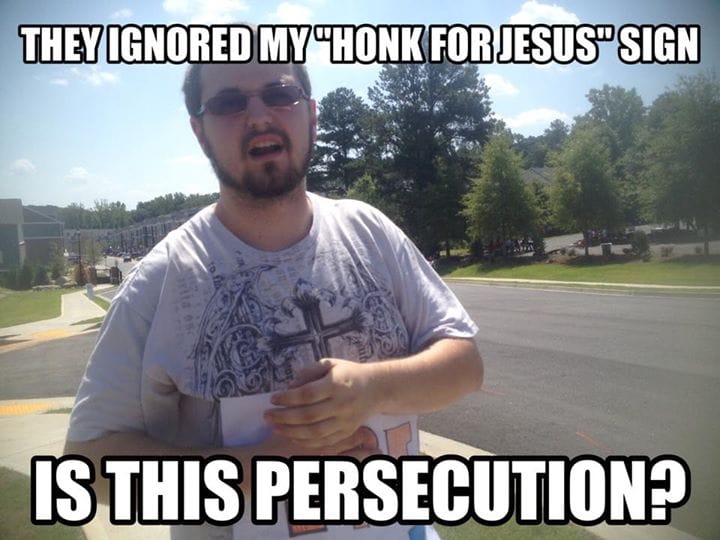
Recently, I received the following email about Christian persecution from an Evangelical reader:
I have an important question that cannot be ignored…because it is going on today. Christians are being savagely persecuted, limbs being cut off, being beheaded, all across Nigeria and other African nations. There have been more Christian martyrs in this last 30 years alone, all across the Middle East, the Far East and especially in Africa. In the 1990s, under Idi Amin in Uganda, mothers were getting their breasts chopped off so that they could not feed their babies. Babies were being thrown into the air in order to have them fall on a sword and be split in two. Unspeakable violence against innocent people. Christians being told to renounce their faith, or face persecution, torture and death. Why, if there were no transformative, undergirding power in Christ, would people choose torture and death and not recant? Where does such courage come from? If they aren’t getting comfort and fortitude from a greater power within them? These are important questions, and should not be ignored in an honest, unbiased search for truth. If people are truly seeking for truth, and trying to help and support one another on the journey, such questions need to be asked.
Evangelicals believe that, historically, Christians have been persecuted for their faith; that persecution is common experience, a sign of truth faith. This thinking is so deeply embedded in Evangelical thinking, that to suggest that Christian persecution is largely a myth is met with outrage and accusations of minimizing oppression believers have faced over the past two thousand years.
Let me be clear, Christians have, on occasion, suffered persecution for their faith. This can be said of Muslims, Buddhists, Mormons, pagans, and atheists too. When people have beliefs outside of cultural norms, they can face opposition and persecution from people who will not or cannot understand or accept beliefs different from their own. That said, MOST claims of Christian persecution lack evidentiary warrant or are lies. Have you ever had an Evangelical confidently claim that all twelve apostles were martyred for their faith? Sure you have, and this lie has become so fixed in Evangelical thinking that no one bothers to ask whether it is true. It’s not. At best, we have some evidence that suggests two or three of apostles might have been executed, but there is no evidence outside of church tradition for the martyrdoms of all of the apostles.
Few Evangelicals bother to ask WHY these alleged martyrs were killed. Were they really executed because of their faith? No. Much of the persecution believers faced was due to breaking the law, and not because of personal belief. When Christians refused to obey the law, they forced government powers to act; to punish, and if necessary, execute them for disobedience. Ask yourself, why was Jesus executed? Was it because he was a Jew rabbi? Was it because he preached morality and virtue? Or did the Roman government kill Jesus because he was a lawbreaker; a threat to Roman society?
In 2013, Dr. Candida Moss, then a professor at Notre Dame, wrote a book titled “The Myth of Persecution: How Early Christians Invented a Story of Martyrdom.”
The Sunday school narrative of a church of martyrs, of Christians huddled in catacombs out of fear, meeting in secret to avoid arrest, and mercilessly thrown to lions for their religious beliefs is a macabre fairy tale. When Christians appeared in Roman courtrooms, they were not tried as heretics, blasphemers, or even fools. Christians had a reputation for being socially reclusive, refusing to join the military, and refusing to swear oaths. Once in the courtroom Christians said things that sounded like sedition. They were rude, subversive, and disrespectful. Most important, they were threatening. Even if the actions of the Romans still seem unjust, we must admit that they had reasons for treating Christians the way they did. The fact that religion and politics were so intimately blended with one another means that it is difficult to parse the motivations of Roman administrators as either religious or political. But from a Roman perspective and from the perspective of members of most ancient religious groups and political organizations, the Romans had the moral high ground. They were protecting the Empire from the wrath of the gods and its effects. That Christians were executed should not surprise us, this is a world in which people paid the “ultimate price” for seemingly small offenses.
As we have seen in the past two chapters, a close look at the evidence shows that Christians were never the victims of sustained, targeted persecution. Even the so-called great persecutions under emperors Decius and Diocletian have been vastly exaggerated in our Christian sources. In general, when Christians were executed, it was for activities that were authentically politically and socially subversive. In the case of the emperor Decius , it seems that the so-called persecution of Christians wasn’t aimed at Christians of all. It was a way of bringing about social and political unity in the Empire, something more like a pledge of allegiance then religious persecution.
In the chapter titled Borrowing of Jewish and Pagan Traditions, Moss wrote:
Even a brief study of early Christian martyrdom literature reveals that Christians were influenced by ancient Greek, Roman, and Jewish traditions about death. The heroes of the classical world were reshaped into soldiers for Christ. When people admit that Christians were heirs to this legacy, they do so selectively. Many acknowledge the Christian martyrs inherit or at least claim to inherit the mantle of martyrdom from ancient Judaism. The references to and comparisons with the Maccabees provide incontrovertible evidence that Christians saw their martyrs as part of this tradition. This much is acknowledged or at least implicitly acknowledged in most scholarly and religious treatments of the subject.
When it comes to the Greek and Roman influences, however, things are very different. We would be hard-pressed to find any modern denomination of Christianity that admits Greek and Roman heroes and heroines in their canon of martyrs, even if Christians like Justin Martyr were willing to revere Socrates as a Christian before Christ. Why the difference? The distinction is not based on the evidence, but on the way that people think about the relationship between Christians and Jews. For Christians, the Old Testament is believed to contain a series of prophecies about Jesus and the church. If Christian martyrs seem to be like figures from the old and new Testaments, it is because their deaths are fulfillments of prophecies. They are seen as being part of a single unbroken tradition, a single witness to truth.
In the case of Greek and Roman examples, the connection between Christian and pagan martyrs is more problematic. There is no prophetic or divine time between Christianity and Greek and Roman religion and philosophy. On the contrary, the adaptation of paganism and Christianity threatens the idea that Christianity alone has the truth. Those who reject the classical tradition for religious reasons and hold Christian martyrs in high esteem tend to ignore Greek and Roman antecedents to martyrdom.
This is a game of cultural favorites. There’s a theological explanation for the fact the Christian martyrdom stories are similar to biblical narratives of persecution, but there is no such explanation for the similarities with pagan traditions. That Christianity might have borrowed from pluralistic, polytheistic religious traditions is difficult for those who conceive of themselves as part of an unbroken singular tradition. The problem is exacerbated by the fact that Greek and Roman religious practices no longer exist. The idea that Christianity borrowed from or was dependent upon morally questionable failed religions ruffles feathers and prayer books.
The truth of the matter is that as we have seen, Christians adapted their ideas about martyrdom and sometimes even the stories about the martyrs themselves from both ancient Jewish and pagan writers. We cannot help but note the irony here. Christians are thought to be unique because they die for Christ, but the stories by which they communicate their uniqueness are borrowed from other cultures. Clearly Christian martyrdom is one of a number of ancient varieties of martyrdom. Even though early Christians adapted, augmented, and otherwise contorted ancient models in their own stories, they were nonetheless dependent upon earlier literature. To be sure, Christian martyrdom stories depart from classical examples of noble deaths, but toying with, trumping, reversing, and usurping are not the same as inventing. Early Christians consciously and deliberately harnessed the cultural power of Greek, Roman, and Jewish heroes for their own ends.
The letter writer goes on to ask a rhetorical question (in her mind, anyway) that Evangelicals commonly ask me: Would Christians be martyred for lie? The short answer is yes! People are willing to be martyred for all sorts of reasons, including those that have no foundation in truth. Why, then, are some Christians willing to have their heads lopped off for Jesus?
Evangelicals are taught that this present life is transitory; that this life is preparation for the afterlife; that this life is nothing compared to what awaits them in Heaven after they die. Thus, it is not surprising that some Christians are willing to stand for Jesus, even if it means losing their lives. Sure, they will be dead, but they will awake in Heaven, free from the evils of this world. Sadly, those who are martyred will receive praise and honor among their fellow Christians, even though there is no evidence for the existence of the resurrected Jesus. Evangelicals think a dead man is coming to save them. He’s not, and unfortunately, they will never know that. Christians die no differently than atheists. Last breath, lights out, that’s all folks! (Picture the end of Loony Tunes cartoons back in the day.)
Romans 13 commands Christians to obey the laws of the land. If the government prosecutes churches and believers for breaking the law, is it persecution? No. Persecution is when people are punished by the government for their religious beliefs and practices; not when believers refuse to follow the laws the rest of us do and suffer the consequences. If a missionary smuggles Bibles into North Korea and he is arrested and incarcerated for doing so, is he being persecuted? No, he broke the law. The same goes for smuggling Bibles into countries that ban Bible distribution or evangelizing people in countries where proselytization is a crime. By all means do what “God” has laid upon your heart, but don’t scream “persecution” when you are punished for your crimes. Instead, endure your “persecution” as a faithful servant of God, awaiting the day when prayers are answered and your prison door is miraculously unlocked, setting you free. Or you and your Christian supporters can plead with the State Department, your elected representatives, and even the President of the United States to get you out of the slammer. Make sure they emphasize that you are a poor, humble servant of Christ who is being persecuted for your faith. Not a pigheaded lawbreaker; but a meek, mild liar for Jesus.
Religious persecution is real, but it is nowhere near as widespread as Evangelicals suggest. Many Evangelicals have read John Foxe’s classic sixteenth century book, Foxe’s Book of Martyrs. They wrongly conclude that the stories in the book are true, and that persecution is a normal part of Christian existence. The book is, in fact, an admixture of facts and errors, as modern historians will attest. Only Evangelicals treat the book as an infallible account of Christian persecution. In the Independent Fundamentalist Baptist (IFB) church movement I grew up up in, Foxe’s book was considered essential reading, right next to the King James Bible, Strong’s Exhaustive Concordance, and the 1828 edition of Webster’s Dictionary.
Bruce, is there anything you are will to die for? Sure, I am willing to protect my partner, children, and grandchildren from harm, even if it causes my death. I am willing to defend my home if the Huns are at the gate or Herr Trump’s Gestapo is trying to round us up for trip to extermination camps. If I saw someone trying to harm or kill someone else, I would try to intervene. That said, would I die for atheism? Hell, no. If a gun was put to my head and I was given a choice between death and converting to Christianity, I would convert immediately. I wouldn’t “really” get saved, but being a Christian is easy to fake. My partner, Polly, and I have not been to a church service in seventeen years — outside of funerals and weddings. That said, I have no doubt that we could fake being Christians, so much so that we could easily fool preachers. In fact, I am confident that I can still deliver a rousing sermon, give an altar call, and lead people to Christ — all without a “greater power within.”
Were you raised in Evangelical churches? What were you taught about Christian martyrdom? Did your pastors encourage you to read the cult classic, Foxe’s Book of Martyrs? Did you fear that you might be martyred someday? Please share your thoughts in the comment section.
Bruce Gerencser, 69, lives in rural Northwest Ohio with his wife of 48 years. He and his wife have six grown children and thirteen grandchildren. Bruce pastored Evangelical churches for twenty-five years in Ohio, Texas, and Michigan. Bruce left the ministry in 2005, and in 2008 he left Christianity. Bruce is now a humanist and an atheist.
Your comments are welcome and appreciated. All first-time comments are moderated. Please read the commenting rules before commenting.
I was an Evangelical Christian for fifty years, and a pastor for twenty-five years. I had a lot of personal experiences with the God of the Bible. How could I not since the Holy Spirit lived inside of me 24/7, teaching and guiding me in everything pertaining to life and godliness? My life was littered with personal interactions with the thrice holy God.
At the age of six, I had my first supernatural encounter, not with God, but Satan. One day, I “sensed” the Devil’s presence in my bedroom. I left my room, and when I came back, I found that my clothes that were on top of the dresser were thrown all over the room. Who did this? I was certain Satan did. The more likely culprit was my Satanic five-year-old brother or three-year-old sister. 🙂 However, thanks to the indoctrination and conditioning I had already received at Scott Memorial Baptist Church (now Shadow Mountain Community Church) in San Diego, I was certain that Satan was real and personally involved in my life (just as Jesus was).
At the age of fifteen, I attended an Al Lacy revival meeting at Trinity Baptist Church in Findlay. By then, I had attended church almost 1,500 times, both with my parents and by myself. I heard scores of gospel sermons, yet until the Lacy revival, I had never repented and put my faith in Jesus Christ. On that night, I “felt” deep Holy Spirit conviction. At the appointed time, I went forward and was instantaneously saved. I had no doubt that it was God himself speaking me.
Two weeks later, I again felt Holy Spirit conviction, this time over what to do with my life. I decided on that night that God was calling me to preach. I went forward during the altar call and professed before the church, including dozens of my high school friends, that God was calling me to enter the ministry. Several weeks later, I preached my first sermon before one hundred or so junior high school students. My text? 2 Corinthians 5:20: Now then we are ambassadors for Christ, as though God did beseech you by us: we pray you in Christ’s stead, be ye reconciled to God. (KJV)
Over the years, I had numerous personal experiences with God. I sometimes felt his presence while I preached, and there were times when the presence of God was felt by most people in attendance. There were times when I felt God’s presence when praying, especially when I was praying by myself in the darkness of the church sanctuary.
For most of my life, I believed God was ever-present in my life, even though he rarely, if ever answered my prayers. How did I KNOW that I was experiencing the presence of God? What evidence did I have for those experiences? None, outside of faith.
A common thread in these programs is the requirement that religious believers (mainly Christians, Muslims, and Jews) provide EVIDENCE for their claims, and not personal stories and testimonies. The reason for this is simple. Personal experiences apply to the individual person alone. I shared several personal experiences in this post. Are these stories evidence for the existence of God? Of course not. All these stories say is that I had these experiences and believed they were true. By faith, I believed God was speaking to me and working in my life. Could I justify these claims? No, but I believed them to be true.
Over the years, scores of Evangelicals, along with a handful of Catholics, Muslims, and Mormons, have dumped their personal testimonies in the comment section, thinking that I would be won over to Jesus by their experiences. And when I reject their supernatural stories, believers storm off in anger, thinking they have provided me evidence for the existence of God and the veracity of the Bible. They haven’t. No personal testimony is going to reach me for Jesus. Just because Evangelicals say that God did A, B, C, and D for them doesn’t mean he actually did. I remain unconvinced until empirical evidence is provided for supernatural claims. And until that evidence is forthcoming, I cannot and will not believe. I am unwilling to “faith it.”
Are you a former Evangelical Christian? Did you have supernatural interactions with God/Jesus/Holy Spirit? Did you ever sense the presence of God in your life? How do you explain these experiences now that you no longer believe? Please share your stories in the comment section.
Bruce Gerencser, 69, lives in rural Northwest Ohio with his wife of 48 years. He and his wife have six grown children and thirteen grandchildren. Bruce pastored Evangelical churches for twenty-five years in Ohio, Texas, and Michigan. Bruce left the ministry in 2005, and in 2008 he left Christianity. Bruce is now a humanist and an atheist.
Your comments are welcome and appreciated. All first-time comments are moderated. Please read the commenting rules before commenting.
If is carrying a lot of weight in this question. How would one go about “proving” Christianity? So far, every argument I have heard from believers allegedly “proving” Christianity comes up short. Quite frankly, many of the arguments Christian apologists use are fantastical or absurd. These arguments may work with people already predisposed to Christianity, but they won’t usually work atheists. Apologists continue to churn out books defending Christianity, but these books aren’t for unbelievers. The target audience is believers, and the goal is to provide them with “evidence” to reinforce and justify their claims, along with settling their nerves after having an atheist eviscerate their beliefs. (Many atheists are former Christians themselves. They know the Bible inside and out.)
Is it possible that someone could convince me that Christianity is true? I would like to say yes, wanting to keep an open mind, but knowing all I do about Christianity, the Bible, and the various arguments used by apologists to defend the faith, I can’t imagine any Christian being able to convince me that I should return to Christianity. If you are a Christian, you are welcome to try to convert me, but I hope you can handle rejection and disappointment; that’s likely what you will experience by trying to put another notch on your gospel six-shooter.
Will this post stop apologists from trying to evangelize me? Of course not. As sure as the sun comes up in the morning, a believer will leave a comment on this site or send me an email detailing their supercalifragilisticexpialidocious argument they are sure will lead me to the light. Sorry, but I was a Christian for most of my life. I spent five decades in the “light.” I was a pastor for twenty-five years. I am confident that I have heard every possible argument for the existence of the Christian deity and the alleged veracity of Christianity. What could you possibly say that I haven’t heard countless times before? Feel free to advance whatever argument you think will reach me, but understand that there is little doubt about whether I have heard it (or used it myself) before.
Bruce Gerencser, 69, lives in rural Northwest Ohio with his wife of 48 years. He and his wife have six grown children and thirteen grandchildren. Bruce pastored Evangelical churches for twenty-five years in Ohio, Texas, and Michigan. Bruce left the ministry in 2005, and in 2008 he left Christianity. Bruce is now a humanist and an atheist.
Your comments are welcome and appreciated. All first-time comments are moderated. Please read the commenting rules before commenting.
Every day, I learn things about science I didn’t know before. I am always learning new stuff, but make no mistake about it, I know very little about science. I know the basics, and I continue to educate myself through reading and listening to podcasts, but I am not, nor will I ever be, an expert. This is what happens when you spend most of your life thinking the King James Bible is a science textbook and the universe as created in six twenty-four hour days, 6,029 years ago. It was not until I deconverted that I read books about biology, cosmology, and evolution.
Since I am not an science expert, I do what I always do; I rely on people who are experts to teach me and explain what I don’t know. This doesn’t mean experts are infallible, but, generally, experts can be trusted to tell us the truth (as they understand it at that moment). I try to check new things I hear against scientific consensus. I learned years ago as a pastor that if I came up with a novel interpretation of the Bible, it was likely that I was wrong. I still live by this principle today.
Sadly, way too many Evangelicals think that they know more than scientists do because the Holy Spirit is their teacher and guide. Dr. David Tee, whose real name is Derrick Thomas Thiessen, illustrates this point when he says:
As usual, he [Bruce Gerencser] thinks unbelievers can understand the Bible even though the Bible clearly says they can’t because they do not receive the Spirit of Truth. Everyone needs the Spirit of Truth to find what God is saying and so that everyone gets the same message.
In other words, the vast majority of humans can’t understand the Bible. Regardless of how much education they have, Bible knowledge is impossible for them because they are not indwelt by the Holy Spirit. This is why a man with a Bible college education from an unaccredited college thinks he knows more about the Bible than most unbelieving scholars, even if they have PhDs and extensive knowledge about the Bible.
Sunday after Sunday, Evangelical preachers — many of whom who have no relevant college training in the Bible, particularly the original languages — stand confidently before their congregations and say, THUS SAITH THE LORD. I have heard scores of sermons preached by men who have either no secondary training or have degrees from institutions focused on teaching preachers what to think, instead of how to think. These preachers stand before their congregations, preaching a book that they don’t know much about. Often, they just regurgitate what they heard in church or college. The next time you get a chance, check out the curriculums of several Evangelical Bible colleges. You will quickly learn how little they are taught about the Bible. Most preachers will exit college without comprehensively studying most of the books of the Bible (and survey courses don’t count).
That’s not to say that all Evangelical preachers are uneducated. I know more than a few Evangelicals who have educations from major universities. Why they are still Evangelicals befuddles me, but it would be wrong to judge all preachers by the ignorant hillbillies who comment on this site.
Bruce Gerencser, 69, lives in rural Northwest Ohio with his wife of 48 years. He and his wife have six grown children and thirteen grandchildren. Bruce pastored Evangelical churches for twenty-five years in Ohio, Texas, and Michigan. Bruce left the ministry in 2005, and in 2008 he left Christianity. Bruce is now a humanist and an atheist.
Your comments are welcome and appreciated. All first-time comments are moderated. Please read the commenting rules before commenting.
I love it when a new reader assumes that I am just an illiterate atheist who doesn’t know anything about the Bible. Typically, such people lack curiosity, so they don’t read my ABOUT page. Then I let them know that I was part of the Evangelical church for fifty years; that I spent twenty-five years pastoring churches in Ohio, Texas, and Michigan. When told this, their arguments switch to questions about what I “really” believed or what hurt me enough to cause me to leave Christianity. Sometimes, Evangelicals, with a wave of their sanctimonious hands, dismiss my story out of hand, saying I never was a believer. What they never do is engage me on what the Bible actually teaches.
Sometimes, when confronted with posts by me that challenge their beliefs, Evangelicals dismiss me by saying that it is evident I have never read the Bible. I snicker when someone says this to me. I have read the Bible from table of contents to index numerous times — more times than MOST Evangelical Christians. Further, I spent 20,000 hours of my life reading and studying the Bible, reading countless (well, I could count them if I were inclined to do so) theological tomes in my studies. Years ago, a Christian school student walked into my study and looked at all my books, saying, “Preacher, did you read all of these books?” I smiled and said, “most of them.”
Recently, I bought an NRSV study Bible. I plan to re-read the Bible as time allows. I am interested in seeing how my thinking about the Biblical text has evolved over the past seventeen years. Granted, some atheists are illiterate about the core teachings of Christianity. Believe me, I find their pontifications embarrassing too. Atheism is not well served by apologists who are too lazy to study and understand that which they criticize. The good news is that many atheists are former Christians. We are not ignorant of what the Bible teaches.. Contrary to what Thiessen said above, We know the Bible inside and out — no Holy Ghost needed. We are living testaments to their false claim that people deconvert because they were poorly taught or lacking knowledge about the Bible. If you happen to think all atheists are stupid, by all means press your claims in the comment section. Let’s see who is stupid.
Bruce Gerencser, 69, lives in rural Northwest Ohio with his wife of 48 years. He and his wife have six grown children and thirteen grandchildren. Bruce pastored Evangelical churches for twenty-five years in Ohio, Texas, and Michigan. Bruce left the ministry in 2005, and in 2008 he left Christianity. Bruce is now a humanist and an atheist.
Your comments are welcome and appreciated. All first-time comments are moderated. Please read the commenting rules before commenting.
Recently, a local Evangelical man responded to my recent letter to the editor of the Defiance Crescent-News about the LifeWise Academy release time program. His letter was published today. Here’s what he had to say. The title, by the way, is added to the letter by the editor of the newspaper. He is also a Christian, so I expect he agrees with its sentiment.
Pray for this man
The Bible (Matthew 24:10-12) speaks of a falling away of the church as we approach the end of an age. I can’t think of more classic example of that than an ex-pastor of decades long dedication maligning the Bible, the Church and a religious organization. [Ooh, I am a classic example of the “great falling away” the Bible speaks of.]
That is the rotted fruit of freewill that God has given us. I cannot imagine the turmoil faced by this man that has caused such a gigantic swing in his spiritual thinking. [Note the straw man he has built in his mind about me: a man with a life filled with turmoil. As far as freewill is concerned, it is a myth. I will gladly debate any and all local Christians on this issue, especially since the Bible does NOT teach humans have freewill.]
But I don’t take that away from him. It is his choice, and it will be his consequence for it. The sad fact is by his public announcement he may well lead others to follow his path, and that too will have serious consequences. [I can only hope.]
The organization which he berates not only leads children to the Cross of Jesus, but it also builds character and honesty and fosters love, something that is missing in some of the homes these children come from. [And they do so by hiding their true agenda.]
Matthew 18:6: “but whoever causes one of these little ones who believe in me to sin, It would be better for him to have a great millstone fastened around his neck and to be drowned in the depth of the sea.” [Awesome. No Hell for me. This man suggests putting a millstone around my neck and throwing me in the sea to drown. What an awesome God he serves.]
Please, may every Christian who reads this, pray for this person. [Thousands of Evangelicals have prayed for me over the past seventeen years, without success. Either God ain’t listening or he doesn’t exist. My money is on the latter.]
Ron Bliss Wauseon
— end of letter
Today, I also received an email from a local man praising me for my letter to the editor. And for that I am grateful.
Bruce Gerencser, 69, lives in rural Northwest Ohio with his wife of 48 years. He and his wife have six grown children and thirteen grandchildren. Bruce pastored Evangelical churches for twenty-five years in Ohio, Texas, and Michigan. Bruce left the ministry in 2005, and in 2008 he left Christianity. Bruce is now a humanist and an atheist.
Your comments are welcome and appreciated. All first-time comments are moderated. Please read the commenting rules before commenting.
Ohio, one of a handful of states without comprehensive sex education taught in schools, has a higher teen birth rate than the national average.
The national birth rate for females 15-19 years old was 13.1 per 1,000 females and Ohio’s teen birth rate is 14.6 per 1,000 females in 2023, according to the Centers for Disease Control and Prevention.
More than half (61%) of Ohio’s chlamydia cases in 2023 were people between the ages of 15-24, according to the Ohio Department of Health. Ohio’s syphilis rate (16.3 per 100,000) was higher than the national average (15.8 per 100,000) in 2023, according to the CDC.
“What we’ve seen is states that have no sex ed or poor sex ed policies, they typically fare worse on health indicators such as (sexually transmitted infections) rates, teen birth rates, having lower contraceptive knowledge, and other existing health disparities,” said Nawal Umar, senior policy analyst for Sexuality Information and Education Council of the United States (SIECUS).
“These states are also putting their young people at higher risk for sexual violence victimization and having poor mental health outcomes because sex education provides really critical instruction, consent and communication and healthy relationships and so much more,” Umar said.
Ohio’s curriculum stresses abstinence as a general policy and requires some instruction about sexually transmitted infections, according to the Ohio Revised Code.
Schools are required to “emphasize adoption as an option to unintended pregnancies” and “teach the potential physical, psychological, emotional, and social side effects” of sex outside of marriage, according to Ohio’s law.
Because Ohio lacks comprehensive sex education, it’s ultimately up to each school district on how they decide to teach it.
“When there’s not a sex education policy in place at the state level, one of the major consequences of that is that teens across the state can have very diverse experiences when it comes to the kind of instruction they’re receiving about their bodies because there’s a lack of uniform policy,” Umar said.
The Ohio Department of Education and Workforce is required to conduct an annual audit to ensure school districts are in compliance with the state’s law.
Every district completed the 2023-24 audit and all but three school districts were found to be overall compliant. Jefferson Township Local School District (Montgomery County), Ridgewood Local School District (Coshocton County), and Washington Local Schools (Lucas County) were non-compliant.
In explaining why it didn’t meet the standards, Ridgewood told the state “many family structures exist today, and all can provide children with a loving and supportive environment.”
“We have school staff and students who come from single-parent households, same-sex couples, and traditional married couple families alike,” the district said. “This highlights the importance of recognizing and respecting all family types. Furthermore, sex education should never be used to shame students for their family background.”
Jefferson Township’s district said it only have 255 students and was unable to find someone to teach sex ed, according to ODEW’s audit.
“We do not teach children that if they were born out of wedlock there are harmful consequences for society,” Washington Local Schools wrote in their explanation. “All children have opportunities and are valued by our school district.”
Ohio is the only state without its own state health education content standards. Ohio lawmakers decide curriculum requirements, so the State Board of Education can not require health education standards.
“It’s maddening that the State of Ohio has refused to implement this after decades of experts, educators, even religious communities, asking for this curriculum to be delivered in public schools because, unfortunately, some students don’t have families who are able to provide them with this information,” said Abortion Forward Executive Director Kellie Copeland.
Comprehensive sex ed is medically accurate, age-appropriate information that teaches about sexual health, healthy relationships, and consent, said Jenna Wojdacz, Planned Parenthood of Greater Ohio’s senior director of strategy and community engagement.
“Access to accurate sexual health information should not be political,” Wojdacz said. “It’s certainly what our young Ohio students need.”
The Ohio Center for Sex Education is the education arm of Planned Parenthood of Greater Ohio that teaches comprehensive sex education in schools and community organizations.
The center currently teaches in six school districts — Cleveland Metropolitan School District (Cuyahoga County), Akron Public Schools (Summit County), Lakewood City Schools (Cuyahoga County), Berea Schools (Cuyahoga County), Shaker Heights Schools (Cuyahoga County), and Columbus City Schools (Franklin County).
A 2021 report from the Journal of Adolescent Health reviewed three decades of research and determined there is strong support for comprehensive sex education.
“When we don’t have comprehensive sex education, we know that learners are getting misinformation that is basically values laden by somebody else’s propaganda agenda,” Wojdacz said.
Benefits of teaching comprehensive sex ed include reduced teenage birth rates, reduced STI rates, increased contraceptive usage, and delayed sexual activity, according to Umar.
Students who received comprehensive sex education were less likely to have a teen pregnancy than those who received either no sex ed or abstinence-only programs, according to a 2008 report in the Journal of Adolescent Health.
Advocates spoke out against having abstinence-only as a general policy.
“It’s ineffective,” Umar said. “It also tends to be pretty heteronormative.”
“A lot of the abstinence-only curriculum teaches this purity idea that if something sexually happens to you, then you’re not pure,” Copeland said. “That is so damaging to the psyche of people who have either become sexually active because they wanted to or because they didn’t want to.”
Ultimately, Copeland said, teaching abstinence-only as a general policy does not work.
“It leaves (students) without vital information for when they do become sexually active later in their lives,” she said. “It’s really important for people to understand how their bodies work, how pregnancy works, and how sexually transmitted infections work.”
Receiving comprehensive sex education does not encourage students to engage in sexual activity, Wojdacz said.
“In no way does our curriculum promote giving it a try or encouraging people to engage in any activities,” she said. “There’s no prescriptive aspect to comprehensive sex ed. … It’s reductive to suggest that accurate information is going to suddenly trigger a bunch of destructive behavior in people or a bunch of ill-advised behavior.”
Ohio is one of 13 states that received an “F” on SIECUS’s state profiles on sex education policy. Washington, Oregon, California, Illinois, New Jersey and Rhode Island all received an “A.”
Twenty-seven states and the District of Columbia have laws requiring sex education, according to SIECUS.
Umar urges Ohio lawmakers to push for better sex ed policies.
“There’s so many benefits that could be achieved by improving sex education,” she said.
Bruce Gerencser, 69, lives in rural Northwest Ohio with his wife of 48 years. He and his wife have six grown children and thirteen grandchildren. Bruce pastored Evangelical churches for twenty-five years in Ohio, Texas, and Michigan. Bruce left the ministry in 2005, and in 2008 he left Christianity. Bruce is now a humanist and an atheist.
Your comments are welcome and appreciated. All first-time comments are moderated. Please read the commenting rules before commenting.
This cookie is set by X to identify and track the website visitor. Registers if a users is signed in the X platform and collects information about ad preferences.
2 years
personalization_id
Unique value with which users can be identified by X. Collected information is used to be personalize X services, including X trends, stories, ads and suggestions.
2 years
external_referer
Our Website uses X buttons to allow our visitors to follow our promotional X feeds, and sometimes embed feeds on our Website.