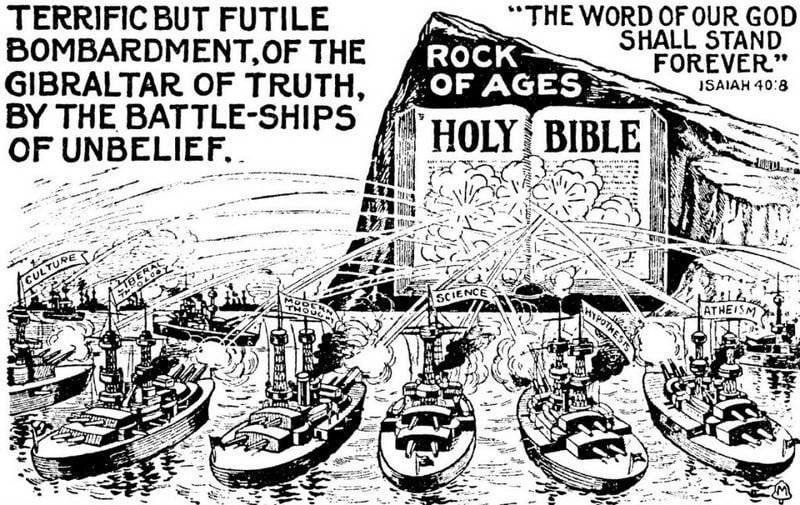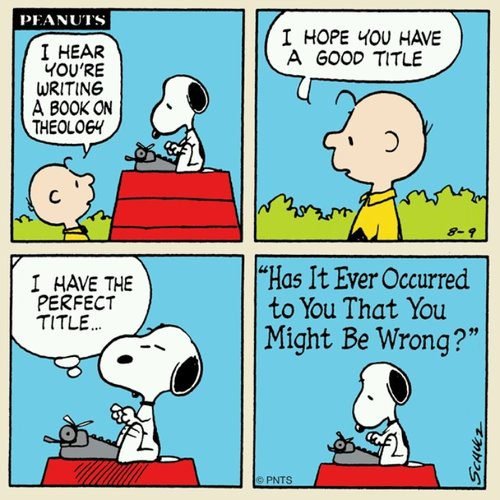
Dr. David Tee, an Evangelical preachers whose real name is Derrick Thomas Thiessen, continues to churn out posts about me, most of which I ignore. This one was impossible for me to ignore. The post in question is titled Do Not Listen to Unbelievers. All spelling, grammar, punctuation, and irrationality in the original.
If he [Satan] can bring down a dedicated Christian like BG [Bruce Gerencser] through an unbeliever like Bart Ehrman, he can do it to anyone who is unwary and thinks unbelievers know more than Christians do.
….
BG [Bruce Gerencser] serves as an example of what happens when one listens to unbelievers over godly people and God’s word.
….
The first question every Christian should ask themselves is ‘Why would unbelievers know more about the bible than Christians or God do?‘ They do not believe, thus how would they have the truth about the bible?
Shouldn’t the first question asked by Christians be, “How can anyone empirically know that the Bible is the Word (s) of God, and is inerrant and infallible in all that it says?”
In other words, Thiessen, knows more than renowned scholar, Dr. Bart Ehrman. In fact, he knows more about anything compared to what unbelieving experts know. Imagine all the unbelieving experts Thiessen dismisses with a wave of the hand, all because they are either atheists or worship a different deity from the Christian God. Imagine how empty and ignorant life would be if we automatically dismissed every expert that didn’t hold to the same beliefs as ours. For example, most of my doctors are religious. My primary care physician is an Evangelical Christian. Outside of comments made that assume I am a Christian, I have never questioned the knowledge and skill of these doctors. All that matters to me is their competency. I couldn’t care less about where they sit their asses on Sundays.
Unbelievers deny clear evidence supporting the bible, so how would they be in a position to determine if the Bible is accurate or true or not?
Time to put up or shut up, what “clear” evidence supporting the Bible am I ignoring? I have challenged Thiessen several times to a written or public debate on these and other issues. Instead of justifying his claims, Thiessen’s dismisses all challengers by asserting that unbelievers don’t know anything about the Bible. This, of course, is empirically untrue. One can know the Bible inside and out without ever being a Christian. And when I deconverted, I didn’t magically lose all the Bible knowledge I gained from fifty years in the Evangelical church. I am sure it pisses Thiessen off when former Evangelical preachers, missionaries, and professors speak authoritatively on the Bible. He’s convinced himself that he is intellectually superior to these men and women, despite giving evidence for being anything but.
They do not, and they are not. It is the unbeliever who is deceived and blinded by evil, so how would they know the Bible is false?
I know the Bible is errant and fallible based on extant information available to us; a position held by almost ALL Bible scholars apart from those who are Evangelicals. I know that the claims Thiessen and other Fundamentalist Christians make for the Bible are false because the evidence at hand says so. For Thiessen, the issue is not evidence as much as it is fealty to certain Evangelical dogmas. Simply put, Thiessen’s circular logic leads him to believe that the Bible is inerrant and infallible because it (allegedly) says it is. No amount of evidence will change his mind. Why? Because the Bible says, Let God be true and every man a liar.
The Christian is the one who is free from deception and lies and knows the truth; thus, any Christian who takes an unbeliever’s word over God’s is asking for destruction and other trouble.
Thiessen defines Christian thusly: a person who is free from deception and lies and knows the truth.🤣 This definition is found nowhere in the Bible.
Thiessen assumes there is one truth [his]. Believe as he does and you will not be deceived. Now, he will object to me saying this, but did he not say that his intellect and knowledge is superior to that of ALL unbelieving Bible scholars and scientists?
Here’s a man with only a Fundamentalist Bible college education and (allegedly) a ThD (not a PhD) from an unaccredited Christian college he refuses to name, declaring himself smarter than thousands and thousands of non-Christian Bible scholars and scientists. Thiessen thinks his wooden, literalistic interpretations of the Bible are superior in every way to the intellectual giants of this and past generations — the unsaved ones, anyway.
Time and again all the sciences have proven the Bible true and have failed to find one error or contradiction.
Anyone with a modicum of understanding of the Bible and science knows that Thiessen is either delusional — the result of seven decades of Evangelical indoctrination and conditioning — he’s secretly an atheist trying (and succeeding) to make Christianity look bad, he suffered brain damage as a child and never recovered, or he is a liar.
Thiessen claims that no one — not one time — has ever found an error or contradiction in the Bible. This, of course, is patently false. I have pointed out a few of these errors and contradictions over the years, and there’s a plethora of blogs, videos, and podcasts that disabuse Evangelicals such as Thiessen of their beliefs about the Bible. Just remember, Google is God. Pray to it and it will answer your prayers.
Granted, Evangelicals have “explanations” for most Bible contradictions and errors — but not all, and many of these explanations are intellectually lacking, and, at times, fantastical. And we must always be aware of the answer to every question and challenge Evangelicals can’t answer: Faith. Faith is a discussion stopper because it is belief without evidence (as taught in Hebrews 11).
….
We have recorded in our books our words which state that . . . no archaeological discovery has been made that proves the Bible false.
Yes, Thiessen is an “author,” having self-published several books.
Dr. Ehrman and other unbelievers are all part of that system of ideas, creating false tales about the bible, not out of facts but out of their unbelief and denials.
According to Thiessen, unbelieving Bible scholars create false tales about the Bible, not based on facts, but on their unbelief and denial of Biblical truth.
….
Why would Christians lie [about the Bible]? Every Christian knows that if they lie, they will lose souls, so what is the purpose of lying about God’s word? Plus, the Bible tells us in both the OT and the NT not to bear false witness or lie one to another, so why would Christians lie? They would be committing sin and ruining the work God wants them to do.
A “lie” is an untruth. People can and do lie without intending to do so. Christianity is a 2,000 year old lie; one passed on from generation to generation, with each generation interpreting the Bible differently from previous ones. Sunday after Sunday, preachers preach this lie as supernatural truth, and those sitting in the pews say AMEN with nary a thought about whether what they are hearing is true. This process of indoctrination and conditioning has been going on since the Bible was written.
Sometimes, Evangelicals deliberately lie. I have caught more than a few Christians telling lies on this site; making claims they knew were wrong. Preachers, in particular, can lie to keep their jobs, pacify their congregations, or make themselves look like “experts.” With fingers crossed behind their backs, these so-called men of God preach one thing from their pulpits and believe something different when in the privacy of their studies or when shooting the breeze with their colleagues in the ministry.
There is no point in lying to anyone about the Bible. If anyone is going to lie, it would be the unbelievers who have no objective moral code to live by.
Thiessen has a lack of imagination if he can’t think of any reasons preachers might lie about the Bible. Unbelievers are the liars, according to Thiessen, and we lie because we have “no objective moral code to live by.”
Thiessen thinks he lives according to an objective moral code; that code being his personal, and, at times, perverse interpretations of the Bible. However, like all of us, Thiessen has a subjective moral code. If Thiessen disagrees with me on this claim, I am more than happy to disabuse him of his moral claims.
This brings up the problem of young Christians who lose their faith because of what their unbelieving professors say in class.
The young Christians take the word of the unbelieving professors over God and their pastors because they have been taught wrong about science and scientists. They also did what BG [Bruce Gerencser] did, take the word of unbelievers over the Holy God of the Bible.
There’s an obvious problem with Thiessen’s claims. I was not a young Christian when I deconverted. I was a fifty-year-old man when I walked away from Christianity, after having spent twenty-five years preaching and teaching the Bible.
Unlike Thiessen. I value expertise wherever I find it, regardless of the religion of the expert. Of course, Thiessen grants the Bible supernatural power it does not have. The Bible is an ancient religious text written largely by unknown authors. There is no evidence for God’s authorship of the Bible, other than a handful of Bible verses that claim at least parts of the Bible are supernatural in origin.
How would unbelievers know if God lied? Science and scientists cannot see into the past and cannot tell anyone what did or did not take place. Dr. Craig Evans and many other Christian scholars have proven Ehrman to be wrong every time they discuss the latter’s points.
Thiessen can’t see into the past and cannot tell anyone what did or not take place either, but he believes he can when it comes to the creation of the universe and other Biblical claims.
If God wrote the Bible, as Thiessen claims, then God repeatedly lied about all sorts of things. Again, there is a plethora of evidence available that shows God saying one thing in one place in the Bible, and something completely different elsewhere.
As far as Dr. Ehrman is concerned, most of his scholarly critics — which doesn’t include Thiessen — agree with the data he presents, but disagree with his interpretations of said data. Is Ehrman wrong just because he is an agnostic atheist? Of course not. Instead of wallowing in the meta, Thiessen would better serve Christianity if he responded to Ehrman academically. If Ehrman is wrong, show it. Instead of focusing on inconsequential minutiae as Thiessen is wont to do, how about directly and comprehensively challenging and rebutting his claims? I doubt if Thiessen is up to the task. I know I am not. While I have extensive knowledge about Evangelicalism and its doctrines, I don’t know everything there is to know about Christianity. And this is why I rely on experts such as Ehrman to fill in the gaps in my understanding.
The unbelievers do not have the truth about the past or the Bible. It is only fools who stop listening to God and listen to those who do not believe. God is the only one who knows what took place in the past, and it is better to listen to him than those who have no knowledge of past events and reject the evidence supporting the Bible.
According to Thiessen, only the God of the Bible knows what happened in the past. What he means is that only his peculiar God knows the past. This, or course, is untrue. Thanks to science, we can peer into the distant past and make observations about the universe. Now, if God wrote a book that detailed what took place millions of years ago, I would read it, but God (nor Jesus) has never written one word about anything. All we have is what humans say about God. God, himself, is silent. So the question that must be asked is WHY should we believe anything the authors of the Bible say?
If you want the truth, then you follow the Holy Spirit to it, leaving behind interpretation so you can see the truth clearly. The physical evidence does not support unbelievers’ alternatives. It only supports the Bible.
I thought the Bible was “truth,” and all we had to do is read it to get understanding? Thiessen is now saying that understanding the Bible requires the Holy Spirit (God) leading us to the proper interpretation of the Good Book. Don’t you have to have the Holy Spirit living inside of you to be a Christian? This means, then, that no unbeliever, according to Thiessen, can understand the Bible. This also means that the moment I deconverted, God wiped my mind of all knowledge of him and the book he allegedly wrote.
I am not sure what we do with someone that says, “The physical evidence . . . only supports the Bible.” This statement is not a matter of difference of opinion; it’s a delusion, one born out of a lifetime of Fundamentalist indoctrination and conditioning. No amount of contrary evidence will change Thiessen’s mind, so I no longer try to do so. The main reason for sharing his post on this site and replying to it is to give readers examples of the bad thinking that permeates Evangelical Christianity,
Why do you think there are over 150 ancient flood and creation myths and not one ancient evolutionary myth? Any ancient person mentioning a non-supernatural creation does so without any physical evidence and only uses personal denial and unbelief to make their claims.
The Bible is true and unbelievers should never be listened to as they do not have the truth about the Bible.
Is Thiessen really this stupid? Of course there is “not one ancient evolutionary myth.” Our understanding of evolution only dates back to the nineteenth century, so it’s impossible for there to be an evolutionary myth. Creation stories are based on pre-science myths, evolution is based on a progressive, scientific understanding of our biological world.
Note that Thiessen claims there is NO physical evidence for evolution, only young earth creationism — the universe was created 6,029 years ago in six literal twenty-four days. Science tells us these claims are false, but until Thiessen grants science its due, he will continue to believe one of many mythical creation stories.
Derrick, please say Hi to Fred and Wilma. 😜
Bruce Gerencser, 69, lives in rural Northwest Ohio with his wife of 48 years. He and his wife have six grown children and thirteen grandchildren. Bruce pastored Evangelical churches for twenty-five years in Ohio, Texas, and Michigan. Bruce left the ministry in 2005, and in 2008 he left Christianity. Bruce is now a humanist and an atheist.
Your comments are welcome and appreciated. All first-time comments are moderated. Please read the commenting rules before commenting.
You can email Bruce via the Contact Form.