Welcome

  • Living With OCPD

    garfield ocpd

    I have battled Obsessive Compulsive Personality Disorder (OCPD) for most of my adult life. While OCPD and OCD have some similarities, there are differences, namely:

    • People with OCD have insight, meaning they are aware that their unwanted thoughts are unreasonable. People with OCPD think their way is the “right and best way” and usually feel comfortable with such self-imposed systems of rules.
    • The thoughts, behaviors and feared consequences common to OCD are typically not relevant to real-life concerns; people with OCPD are fixated with following procedures to manage daily tasks.
    • Often OCD interferes in several areas in the person’s life including work, social and/or family life. OCPD usually interferes with interpersonal relationships, but makes work functioning more efficient. It is not the job itself that is hurt by OCPD traits, but the relationships with co-workers, or even employers can be strained.
    • Typically, people with OCPD don’t believe they require treatment. They believe that if everyone else conformed to their strict rules, things would be fine! The threat of losing a job or a relationship due to interpersonal conflict may be the motivator for therapy. This is in contrast to people with OCD who feel tortured by their unwanted thoughts and rituals, and are more aware of the unreasonable demands that the symptoms place on others, often feeling guilty because of this.
    • Family members of people with OCPD often feel extremely criticized and controlled by people with OCPD. Similar to living with someone with OCD, being ruled under OCPD demands can be very frustrating and upsetting, often leading to conflict. (OCPD Fact Sheet)

    I have been considered a perfectionist most of my life, a badge I wore with honor for many years, and one I still wear on occasion. As we age — I am almost sixty-nine — we tend to reflect on our lives and how we got where we are today. Self-reflection and assessment are good, allowing us the opportunity to be honest about the path we have taken and choices we have made in life. (My therapist told me that I am one of the most self aware people she knows. Good? Bad? I don’t know.)

    When I first realized twenty-five or so years ago that I had a problem — a BIG problem that was harming my wife and children — the first thing I did was try to figure out how I ended up with OCPD. While my mother had perfectionist tendencies, she was quite comfortable living in the midst of clutter and disarray (but not uncleanliness). I concluded that it was my Fundamentalist Baptist upbringing with its literalistic interpretations of the Bible that planted in me the seeds of what would one day become OCPD. I spent most of my adult life diligently and relentlessly striving to follow after Jesus and keep ALL of his commandments. But try as I might, I still continued to come up short. This, of course, only made me pray more, study more, give more, driving me to allot more and more of my time to God/church/ministry. In doing so, the things that should have mattered the most to me — Polly, our children, my health, and enjoying life — received little attention. Polly was taught at Midwestern Baptist College — the IFB institution both of us attended in the 1970s — that she would have to sacrifice her relationship with me for the sake of the ministry. I was, after all, a divinely called man of God. Needless to say, for way too many years, our lives were consumed by Christianity and the work of the ministry, so much so that we lost all sense of who we really were.

    ocd santa

    Perhaps someday one or more of my six adult children will write about growing up in a home with a preacher father who had OCPD. The stories are humorous now, but not so much when they were lived out in real-time. My children are well versed in Dad’s rules of conduct. Granted, some of these rules such as “do it right the first time” have served them well in their chosen fields of employment, but their teacher was quite the taskmaster, and I am certain there were better ways for them to learn these rules.

    My oldest sons “fondly” remember helping me center the church pulpit, right down to one-sixteenth of an inch. Did it matter if the pulpit was slightly off-center? For most people — of course not; but, for me it did. I felt the same way about how I prepared my sermons, folded the bulletins, cleaned the church, and did countless other day-to-day responsibilities. When I took on secular jobs, employers loved me because I was a no-nonsense, time-to-lean, time-to-clean manager. (Is it any surprise that most of my adult jobs were either pastoring churches or management jobs?)

    People walking into my study were greeted by a perfectly cleaned and ordered office. The desktop was neat, and the drawers were organized, with everything having a place. My bookshelves were perfectly ordered from tallest to smallest book and then by subject. Dress-wise, I wore white one-hundred-percent pinpoint cotton shirts and black wingtip shoes. My suits were well-kept and matched whatever tie I was wearing. My appearance mattered to me (and still does). Congregants knew they would never find me shopping at the local Walmart wearing a t-shirt and sweatpants.

    What I have mentioned above sounds fine, right? Surely, I should have a right to order my life any way I want to. And that would be true, except for the fact that I live in a world populated by other people; people who are not like me; people who are happy with clutter, disarray, and OMG even dirt! It is in their personal relationships that people with OCPD have problems, and, in some instances, they can drive away the very people who love them.

    For the first twenty-five years of marriage, my relationship with Polly was defined by Fundamentalist Baptist/patriarchal thinking. It doesn’t take a genius to figure out that such beliefs play well in the minds of people with OCPD. I had high expectations not only for myself, but for my partner and children too. We all, of course, miserably failed, but all that did was increase the pressures to conform to silly (and at times harmful) behavioral expectations. It didn’t help matters that I was an outgoing decision-maker married to a passive, always-conform-to-the-wishes-of-others, woman. While we put on quite a dog and pony show for most of our time in the ministry, behind the scenes things were not as they outwardly appeared to be.

    In the early 2000s, I began to see how harmful my behavior was when it came to my familial relationships (and to a lesser degree my relationship with congregants). While it would be another decade before I would finally seek out professional secular counseling, I did begin to make changes in my life. These changes caused a new set of conflicts due to the fact that everyone was used to me being the boss, with everything being according to MY plan. While Polly and the kids loved their new-found freedom, there were times where they were quite content to let me be the stern patriarch. As with all lasting change, it takes time to undo deeply-seated behaviors.

    I am not so naive as to believe that I am “cured” of OCPD. I am not. My counselor is adept at pointing out to me when certain behaviors of mine move toward what she calls my OCD tendencies. I have had to be repeatedly schooled in the difference between good/bad and different. For example, young people today generally discipline their children differently from their baby-boomer parents. Read enough memes on Facebook and you will conclude that young parents have lost their minds when it comes to raising their children. What that brat needs is an ass-whipping, boomer grandparents say. What I continue to learn is that people who act differently from me, look different from me, or have beliefs different from mine are not necessarily wrong/bad. Most often, what they really are is “different.” Learning to be at peace with differences has gone a long way in muting my OCPD thinking.

    Both Polly and I agree that the last twenty or so years of married life have been great. One of the reasons for this has been my willingness to realize where my OCPD is causing harm and making the necessary changes to end the harm. The first thing I learned is that everyone is entitled to his or her own space. I have every right to order my office, drawers, and space as I want them to be. I no longer apologize for having OCPD. All that I ask of others is that when they invade my space, they respect my wishes. And that works for others too. I have to respect the personal boundaries of Polly, our six children, and our sixteen awesome grandchildren. This is why I do not meddle in their lives. I give advice when asked, but outside of that, they are free to live as they please. Do my children and adult grandchildren make decisions I disagree with, decisions that leave me mumbling and cussing? Yep, but it’s their lives, not mine, and I love them regardless of the choices they make.

    The second thing I learned is that it is important for Polly and me to have times of distance from each other. It is okay for each of us to do things without the other. We don’t have to like all the same things. Understanding this has allowed Polly’s life to blossom in ways I could never have imagined. If you had known Polly in 1999 and then met the 2022 version, why you would wonder if she is possessed. From going back to college and graduating, to becoming an outspoken manager at work, Polly is an awesome example of what someone can become once the chains of Fundamentalism and patriarchal thinking have been broken.
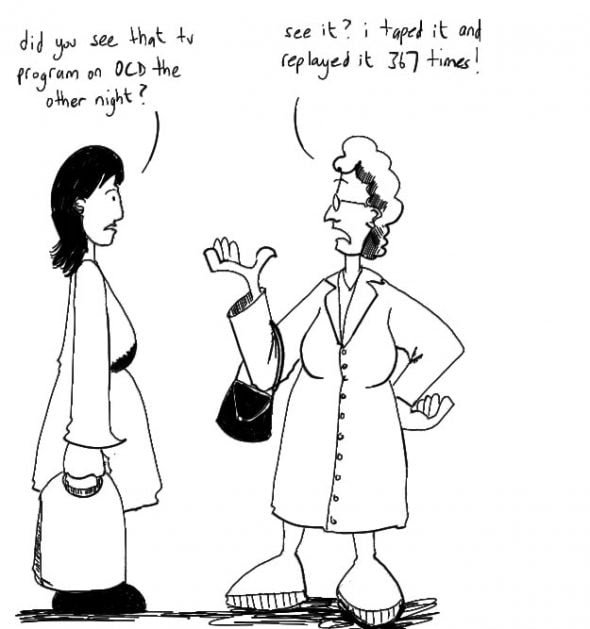
    ocd cartoon

    The third thing I learned is that my OCPD can be productively channeled, with my personal relationships surviving afterward. Polly loves it when she comes home and finds that I have emptied the cupboards, cleaned them, and replaced everything neatly and in order. The joke in the family is that people want me to come clean their house for them, but they can’t stand being around me when I do. 🤣 In the communal spaces where our lives collide, Polly and I have had to learn to give and take. I have learned that it is okay to leave the newspaper on the floor until tomorrow, and Polly has learned, come holidays, that I am going to clean every inch of the house, including under the refrigerator — with her help, of course. She will never understand why my underwear drawer needs to be straightened up for company, and she will likely never understand the need to clean under the stove/refrigerator four times a year. But, because she loves me, she smiles and says, what do you need me to do next?

    My chronic health problems and unrelenting pain have forced me to let go of some of my obsessions. I can’t, so I don’t. I don’t find this giving in/giving up easy to deal with, but I have come to see that life is too short for me to not enjoy the moment even if everything is not in perfect order. That said, I still have OCPD moments, and I suspect I always will. Several years ago, I had a dentist appointment. The dental assistant had me take a seat in the exam room. When she returned, she found me tapping the valance on the blind with my cane. I told her, I have been sitting here for years with that crooked valance driving me crazy. There, it’s fixed! She laughed. Later, she returned and told me that all the valances in the other rooms were off-center too. She said, I never noticed that until you pointed it out to me. I likely will always have an eye for when something is crooked, especially wall hangings and sign lettering. Why can’t the doctor’s office get notices straight when they tape them on the wall, right? Dammit, how hard is it to do the job right the first time! Sigh. You see, OCPD never completely goes away, but it can be managed and controlled, allowing me, for the most part, to have satisfying and happy relationships with the people I love.

    Do you have OCPD or OCD tendencies? Please share your experiences in the comment section. I am especially interested in hearing about how Fundamentalist Christianity affected your behavior.

    Bruce Gerencser, 69, lives in rural Northwest Ohio with his wife of 48 years. He and his wife have six grown children and thirteen grandchildren. Bruce pastored Evangelical churches for twenty-five years in Ohio, Texas, and Michigan. Bruce left the ministry in 2005, and in 2008 he left Christianity. Bruce is now a humanist and an atheist.

    Your comments are welcome and appreciated. All first-time comments are moderated. Please read the commenting rules before commenting.

    You can email Bruce via the Contact Form.

  • I’m Still a Junior High Boy With a Dirty Mind

    wringer washer brain

    I saw this post on Facebook tonight . . .

    LOOKING FOR A HANDYMAN 👀 somebody that can

    I turned to Polly, and read her each line . . .

    I’m a handy man, aren’t I?

    Polly snickers, rolls her eyes . . .

    🩵LAY FLOORING – vinyl & brace my bedroom

    I’m pretty good at laying flooring. Especially in bedrooms.

    💗 KNOWS HOW TO DONDRY WALL – only 1 piece to do I think?

    This sounds like a kinky sex position — the DONDRY WALL, I’m game.

    ….

    That’s the biggest things I need from a handyman, but I would like somebody that knows what they’re doing (with experience!) to come in & check out my place! I have cash in hand for the jobs done.

    I am experienced and know what I am doing. She wants me to come check out her “place.” And she’s going to pay me!

    🫶🏼 PLEASE BE SOMEBODY THAT HAS TIME ON THEIR HANDS RIGHT NOW! I’m trying to get this done in a certain amount of time, so if you work a full time job this isn’t the job for you!! Time is the most crucial here for me 🫶🏼

    This is the job for me. I have lots of time on my hands, and I have been known to get jobs done in five minutes or less.

    Polly and I laugh together.

    I know, I know, we are beyond redemption. Polly has corrupted me. 🙂

    Bruce Gerencser, 69, lives in rural Northwest Ohio with his wife of 48 years. He and his wife have six grown children and thirteen grandchildren. Bruce pastored Evangelical churches for twenty-five years in Ohio, Texas, and Michigan. Bruce left the ministry in 2005, and in 2008 he left Christianity. Bruce is now a humanist and an atheist.

    Your comments are welcome and appreciated. All first-time comments are moderated. Please read the commenting rules before commenting.

    You can email Bruce via the Contact Form.

  • When You Don’t Want to be Saved to Live Another Day

    sleep and death

    It’s 5:00 am.

    While under the influence of the Spirit I thought . . .

    (Inner Monologue)

    Why do I feel so funny?

    What have I eaten today? When is the last time I have eaten?

    Hmm . . . 12 hours.

    So my blood sugar is low. No need to check it. It’s in the 50s when I feel like this,

    You need to drink a coke and eat something.

    Ugh. Will I or won’t I vomit?

    Okay, I’ll drink a coke and eat a sandwich.

    My mind is now silent . . .

    I think I will lie down rest for a moment. And then I think I’ll drink a coke, maybe even two.

    To weak now to stand, I fall on the bed.

    Weak as I may be, my mind is clear.

    Fuck Coke. Fuck Sandwich too.

    Sleep. When I sleep I’m not in pain.

    I lift my head and nod.

    Sleep.

    Most nights a different voice says: Wake up. Think of Polly. Think of your family, your grandchildren. Don’t be a selfish prick. You owe it to them to suffer til the bitter end.

    Tonight, this voice is silent. My mind is clear. Isn’t all death selfish? Do I owe anyone my continued existence? All I want is for this god damn pain to stop. You know like when you are under anesthesia. Wonderful, pain-free, thought-free sleep.

    Sleep.

    They say true love endures to the end. Almost, as in the love I share with Polly. But on this night, memories will have to suffice. I want the pain to stop. I want the nightlong-wrestling-with-pain-just-to get-an-hour-or-two-of-sleep to stop.

    Sleep.

    Just let nature take its course. No one will know but us. Who is talking to us, or is it just me? I’m confused, yet my mind is clear.

    Pain.

    Sleep.

    Soon, nature wins this titanic struggle. Pain always knew that in the end nature wins. Nature always wins.

    Sleep.

    Death—tears gone, crying gone, pain gone. (Revelation 21:4 kinda)

    Finally, I have found God.

    The one God we all seek in the end

    Her name is sleep.

    For in her kingdom, tears gone, crying gone, pain gone. (Revelation 21:4 kinda)

    So on this night, with a clear mind, I selfishly choose blessed wonderful pain-free sleep. Tonight must be about me.

    Sleep.

    (Polly enters my thought)

    I feel someone gently pushing on my side, calling out my name, asking if I’m okay.

    No, I’m not okay. My blood sug. . . ar is uh . . . low . . . I need a Coke.

    I’m cold, I mean really really cold. Unbeknownst to me, I had slept for hours, sweating the whole time, a sweat soaked bed witness to the deed. I’m freezing, as my glucose level continues to drop. Death draws ever closer.

    I put my heavy blue terry robe on and lie back down. Just a little rest. Can’t I at least have that tonight?

    Someone covers me with another blanket.

    You need to drink something. If not a Coke, how about orange juice?

    There’s the gentleness of love in her voice, tinged with concern, yet she knows I have long talked of this day, even more so recently. Is it not his choice, and not mine?

    I just want to sleep. I’m tired. I can’t stand the pain, the incessant suffering.

    I could argue mental incompetency or dementia. Don’t my wants and needs matter?, Polly wonders.

    Not at this final moment in time. We all will one day stand at this very point.

    A stifled cry, a soft voice, reminiscent of the girl I met fifty years ago, says I understand.

    I just want to . . .

    Tears gone, crying gone, pain gone. (Revelation 21:4 kinda)

    Bruce Gerencser, 69, lives in rural Northwest Ohio with his wife of 48 years. He and his wife have six grown children and thirteen grandchildren. Bruce pastored Evangelical churches for twenty-five years in Ohio, Texas, and Michigan. Bruce left the ministry in 2005, and in 2008 he left Christianity. Bruce is now a humanist and an atheist.

    Your comments are welcome and appreciated. All first-time comments are moderated. Please read the commenting rules before commenting.

    You can email Bruce via the Contact Form.

  • Altering My Policy on Quoting Bible Verses in Comments

    comment guidelines

    Previously, I have prevented Evangelical zealots from filling the comment section with proof texts, often without any commentary. Such people think that the Bible is self-explanatory; which is contrary to what the Good Book actually teaches on the matter. Question? If the Bible is self-explanatory, why are there 900 or so Christian colleges in the United States that train people for 4-6 years to preach the self-explanatory Bible? If the Bible is self-explanatory, why do Evangelical preachers hold multiple services every week to teach congregations the Word of God?

    With that thought in mind, I have decided to alter this site’s policy on quoting Bible verses in the comment section.

    You may now quote Bible verses as long as you do not claim they are supernatural or authoritative. The verses will be treated just like the words of any other written text.

    You are required, then, to state why you are quoting these verses. Don’t assume we know. We are not as smart as you are. I received a Men in Black-like mind wipe when I deconverted, so I lost fifty years of knowledge overnight. I don’t know squat compared to you, oh great one!

    If you invoke God, the supernatural, or some sort of authority, you are required to give evidence for the existence of God; that this God is the God of the Christian Bible; that the God of the Christian Bible supernaturally birthed the Bible, giving it his authority. The Bible is like no other book, you may say, but such faith claims will not suffice. You must defend your God and his Bible on the fields of Evidence and Reason.

    If you cannot do so, your proof texts are not welcome.

    Why should any of us care what your holy book says?

    Well, it’s God’s Word.

    Prove it.

    You wrongly assume your Bible’s words have some sort of magical power or meaning to the non-initiated or those no longer in the cult.

    They don’t.

    Talking about the Bible can be interesting. I enjoy the intellectual exercise. After all, I was a Christian for 50 years — 17 years longer than Jesus was 😂

    But, it’s just a book, no different from hundreds of other books I’ve owned.

    However, once you claim the Bible is supernatural and authoritative, questions are sure to follow.

    I hope you understand,

    signature

    Bruce Gerencser, 69, lives in rural Northwest Ohio with his wife of 48 years. He and his wife have six grown children and thirteen grandchildren. Bruce pastored Evangelical churches for twenty-five years in Ohio, Texas, and Michigan. Bruce left the ministry in 2005, and in 2008 he left Christianity. Bruce is now a humanist and an atheist.

    Your comments are welcome and appreciated. All first-time comments are moderated. Please read the commenting rules before commenting.

    You can email Bruce via the Contact Form.

  • My Season of Rebellion — IFB-Style

    rebellious Bruce Gerencser

    1971-72 found me attending ninth grade at Central Junior High School in Findlay, Ohio. This was a rough year for me. In the space of a year, my parents divorced, I contracted mumps and chicken pox, and had my first major health problem — unexplained joint swelling, especially in my elbows and feet, which was attributed to “growing pains.”

    My parents soon married new people. My dad married a nineteen-year-old girl with a baby, and my mom married her first cousin, a recent parolee from a Texas prison. Life as I knew it was over. A few months later, Dad moved us to Tucson, Arizona, hoping to avoid bill collectors.

    In the fall of my tenth-grade year, I went through a short period of rebellion — Independent Fundamentalist Baptist (IFB)-style.

    I started dressing down for church, often wearing combat boots, jeans, and white t-shirts to church.

    I moved from the front of the church to the back of the church. This allowed me to avoid the critical eye of church pastors. Until it didn’t. One Sunday, Dr. Russell Anderson — of Anderson-Hyles College fame — was preaching at Trinity Baptist Church in Findlay — the church I continued to attend after my parents divorced. On this day, I was sitting in the far back of the church with my friends. We were whispering, passing notes, and horsing around. Our behavior caught Anderson’s attention. He decided the slim, athletic, six-foot redhead was the instigator, and publicly called me out, thinking I would start paying attention to his droning sermon. I, of course, ignored him, and several minutes later, he stopped the service and asked one of the ushers, Ralph Ashcraft — who had two rebellious sons of his own — to sit next to me and straighten me out. This only fueled my anger and rebellion.

    One Saturday, I was helping paint the church annex. One of the pastors came in, looked at my fine work, and proceeded to holler at me. I threw the roller in the paint pan and said, “Do it yourself, then.” This did not go over well. The senior pastor tattled on me, and soon the youth pastor tracked me down to let me know I couldn’t speak to THE pastor in such a manner.This continued to fuel my anger and rebellion.

    Another weekend, I was hanging out my my friend Sonny. We decided to call a local tow company and have them tow away Sonny’s neighbor’s car. When asked for a phone number, Sonny gave them mine. Our prank failed, but a Findlay police officer was waiting to talk to me when I arrived home.

    Later that year, Sonny and I stole his dad’s 1955 Chevrolet one night and took it for a joy ride, including turfing numerous yards. Our exploits made the local newspaper. Fortunately, we were never caught.

    In the fall, the church held a youth group hayride at Bob and Bonnie Bolander’s home. As I was sitting there with a group of my friends, dressed in stylish my boots, jeans, and t-shirt, Bob came to where we were sitting and gave us stern instructions. I proceeded to tell him, in glorious rebellious fashion to “fuck off.” That didn’t go well, but it did give me street credit with my homies.

    It should have been evident that I was struggling. I was a hurting kid whose parents had destroyed his life. Not one pastor or congregant paid much attention to me, even though the church had become my new family. No one asked how I was feeling or what they could do for me. People weren’t mean; they were indifferent.

    And then one night EVERYTHING changed. In a moment, my rebellion disappeared, and God wonderfully saved me. Two weeks later, I confessed before the church that God was calling me to preach. For the next thirty-five years, I devoted myself to loving, following, and worshiping Jesus. I spent twenty-five of those years pastoring Evangelical churches full-time in Ohio, Texas, and Michigan. I was a true-blue follower of Jesus, until I wasn’t. In 2008, I left Christianity. I am now a rebellious atheist and humanist.

    Bruce Gerencser, 69, lives in rural Northwest Ohio with his wife of 48 years. He and his wife have six grown children and thirteen grandchildren. Bruce pastored Evangelical churches for twenty-five years in Ohio, Texas, and Michigan. Bruce left the ministry in 2005, and in 2008 he left Christianity. Bruce is now a humanist and an atheist.

    Your comments are welcome and appreciated. All first-time comments are moderated. Please read the commenting rules before commenting.

    You can email Bruce via the Contact Form.

  • Thirty Years of Chronic Pain Relief Treatments and I’m Still Hurting

    cures for pain

    I was diagnosed with fibromyalgia in 1997. Since then, I have added osteoarthritis, degenerative spine disease, gastroparesis, exocrine pancreatic insufficiency, and severe axonal neuropathy to my health resume, along with a plethora of debilitating symptoms that afflict me day and night.

    Over the past thirty years, countless people have suggested I do this or that for pain; that they are sure if I will do ___________ that all or most of my pain will magically disappear. Anecdotes abound. I know a person who did __________ and their fibromyalgia went completely away! I know another person who took this or that supplement/magic food, and all their pain disappeared! And so the emails, texts, and social media messages say, day after day, month after month, year after year. Never mind what I want. They just KNOW that if I will follow their anecdotal proclamations, I will be healed.

    What follows is a list of things I have tried for pain since 1997:

    Prayer

    Pleading with God

    Asking others to pray for my healing

    Pretending I am not in pain

    Magnets

    Genie massager

    Chiropractor

    Darvocet (removed from market due to causing heart problems)

    Tramadol

    Flexeril

    Restoril

    Amitriptyline

    Lyrica

    Guaifenesin (off label use)

    TENS unit

    Diet change

    Exercise

    Supplements

    Hydrocodone

    Gabapentin

    Steaming hot baths (with magnesium epsom salts)

    Distraction

    Moved to Yuma, Arizona, hoping the weather would be good for me

    Electric heating pads for legs, neck, and spine

    Gel boiled water heating pads

    Padded bed covering

    Weighted blanket

    Aspirin and Tylenol

    Massage by Miss Polly, the sexy masseuse

    Surgery

    Therapy

    Steroid and lidocaine injections

    Physical therapy (a waste of time)

    NSAID creams and patches (worthless)

    Ambien

    Gabapentin again

    Flexeril again

    Pain medications cut or removed per medical practice policy

    Hit other body part to take away pain in extremity

    Cannabis

    Cymbalta (for neuropathy in legs)

    Crying

    During this time I read books about Fibromyalgia and chronic pain. I also saw more doctors than I can count: primary care doctor, rheumatologist, neurologist, multiple pain management doctors, and neurosurgeon. I’ve been seen by teams of doctors at the University of Michigan and Toledo Hospital. In 2007, I had a complete day-long work-up for multiple sclerosis (MS).

    Here’s what has worked — so far:

    • Hydrocodone
    • Aspirin and Tylenol
    • Massage by Miss Polly, the sexy masseuse
    • Genie massager (a professional electric massager used in therapy/chiropractor offices)
    • Hot baths
    • Electric heating pads
    • Cymbalta (for neuropathy)
    • Cannabis (for sleep and nausea, doesn’t do much for pain, outside of helping me sleep)
    • Distraction (particularly cats, grandchildren, and writing)

    As you can see, I have done what I can to alleviate my pain. The “miracle” jar is empty, and no cure is on the horizon. I fully expect to live the remaining days of my life in pain. It is what it is. I can accept that, though it seems other well-meaning people can’t. They are certain that if I will just listen to them and do ___________, my pain will markedly decrease or go away. Their “certainty” turns them into prophets of woo — a term used to describe beliefs involving pseudoscience, superstition, or magical thinking.

    Want to help me? Continue to read my writing. Send me an encouraging email or message now and again. Comment on this blog. Donate (see, Bruce is in it for the money). Write a guest post. Promote my blog far and wide. Suggest to me subjects to cover with a blog post. Send Polly a note, thanking her for putting up with my shit. Bethany too. Both of them deserve better.

    Thank you for your continued love and support.

    signature

    Bruce Gerencser, 69, lives in rural Northwest Ohio with his wife of 48 years. He and his wife have six grown children and thirteen grandchildren. Bruce pastored Evangelical churches for twenty-five years in Ohio, Texas, and Michigan. Bruce left the ministry in 2005, and in 2008 he left Christianity. Bruce is now a humanist and an atheist.

    Your comments are welcome and appreciated. All first-time comments are moderated. Please read the commenting rules before commenting.

    You can email Bruce via the Contact Form.

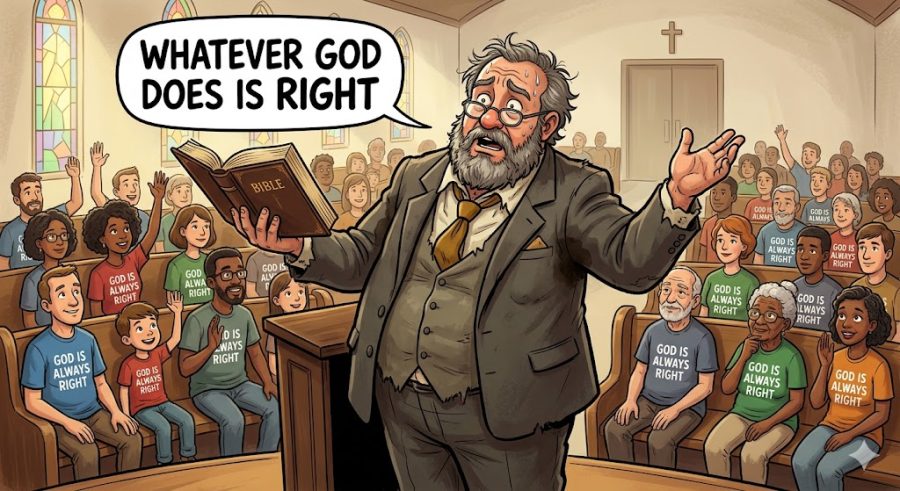
  • Whatever God Does is Right

    god is always right

    I listen to a plethora of YouTube channels, particularly call-in shows whose hosts attempt to engage and debate Evangelicals, Catholics, Muslims, and Jews. Evangelicals, in particular, often appeal to “divine command theory” to justify their God’s behavior.

    The Internet Encyclopedia of Philosophy defines divine command theory as:

    the view that morality is somehow dependent upon God, and that moral obligation consists in obedience to God’s commands.

    In other words, whatever God does is right. And I mean whatever . . . I have listened to countless Evangelicals defend everything from owning people as property (slavery) to rape to genocide. From philosophical arguments to appeals to the supremacy of “God’s ways,” God is vociferously defended by Evangelical apologists. No quarter is given. God’s holy name must be defended at all costs. And defend it they do, with justifications, excuses, and bizarre interpretations.

    Underlying the notion of divine command theory is the claim that God is ALWAYS good; that whatever God does is, without exception, good. This means that when God ordered the genocide of the Amalekite people, it was a moral, just, and good command. When God ordered the slaughter of infants, no fault can be found in what followed.

    Sensitive to being accused of promoting and justifying genocide, Evangelicals often cook up all sorts of explanations that allegedly protect God’s name against accusations of immorality. “God knew all those babies were going to go to Heaven anyway, so babies having their heads dashed upon the rocks is “good.” Of course, this means Evangelicals should be pro-abortion, killing fetuses before they are old enough to know the difference between right and wrong. Most Evangelicals believe fetuses and babies go to Heaven when they die. so it stands to reason that abortion (or slaughter by the Jews) is good as the result is eternity in Heaven. In other words, the end justifies the means. Wait a minute, I thought Evangelicals oppose situational ethics? Oh that’s what they say, but when defending God, absolute morality becomes an ever-moving target. The Ten Commandments say “Thou shalt not kill (murder).” Yet, it seems that when God is doing the killing, the supposedly “moral law of God” is massaged or ignored. Just remember, God’s ways are not our ways. In the minds of Evangelicals, whatever God does is moral and right, even when it seems that what he is doing is immoral. Just because rape, slavery, genocide, and murder are “sins” to fallen sinners, it doesn’t follow that those same acts committed by God are just, moral, and right. The Evangelical deity is never held accountable for his actions. How can mere mortals judge God? Evangelicals say, carving out an exception for God. This means that despite claims of having objective morals, Evangelicals, as do all of us, actually have subjective morals

    Most Evangelicals believe the Bible was written by God, inerrant and infallible in all it says. This core belief forces Evangelicals to commit to defending the Bible regardless of what it says. No evil is beyond justification if God did it. Remember, this is the same God who created Hell/Lake of Fire, the final resting place for all non-Evangelicals. As eternity rolls on, unbelievers will be tortured by God for one simple reason: they didn’t believe in Jesus.

    Here’s the thing, belief isn’t a choice. Either you believe or you don’t. We cannot genuinely believe if we are not convinced that a claim is true (I speak generally). Yes, this is a complex issue, especially when you consider human free will. Do we have free will? I’m inclined to think that we don’t; that our lives give the appearance of free will without actually being “free.” The notion that we have libertarian free will cannot be rationally sustained, though I am sure that some commenters want to disabuse me of this notion.

    The Christian God is neither just, moral, nor good. I have seen no evidence in the Bible that would suggest I am wrong. If you disagree with me, please defend your God or divine command theory in the comment section. I await your defense of a “good” God.

    Bruce Gerencser, 69, lives in rural Northwest Ohio with his wife of 48 years. He and his wife have six grown children and thirteen grandchildren. Bruce pastored Evangelical churches for twenty-five years in Ohio, Texas, and Michigan. Bruce left the ministry in 2005, and in 2008 he left Christianity. Bruce is now a humanist and an atheist.

    Your comments are welcome and appreciated. All first-time comments are moderated. Please read the commenting rules before commenting.

    You can email Bruce via the Contact Form.

  • Quote of the Day: The Process of Grotesque Self-Deception in American Politics

    war brings peace middle east

    By Mark Twain

    Next the statesmen will invent cheap lies, putting the blame upon the nation that is attacked, and every man will be glad of those conscience-soothing falsities, and will diligently study them, and refuse to examine any refutations of them; and thus he will by and by convince himself that the war is just, and will thank God for the better sleep he enjoys after this process of grotesque self-deception. (Chronicle of Young Satan)

    ….

    The loud little handful—as usual—will shout for the war… The great, big, dull bulk of the nation will rub its sleepy eyes… and say, earnestly and indignantly, ‘It is unjust and dishonorable, and there is no necessity for it. (The Chronicle of Young Satan)

    ….

    Man is the only animal that deals in that atrocity of atrocities—War. He is the only one that gathers his brethren about him and goes forth in cold blood and calm pulse to exterminate his kind. (The Lowest Animal)

    The War Prayer, a short story by Mark Twain, as published on American Literature

    It was a time of great and exalting excitement. The country was up in arms, the war was on, in every breast burned the holy fire of patriotism; the drums were beating, the bands playing, the toy pistols popping, the bunched firecrackers hissing and sputtering; on every hand and far down the receding and fading spreads of roofs and balconies a fluttering wilderness of flags flashed in the sun; daily the young volunteers marched down the wide avenue gay and fine in their new uniforms, the proud fathers and mothers and sisters and sweethearts cheering them with voices choked with happy emotion as they swung by; nightly the packed mass meetings listened, panting, to patriot oratory which stirred the deepest deeps of their hearts and which they interrupted at briefest intervals with cyclones of applause, the tears running down their cheeks the while; in the churches the pastors preached devotion to flag and country and invoked the God of Battles, beseeching His aid in our good cause in outpouring of fervid eloquence which moved every listener.

    It was indeed a glad and gracious time, and the half dozen rash spirits that ventured to disapprove of the war and cast a doubt upon its righteousness straightway got such a stern and angry warning that for their personal safety’s sake they quickly shrank out of sight and offended no more in that way.

    Sunday morning came-next day the battalions would leave for the front; the church was filled; the volunteers were there, their faces alight with material dreams-visions of a stern advance, the gathering momentum, the rushing charge, the flashing sabers, the flight of the foe, the tumult, the enveloping smoke, the fierce pursuit, the surrender!-then home from the war, bronzed heros, welcomed, adored, submerged in golden seas of glory! With the volunteers sat their dear ones, proud, happy, and envied by the neighbors and friends who had no sons and brothers to send forth to the field of honor, there to win for the flag or, failing, die the noblest of noble deaths. The service proceeded; a war chapter from the Old Testament was read; the first prayer was said; it was followed by an organ burst that shook the building, and with one impulse the house rose, with glowing eyes and beating hearts, and poured out that tremendous invocation — “God the all-terrible! Thou who ordainest, Thunder thy clarion and lightning thy sword!”

    Then came the “long” prayer. None could remember the like of it for passionate pleading and moving and beautiful language. The burden of its supplication was that an ever–merciful and benignant Father of us all would watch over our noble young soldiers and aid, comfort, and encourage them in their patriotic work; bless them, shield them in His mighty hand, make them strong and confident, invincible in the bloody onset; help them to crush the foe, grant to them and to their flag and country imperishable honor and glory –

    An aged stranger entered and moved with slow and noiseless step up the main aisle, his eyes fixed upon the minister, his long body clothed in a robe that reached to his feet, his head bare, his white hair descending in a frothy cataract to his shoulders, his seamy face unnaturally pale, pale even to ghastliness. With all eyes following him and wondering, he made his silent way; without pausing, he ascended to the preacher’s side and stood there, waiting. With shut lids the preacher, unconscious of his presence, continued his moving prayer, and at last finished it with the words, uttered in fervent appeal,”Bless our arms, grant us the victory, O Lord our God, Father and Protector of our land and flag!”

    The stranger touched his arm, motioned him to step aside — which the startled minister did — and took his place. During some moments he surveyed the spellbound audience with solemn eyes in which burned an uncanny light; then in a deep voice he said

    “I come from the Throne-bearing a message from Almighty God!” The words smote the house with a shock; if the stranger perceived it he gave no attention. “He has heard the prayer of His servant your shepherd and grant it if such shall be your desire after I, His messenger, shall have explained to you its import-that is to say, its full import. For it is like unto many of the prayers of men, in that it asks for more than he who utters it is aware of-except he pause and think. “God’s servant and yours has prayed his prayer. Has he paused and taken thought? Is it one prayer? No, it is two- one uttered, the other not. Both have reached the ear of His Who hearth all supplications, the spoken and the unspoken. Ponder this-keep it in mind. If you beseech a blessing upon yourself, beware! lest without intent you invoke a curse upon a neighbor at the same time. If you pray for the blessing of rain upon your crop which needs it, by that act you are possibly praying for a curse upon some neighbor’s crop which may not need rain and can be injured by it. “You have heard your servant’s prayer-the uttered part of it. I am commissioned by God to put into words the other part of it-that part which the pastor, and also you in your hearts, fervently prayed silently. And ignorantly and unthinkingly? God grant that it was so! You heard these words: ‘Grant us the victory, O Lord our God!’ That is sufficient. The whole of the uttered prayer is compact into those pregnant words. Elaborations were not necessary. When you have prayed for victory you have prayed for many unmentioned results which follow victory-must follow it, cannot help but follow it. Upon the listening spirit of God the Father fell also the unspoken part of the prayer. He commandeth me to put it into words. Listen!

    “O Lord our Father, our young patriots, idols of our hearts, go forth to battle — be Thou near them! With them, in spirit, we also go forth from the sweet peace of our beloved firesides to smite the foe. O Lord our God, help us to tear their soldiers to bloody shreds with our shells; help us to cover their smiling fields with the pale forms of their patriot dead; help us to drown the thunder of the guns with the shrieks of their wounded, writhing in pain; help us to lay waste their humble homes with a hurricane of fire; help us to wring the hearts of their unoffending widows with unavailing grief; help us to turn them out roofless with their little children to wander unfriended the wastes of their desolated land in rags and hunger and thirst, sports of the sun flames of summer and the icy winds of winter, broken in spirit, worn with travail, imploring Thee for the refuge of the grave and denied it-for our sakes who adore Thee, Lord, blast their hopes, blight their lives, protract their bitter pilgrimage, make heavy their steps, water their way with their tears, stain the white snow with the blood of their wounded feet! We ask it, in the spirit of love, of Him Who is the Source of Love, and Who is ever-faithful refuge and friend of all that are sore beset and seek His aid with humble and contrite hearts. Amen.

    (After a pause)

    “Ye have prayed it; if ye still desire it, speak! The messenger of the Most High waits.”

    It was believed afterward that the man was a lunatic, because there was no sense in what he said.

    Bruce Gerencser, 69, lives in rural Northwest Ohio with his wife of 48 years. He and his wife have six grown children and thirteen grandchildren. Bruce pastored Evangelical churches for twenty-five years in Ohio, Texas, and Michigan. Bruce left the ministry in 2005, and in 2008 he left Christianity. Bruce is now a humanist and an atheist.

    Your comments are welcome and appreciated. All first-time comments are moderated. Please read the commenting rules before commenting.

    You can email Bruce via the Contact Form.

  • Quote of the Day: The Connection Between Oil and U.S. Military Conflicts

    iranian oil

    Americans are very lucky, because wherever they go to bring freedom… they find oil.

    — Michele Serra, Italian journalist

    Bruce Gerencser, 69, lives in rural Northwest Ohio with his wife of 48 years. He and his wife have six grown children and thirteen grandchildren. Bruce pastored Evangelical churches for twenty-five years in Ohio, Texas, and Michigan. Bruce left the ministry in 2005, and in 2008 he left Christianity. Bruce is now a humanist and an atheist.

    Your comments are welcome and appreciated. All first-time comments are moderated. Please read the commenting rules before commenting.

    You can email Bruce via the Contact Form.