
Tag: Questions

  • Questions: Have Atheist Content Creators Won the Day Over Christian Apologists?

    questions

    Every year or two, I ask readers to submit questions they want me to answer. That time has arrived once again. Any question. Any subject. Please leave your questions in the comment section or send them to me via email. I will try to answer them in the order received.

    I look forward to reading and answering your questions.

    Long-time reader Geoff asked:

    How do you feel the ‘argument from reason’ is going? YouTube is awash with atheist presenters, much of it pretty poor, but there’s a core of really convincing channels, very moderate in approach, and with ever-increasing subscribers. I’m thinking especially of the likes of Genetically Modified Skeptik, Alex O’Connor Cosmic Skeptik, and Rationality Rules. Previously Matt Dillahunty and Atheist Experience was perhaps the main source, but Dillahunty’s abrasive style and the awful quality of the phone-ins surely put many people off, and there was certainly little in the way of developing nuanced arguments.

    Anyhow, I feel that the argument from reason is now so overwhelmingly in favour of the atheist case that I feel apologetics is almost dead in the water, but perhaps it’s simply that I’m immersed at ‘the wrong end of the pool’. What do you think?

    Go to YouTube these days and you will find a plethora of atheist creators putting out content that challenges Christianity, using philosophical and scientific arguments to do so. YouTubers such as Alex O’Connor, Steven Woodford, Drew McCoy, Matt Dillahunty, and others are well-schooled in philosophy and the various arguments for the existence of God and other arguments used to justify Christian belief. I thoroughly enjoy their videos, although I have reached a similar point to Geoff, that there are no more new arguments to be made; that much like Samson slaying 1,000 Philistines with the jawbone of an ass, these defenders of rationality, skepticism, and reason have slayed virtually every argument used by Evangelical and Catholic apologists to defend the existence of God and the claims of Christianity.

    If I have one point of criticism of these atheists it is this: when it comes to theology and the Biblical text itself, they often display a shallow or Fundamentalist understanding of what the Bible says and what Christians really believe. Some of them just regurgitate what they have heard other atheists say, while others lack sufficient education to have complex, informed discussions about the Biblical text and Christianity. Sometimes, I will email them when they make glaring errors, hoping to educate them on the subject in question. Unfortunately, I have yet to have one of them respond to me. If you are going to make content deconstructing what it is that Christians believe, it would be helpful if you actually KNOW what they believe. And Christians are just as bad. They can be woefully ignorant about the Bible and its teachings, and when it comes to church history, ignorance is the norm.

    There indeed is a lot of atheist-created content on YouTube and TikTok. Juvenile, elementary-level critiques — long on rhetoric and ridicule — can be found everywhere on social media. I used to challenge such things, but I gave up. Some of the creators are in the “angry atheist” phase of life, so I know that no amount of calm, rational criticism will change their minds. It takes time for wounds to heal.

    Have atheists won the day? Perhaps, but there’s still a place for well-spoken, thoughtful atheists to produce content for public consumption. As I have pondered starting a podcast (I know, I know, I have been pondering for so long we are in a new decade) I ask myself, “What can I add to the discussions that atheists and Christians might find helpful?” My thought as of today — subject to change — is to start a podcast that specifically focuses on the Independent Fundamentalist Baptist (IFB) church movement. There’s very little content on this subject, and since my expertise lies here, I thought the IFB might be a worthy subject of a new podcast. While I can intelligently discuss the existence of God and I have a rudimentary understanding of science, a philosopher and scientist (in an educated sense) I am not. I know what I know, and I certainly know what I don’t.

    I watch or listen to The Atheist Experience, Talk Heathen, Pangburn, Truth Wanted, SciManDan, MythVision, Dan McClellan, Bart Ehrman, Belief It or Not, Data Over Dogma, Digital Hammurabi, Gutsick Gibbon, James Tabor, Jon Perry, Kip Davis, and several programs on The Line Network featuring Matt Dillahunty as host. (I also listen to some political, science, and sports podcasts.) I agree that Dillahunty has become increasingly angry and argumentative over the years, but I do love his content, especially his debates or table discussions with various atheists and Christians. (The Christians who call in to atheist talk shows are generally dreadful, lacking in solid theological training and understanding of church history.) I really enjoyed his recent debate with Than Christopoulos on the resurrection of Jesus. Wonderful discussion. Both men were thoughtful and polite.

    Video Link

    I deconverted sixteen years ago. Since then, I have interacted with countless Christians, especially Evangelicals. It has been years since I have heard a new or original argument for the existence of God and the nature of the Biblical text. I am far less patient these days due to having to answer the same questions, arguments, and challenges over and over and over again. It does get old after a while. I suspect some of the creators mentioned above will one day reach a similar place. Contrary to what Evangelical apologists say, the Bible is not an inexhaustive book. Eventually, there’s nothing more to say on the matter.

    Bruce Gerencser, 69, lives in rural Northwest Ohio with his wife of 48 years. He and his wife have six grown children and thirteen grandchildren. Bruce pastored Evangelical churches for twenty-five years in Ohio, Texas, and Michigan. Bruce left the ministry in 2005, and in 2008 he left Christianity. Bruce is now a humanist and an atheist.

    Your comments are welcome and appreciated. All first-time comments are moderated. Please read the commenting rules before commenting.

    You can email Bruce via the Contact Form.

  • Questions: Bruce, Do You Have a Good Relationship With Your Children?

    questions

    Every year or two, I ask readers to submit questions they want me to answer. That time has arrived once again. Any question. Any subject. Please leave your questions in the comment section or send them to me via email. I will try to answer them in the order received.

    I look forward to reading and answering your questions.

    A reader recently asked:

    Do you have a good relationship with all of your kids? Did any of them ever express resentment or say they’re damaged from being raised IFB (due to fear of hell, sexism, homophobia, general shame, etc)? Do you think it’s possible to still spend time with family members who are still hardcore believers when you’re raising your own kid differently without it damaging your kid?

    My partner, Polly, and I have six adult children, ages 45, 43, 40, 35, 33, and 31 (on their next birthday). Four of our children are married or living in committed relationships. We have sixteen grandchildren, ranging in age from five to twenty-three. By all accounts, both Polly and I have good relationships with our children and their families. All of our children live within twenty minutes of our home in Ney. Some of them we see once or more every week. For others, it may be a few weeks between visits. Regardless, both Polly and I think we are close to our children and their families. Whether our children think the same, you would have to ask them. As a man who is largely homebound due to chronic illness and pain, I would love to see my children, their spouses, and grandchildren more often. I recognize they have their own lives, jobs, and responsibilities, but I do yearn for more visits and interaction, as does Polly.

    What constitutes a “good relationship” depends on the parties involved. I have different experiences and relationships with each of my children. How they view me as their father is theirs to share. As far as I know, my children love and respect me. Over the past two weeks, I have seen all our children — save son #2; and he and I have stayed in contact via texts. On Sunday, our youngest daughter and her three children came over for lunch, as did our oldest son and two of his three children. He and our oldest grandson, Levi, cleaned out our gutters and unplugged the downspouts. Our youngest son mows our grass every week, and then stays for dinner. Last night, I talked with son #3 about a family problem he was having. We spoke for an hour.

    Our family is close, and always willing to help us when needed. And we do the same for them. Could we be closer? Sure. Does our family have unresolved conflict or trauma? Sure, as ALL families do. That said, if you really want to know how our children view their relationships with Mom and Dad, you will have to ask them. I cannot and will not speak for them.

    This reader also asked, “Did any of them ever express resentment or say they’re damaged from being raised IFB?”

    Not towards their parents. They understand why we were IFB and Mom and Dad were devout Evangelical Christians. They don’t blame us as much as they do the Independent Fundamentalist Baptist (IFB) church movement itself. They know we were products of lifelong conditioning and indoctrination. As far as resentment is concerned, I have never sensed resentment from any of our children. The Gerencser family is quite stoic, living “live and let live” lives. Do we talk about the past? Sure. Are apologies made and regrets shared? Yes.

    Our children, except Bethany — our oldest daughter with Down syndrome — own their own homes and live on their own. If one of them were a hardcore Fundamentalist Christian, could I still have a good relationship with him or her? I’d like to think so. However, I know sects such as the IFB are exclusionary, reactionary, and narrow-minded. This means that we might not be able to openly and frankly talk with them about certain things. Knowing this, I would do everything in my power to have a good relationship with them. Polly and I deconverted seventeen years ago. Our family remains close,

    Our family is far from perfect, but I wouldn’t trade them for all the money in the world.

    Bruce Gerencser, 69, lives in rural Northwest Ohio with his wife of 48 years. He and his wife have six grown children and thirteen grandchildren. Bruce pastored Evangelical churches for twenty-five years in Ohio, Texas, and Michigan. Bruce left the ministry in 2005, and in 2008 he left Christianity. Bruce is now a humanist and an atheist.

    Your comments are welcome and appreciated. All first-time comments are moderated. Please read the commenting rules before commenting.

    You can email Bruce via the Contact Form.

  • Questions: Is a Doctorate of Theology of Any Value in the Secular Marketplace?

    questions

    Jim asked:

    Is a doctorate of theology of any value in the secular marketplace?

    There are three types of religious institutions in the United States:

    • Institutions accredited by national accrediting agencies that accredit secular and religious institutions alike
    • Institutions accredited by religious accrediting agencies
    • Unaccredited institutions

    If you have a Th.D (doctor of theology) from a nationally accredited institution, your degree may have value in the secular workplace. The same goes for a Ph.D. from a religious institutions. If your credits can transfer to a state institution, your degree will likely have credibility in the workplace.

    If you have a Th.D (doctor of theology) from a school accredited by a religious accrediting agency, it is less likely your degree will have value in the secular workplace. It is unlikely that your credits will transfer to a state institution. Some of these accrediting agencies are little more than storefronts or PO boxes. Others are more rigorous, so your mileage may vary.

    If you have a Th.D (doctor of theology) from an unaccredited college, your degree will likely be worthless in the secular workplace. Your credits cannot be transferred to a state institution.

    Some employers won’t care whether your degree is from an accredited institution. Your education is just a line on your resume. Where accreditation becomes a problem is when you seek employment that requires licensure. For example, you may have a teaching degree from Pensacola Christian College, but the degree is worthless when it comes to being licensed to teach in a public school. Unaccredited Christian college degrees only have value among like-minded people and religious institutions. This is a hard lesson for people with such degrees to learn. They wrongly think employers will treat them as they do prospective employees with degrees from state institutions. Four to six years of college, only to learn their degree is worthless outside of the church, unaccredited colleges, Christian schools, and parachurch organizations.

    Sometimes, employers won’t care whether your degree is from an accredited institution. Ignorant of what these schools teach, employers wrongly think all degrees are the same. Other times, having a religious degree hurts your employment prospects. The prospective employer might view you as a Bible thumper or wonder what you studied for four years. You spent four years studying the Bible? How will that apply to you doing this job? I had one resume “expert” tell me that I should remove from my resume all of my church experience, saying employers may view this negatively. I looked at her and said, “That will leave a twenty-five-year hole in my resume! Should I just say I was in prison for twenty-five years?”

    Many people, encouraged by their parents, churches, and pastors, enroll at Christian colleges when they are young. They trust that these adults have their best interests at heart — and they do, from a religious perspective. However, you have no idea where your life will take you over the next forty years of your work career. You might decide to leave the ministry and enter the secular workforce. You will quickly learn that your theology or religious education degree has little value in the real world.

    Let me conclude this post by talking about pastors who claim they have doctorates. While some Evangelical pastors have earned doctorates, many of them have honorary degrees or degrees “earned” from diploma mills or unaccredited institutions. In the Independent Fundamentalist Baptist (IFB) church movement, almost all doctorates are honorary or from bogus institutions.

    Please see IFB Doctorates: Doctor, Doctor, Doctor, Everyone’s a Doctor for further information.

    Bruce Gerencser, 69, lives in rural Northwest Ohio with his wife of 48 years. He and his wife have six grown children and thirteen grandchildren. Bruce pastored Evangelical churches for twenty-five years in Ohio, Texas, and Michigan. Bruce left the ministry in 2005, and in 2008 he left Christianity. Bruce is now a humanist and an atheist.

    Your comments are welcome and appreciated. All first-time comments are moderated. Please read the commenting rules before commenting.

    You can email Bruce via the Contact Form.
  • Questions: Bruce, Why Are You an Advocate of The LGBTQ Community?

    questions

    A reader asked on social media:

    Why are you an advocate of the LGBTQ community?

    I am an advocate of the LGBTQ community because I believe all Americans should have equal justice and protection under the law. That’s it. I expect and demand that LGBTQ people have the same rights as I do. And when they don’t, I advocate for change.

    I don’t have to understand or agree with LGBTQ people (or Evangelical Christians) to insist that they have the same civil rights as I — a heterosexual man — have.

    This is not a complicated issue for me. Granted, it helps that one of my sons is part of the LGBTQ community, but I was a supporter and defender long before he came out.

    Please see:

    Bruce, What was Your View on Homosexuality When You Were a Pastor?

    What Evangelical Christianity Taught Me About Homosexuality

    My Journey From Homophobia to a Supporter of LGBTQ People

    Bruce, Were You Transphobic as an Evangelical Pastor?

    Bruce, What was Your View on Homosexuality When You Were a Pastor?

    Bruce Gerencser, 69, lives in rural Northwest Ohio with his wife of 48 years. He and his wife have six grown children and thirteen grandchildren. Bruce pastored Evangelical churches for twenty-five years in Ohio, Texas, and Michigan. Bruce left the ministry in 2005, and in 2008 he left Christianity. Bruce is now a humanist and an atheist.

    Your comments are welcome and appreciated. All first-time comments are moderated. Please read the commenting rules before commenting.

    You can email Bruce via the Contact Form.

  • Questions: Bruce, Did You Deconvert Because You Wanted to Drink Alcohol?

    questions

    Every year or two, I ask readers to submit questions they want me to answer. That time has arrived once again. Any question. Any subject. Please leave your questions in the comment section or send them to me via email. I will try to answer them in the order received.

    I look forward to reading and answering your questions. Spelling, grammar, and structure corrected and edited for readability.

    Revival “I Lie for Jesus Fires,” asked the following question:

    I have noticed on more than one post here that you talk about whiskey and beer drinking.

    Sadly, a lot of people raised in church, and who have truly accepted Jesus, sometimes get it in their head that they “missed out” on partying and drinking from their teens and 20s and will want to do it in their 50s and 60s — such is the case with my mother-in-law.

    Did you betray Jesus because you wanted to drink alcohol and get drunk?

    I was in my forties before I drank the Devil’s brew for the first time. As an Independent Fundamentalist Baptist (IFB), I was a teetotaler — as were my fellow church members. As an atheist and a humanist, I am free to drink alcohol any time I want. We have a well-stocked liquor cabinet and beer in the refrigerator. Typically, I drink whiskey, mixed drinks, or wine three or four times a month. Polly is primarily a beer and wine drinker. Neither of us has been drunk. I take narcotic pain meds, so I must limit my alcohol intake. Polly will drink a couple of beers and glasses of wine on the weekends, as will our oldest daughter Bethany.

    My desire to drink alcohol played no part in my deconversion. That would be a silly reason to deconvert, wouldn’t it? Hey Jesus, I want my sins forgiven and I want to go to Heaven after I die, but I want to drink whiskey, beer, and wine more, so no thanks on salvation. Of course, the Bible does not condemn alcohol drinking. Jesus drank alcoholic wine, as did most people alive during his time. The Bible calls drunkenness a sin, but not social drinking.

    Revival Fires asks if I am trying to live my youthful years now; if I am trying to do things I missed out on as a young adult. Christian Fundamentalism robbed me of many normal experiences, so, yes, I am trying to do some of the things that were forbidden years ago. I only wish I had a young man’s body. Alas, I make do with what I got. 🙂

    Bruce Gerencser, 69, lives in rural Northwest Ohio with his wife of 48 years. He and his wife have six grown children and thirteen grandchildren. Bruce pastored Evangelical churches for twenty-five years in Ohio, Texas, and Michigan. Bruce left the ministry in 2005, and in 2008 he left Christianity. Bruce is now a humanist and an atheist.

    Your comments are welcome and appreciated. All first-time comments are moderated. Please read the commenting rules before commenting.

    You can email Bruce via the Contact Form.

  • Questions: Bruce, Are You Losing Any Sleep Over Arizona’s Abortion Law?

    questions

    Every year or two, I ask readers to submit questions they want me to answer. That time has arrived once again. Any question. Any subject. Please leave your questions in the comment section or send them to me via email. I will try to answer them in the order received.

    I look forward to reading and answering your questions.

    Revival “I Lie for Jesus” asked:

    How much sleep is being lost that the babies are gonna live in Arizona? Baby killers having a fit.

    I don’t know about anyone else, but I am not losing any sleep over Arizona banning abortion. Women’s lives and rights are in the balance, so there is no time for me to sleep. Instead, I am doing all I can to legalize abortion, not only in Arizona, but every state in the Union.

    A baby is a fetus that can live outside of the womb on its own. When the egg and sperm unite, potential life is formed. This potential life grows from a zygote to a fetus to a baby. I support unrestricted abortion up until viability. Most abortions take place in the first trimester.

    It is forced birthers who are having a fit. They know they have overplayed their hand, and now they must contend with pro-reproductive rights initiatives on state ballots. In every state where abortion has been on the ballot, reproductive rights initiatives won. I proudly helped legalize abortion in Ohio last year. If this makes me a “baby killer,” so be it.

    Bruce Gerencser, 69, lives in rural Northwest Ohio with his wife of 48 years. He and his wife have six grown children and thirteen grandchildren. Bruce pastored Evangelical churches for twenty-five years in Ohio, Texas, and Michigan. Bruce left the ministry in 2005, and in 2008 he left Christianity. Bruce is now a humanist and an atheist.

    Your comments are welcome and appreciated. All first-time comments are moderated. Please read the commenting rules before commenting.

    You can email Bruce via the Contact Form.

  • Questions: Bruce, Did You and Polly Try Other “Gods” Before You Deconverted?

    questions

    Question from social media:

    Bruce, did you and Polly try other “Gods” before you deconverted?

    The short answer is no. I have never thought I had to try every flavor and brand of whiskey to decide whether I like whiskey. While the flavors can be distinct and brands can differ from one another, whiskey is whiskey. I have four different brands of whiskey in our liquor cabinet. Each tastes slightly different from the others, but none to such a degree that I can’t tell I am drinking whiskey. Get a dozen whiskey aficionados in one room and ask them which whiskey is “God,” and you will get all sorts of answers. But none of them will say that this or that glass of whiskey is not whiskey. So it is with “God.”

    I was born in a Christian nation, a country that prides itself in freedom of religion, yet is dominated by Christianity. I came of age in Evangelical Christianity. Saved and baptized at the age of fifteen in an Independent Fundamentalist Baptist (IFB) church, I later attended a small IFB college, married an IFB pastor’s daughter, and spent twenty-five years pastoring Evangelical (IFB, Southern Baptist, Christian Union, Sovereign Grace, and Non-denominational) churches in Ohio, Texas, and Michigan. It is Christianity — particularly Evangelicalism — that I know well. It is the religion of my tribe and my culture. It is this religion I primarily deconverted from.

    I pastored my last church in 2003. Between July 2002 and November 2008, my wife and I and our children personally visited the churches listed below. These are the church names we could remember. There are others we have either forgotten or vaguely remember, so we didn’t put them on the list. Churches in bold we attended more than once. All told, from 2002-2008 we visited about 125 churches.

    Churches We Visited 2002-2008Location
    Our Father’s HouseWest Unity, Ohio
    First Brethren ChurchBryan, Ohio
    First Baptist ChurchBryan, Ohio
    Grace Community ChurchBryan, Ohio
    Lick Creek Church of the BrethrenBryan,Ohio
    First Church of ChristBryan, Ohio
    Eastland Baptist ChurchBryan, Ohio
    Bryan Alliance ChurchBryan, Ohio
    Union Chapel Church of GodBryan, Ohio
    Celebrate Life Christian FellowshipBryan, Ohio
    Faith United Methodist ChurchBryan, Ohio
    Trinity Episcopal ChurchBryan, Ohio
    Archbold Evangelical ChurchArchbold, Ohio
    Sherwood Baptist ChurchSherwood, Ohio
    Ney Church of GodNey, Ohio
    Ney United Methodist ChurchNey, Ohio
    Sonrise Community ChurchNey, Ohio
    Farmer United Methodist ChurchFarmer, Ohio
    Lost Creek Emmanuel Missionary ChurchFarmer, Ohio
    Hicksville Church of the NazareneHicksville, Ohio
    Community Christian CenterHicksville, Ohio
    Grace Bible ChurchButler, Indiana
    St John’s Lutheran ChurchDefiance, Ohio
    Harvest Life FellowshipDefiance, Ohio
    Community Christian CenterDefiance, Ohio
    Second Baptist ChurchDefiance, Ohio
    First Baptist ChurchDefiance, Ohio
    Grace Episcopal ChurchDefiance, Ohio
    First Assembly of GodDefiance, Ohio
    Defiance Christian ChurchDefiance, Ohio
    First Presbyterian ChurchDefiance, Ohio
    St John’s United Church of ChristDefiance, Ohio
    Peace Lutheran ChurchDefiance, Ohio
    Pine Grove Mennonite ChurchStryker, Ohio
    St James Lutheran ChurchBurlington, Ohio
    Zion Lutheran ChurchEdgerton, Ohio
    Northwest Christian ChurchEdon, Ohio
    Restoration FellowshipWilliams Center, Ohio
    Pioneer Bible FellowshipPioneer, Ohio
    Frontier Baptist ChurchFrontier, Michigan
    Salem Mennonite ChurchWaldron, Michigan
    Waldron Wesleyan ChurchWaldron, Michigan
    Lickley Corners Baptist ChurchWaldron, Michigan
    Prattville Community ChurchPrattville, Michigan
    Betzer Community ChurchPittsford, Michigan
    Fayette Church of the NazareneFayette, Ohio
    Fayette Bible ChurchFayette, Ohio
    Fayette Christian ChurchFayette, Ohio
    Morenci Bible FellowshipMorenci, Michigan
    First Baptist ChurchMorenci, Michigan
    Demings Lake Reformed Baptist ChurchDemings Lake, Michigan
    Medina Federated ChurchMedina, Michigan
    Thornhill Baptist ChurchHudson, Michigan
    First Baptist ChurchHudson, Michigan
    Rollins Friends ChurchAddison, Michigan
    Canandaigua Community ChurchCanandaigua. Michigan
    Alvordton United BrethrenAlvordton, Ohio
    Pettisville Missionary ChurchPettisville, Ohio
    Vineyard ChurchToledo, Ohio
    Providence Reformed Baptist ChurchToledo, Ohio
    Lighthouse Memorial ChurchMillersport, Ohio
    Newark Baptist TempleHeath, Ohio
    Church of GodHeath, Ohio
    30th Street Baptist ChurchHeath, Ohio
    St Francis De Sales Catholic ChurchNewark, Ohio
    Bible Baptist ChurchNewark, Ohio
    Cedar Hill Baptist ChurchNewark, Ohio
    Eastland Heights Baptist ChurchNewark, Ohio
    Northside Baptist ChurchNewark, Ohio
    Newark Brethren ChurchNewark, Ohio
    St John’s Lutheran ChurchNewark, Ohio
    Vineyard of Licking CountyNewark, Ohio
    Vineyard Grace FellowshipNewark, Ohio
    Grace FellowshipNewark, Ohio
    Faith Bible ChurchJersey, Ohio
    Vineyard Christian ChurchPataskala, Ohio
    Cornerstone Baptist ChurchNew Lexington, Ohio
    St Nicolas Greek Orthodox ChurchFort Wayne, Indiana
    Nondenominational ChurchAngola, Indiana
    Nondenominational ChurchFremont, Indiana
    Victory Baptist ChurchClare, Michigan
    First Assembly of GodYuma, Arizona
    Desert Grace Community ChurchYuma, Arizona
    Calvary Lutheran ChurchYuma, Arizona
    Bible Baptist ChurchYuma, Arizona
    Calvary ChapelYuma, Arizona
    OasisYuma, Arizona
    Faith Baptist ChurchYuma, Arizona
    Valley Baptist ChurchYuma, Arizona
    Calvary Assembly of GodYuma, Arizona
    Foothills Assembly of GodYuma, Arizona
    Morningside Baptist ChurchYuma, Arizona
    Faith Horizons Baptist ChurchYuma, Arizona
    Stone Ridge Baptist ChurchYuma, Arizona
    Old Order Mennonite ChurchYuma, Arizona
    Grace Bible FellowshipYuma, Arizona
    Calvary Temple of ChristYuma, Arizona
    Maranatha Baptist ChurchYuma, Arizona
    Independent Lutheran ChurchYuma, Arizona
    Community Christian ChurchYuma, Arizona
    Church meeting in funeral chapelYuma, Arizona
    Pentecostal ChurchWinterhaven, California
    North Holtville Friends ChurchHoltville, California
    Sierra Vista Baptist ChurchSierra Vista, Arizona
    Hedgesville Baptist ChurchHedgesville, West Virginia
    New Life Baptist ChurchWeston, West Virginia

    As you can see, we covered our bases when it came to organized Christianity. We didn’t visit any IFB churches, nor did we focus solely on Evangelical congregations. Been there, done that, right? Seen one, seen them all? Go ahead and start whining now. I know, I know, your church is DIFFERENT! Sure it is.

    We saw no need to visit Jewish or Muslim congregations. While there are differences between the three Abrahamic religions, not so much so that you can’t determine their veracity without immersing yourself in their writings. All three are text-based monotheistic religions that allegedly worship the same deity.

    We understood that we were frail, finite beings, marching one step at a time towards death. Having been taught that non-Christians would spend eternity being tortured by God in a burning Lake of Fire, we were naturally fearful about choosing the wrong religion or worshipping the wrong God. Once we determined that the Bible was not what Evangelicals claimed it was and the central claims of Christianity were false, we lost our fear of Hell. Not right away. It took time to undo five decades of religious indoctrination and conditioning.

    Granted, some Christians reject a literal Hell and eternal punishment, crafting all sorts of workarounds meant to not make God look like the monster he most certainly is. I read several books on annihilationism, universalism, etc., and concluded that all of them were intellectually lacking; written by authors who couldn’t bear to let go of God and their chosen religion. (And I am not suggesting their writing was without merit. I just concluded that their views were not intellectually compelling; not enough to sway me to their side.)

    I am an agnostic atheist. While I can’t say for certain that no gods exist, I am confident that they don’t. I could be wrong, but I doubt that I am. When it comes to the Christian deity, I am convinced that he is a work of fiction. No amount of reading or study will convince me otherwise. I have studied the lay of land, having spent decades reading the Bible and Christian theology. I can’t imagine a Christian apologist saying something or making an argument that I have not heard before. Thus, I have closed the book on Christianity. Perhaps, in the future, a God not yet known will reveal itself to us. If that happens, I will consider that God’s or its follower’s claims accordingly (if he or she makes any).

    Humans worship countless Gods. According to Wikipedia — the one true God — there are approximately 4,200 world religions or denominations. Need I study all of them, attend their worship services, or read their texts before I conclude they are false? No. It would take a lifetime to do so — a waste of time if there ever was one. Remove the religions that threaten judgment and eternal punishment, there is nothing left to fear. Religion then becomes personal and social in nature; that which meets felt needs and gives people meaning and purpose. I have no need of religion to find these things. Secular humanism provides the ethical and moral foundation for my life, and family gives me all the meaning and purpose I need. I have no thoughts about life after death. I don’t want to die, but I know it is inevitable. I don’t fret over that which I cannot control. I choose to live for the moment; to live each day the best I can, surrounded by those who matter to me. Even though my body is wracked with horrible pain, I try to find enjoyment in life. Having six children, sixteen grandchildren, and three cats gives me plenty of opportunities to enjoy life, as does watching wild animals and stray/ferals cats in our backyard, working in the yard, building my model train layout, taking country drives with Polly and Bethany, and writing for this blog. I have much to enjoy in life — all without God.

    Bruce Gerencser, 69, lives in rural Northwest Ohio with his wife of 48 years. He and his wife have six grown children and thirteen grandchildren. Bruce pastored Evangelical churches for twenty-five years in Ohio, Texas, and Michigan. Bruce left the ministry in 2005, and in 2008 he left Christianity. Bruce is now a humanist and an atheist.

    Your comments are welcome and appreciated. All first-time comments are moderated. Please read the commenting rules before commenting.

    You can email Bruce via the Contact Form.

  • Bruce, Has Your Story Won Any Converts to Atheism?

    peanut gallery

    Several years ago, a Seventh-Day Adventist pastor emailed me and asked:

    You certainly are preaching your good news still, eh? Once a preacher, always a preacher I guess. I read some of your site and I find it intriguing, if a bit … missionary … in its atheistic zeal. I’m curious if your message about your personal journey has won any converts to the atheism cause. Or did most former Christians just come to your site because they already had one foot on the way out and saw you out here? Like you, I’m sick of the lies inside the churches. But its clear I don’t hate the same set of “lies” you do. Unlike many Christian pastors, I have no interest in converting anyone and never have. I write only because I went through this same journey (and its subsequent fallout) with a fellow pastor in the Seventh-day Adventist church, Ryan Bell, and I am gathering information as to why these journeys take place at all. So thanks for taking the time to write down why you left. It actually strengthens me in staying.

    I have always been passionate about whatever I do in my life. So, what might be perceived as “missionary zeal” is actually just Bruce being Bruce. As a writer, I believe I have something to say that matters, so I put my whole being into my work. That said, my goal has never been to be an evangelist for atheism. My target audience remains the same today as it was seventeen years ago: those who have questions/doubts about Christianity and those who have left Christianity. I see myself as a facilitator. My goal is to help people distance themselves from Fundamentalist Christianity. (Please see Are Evangelicals Fundamentalists?)

    The letter writer asks if my story has won any converts to atheism. The short answer is yes. Numerous ex-Evangelical pastors, evangelists, missionaries, and laypeople say that my writing was instrumental in their deconversion. While this is not my goal, I am humbled by the fact that many people find my writing helpful. That thousands of people read this blog still blows my mind.

    The readers of this blog are quite eclectic. While I am an agnostic atheist, many readers are not. Evangelicals and liberal Christians, along with atheists, agnostics, pagans, and other non-Christians read my writing. Many of them have both feet firmly planted in their religious traditions. Others do not. Questioners and doubters, along with people seriously considering leaving the fold, often find that my writing resonates with them. My words ring true.

    Of course, I also attract Evangelical apologists and critics, along with Muslim and Catholic zealots. Countless Christians have sent me emails or left comments on a particular post, hoping to bring me back into the fold, deconstruct my life, or discredit my story. In my early blogging days, I thought that if I just openly and honestly shared my story, apologists, zealots, and critics would, at the very least, understand where I am coming from. Those days are long gone. Instead of engaging in endless debates, I give such people one opportunity to “share” whatever it is God has laid upon their hearts. If they play well with others, I might approve further comments from them. Unfortunately, most Evangelical commenters are terrible representatives of Christ on earth. (Please see Dear Evangelical.) Even if they could mount an effective defense of Christianity, why would I ever want to be around such nasty, arrogant, mean-spirited people?

    As far as the “why” of my deconversion, here’s my stock answer:

    I no longer believe that the central claims of Christianity are true. I came to a place in my life where these beliefs no longer made sense to me. (Please see The Michael Mock Rule: It Just Doesn’t Make Sense.) I reject all the miraculous claims made for Jesus, from his virgin birth to his resurrection from the dead. I do believe Jesus is was a real flesh and blood human being who lived on Palestine 2,000 years ago, However, as with all humans, he lived and died, end of story.

    Over the years, I have corresponded with hundreds of clergy who are either no longer believers or have serious doubts about Christianity. Their numbers are increasing daily. Why is that?

    Bruce Gerencser, 69, lives in rural Northwest Ohio with his wife of 48 years. He and his wife have six grown children and thirteen grandchildren. Bruce pastored Evangelical churches for twenty-five years in Ohio, Texas, and Michigan. Bruce left the ministry in 2005, and in 2008 he left Christianity. Bruce is now a humanist and an atheist.

    Your comments are welcome and appreciated. All first-time comments are moderated. Please read the commenting rules before commenting.

    You can email Bruce via the Contact Form.

  • Christians Say the Darnedest Things: IFB Pastor Mike Allison Says There Will be No Questions or Discussions in HIS Church

    pastor mike allison

    Mike Allison pastors Madison Baptist Church in Madison, Alabama. Madison Baptist is an Independent Fundamentalist Baptist (IFB) congregation. Allison has been its pastor for thirty-four years.

    Allison describes himself this way:

    Dr. Michael Allison was born in Sturgis, MI and married his wife Janet shortly after high school. They have two daughters, Kathy and Kari. He was saved in October of 1971 while working his afternoon shift at Radio Station WAOP in Otsego, Michigan. He was called to preach in 1974 and graduated with a Bachelor of Arts degree from Tennessee Temple College in 1976. He also holds a Master’s Degree in Religious Education and a Doctor of Ministry from Bethany Theological Seminary and an honorary Doctor of Divinity from Fairhaven Baptist College. He has been pastor of Madison Baptist Church since 1989.

    His degrees and “doctorate” are from unaccredited IFB institutions.

    Most churches are welcoming. Not Madison Baptist. Allison plasters the following on his church’s website:

    We are an independent, fundamental, King James Bible-preaching, Bible-believing church. It is our prayer that we can help you grow in the grace and knowledge of our Lord and Savior Jesus Christ as you seek to do His will. Pastor Mike Allison has been our pastor since 1989.

    Our services are live streamed on YouTube, Facebook, Sermon Audio and Vimeo.

    Madison Baptist Church is not an open forum for discussion and ideas.  It is a Church, an assembly of believers in Jesus Christ as Saviour, who accept the Bible to be TRUE and right in EVERY detail.  This assembly meets to worship the God of the Bible, and to hear His Word preached by a MAN of God as designated by the Church.  This assembly invites any and all who want to HEAR the truth of God expounded and explained.  However, any disruptors on the premises will have their invitation immediately revoked; they are then trespassers, and will be treated as such.

    Bathroom Policy: our bathrooms are only for those whose anatomy would match the word on the outside of the bathroom, not what they think or feel they are.  Violators will be expelled and prosecuted.

    There’s one king at Madison Baptist, and it sure ain’t Jesus.

    Evidently, Allison checks for penises and vaginas at the front door.

    Bruce Gerencser, 69, lives in rural Northwest Ohio with his wife of 48 years. He and his wife have six grown children and thirteen grandchildren. Bruce pastored Evangelical churches for twenty-five years in Ohio, Texas, and Michigan. Bruce left the ministry in 2005, and in 2008 he left Christianity. Bruce is now a humanist and an atheist.

    Your comments are welcome and appreciated. All first-time comments are moderated. Please read the commenting rules before commenting.

    You can email Bruce via the Contact Form.

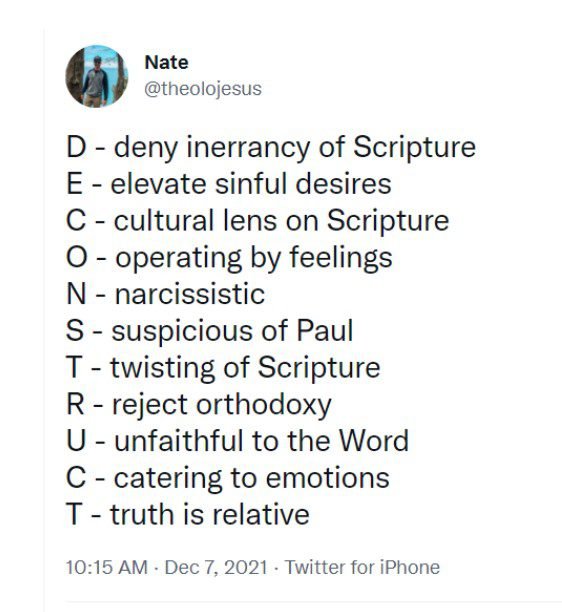
  • “Deconstruction” According to Evangelical Preachers

    deconstruction
    How Evangelical Preachers View Deconstruction

    Evangelicalism has a deconstruction crisis. I know they do based on the sheer number of articles, blog posts, podcasts, and sermons churned out by Evangelical taking heads, warning that deconstruction is okay as long as it keeps your ass in the pew and your tithe in the offering place.

    Evangelical rapper Lecrae described deconstruction like this:

    Deconstruction is not a bad thing if it leads to reconstruction. Sometimes you have to demolish a building that has mold and then build something else on that foundation. We’re not getting rid of the foundation. The foundation is Christ. But we’re building on that foundation and tearing down some things that were unnecessary.

    Of course, Evangelical preachers wish deconstruction would go away altogether. They see it as a product of postmodernism, with its questions and doubts. They wish for a return to the good old days of the 1950s, but an increasing number of Evangelicals refuse to buy what preachers are selling. Deconstruction begins with seeking answers to unanswered questions. Evangelicals often turn to their pastors, parents, and fellow church members first, hoping to find answers to their questions. Instead, they are served up warmed-over rote answers, complete with appeals to the Bible. When these “answers” fail to assuage inquiring minds filled with questions, preachers often turn to fear, warning deconstructionists of the danger of wandering outside of the Evangelical bubble. Hell and judgment, being powerful motivations to conform, will sometimes put an end to deconstruction. PRAISE JESUS, another loss averted. Please make that check out to “First Baptist Church.”

    An increasing number of Evangelicals ignore the paternalistic warnings of their pastors and continue seeking answers to their doubts and questions. These folks typically leave the fold, never to return. Tired of cheap, easy answers, they seek out people who will tell them the truth with no strings attached. I have helped countless people along their deconstruction journey. I don’t have an agenda. I am not interested in turning them into atheists. I don’t want their money. I just want to share my story and, if possible, answer whatever questions they might have. And if I can’t, I recommend books that might help him. My goal is to help facilitate their journey, knowing that the journey is far more important than the destination. Can any Evangelical preacher say the same thing?

    Many Evangelical preachers can’t imagine a world where God, Jesus, or the Bible are called into question. Questions and doubts are from the Devil or signs of worldliness. Sure, it is okay to question whether Paul wrote the book of Hebrews, but, by God, we must not question the inerrancy and infallibility of the Bible. There are certain foundational “truths” in Evangelicalism that must never, never be challenged or questioned. Deconstruction demands that no subject be off-limits. Post-modernity is coming for Evangelicalism, and unless they rethink their defense, deconstruction will only increase, both among the laity and the clergy.

    Bruce Gerencser, 69, lives in rural Northwest Ohio with his wife of 48 years. He and his wife have six grown children and thirteen grandchildren. Bruce pastored Evangelical churches for twenty-five years in Ohio, Texas, and Michigan. Bruce left the ministry in 2005, and in 2008 he left Christianity. Bruce is now a humanist and an atheist.

    Your comments are welcome and appreciated. All first-time comments are moderated. Please read the commenting rules before commenting.

    You can email Bruce via the Contact Form.