The North Face is currently using a drag queen to help push its gay pride clothing line. This line includes a couple of items for children, and these pieces furtively advocate for the LGBTQ lifestyle. The North Face ad begins, ”Hi, it’s me, Pattie Gonia, a real-life homosexual. I’m here with The North Face.”
But that’s just the beginning! The North Face’s new rainbow-themed clothes and accessories, including a rainbow jacket and a blanket for children, are part of its gay pride collection and marketing campaign. And this particular ad features a drag queen spokesperson actually saying, “COME OUT,” as a double entendre. He continues in a high, screeching voice, “We are here to invite you to COME OUT … in nature with us!”
The advertisement includes an invitation to their summer tour called “Summer of Pride,” held in select cities: “This tour has everything. There will be hiking, community, art, lesbians, and lesbians making art! Last year, we gay sashayed across the nation and celebrated pride with hundreds of you.”
The ad also features the male spokesman in full drag, wearing a rainbow mini-dress, matching rainbow leg warmers, heels, a wig, a rainbow headband, makeup, eyelash extensions, and huge hoop earrings. Nothing about this get-up promotes the great outdoors. The commercial ends with him stating, “That’s pretty gay!”
Adidas
People across the nation are outraged over the Adidas Pride 2023 collection, particularly after the company chose a biological male to model a woman’s one-piece swimsuit. The ad shows a hairy chest and crotch bulge to get the campaign’s point across.
Adidas is also taking heat because it is extremely offensive to women for the company to pay a biological male to model a woman’s swimsuit. In truth, Adidas is pushing an agenda of sexual confusion instead of just selling athletic clothing and swimwear.
The brand’s Pride campaign has been promoted by British Olympic diver Tom Daley, but he is not seen wearing the woman’s swimsuit.
As part of the Adidas campaign, Daley has written a “Love Letter to Sport” that said, in part, “No matter their sexual orientation, gender identity, whatever it is. Every single athlete should be free to love you while loving whoever they want; and most importantly, being true to whoever they are.”
This unnatural behavior is portrayed as a normal occurrence as Adidas embraces the LGBTQ community and glorifies the transgender lifestyle in its most recent ad.
But 1MM finds it extremely dangerous to share lies and deceit while propagating what God calls an abomination, camouflaged as kindness, love, and inclusivity. Yes, we are instructed to love one another, but we must also hold others accountable and speak out against sin.
Target
The Target boycott continues!
Target is currently selling gay pride clothing and accessories for infants and children, specifically transgender and gender-neutral items, furtively advocating for the LGBTQ lifestyle.
Target’s rainbow-themed T-shirts for children and onesies for babies are part of its gay pride marketing campaign.
The children’s T-shirt imprints include logos such as “It Takes All Kinds” and “Always Proud.” The infant items include “Bien Proud” designs, along with other rainbow skirts and accessories for children, preschool age and younger.
Please sign our petition and let Target know their decision to engage in corporate promotion and financial support of homosexuality is a bad idea, especially considering the number of mothers currently shopping for graduation gifts, college essentials, summer merchandise, and upcoming vacation items.
Maybelline
Maybelline is facing serious backlash due to its paid partnership with transgender activist Dylan Mulvaney. The trans social media influencer Dylan Mulvaney is known for pushing his sinful lifestyle onto impressionable teens who see the influencer glamorize his lifestyle on TikTok. During one TikTok video, he applies several Maybelline products to play up his gender-dysphoric identity as a trans woman.
Maybelline paying Dylan to model its makeup has sparked outrage with conservative consumers. Maybelline is also taking heat because this is extremely offensive to women to pay a biological male to model its makeup brand in its recent ad. In truth, Maybelline is pushing an agenda of sexual confusion instead of just selling makeup.
This perverted behavior is portrayed as a normal occurrence as Maybelline embraces the LGBTQ community by glorifying the transgender lifestyle in its most recent partnership.
But 1MM finds it extremely dangerous to share lies and deceit while propagating what God calls an abomination, camouflaged as kindness, love, and inclusivity. Yes, we are instructed to love one another, but we must also hold others accountable and speak out against sin.
M A C Cosmetics
Parents should be aware that M·A·C· Cosmetics has a dedicated VIVA GLAM line that financially supports the LGBTQ lifestyle. M·A·C· uses transgenders, drag queens, and particularly, trans social media influencers to push this lifestyle onto impressionable teens who see the influencers glamorize their lifestyle. In truth, M·A·C· is pushing an agenda of sexual confusion instead of just selling makeup.
This perverted behavior is portrayed as a normal occurrence as M·A·C· embraces the LGBTQ community by glorifying the transgender and drag lifestyle even though it is an unhealthy lifestyle. M·A·C· camouflages their agenda as good by calling themselves Mactivists.
The official M·A·C· Cosmetics website states: “27 years of giving a glam! Since 1994, M·A·C VIVA GLAM has raised OVER $500,000,000 globally – and counting! – to support healthy futures and equal rights for all. That’s over 9,713 grants given to 1,818 organizations in 92 countries. And over 19,000,000 lives changed around the world.”
Yes, M·A·C· has donated 100% of the VIVA GLAM lipstick selling price of $19 each to help the LGBTQ community and people living with or affected by HIV/AIDS. Ironically, M·A·C· claims to support healthy futures when it is proven the LGBTQ lifestyle is unhealthy.
The M·A·C· website also brags, “Our founding credo – All Ages, All Races, All Genders – remains more integral to who we are now than ever before, as we fight for the rights and freedoms of all our friends and fans around the world.”
M·A·C·’s website clearly celebrates pride all year long, and the cosmetic retailer is proud to celebrate what they call beauty without gender boundaries.
But 1MM finds it extremely dangerous to share lies and deceit while propagating what God calls an abomination, camouflaged as kindness, love, and inclusivity. Yes, we are instructed to love one another, but we must also hold others accountable and speak out against sin.
Bruce Gerencser, 66, lives in rural Northwest Ohio with his wife of 45 years. He and his wife have six grown children and thirteen grandchildren. Bruce pastored Evangelical churches for twenty-five years in Ohio, Texas, and Michigan. Bruce left the ministry in 2005, and in 2008 he left Christianity. Bruce is now a humanist and an atheist.
One Million Moms, an arm of the American Family Association, is outraged over the appearance of gay men in a Men’s Wearhouse advertisement. OMM sent out an email blast titled “Men’s Wearhouse Finds It Necessary to Flaunt an Alternative Lifestyle to Sell Their Clothes” to thousands of like-minded Fundamentalists and one not-like-minded atheist :), alerting them to the latest appearance of gay men in public. Here’s what homophobe extraordinaire, Monica Cole, had to say:
Men’s Wearhouse should be ashamed of attempting to normalize sin by featuring two gay men getting married in their 2023 “Love the way you look on your big day” commercial. It includes two men dressed in wedding attire, hand in hand after their ceremony, and emphasizes during the ad, “And we mean everybody.”
Obviously, this “Love the way you look” ad (with hashtag #LTWYL) promotes same-sex marriage to please a small percentage of customers while pushing away conservative customers. Not to mention, there is also a female dressed in a groomsman’s suit during this commercial.
Even though homosexuality is unnatural, this advertisement is pushing the LGBTQ agenda. Men’s Wearhouse is using public airwaves to subject families to decadent morals and values while belittling the sanctity of marriage. As an even greater concern, the controversial commercial is airing as early as 6:00 p.m., when children are likely watching television. It is not a retailer’s job to introduce so-called “social issues” like this to our children in a commercial. Men’s Wearhouse is glorifying sin, and no sin should be honored.
Millions of Americans strongly believe marriage should be between one man and one woman. But Men’s Wearhouse is taking sides instead of remaining neutral in the culture war. Men’s Wearhouse will hear from the left, so they need to hear from us as well. One day, we will answer for our actions or lack of them. So, we must remain diligent and stand up for Biblical values and truth. Repeatedly, Scripture says that homosexuality is wrong, and God will not tolerate this sinful nature (Romans 1:26-27).
OMM accuses Men’s Wearhouse of:
Normalizing sin by featuring two gay men getting married
Promoting same-sex marriage
Pushing away conservative Christians
Pushing the LGBTQ agenda
Using public airwaves to subject families to decadent morals and values
Introducing children to so-called “social issues”
Glorifying sin
Not being neutral in the “culture war”
OMM got all this from a TV ad. Here’s the thirty-second ad that has Cole and her fellow Evangelicals all upset:
By the way, half of the ad features heterosexual couples. And, shades of George Wallace, mixed-race couples!
Of all the things OMM could focus on, they choose to fix their righteous indignation on a 30-second clothing ad. I seriously doubt Men’s Wearhouse will pay any attention to their fake outrage. It’s 2023, ladies. LGBTQ people ain’t going away. All you are doing is making fools of yourselves and Christianity.
Bruce Gerencser, 66, lives in rural Northwest Ohio with his wife of 45 years. He and his wife have six grown children and thirteen grandchildren. Bruce pastored Evangelical churches for twenty-five years in Ohio, Texas, and Michigan. Bruce left the ministry in 2005, and in 2008 he left Christianity. Bruce is now a humanist and an atheist.
Lego recently announced its launch of a rainbow-colored building block set available June 1 – just in time for Gay Pride Month.
Lego has created its first LGBTQ toy that glorifies gender inclusivity and ignores one’s biological sex. This 346-piece set includes a rainbow-colored background and figures of each color. There is even a purple drag queen figure, according to Matthew Ashton, the designer of the set.
“We’re super excited to reveal our new set – Lego: Everyone Is Awesome!” the company tweeted Thursday. “Because we celebrate every Lego builder.”
“The set features a rainbow wall, plus black and brown, and the colors of the transgender flag: sky blue, white, and pink,” Fox Business reported. “The rainbow wall has 11 accompanying figures with a corresponding color.”
With the pro-LGBTQ toy being recommended for ages 18+, many critics are concerned about the actual contents inside the new product’s box and its appropriateness for minors, but Ashton insists that it is for all.
“I wanted to create a simple little set with a powerful message of love, inclusivity, and acceptance … so here it is! #lego love to you all!” tweeted Ashton, who is also a Lego vice president of design.
Aston claims the set advocates tolerance but is also persistent that Lego be on board to build the LGBTQ agenda.
“That’s what’s been so important to me in getting this set out with a message that we can be really proud of,” he added.
It’s apparent that even toy manufacturers are attempting to indoctrinate children by exposing them to the LGBTQ lifestyle. Why can’t Lego let kids be kids instead of glamorizing a sinful lifestyle?
Lego is confusing our innocent children by attempting to normalize this lifestyle choice, which is not only irresponsible but also dangerous to the well-being of our children. Toy manufacturers need to remain neutral and should avoid aiming to please a small percentage of customers while pushing away conservative customers.
It is crystal clear that Lego is attempting to desensitize our youth, so One Million Moms believes it’s urgent to warn parents of the company’s agenda.
One News Now covered this story recently. We have included the article here for additional information. One News Now is a division of American Family Association, the parent organization of One Million Moms.
We must remain diligent and stand up for biblical values and truth. Scripture says multiple times that homosexuality is wrong, and God will not tolerate this sinful nature.
Bruce Gerencser, 66, lives in rural Northwest Ohio with his wife of 45 years. He and his wife have six grown children and thirteen grandchildren. Bruce pastored Evangelical churches for twenty-five years in Ohio, Texas, and Michigan. Bruce left the ministry in 2005, and in 2008 he left Christianity. Bruce is now a humanist and an atheist.
No, silly. Easter is the day we celebrate the resurrection of Jesus! Shall we talk about Christmas next? You know, the “reason” for the season. Give me my presents, Santa. Uh, thank you Jesus, for, uh, well, for something.
I read a number of Evangelical websites and blogs. Some days, I want to pull my hair out or bang my forehead on the table as I read about the latest faux threat to modern civilization or the “persecution” American Christians are facing because they have to treat LGBTQ as if they are human. I derisively laugh, cuss, and shake my head, but I must continue to wade through the bovine waste river if I plan to be an informed and literate writer. It’s my cross to bear. Buncha homophobes, the lot of them
I subscribe to the One Million Moms newsletter. One Million Moms is a smelly armpit of The American Family Association (AFA). Million Mommies is what I call the female outrage wing of AFA. They focus on boycotting companies that advertise things on TV shows they think are offensive, immoral, or anti-Christian. Their website lists the current outrages and companies who have changed their ways due to a Million Mommies boycott or letter-writing campaign. (Uber, Oreo, Frank’s Hot Sauce) They are well-organized, avid letter writers, and by all accounts, obsessed with the sex other people are having.
Monica Cole is the director of One Million Moms. Several years ago, Cole sent out a weekly Million Mommies newsletter that was different from others I have received in the past. No call to action, no letters to write, no boycott, no panties in a bunch. In other words, none of the usual angst-filled Million Mommies stuff. Cole, concerned for sinners such as you and me, made that week’s newsletter all about Easter, the resurrection of Jesus, and the Christian gospel. She hoped readers would forward it on to lost friends and family members:
If you know of someone who is not saved, please pass this on to them. Share the greatest gift of all with them: a relationship with Jesus Christ and eternal life. Also, share this with your brothers and sisters in Christ so they may use this to share with others. God commands that we share the gospel with others. We need to help one another become passionate followers of Jesus Christ.
What I found interesting is how Cole explained the gospel and salvation, Here’s what Cole thinks the gospel is and what a sinner should do to find salvation:
Resurrection Sunday is a time to Rejoice! Jesus paid a debt for us that no one else could ever pay so that we could be in heaven with Him for eternity. God gave the perfect sacrifice, His only Son, and if we believe in Him, then we will be forgiven and saved from our sins.
To be saved, you must believe that Jesus Christ died on the cross for EVERYONE’S sins, including your own, and receive Him as your personal Savior so that one day you can be with our Heavenly Father. If you believe Jesus died on the cross to save us from our sins, you will also need to admit you are a sinner – as we all are. Romans 3:23 KJV says, “For all have sinned, and come short of the glory of God.” If you have never confessed your sin and belief in Christ, take time to do it right now. Jesus is the only way to be saved from your sins and receive eternal life.
On the third day, he rose again from the dead. This is the Good News that Christians celebrate: His Resurrection! He is ALIVE! And one day our Savior will return. He, and only He, sets us free from our sins! “Jesus saith unto him, ‘I am the way, the truth, and the life: no man cometh unto the Father, but by me.’” John 14:6 KJV
The birth of Jesus is wonderful, but the resurrection is even more exciting. It is the finale to the Christmas story. Jesus accomplished what he came for. Jesus’ last words before dying on the cross were documented in John 19:30 as, “It is finished.” He knew that all was now completed and that Scripture would be fulfilled. To suggest that more needs to be done to earn your way to heaven is the same as saying Jesus died for nothing. “For by grace are ye saved through faith; and that not of yourselves: it is the gift of God. Not of works, lest any man should boast.” Ephesians 2:8-9 KJV
Nails were not what held Jesus to the cross. Jesus had the power to come down from that cross, but He knew this is what had to be done for His believers to be saved. He died on the cross for you and me because of His love for us. He loved us that much! “For God so loved the world, that he gave his only begotten Son, that whosoever believeth in him should not perish, but have everlasting life.” John 3:16 KJV
According to Cole, to be saved, people must believe and do the following:
Admit that Jesus died on the cross for their sins
Admit that they are sinners
Receive Him (Jesus) as their personal Savior
If people will do this they will:
Be saved from their sins
Receive eternal life
One day live with the Heavenly Father
That’s it!
Man, I am sooooo glad I did this 48 years ago. Praise Jesus, I am still gloriously, wonderfully saved! My eternal reservation is booked and I am ready to go when Jesus either calls my name or comes in the clouds to fetch me. I may be an atheist, but I sincerely prayed the sinner’s prayer. I’m good to go, right? A-w-e-s-o-m-e!
Sadly, this is the bankrupt gospel preached in thousands and thousands of Evangelical and Independent Fundamentalist Baptist (IFB) churches. It is the gospel preached by the likes of the late Jack Hyles, Bob Gray, Sr., Franklin Graham, Joel Osteen, Bethel Church Redding, Joyce Meyer, Greg Laurie, and most Evangelical megachurch pastors. It is a gospel that requires nothing more than I’ve-got-a-pulse sincerity and mental assent to a propositional set of facts. This gospel is what Deitrich Bonhoeffer called “cheap grace.”
I call this gospel the 1-2-3 repeat after me gospel. (Please see One, Two, Three, Repeat After Me: Salvation Bob Gray Style.) In theological terms, this truncated gospel is called decisional regeneration or easy believism. That I can still be considered a Christian should be offensive to every follower of Jesus, yet many people think that I am still a born-again child of God and Heaven will someday be my eternal home. I might lose some rewards, have my gym pass revoked, or my mansion might not be as spiffy as Charles Spurgeon’s, but my future is secure, all because I prayed the sinner’s prayer at age 15 at Trinity Baptist Church in Findlay, Ohio.
By stringing a bunch of Bible verses together, many Evangelical churches and pastors have reduced the Christian gospel to meaningless drivel. Being a Christian should mean something. Isn’t the essence of the Christian gospel following after Jesus? Can people really be Christians if they aren’t following Jesus, if they aren’t committed to believing and practicing his teachings?
Part of the problem is that there are at least five plans of salvation in the Bible. In the Old Testament, salvation was procured through keeping the law and blood sacrifice. In the New Testament, we have the gospel of Jesus, the gospel of Paul, the gospel of Peter, and the gospel of James. Each of these New Testament gospels is different from the others, and this is why there are so many Christian sects, each with their own gospel. Which gospel a sect, church, or pastor emphasizes determines what a person must do or believe to be a Christian.
Here in the 21st century, the gospel of Paul rules the salvation roost. Some sects, churches, and pastors try to merge Paul’s gospel with the others, resulting in a hybrid gospel. But, if being a Christian means following Jesus, shouldn’t HIS gospel be the one preached in Christian churches? Why do so few churches preach Jesus’s gospel? Why do they focus on Paul’s gospel and doctrine, and not Jesus’s gospel? Could the reason be that Jesus focused on how a person lives, and not what a person believes? Could the reason be that Jesus’ gospel required singular love and devotion to God and mankind — the two Great Commandments?
Take the sermon on the mount. Did Jesus preach anything remotely similar to Monica Cole’s gospel or the gospel that will be preached at countless Evangelical churches this Sunday? He did not. Jesus preached a gospel of works, a gospel that called on people to forsake their nets, family, and everything they held dear and follow after him. Jesus didn’t say to those gathered on the mount to hear him: say you are sorry for your sins and promise to believe in me after I die on the cross. He didn’t ask Jews to ask Jesus into their heart or walk down the aisle and make a public profession of faith. Compare what Jesus preached in Matthew 5-7 with what is preached in the average Evangelical church. The contrast couldn’t be starker. Jesus called to people and said follow me. Evangelical preachers call to people and say, believe these facts, pray this prayer. and you will be saved! Oh, and throw a tenner in the plate while you are at it.
The sermon on the mount is Jesus’ manifesto. He wanted to make sure people understood what it meant to be his follower. Any casual observer of Evangelicalism can see that the gospel preached by Jesus does not remotely resemble what is preached in most Evangelical churches. And it’s not just an Evangelical problem. Mainline and Catholic churches birthed generation after generation of nominal, name-only Christians. What we really have in America is cultural Christianity; a Christianity that bears little resemblance to the teachings and life of its founder.
In Matthew 25:31-46, Jesus is quite clear about the essence of his gospel. Notice what he said:
When the Son of man shall come in his glory, and all the holy angels with him, then shall he sit upon the throne of his glory: and before him shall be gathered all nations: and he shall separate them one from another, as a shepherd divideth his sheep from the goats: and he shall set the sheep on his right hand, but the goats on the left. Then shall the King say unto them on his right hand, Come, ye blessed of my Father, inherit the kingdom prepared for you from the foundation of the world: for I was an hungred, and ye gave me meat: I was thirsty, and ye gave me drink: I was a stranger, and ye took me in: naked, and ye clothed me: I was sick, and ye visited me: I was in prison, and ye came unto me. Then shall the righteous answer him, saying, Lord, when saw we thee an hungred, and fed thee? or thirsty, and gave thee drink? When saw we thee a stranger, and took thee in? or naked, and clothed thee? Or when saw we thee sick, or in prison, and came unto thee? And the King shall answer and say unto them, Verily I say unto you, Inasmuch as ye have done it unto one of the least of these my brethren, ye have done it unto me. Then shall he say also unto them on the left hand, Depart from me, ye cursed, into everlasting fire, prepared for the devil and his angels: for I was an hungred, and ye gave me no meat: I was thirsty, and ye gave me no drink: I was a stranger, and ye took me not in: naked, and ye clothed me not: sick, and in prison, and ye visited me not.Then shall they also answer him, saying, Lord, when saw we thee an hungred, or athirst, or a stranger, or naked, or sick, or in prison, and did not minister unto thee? Then shall he answer them, saying, Verily I say unto you, Inasmuch as ye did it not to one of the least of these, ye did it not to me. And these shall go away into everlasting punishment: but the righteous into life eternal.
Sheep and Goats. Saved and Lost. Everlasting Punishment and Life Eternal. All determined, not by what people believe, but by how they live. Evangelicals have all kinds of explanations for this passage of Scripture. It’s a difficult, complex passage, they say. Doesn’t seem that way to me. A literal reading of the text makes it clear: what separates the sheep/saved from the goats/lost are their works. Surely Jesus meant what he said, yes? Why all the ‘splaining and excuses? Why all the theological gymnastics? Yes, Jesus contradicts Paul, but aren’t Christians followers of Jesus, not Paul?
The late Keith Green, an Evangelical from the Jesus People era, sang a song about Matthew 25. I still remember the ending: the only difference between these two groups of people is what they did and did not do!
I may be an atheist, but I admire and respect any Christians who take seriously their faith and do their best to follow after Jesus.
There are many mainline, progressive, and liberal Christians who think the essence of Christianity is loving God with their heart, soul, and mind and loving their neighbor. After all, Jesus did say that the law and prophets, the entire Bible at the time, hinged on two commands: love God, love humanity.
But when the Pharisees had heard that he had put the Sadducees to silence, they were gathered together. Then one of them, which was a lawyer, asked him a question, tempting him, and saying, Master, which is the great commandment in the law? Jesus said unto him, Thou shalt love the Lord thy God with all thy heart, and with all thy soul, and with all thy mind. This is the first and great commandment. And the second is like unto it, Thou shalt love thy neighbour as thyself. On these two commandments hang all the law and the prophets.
Or what man is there of you, whom if his son ask bread, will he give him a stone? Or if he ask a fish, will he give him a serpent? If ye then, being evil, know how to give good gifts unto your children, how much more shall your Father which is in heaven give good things to them that ask him? Therefore all things whatsoever ye would that men should do to you, do ye even so to them: for this is the law and the prophets.
I think I speak for many atheists, agnostics, and non-Christians when I say, if the Christianity on display in America remotely resembled Jesus’ gospel, I suspect we wouldn’t have much to complain about. If Evangelicals focused on loving God and loving humanity, the world would be a much better place. Instead, they focus on right beliefs, right morals, and right politics – my God, Evangelicals, again, overwhelmingly voted for Donald Trump — and the result is what we see everywhere we look: hateful, mean, judgmental assholes who have no tolerance for any belief or way of life but their own. It is THIS Christianity that most of us find offensive.
No one should take this post as me saying that if Christianity was ______________, I would return to the fold. I think the historical foundation of Christianity is false and I cannot envision a way of looking beyond what I know in order to, by faith, “believe.” That said, I do admire people who take seriously the teachings of Jesus, and do their best to love others. I can say the same for any religion or worldview. The proof of its value is determined by the works of those who claim that particular religion as their own.
Keith Green? I am of the opinion that if he was still alive, he likely would have left Evangelicalism, thoroughly disgusted with what it has become.
Bruce Gerencser, 66, lives in rural Northwest Ohio with his wife of 45 years. He and his wife have six grown children and thirteen grandchildren. Bruce pastored Evangelical churches for twenty-five years in Ohio, Texas, and Michigan. Bruce left the ministry in 2005, and in 2008 he left Christianity. Bruce is now a humanist and an atheist.
One Million Moms, the female outrage department of the American Family Association, are upset over a new Cottonelle ad that asks women to dare to go commando. Here’s what director Monica Cole’s press release had to say:
In Cottonelle’s newest advertising campaign “Dare to Go Commando,” a company spokeswoman asks individuals if they feel cleaner after using Cottonelle because of the ripple texture. The Cottonelle spokeswoman goes so far as to ask another woman if she feels clean enough to go commando now. The woman agrees and walks back into the restroom to return with her undies in a small shopping bag. The commercial ends with both women pulling down the waistbands of their pants just enough to reveal they don’t have panties on.
Cottonelle is encouraging consumers to go without underwear. Oh, please! This is ridiculous. This type of advertising is extremely inappropriate.
The tissue paper company also has a similar ad, “Go Cottonelle. Go Commando.” In this ad, the spokeswoman asks a man to go commando, and it ends the same way.
Cottonelle Promotion Photograph
Evidently, the women of One Million Moms want to hold on to their cotton Fruit of the Looms, and don’t want American women walking around sans underwear. They really should pay more attention. As a man who has seen plenty of female backside over the years, I can say that women have been going almost commando for years. These days, they can make dozens of pairs of underwear from a yard of material. I will leave it to female readers to decide whether going commando is more comfortable or appropriate. All I can say is that One Million Moms better not ask their husbands to support their effort. I’ve seen on the street Christian men, hand over one eye, carefully observing the female anatomy. I highly doubt they want to see the return of panty lines.
This is so silly, is it not? Of all the things one could be offended and outraged by, women not wearing underwear tops the list?
Bruce Gerencser, 66, lives in rural Northwest Ohio with his wife of 45 years. He and his wife have six grown children and thirteen grandchildren. Bruce pastored Evangelical churches for twenty-five years in Ohio, Texas, and Michigan. Bruce left the ministry in 2005, and in 2008 he left Christianity. Bruce is now a humanist and an atheist.
Taco Bell is following a trend in crude commercials. While a few fast food restaurants are cleaning up their ads, Taco Bell decided to air a commercial that includes foul language.
The newest Taco Bell commercial says, “When your morning is hell, just go to Taco Bell.” They should not use the word hell in a jingle. We all know children repeat what they hear [like when they hear the word HELL in church?].
Taco Bell’s “Morning is hell” ad is irresponsible and offensive. This inappropriate advertisement is airing during primetime when children are likely watching. It is extremely destructive and damaging to impressionable children viewing the commercial.
Please contact Taco Bell through our website and ask the company to pull the current ad immediately! Also, encourage Taco Bell to be more responsible in future marketing campaigns. If Taco Bell wants our business, it must no longer use foul language in its ads.
— Monica Cole, One Million Moms, Taco Bell has joined in Tasteless Advertising, February 16, 2017
This is the time of year when Evangelical soothsayers, psychics, and Nate Silver (ESPN 538) make predictions for the coming year. I thought, in keeping with the spirit of the New Year, that I, the atheist version of Carnac the Magnificent, would make a few predictions of my own. Here’s my 15 Astounding Predictions for 2016.
Richard Dawkins will say something stupid.
Neil deGrasse Tyson will say something brilliant.
The Pope will not get laid.
Evangelicals will continue to say the rapture is nigh.
At least three Evangelical preachers will be arrested and charged with molesting children and 25 others will be accused of sexual misconduct.
Evangelicals will continue to say atheists hate God and secretly want to have wanton, immoral sex.
Franklin Graham will be exposed as a cross dressing transvestite.
Evangelical Calvinists will continue to say their critics don’t understand Calvinism.
Donald Trump will say bat-shit crazy stuff and his followers will love it.
Evangelicals will continue to think that Christianity is under attack and that secularists are trying to make Christianity illegal.
Tea Party Republicans will continue to think that the lame stream media controls America and that Muslim socialist Barack Hussein Obama is coming to take their guns.
The day after Thanksgiving, Fox News will say that there is a War on Christmas.
One Million Moms will continue to be outraged over nudity, cursing, and gay kissing on TV. This year they will find their lost remote and learn that if they push the channel button it changes the channel.
Democrats will win the presidency, a sure sign that the Antichrist is preparing to usher in the new world order.
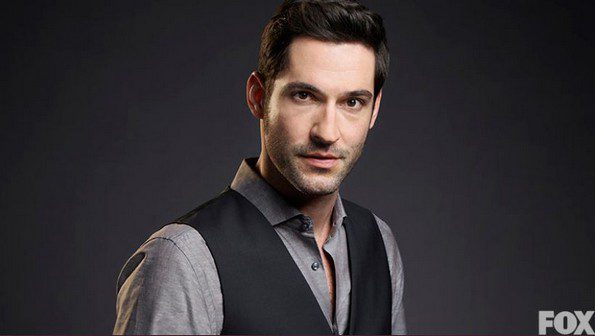
Actor Tom Ellis will portray Lucifer Morningstar on FOX’s TV Show Lucifer
Snark and sarcasm
Another day, another faux outrage by Monica Cole and the sexually frustrated, batteries in the vibrator are dead, women of One Million Moms. Later this year, FOX plans on debuting a TV show titled Lucifer. FOX describes the show this way:
The Devil has come to Los Angeles…
Based upon the characters created by Neil Gaiman, Sam Kieth and Mike Dringenberg for DC Entertainment’s Vertigo imprint, LUCIFER is the story of the original fallen angel. Bored and unhappy as the Lord of Hell, LUCIFER MORNINGSTAR (Tom Ellis, “Merlin”) has abandoned his throne and retired to L.A., where he owns Lux, an upscale nightclub.
Charming, charismatic and devilishly handsome, Lucifer is enjoying his retirement, indulging in a few of his favorite things – wine, women and song – when a beautiful pop star is brutally murdered outside of Lux. For the first time in roughly 10 billion years, he feels something awaken deep within him as a result of this murder. Compassion? Sympathy? The very thought disturbs him – as well as his best friend and confidante, MAZIKEEN aka MAZE (Lesley-Ann Brandt, “The Librarians”), a fierce demon in the form of a beautiful young woman.
The murder attracts the attention of LAPD homicide detective CHLOE DANCER (Lauren German, “Chicago Fire”), who initially is dismissive of Lucifer. But she becomes intrigued by his talent for drawing out people’s secrets and his desire to dispense justice, doling out punishment to those who deserve it. As they work together to solve the pop star’s murder, Lucifer is struck by Chloe’s inherent goodness. Accustomed to dealing with the absolute worst of humanity, Lucifer is intrigued by Chloe’s apparent purity and begins to wonder if there’s hope for his own soul yet.
At the same time, God’s emissary, the angel AMENADIEL (DB Woodside, “Suits,” “24”), has been sent to Los Angeles to convince Lucifer to return to the underworld…can the Devil incarnate be tempted toward the side of Good, or will his original calling pull him back toward Evil?
One Million Moms is outraged over FOX’s unbiblical, humanizing presentation of Lucifer. In a May 2015 post urging Mommies to sign a petition demanding FOX drop the program, Cole wrote:
FOX has plans in 2016 to air “Lucifer,” a new series which will glorify Satan as a caring, likable person in human flesh.
The series will focus on Lucifer portrayed as a good guy, “who is bored and unhappy as the Lord of Hell.” He resigns his throne, abandons his kingdom and retires to Los Angeles, where he gets his kicks helping the LAPD punish criminals.
At the same time, God’s emissary, the angel Amenadiel, has been sent to Los Angeles to convince Lucifer to return to the underworld.
Previews of the pilot episode depict graphic acts of violence, a nightclub featuring scantily-clad women and a demon…
Today, I got an email from Monica Cole and One Million Moms with the subject line “We are missing your name on the ‘Lucifer’ petition.” I thought, I bet you are. Here’s what Cole had to say in her email:
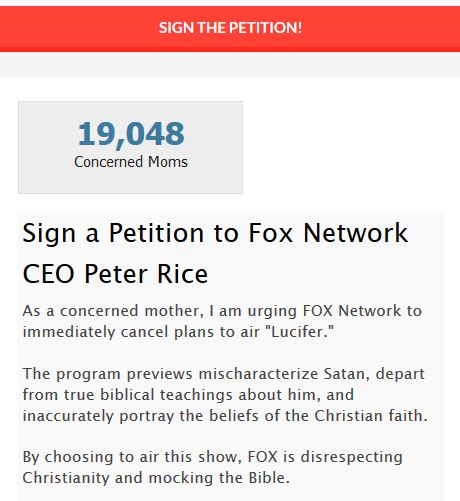
Very soon, One Million Moms will deliver a petition to FOX television network, urging them to cancel plans to air a new series which will glorify Satan as a caring, likable person in human flesh.
We want to include your name, letting FOX know that Christians are standing together!
The previews for “Lucifer” misrepresent Satan, depart from true biblical teachings about him, and inaccurately portray the beliefs of the Christian faith. In airing this show, FOX will be disrespecting Christianity and mocking the Bible.
Add your signature today! 1MM and our children are counting on you!
It’s a pretty slow news day when the biggest thing on your outrage radar is a TV program that “misrepresents Satan.”
Cole whines that FOX’s show disrespects Christianity and mocks the Bible. Aww…so sorry.
Here’s my take. Tom Ellis is an attractive actor and we can’t have fundamentalist Christian women getting all hot and bothered over an attractive Lucifer. If this happened, fundamentalist women would be forced be dig deep into their underwear drawer and find their vibrator so they can satisfy their “need.” But, Bruce, they have a husband who will dutifully perform the missionary service. What self-respecting fundamentalist Christian woman would want to have sex with Billy Bob when they can fantasize about having sex with Lucifer and turn their Passion Rabbit or Ladygasm vibrator on H-I-G-H.
Proving my point, as of today, the Lucifer petition has 19,048 signatures. If you want to add your name, or better yet a fake name, please go here.
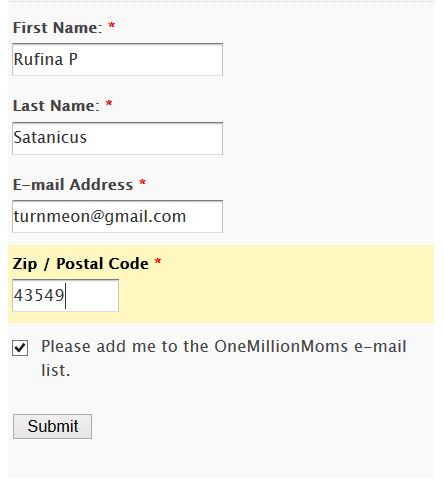
Here’s my petition submission. I encourage you to be creative and let Monica Cole know you support her attempt to defend Lucifer.
One Millions Moms (OMM), the outrage wing of the American Family Association, issued an action alert today condemning the Girl Scouts’ policy on transgender youth. The action alert states:
A new Girl Scouts of the USA policy states it will extend membership to boys who identify as girls…
…This means girls in the organization will be forced to recognize and accept transgenderism as a normal lifestyle. Boys in skirts, boys in make-up and boys in tents will become a part of the program. This change will put young innocent girls at risk.
Adults are willing to experiment on our kids – both the boys who are confused and the girls who will wonder why a boy in a dress is in the bathroom with them…
Here’s the Girl Scouts policy that has OMM upset:
Girl Scouts is proud to be the premiere leadership organization for girls in the country. Placement of transgender youth is handled on a case-by-case basis, with the welfare and best interests of the child and the members of the troop/group in question a top priority. That said, if the child is recognized by the family and school/community as a girl and lives culturally as a girl, then Girl Scouts is an organization that can serve her in a setting that is both emotionally and physically safe.
Simply put, if a child is recognized as a girl by their family and school and lives culturally as a girl, the Girl Scouts will allow the child to be a part of their group. OMM refuses to admit that matters of sexual orientation and sexual identity can be fluid and complex and that biologically sexuality is nuanced and complex. In their mind, God made male and female, end of story. If you are born with a penis you are a male and if you are born with a vagina you are a female. However, if you have done any reading on sexual orientation and sexual identity, you know that, thanks to science, matters orientation and identity are complex. These days, to be conversant on these issues, one must understand terms like heterosexual, homosexual, bisexual, asexual,pansexual,polysexual, androphilia, gynephila, intersex, cisgender, transsexual, transgender, etc. In the simplistic world of the OMM, God, through genetic voodoo makes humans male or female. However, God’s genetic voodoo act can result with in a child being born with the “wrong” genitals or other chromosomal aberrations. God must have been having a bad day, eh? ( Transgender, Intersex, Sexual Orientation)
As with seemingly every American culture conflict, Christian fundamentalism and literalistic interpretations of the Bible are the primary agitators. Science continues to undermine and discredit fundamentalist beliefs. Christian fundamentalists have two choices: they can grudgingly accept the findings of science or they can ignorantly and blindly wage war. Sadly, most fundamentalists choose the latter. Until the light of reason finds a way into their mind, there is no hope of reaching them. All we can do is keep them from hurting others. Like children with scissors, we need to make sure that OMM’s scissors have blunt ends so they can’t hurt themselves or others.
This post will reveal that the American Family Association supports homosexuality and same-sex marriage. It took a bit of digging and following the ever-winding Evangelical money trail, but I ended up with proof that AFA money has gone to support pro-homosexual causes. Not directly, of course, but if you follow the story I tell below, you will see that money from the homophobic AFA trickled down to two gay-friendly United Methodist churches. If you follow through to the end, you will also find out that One Million Dad’s and Mom’s are anything but, and the American Family Association is little more than a chihuahua with the bark of a doberman. By the end of this post, you also will be schooled in how Evangelical groups do business, all on the taxpayer’s dime.
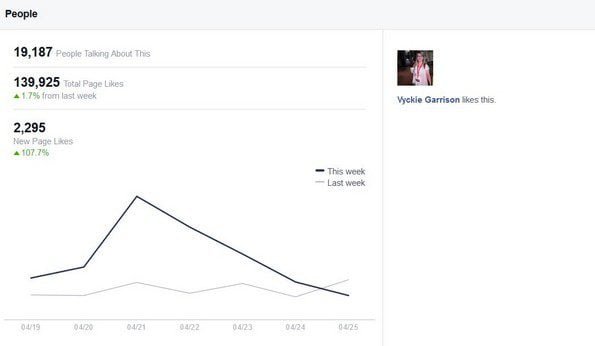
The American Family Association (AFA) was started in 1976 by United Methodist pastor Don Wildmon. His son Tim currently runs the operation. AFA is a fundamentalist parachurch organization, one of the many Evangelical groups at the heart of the American culture war. One Million Moms and One Million Dads are part of the grassroots outrage wing of the AFA. People often assume that One Million Moms and One Million Dads actually each have at least one million members. Nothing could be farther from the truth. It is important to understand this because their group names give the illusion that they represent a large number of Americans. They don’t, as the following graphics will clearly show:
Twitter Followers American Family Association April 25, 2015
As you can see, One Million Moms, One Million Dads, and the American Family Association are anything but what their names suggest.
In 2012, the American Family Association had $20,235,585 in income. They spent $958,609 on fundraising. They paid out $8,350,108 on salaries and compensation. They paid out $2,021,882 in office expenses. Here’s some of their other expenses:
Radio Network $6,919,651
TV Network $586,960
President Tim Wildmon salary $175,063
Executive Vice President Casey Smith salary $106,989
Chief Financial Officer Keith Gann salary $70,742
Vice President Human Resources William Hayden Salary $70,738
Chairman Emeritus Don Wildmon salary $136,296
Director Dan Celia salary $64,083
Pension Contributions $297,599
Employee Benefits $1,426,538 (note: to keep reported salaries down, compensation is hidden by calling it a benefit)
Advertising $647,658
Legal Fees $160,383
Products and Premiums $1,855,975 (note:giveaways and stuff for sale)
Public Education $1,855,975
Utilities $1,039,103
Miscellaneous Expenses $3,948,827 (note: this is also known as the ministry slush fund)
According to current Federal law, the American Family Association is considered a public charity, a 501c3 non-profit. The following chart shows the amount of money spent on lobbying from 2009 through 2012:
American Family Association Lobbying Expenses from 2012 Form 990
These numbers reflect what I call the Oh My God, there’s a Kenyan born socialist nigger in the White House, also known as Barack Obama, effect. Notice the huge bump in lobbying expenditures in 2011 and 2012.
All statistics taken from 2012 American Family Association 990 Form (link no longer active)
The American Family Association publishes a monthly magazine titled The AFA Journal. Total expenditures claimed for this endeavor? $7,273,028. Here’s where we can get a true number of how many people support the hysteria, I mean the work, of AFA. Total average subscribers for 2012? 175,000. Now you understand why the social media numbers of One Million Moms and One Million Dads is so pathetic,
As can be seen by what I have presented here, most of AFA’s money goes for salaries/benefits and radio/TV/magazine. Should U.S. taxpayers be supporting a “charitable” institution like the American Family Association? Because, that is EXACTLY what we are doing. Excluding payroll taxes, AFA, in 2012, paid $154,237 in taxes and licenses and $33,441 in use tax. That’s it. On over $20,000,000 in income, AFA paid a grand total $187,678 in taxes. Since they are a “charity”, almost all of their income is tax exempt.
Since several of the AFA staff are ordained ministers, they are eligible for the clergy housing allowance. In 2012, AFA paid out $84,710 in income tax exempt housing allowance. If the recipients are exempt from Social Security, as many clergy are, they didn’t have to pay social security taxes either.
This post reflects why I think all religious institutions should be required to pay the same taxes as businesses do. As it stands now, U.S taxpayers are funding the AFA and every other American religious sect and parachurch organization. What is especially egregious about the American Family Association is that almost all of their money goes to promote and advance their bigoted anti-abortion, anti-homosexual, anti-same-sex marriage, anti-secular agenda. Lest you doubt their objective, here’s their Mission Statement: (link no longer active)
The mission of the American Family Association is to inform, equip, and activate individuals to strengthen the moral foundations of American culture, and give aid to the church here and abroad in its task of fulfilling the Great Commission.
PHILOSOPHICAL STATEMENT
The American Family Association believes that God has communicated absolute truth to mankind, and that all people are subject to the authority of God’s Word at all times. Therefore AFA believes that a culture based on biblical truth best serves the well-being of our nation and our families, in accordance with the vision of our founding documents; and that personal transformation through the Gospel of Jesus Christ is the greatest agent of biblical change in any culture.
ACTION STATEMENT
The American Family Association acts to:
restrain evil by exposing the works of darkness
promote virtue by upholding in culture that which is right, true and good according to Scripture
convince individuals of sin and challenge them to seek Christ’s grace and forgiveness
motivate people to take a stand on cultural and moral issues at the local, state and national level
encourage Christians to bear witness to the love of Jesus Christ as they live their lives before the world
To that end, AFA spurs activism directed to:
Preservation of Marriage and the Family
Decency and Morality
Sanctity of Human Life
Stewardship
Media Integrity
We believe in holding accountable companies that sponsor programs attacking traditional family values. We also believe in commending those companies that act responsibly regarding programs they support.
And last, but not least, the American Family Association sells coffee beans. Yes sir, “When you purchase Thomas Street Coffee, you’re supporting efforts to proclaim the gospel of Christ in countries where 40% of unreached people groups live, including Ethiopia, Uganda, Honduras, Indonesia, and other coffee growing regions. ” (AFA reference)
In 2012, the American Family Association took in over $20,000,000. On their Thomas Street Coffee page, this is what Tim Wildmon and AFA want you to know; by buying their super-duper, God blessed coffee:
You’re also contributing to efforts to build schools, libraries, medical facilities, and clean water wells; as well as underwriting women’s literacy, agricultural education, and micro-finance programs.
Finally, your support of Thomas Street Coffee supports our parent organization, American Family Association, whose goal is to restore a strong sense of biblical values to American public life.
Based on AFA’s 2012 990 form, I couldn’t find any money going for “schools, libraries, medical facilities, and clean water wells; as well as underwriting women’s literacy, agricultural education, and micro-finance programs.” Imagine if the Wildmon’s and AFA stopped being bigots and actually used their income to help the least of these? You know, like Jesus taught?
AFA sells coffee procured from a group called Dominion Trading, an Evangelical coffee business started by Mike Stemm & Craig Meredith. Dominion was started to “help” Evangelical Ethiopian farmers:
In 2001, two Christian, American businessmen, & Craig Meredith, were asked by the Kale Heywot Church, the largest evangelical denomination in Ethiopia with nearly 7.5 million members, to come to Ethiopia to assess and make recommendations how their people could become self-sufficient and independent of foreign aid. During that trip, God changed the hearts and priorities of these two men, and the genesis for Dominion Trading, LLC. and a unique model for missions was realized.
Dominion Trading began developing extensive relationships with the Ethiopian coffee farmers to establish trust and mutual understanding. From that came collaboration, a focus on coffee quality, and the process to provide direct trade specialty coffee to the United States on a consistent basis. This commitment has created long-term sustainability for many Ethiopian coffee farmers. Additionally, a unique “relational bridge” has been built between the American coffee consumer, who enjoys some of the world’s finest coffee, and the Ethiopian farmer who produces the coffee.
Net profits from Dominion Trading’s coffee sales go to fund New Covenant Foundation, a 501c3 nonprofit corporation. According to the Thomas Street Coffee website (website no longer active):
Net income from Dominion Trading’s green and roasted coffee sales in the United States is donated to their ministry partner, New Covenant Foundation (NCF). NCF is a registered 501c3, whose mission is to 1) proclaim Jesus Christ through indigenous people, 2) to break the bonds of dependency on foreign aid by empowering individuals and communities to be self-supportive and 3) to create mutual partnerships with people that enables long-term transformation of their economy, their environment and their community.
New Covenant’s primary strategy and focus in Ethiopia is 1) supporting indigenous church planters who to-date have lead more than 15,000 people to Christ and planted more than 120 new churches and 2) providing community health education (physical, mental and spiritual) in rural areas. To-date, nearly 800,000 people in 500 communities, in the coffee growing regions of Sidamo and Yirgacheffe, have received the training resulting in nearly a 50% reduction in infant mortality and malnutrition. Additional programs for people with disabilities and women are being implemented. Another similar project is underway in Western Ethiopia to reach 2.5 million people in 1,500 communities with this life saving and transforming training.
This statement would lead most people to think that the net proceeds from Dominion Trading’s coffee is going to do many wonderful things for poor, needy Ethiopians. However, their 2011-2013 Federal Form 990 filings tell a different story.
(You will have to sign up for a FREE Guidestar account in order to look at these forms. If you do any writing or research on Evangelical “ministries”, it is well worth having an account.)
Based on the 990 filings of New Covenant Foundation, the overwhelming majority of the money that was spent went to people and religious organizations in the United States! I say, “that was spent” because at the 2013 filing deadline, New Covenant Foundation had:
no cash on hand
$707,745 savings, short term investments
$1,807,950 investments (up from $1,044,896 at the start of 2013)
Does all of this shock you? It shouldn’t. All the above is standard operating procedure for American Evangelical churches, institutions, and parachurch organizations. Here’s the kicker, one that should cause every reader to be rolling on the floor laughing. Let me set the background for this joke.
You’d agree that the American Family Association, One Million Moms, and One Million Dads are vehemently against homosexuality and same-sex marriage? Of course you would.
You’d agree that these groups spend a significant amount of time going after corporations, businesses, and media outlets that support the “evil” gay agenda? Of course you would.
Based on what I shared above, you’d agree that AFA buys the coffee they sell under the Thomas Street Coffee brand name from Dominion Trading who then donates its net profits to New Covenant Foundation? Of course you would.
Then please, oh please, explain to me New Covenant Foundation giving money to Osterville United Methodist Church in Osterville, Massachusetts, a church, drum roll please, that:
Reconciling congregations are United Methodist Churches that publicly welcome all persons, regardless of sexual orientation, to participate fully in the life of the community. Our statement of reconciliation says, “All persons are recipients of God’s love and grace. We share a faith in Jesus Christ and a commitment in Christianity, and this is our bond. In the spirit of God’s love and witnessing Jesus Christ’s life in action, our church welcomes all people. We acknowledge the diversity of God’s universe and open our hearts as Christ loved His children. Whatever your sexual orientation is, we hope you will visit us and experience the warmth of our welcoming community.
That’s right, the American Family Association buys coffee from Covenant Trading who gives its net profits to New Covenant Foundation who gives funding or makes some sort of payment to Osterville United Methodist Church, a church that considers gay people Christian.
From 2011 through 2013, New Covenant Foundation gave gay-loving Osterville United Methodist Church almost $15,000.
Oh, it gets better. New Covenant Foundation gave $200,000 to the Floris United Methodist Church, Herndon, Virginia building fund. This was the largest single expenditure in 2011 and 2012. Here’s what Floris United Methodist pastor Tom Berlin had to say about homosexuality and the angst it is causing within the United Methodist denomination:
…I am a moderate on this issue. Dead center. I represent those delegates who will vote to maintain the historic stance of the church related to GLBT issues. This is a source of great frustration to many who would like to see change. Our reading of the Bible, especially passages that we cannot translate into positive or neutral statements about homosexual practices, leads to our traditional views. I am also a pragmatist. I cannot help but see the unintended consequences of the change. Right now, in my community in Virginia, there are three formerly Episcopal churches who are being evicted from their facilities by their denomination over these issues. When this happens in the UMC, it will be the poor who will suffer because our mission and outreach budget will go unfunded. It will be the poorest of the poor who suffer the most when the UMC is no longer able to build churches, schools, clinics or have the funds to engage in disaster response around the globe in the wake of a split.
I wanted to speak on this issue because I am a father of four daughters from a generation that by and large doesn’t get what all the fuss is about. They can respect and be gracious about my opinion on human sexuality, but not the church’s silence on disagreement. But the main reason that I wanted to speak is that I serve a church that has a broad range of ideology, with tea party Republicans on one end and liberal Democrats on the other. In my work to keep our loose confederation together in the unity of Christ, I have found truth-telling and candor to be essential qualities. If you want community that includes diversity of opinion, you must have a commitment to being candid with each other. We disagree.
There are gay men and women in my church. There are many who have family members in the GLBT community. There are an abundance of people who just don’t get what all the fuss is about. I wanted to be able to tell them that their beliefs and opinions were honored in their denomination along with those who disagree. I have found that when a gay person or someone with a gay family member comes to my office, and we discuss the matter openly, honestly, and lovingly, we emerge with deeper community and less division. As a gay man said to me after one of these conversations, we don’t agree on everything, but given what you have said, I can come to church here. And I don’t want a church that is defined by my views on sexuality. I want a church where I can feel included. And based on this conversation, I can do that here…
I wonder if Tim Wildmon and the American Family Association are open and affirming towards Pastor Berlin’s statement? (that’s a rhetorical question, BTW)
Let me conclude by saying this, as you can see from the various data above, a lot of people are profiting off of “Jesus.” Does some of the money trickle down to the “least of these”? I am sure it does. But, its actually a very small amount compared to the total amount of income received. In the case of the American Family Association, they are an advocacy group for the homophobic wing of American Evangelicalism. They spend zero dollars on true charity work. While the Federal government considers them a charity, that doesn’t mean they actually do charitable work.
In the case of Mike Stemm and Craig Meredith and Covenant Trading/New Covenant Foundation, it appears that most of the net profits benefit churches and parachurch groups in the United States. While I’m sure some of this money filters down to Ethiopia and other African countries, it is hard to take seriously New Covenant Foundation’s mission when they were, at the end of 2013, sitting on almost $2,000,000 in cash and securities. Perhaps things look differently for 2014, but something tells me it is more of the same.
Thomas Street Coffee sells for over $16.00 a pound for which the poor Ethiopian farmer gets $2.50
From the FAQ of Thomas Street Coffee (Site no longer active)
How much of the profits from your coffee actually goes to the growing regions? And how do your standards compare to organizations such as Fair Trade?
The profits from our roasted coffee sales go back to purchase more green coffee and to support the work of AFA. We purchase the green coffee directly through growers and importers working with the farmers. The farmers are receiving a substantial amount of money for their green, far above any amount that the Fair Trade organization has set. In other words, we pay a premium for our green coffee. Our importers and coffee farmers work with the growers to help them increase the quality and yield on their coffee. Our growers are Christian growers and importers, therefore our purchase of their coffee helps support their work. The dollar amount varies from each region. We are helping people economically. Other items such as water wells, medical clinics, birthing centers, and schools for children come through the profits made from the sale of green coffee. These benefits come directly through the growers and the importers, giving them a practical way to share the gospel. The farmers average income for their green coffee is around $2.50 a pound, compared to Fair Trade at $1.25 per pound Some of our growers such as Kabum in Uganda have worked with the locals to set up banks and educate them about personal savings accounts. Church plants are taking place and people are being taught the importance of tithing. We at TSC are giving a hand up rather than a hand out.