Tag: Atheism

  • Questions: How do You Deal with Evangelical Family and Friends?

    i have a question

    I put out the call to readers, asking them for questions they would like me to answer. If you have a question, please leave it here or email me. All questions will be answered in the order in which they are received.

    Jen asks:

    How do you deal with Fundamentalist/Evangelical family and friends? I’m surrounded by them. Now that I’m an evil Liberal, I’m not taken seriously. When I do speak up, they use silencing techniques. I haven’t been outside the fold for very long, so I have a knee-jerk reaction to their control tactics (I hate them). I’m hoping we can find a way to have a peaceful relationship, but everything is so one-sided. It’s their way or else. I think part of the issue is that I was always the silent submissive one. Now that I can think for myself and speak up, they don’t know how to handle it.

    Jen, a self-described “evil liberal,” is having trouble getting along with Evangelical family and friends. I am sure scores of readers understand Jen’s predicament. She wants to get along with her Evangelical friends and family, but she’s having difficulty doing so due to their incessant need to dominate and control things. She suspects that her outspokenness after being silent and submissive in the past is perhaps part of the problem. Her family and friends don’t know what to do with the “new” Jen.

    jumping man

    Evangelicals are inherently Fundamentalist. If you have not read the post, Are Evangelicals Fundamentalists? I encourage you to do so. Many “enlightened” Evangelicals hate being called Fundamentalists. They will stomp and scream, objecting to being lumped together with the Steven Andersons, Fred Phelps, and Franklin Grahams of the world. Imagine a toddler jumping up and down, screaming, I’M NOT A CHILD. That’s many “offended” Evangelicals. As my previously mentioned post makes clear, true Evangelicals are theological and social Fundamentalists. If it walks, talks, and acts like a Fundamentalist, it is a Fundamentalist. Part of the problem is the far left of the Evangelical tent is inhabited by Christians who are not theologically or socially Evangelicals, yet they claim the Evangelical label. These Evangelicals are actually liberal or progressive Christians, but, for some reason, perhaps familiarity or family connections, they refuse to abandon Evangelicalism.

    Jen’s family and friends sound like they are typical Evangelicals, so I am going to assume that their beliefs are Fundamentalist. What do we know about Fundamentalists? First, Fundamentalists believe the Bible is the inspired, inerrant, infallible Word of God. Second, Fundamentalists tend to interpret the Bible literally. Third, Fundamentalists have a black and white view of the world. And fourth, Fundamentalists crave certainty. These four things breed arrogance and often lead to the boorish behavior Jen describes in her comment. Fundamentalists aren’t interested in seeking truth. In their minds, they have already found it. Fundamentalists think their beliefs are one and the same with the mind of God. How can they not think this way? God, the Holy Spirit, lives inside of them and is their teacher and guide. Armed with an authoritative, infallible book, Fundamentalists are certain they know the answers to every question. Doubt this premise? Ask yourself when is the last time you have heard a Fundamentalist say, “I don’t know,” or “that’s an interesting question, let me think on it and get back with you.” Never, right?

    Certainty stunts or retards intellectual growth. That’s why many Evangelical preachers haven’t changed their beliefs in years, if ever. One of my favorite U2 songs is “I Still Haven’t Found What I am Looking For.

    Video Link

    Evangelicals typically don’t say they haven’t found what they are looking for. Instead, they believe they hit the knowledge jackpot when Jesus reached into their wicked, sinful lives and saved them, imparting to them new life. 2 Corinthians 5:17 says: Therefore if any man be in Christ, he is a new creature: old things are passed away; behold, all things are become new.  At that moment, all things became new, including their knowledge and understanding of, well, e-v-e-r-y-t-h-i-n-g.

    Imagine, if you will, a room of Evangelicals having a discussion about any of current social hot button issues. They are in agreement, say on abortion or same-sex marriage. God has spoken, end of discussion. Thus saith the Lord, right? Into the room walks liberal Jen, the Jen everyone has been praying for; praying that she will see the “light.” Jen thinks that her Evangelical family and friends might appreciate her view on the subject being discussed. So, she shares her progressive viewpoint, and just like that, the oxygen is sucked out of the room. The looks on the faces of her family and friends tell her all she needs to know: “I have spoken out of turn. How dare I share a different opinion. How dare I suggest that there are other ways to look at issues such as abortion or same-sex marriage.” “What’s next,” they think. “Is unsaved Jen going to tell us that LGBTQ people are fine just as they are?” God forbid, right?

    And therein lies the problem when it comes to trying to get along with Evangelical family and friends — especially when there is a herd of them. Dissenting opinions or “unbiblical” speech is NEVER welcome. Everyone is expected to kowtow and conform to Evangelical truth. So what are the Jens of the world to do?

    First, Jen can shut up and refrain from entering discussions. She can continue to be a quiet, submissive wallflower. No one should have to do so, but countless non-Evangelicals, not wanting to have conflict, choose this path.

    Second, Jen can say, “dammit, I have just as much right to speak my mind as anyone else! I am NOT going to be silent!” While I admire such resolve, such an approach is not without danger. I have corresponded with numerous ex-Evangelicals who were ostracized or banished the moment they dared to pet the proverbial cat the wrong way. Readers might find, Count the Cost Before You Say I am an Atheist helpful. In this post, I detail the dangers of speaking your mind. Just remember, once you open your mouth and say _________________, you no longer control what happens next. I know former Christians who spend the holidays at home alone because they have been excommunicated over their heretical, liberal beliefs.

    Let me share a personal story:

    With my parents being dead, we spent Christmas Eve and Christmas Day with Polly’s parents. This abruptly changed in 2010. I left the ministry in 2003 and abandoned Christianity in November 2008. In early 2009, I sent out my family-shattering letter, Dear Family Friends, and Former Parishioners. This letter radically changed our relationship with Polly’s Fundamentalist family.

    Christmas of 2009 was best remembered by a huge elephant in the middle of the room, that elephant being Polly and me and the letter I sent the family. No one said anything, but the tension was quite noticeable.

    2010 found us, just like every year since 1978, at Polly’s parent’s home for Christmas Eve. This would be the last Christmas we would spend with Polly’s parents and her extended family. We decided to blend into the background, and besides short pleasantries, no one talked to us. Not that they didn’t want to. We found out later from one of our children that Polly’s uncle wanted to confront me about our defection from Christianity. Polly Mom’s put a kibosh on that, telling her brother-in-law that she had already lost one daughter and she was not going to lose another. (Polly’s sister was killed in a motorcycle accident in 2005.)

    I appreciate Polly’s Mom being willing to stand up to the man who is generally viewed as the spiritual head of the family. I am glad she put family first. If Polly’s uncle had confronted me there surely would have been an ugly fight. Whatever our differences may be, I deeply respect Polly’s parents. They are kind, loving people and I couldn’t ask for better in-laws.

    Christmas of 2010 was two years after President Obama was elected to his first term. Polly’s family didn’t vote for him, and through the night they made known their hatred for the man, Democrats, and liberals in general. Polly and I, along with many of our children, voted for Obama, so the anti-Obama talk and the subtle racism made for an uncomfortable evening.

    Most years, a gag gift is given to someone. This particular year, the gag gift, given to Polly’s uncle, was an Obama commemorative plate one of our nephew’s had bought on the cheap at Big Lots. One of Polly’s uncle’s grandchildren asked him what the plate was for. He replied, to go poo-poo on, poo-poo being the Fundamentalist word for shit.  This was the last straw for us.

    On our way home the next day, I told Polly that I couldn’t do it anymore and she said neither could she. So, we decided to stop going to Polly’s parents’ home for Christmas Eve. We do try to see Polly’s parents during the holiday, but we no longer attend the family gathering on Christmas Eve. Making this decision saddened us, but we knew we had to make it. (BTW, our children still attend the Christmas Eve gathering.)

    After Polly and I deconverted in 2008, we decided to take the “seen, but not heard” approach when around her family. Everyone knew we had left Christianity, yet that fact did not get in the way of their assaults on our beliefs and politics. Ever been around people who were making a “point” without addressing you directly? That was family holidays for us. After a while, we got tired of being pummeled; tired of being treated as problems that needed fixed. We loved being around Polly’s family — food, fun, and fellowship, right? Well, that ended the moment we dared to step outside of the confines of approved family beliefs.

    You see, that’s what Fundamentalist certainty does. Polly and I were forced to forge a new path and start new family traditions. Sure, we miss the “good old days,” but life moves on. Polly’s family — those who are still among the living, anyway — remain staunch Fundamentalists. It is unlikely that they will change their minds any time soon. Yes, Polly and I changed our minds, and many of you did too, but we are the exceptions to the rule. Once Fundamentalism takes root, it is almost impossible to change your ways. When you are totally invested in being “right,” admitting you might be wrong is damn near impossible.

    Jen is in a difficult spot, and I can’t and won’t tell her what to do. She has to survey the land, so to speak, and determine what she can live with. It is unlikely her Evangelical family will change, so she has to weigh what comprises, if any, she is willing to make. Is she willing to be silent, submissive Jen? If not, can she live with the conflict that is sure to follow? Is she willing to risk losing the relationships she has with family and friends? Choosing the latter will most certainly cost her — painfully so.

    Are you an ex-Evangelical? How to handle your relationships with Evangelical family and friends? Please share your sage advice in the comment section.

    About Bruce Gerencser

    Bruce Gerencser, 62, lives in rural Northwest Ohio with his wife of 41 years. He and his wife have six grown children and twelve grandchildren. Bruce pastored Evangelical churches for twenty-five years in Ohio, Texas, and Michigan. Bruce left the ministry in 2005, and in 2008 he left Christianity. Bruce is now a humanist and an atheist. For more information about Bruce, please read the About page.

    Are you on Social Media? Follow Bruce on Facebook and Twitter.

    Thank you for reading this post. Please share your thoughts in the comment section. If you are a first-time commenter, please read the commenting policy before wowing readers with your words. All first-time comments are moderated. If you would like to contact Bruce directly, please use the contact form to do so.

    Donations are always appreciated. Donations on a monthly basis can be made through Patreon. One-time donations can be made through PayPal.

  • Quote of the Day: Americans Increasingly Indifferent Towards Christianity

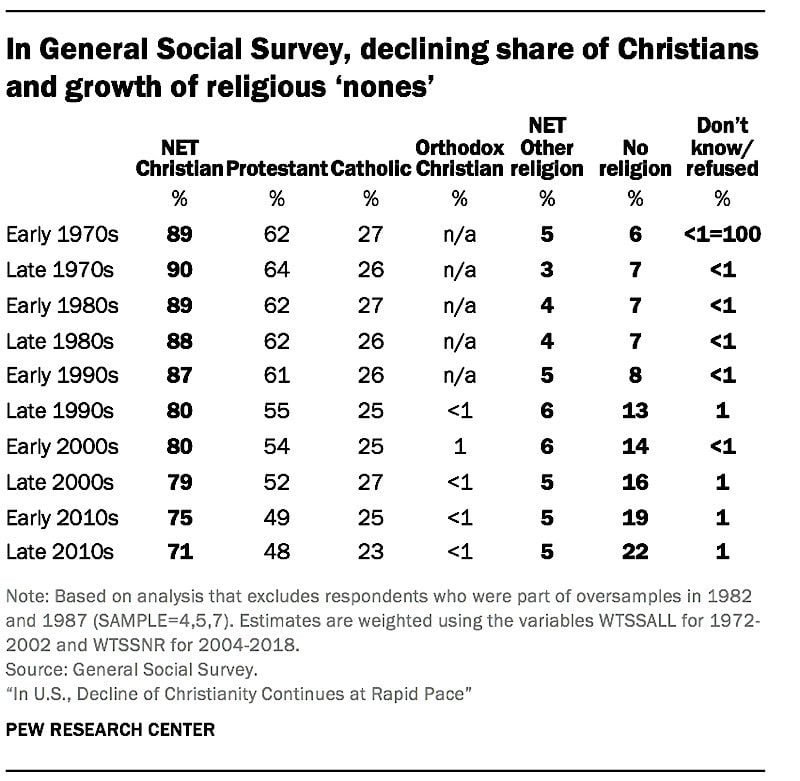
    The United States is becoming a less Christian country, and the decline in religious affiliation is particularly rapid among younger Americans, new figures show.

    The proportion of US adults who describe themselves as Christian has fallen to two-thirds, a drop of 12 percentage points over the past decade, according to data from the Pew Research Center.

    Over the same period, the proportion of those describing themselves as atheist, agnostic or “nothing in particular” has risen by 17 percentage points to more than a quarter of the adult population.

    Although churches and faith movements continue to exert strong political influence on the Trump administration and at the state level, the proportion of American adults attending religious services has declined.

    The proportion of US adults who are white born-again or evangelical Protestants – the religious group which strives hardest to see its political agenda adopted – is now 16%, down from 19% a decade ago.

    The number going to church at least once or twice a month has fallen by seven percentage points over the past decade. More Americans now say they attend religious services a few times a year or less (54%) than say they attend at least monthly (45%).

    The fall in religious identification and activity has affected both Protestant and Roman Catholic churches. According to Pew, 43% of adults identify with Protestantism, down from 51% in 2009. And 20% are Catholic, down from 23% in 2009.

    Fewer than half of millennials (49%) describe themselves as Christians; four in 10 are religious “nones”, and 9% identify with non-Christian faiths.

    As many millennials say they never attend religious services (22%) as those who say they go at least once a week.

    Pew’s report, released on Thursday, says the decline of Christian communities is continuing at a rapid pace.

    Religious ‘nones’ have grown across multiple demographic groups: white people, black people and Hispanics; men and women; all regions of the country; and among college graduates and those with lower levels of educational attainment.

    “Religious ‘nones’ are growing faster among Democrats than Republicans, though their ranks are swelling in both partisan coalitions. And although the religiously unaffiliated are on the rise among younger people and most groups of older adults, their growth is most pronounced among young adults,” the report said.

    — The Guardian, Americans Becoming Less Christian as Over a Quarter Follow no Religion, October 17, 2019

  • Questions: Bruce, Why Did You Become an Atheist?

    i have a question

    I put out the call to readers, asking them for questions they would like me to answer. If you have a question, please leave it here or email me. All questions will be answered in the order in which they are received.

    Chris asked:

    I would like to know how you became an atheist after practicing Christian authoritarianism? What is it that makes people embrace systematic mythologies? Is it fear of death, a wish for immortality?

    I have been asked many times by atheists and Christians alike why I became an atheist. Some questioners want to know more about the “how” of my deconversion. I usually point people to the WHY page. The posts of this page usually answer the “why” and “how” questions of my journey from Evangelical Christianity to atheism.

    The WHY page includes:

    My Baptist Salvation Experience

    From Evangelicalism to Atheism Series

    Why I Stopped Believing

    Please Help Me Understand Why You Stopped Believing

    16 Reasons I am Not a Christian

    Why I Hate Jesus

    The Danger of Being in a Box and Why It Makes Sense When you Are in It

    What I Found When I Left the Box

    The short answer to the question, Bruce, Why Did You Become an Atheist? is this: I thoroughly (and painfully) examined the central claims of Christianity and concluded they were not true. (Please see The Michael Mock Rule: It Just Doesn’t Make Sense) While my story is much more complicated than that, the bottom line is that I don’t believe the Bible is the inspired, inerrant, infallible Word of God; and I don’t believe the claims made within its pages about God, Jesus, and the human condition are true. Once I realized that what I had believed for fifty years was false, I concluded I could no longer call myself a Christian. In November 2008, I walked out the doors of the church (Ney United Methodist Church) for the last time. In 2009, I wrote Dear Family, Friends, and Former Parishioners and sent it to numerous friends, family members, ministerial colleagues, and former parishioners. From that point forward, I have proudly worn the atheist moniker.

    Chris also asks, “What is it that makes people embrace systematic mythologies? Is it fear of death, a wish for immortality?” He asks if people embrace religions such as Christianity because they fear death or wish that there is life after death? The short answer is yes, but as with most questions concerning religion, the answers are far more complex.

    Many atheists choose to call Christians stupid sheep who can’t think for themselves. If only Christians thought for themselves, why they would all be atheists! May I say, oh so kindly, that only stupid goats (atheists) think this way. Why people have religious beliefs is a complex issue; one rooted in biology, sociology, and geography, along with cultural, tribal, and familial beliefs and practices. Sure, people fear death and want to do go Heaven when they die. I am not too fond of the idea death myself, and life after death, at times, does appeal to me. The reasons, however, that lead to people to embrace religious beliefs are more varied and complex than just that they want to live forever.

    Is it any surprise that I was a Christian? I was born to Christian parents, lived in a Christian nation, and was indoctrinated in Christian beliefs for the first fifty years of my life. There was no chance that I would “choose” any other religion but Evangelical Christianity. So it is for billions of people across the world — their beliefs are shaped by the beginnings of their lives. Once we understand how deeply immersed people are in religious faith, it should lead us to be more sympathetic to people who haven’t yet “seen the light.” Calling them stupid accomplishes nothing. The only way to reach Christians with the humanist gospel is to gently challenge their sincerely held beliefs; to cause them to question and doubt that which they hold dear. This is why I recommend the books of Dr. Bart Ehrman, a New Testament scholar at the University of North Carolina:

    The Triumph of Christianity: How a Forbidden Religion Swept the World

    Misquoting Jesus: The Story Behind Who Changed the Bible and Why

    How Jesus Became God : the Exaltation of a Jewish Preacher from Galilee

    Jesus Before the Gospels: How the Earliest Christians Remembered, Changed, and Invented Their Stories of the Savior

    Jesus, Interrupted: Revealing the Hidden Contradictions in the Bible (And Why We Don’t Know About Them)

    Did Jesus Exist?: The Historical Argument for Jesus of Nazareth

    Forged: Writing in the Name of God–Why the Bible’s Authors Are Not Who We Think They Are

    God’s Problem: How the Bible Fails to Answer Our Most Important Question — Why We Suffer

    Ehrman does a good job challenging the foundation of Evangelical Christianity — the Bible. Cause Evangelicals to doubt the authority and veracity of the Bible, and they are well on their way out the proverbial door. Now, that doesn’t mean they will all become atheists. They won’t. However, any move away from Fundamentalism is a good one. (Please see Are Evangelicals Fundamentalists?) Sure, I think atheism is the right response to the questions asked and answered by Dr. Ehrman. However, I also know that many people NEED the social connections faith communities offer. I have no desire to rob people of the things that help them get through this life, even if I think, in the end, we all end up in the same place — the grave.

    About Bruce Gerencser

    Bruce Gerencser, 62, lives in rural Northwest Ohio with his wife of 41 years. He and his wife have six grown children and twelve grandchildren. Bruce pastored Evangelical churches for twenty-five years in Ohio, Texas, and Michigan. Bruce left the ministry in 2005, and in 2008 he left Christianity. Bruce is now a humanist and an atheist. For more information about Bruce, please read the About page.

    Are you on Social Media? Follow Bruce on Facebook and Twitter.

    Thank you for reading this post. Please share your thoughts in the comment section. If you are a first-time commenter, please read the commenting policy before wowing readers with your words. All first-time comments are moderated. If you would like to contact Bruce directly, please use the contact form to do so.

    Donations are always appreciated. Donations on a monthly basis can be made through Patreon. One-time donations can be made through PayPal.

  • Christians Say the Darnedest Things: The Devil is a Leftist

    geri-ungurean

    Let’s go back to a date in our history, which to Leftist Americans and media, is a day that will go down in Infamy. (taken from a quote by FDR after the bombing of Pearl Harbor.)

    Of which date do I speak?  Of course, it was November 8th of 2016 aka “The Day the Music Died” to Socialists and Communists across America.

    I can picture old George Soros, of whom I have written numerous articles through the years, hurling an expensive paper weight through a window while spewing Hungarian expletives for hours and hours.

    We also read that Hillary Clinton had a nuclear meltdown; cussing anyone and everyone out who was associated with her campaign. I can actually picture this: Hillary with glowing red demonic eyes, screaming in decibels previously unknown to man; as her peons scattered like cockroaches to avoid the wrath of the queen.

    All those plans; all those ‘Dreams of Someones’s Father’, all gone up in smoke. “How did this happen?” was asked over and over at CNN (Communist News Network) and amongst the Elite who had this planned so well………they thought.

    ….

    As Christians, it should be obvious to us that the so-called “Trump Derangement Syndrome” is satanic to its core.  The hatred of Trump by liberal Leftists is beyond anything I have ever witnessed in my entire life.

    This hatred from the hearts of Leftist atheists, is born from the prince of the air – the god of this world; the one who will ultimately be thrown into the lake of fire, along with his fallen angels.

    You see, the devil’s desires for this world are aligned with the Left.

    — Geri Ungurean, Absolute Truth From the Word of God: Jesus has Every Answer, The REAL Reason for Trump Derangement Syndrome, October 14, 2019

  • Bruce, Do You Have Faith?

    faith michael nugent

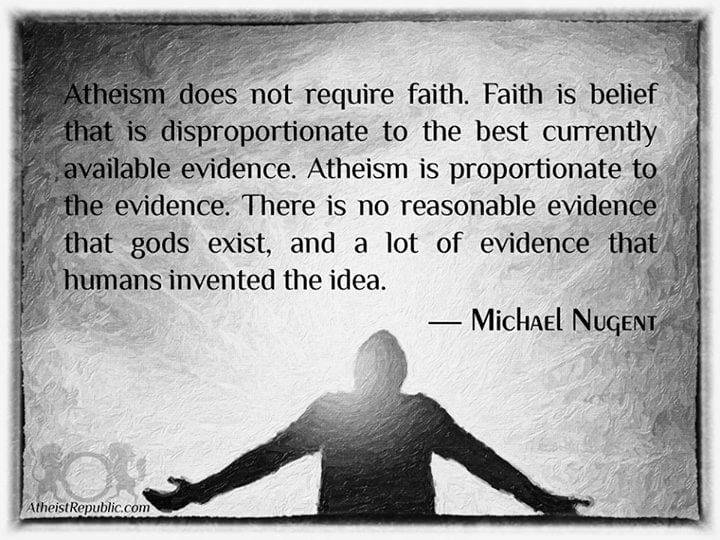
    Recently, a Christian man asked me if I had “faith.” Before I answer his question, it is necessary to define the word faith. Faith means trusting or relying on someone or something; having confidence in a person or plan; loyalty or allegiance to a cause or person. Christians, however, load the word “faith” with all sorts of religious baggage. There’s a big difference between saying I have faith that the sun will rise in the morning, and saying I have faith that Jesus will miraculously heal me from cancer. The former can be understood through science, evidence, and personal experience, whereas the latter claim is without foundation and proof. The former relies on believing what we know to be true, whereas the latter relies on believing despite evidence to the contrary. The former rests on reason, the latter on fancy. There’s a plethora of evidence for the rising of the sun each day, whereas there’s no evidence for Jesus healing people from cancer. Is it possible that Jesus heals people from cancer? Well, anything is possible, but such a notion has no rational foundation. Thus, Jesus healing people from cancer is wild speculation without factual evidence. Christians saying, I KNOW JESUS HEALED ME, is not evidence since no proof of the claims can be provided.

    Either one believes Jesus heals, or one doesn’t. Such a belief requires great faith. The sun coming up in the morning, however, is easily provable by scientific evidence, photographic evidence, and personal experience. I turned sixty-two in June. The sun has arisen 22,733 times since my birth at Cameron Memorial Hospital in June, 1957. I am confident that the sun will appear again tomorrow, and if I am alive, I will see it. Can I know for sure that the sun will arise in the morning? No, but based on past experience, I am relatively certain it will. Thus, I have faith the sun will rise in the morning.

    The definition of Christian faith is found in Hebrews 11:1-3, 6:

    Now faith is the substance of things hoped for, the evidence of things not seen.  For by it the elders obtained a good report. Through faith we understand that the worlds were framed by the word of God, so that things which are seen were not made of things which do appear . . . But without faith it is impossible to please him: for he that cometh to God must believe that he is, and that he is a rewarder of them that diligently seek him.

    For the Christian, faith is hoping for, and the evidence of, things not seen. Is not the essence of Christianity believing, having faith in things that cannot be seen? Millions of Americans “talk” each day to a God whom they have never seen. I have long argued that the main reason I am not a follower of Jesus is that I do not have requisite faith necessary to do so. I have looked at the evidence for the central claims of Christianity, and I have found them lacking. (Please see The Michael Mock Rule: It Just Doesn’t Make Sense.) I am unwilling to put my faith in something that has little, if any, proof. Evangelicals, in particular, believe that the Protestant Christian Bible is the inspired, inerrant, infallible Word of God. How do Evangelicals know this claim is true? They don’t, but by faith, they believe anyway — despite everything Dr. Bart Ehrman says in his books. The same could be said of the virgin birth of Jesus, his resurrection from the dead, and the countless miracles he purportedly worked. Remember, the Bible only records a sliver of the miracles performed by Jesus. The author of the gospel of John said in chapter twenty-one, verse twenty-five:

     And there are also many other things which Jesus did, the which, if they should be written every one, I suppose that even the world itself could not contain the books that should be written.

    Hyperbole? Exaggeration? Not if you are a literalist and an inerrantist. According to Wikipedia, the Library of Alexandria contained upwards of 100,000 books. According to John, this is nothing when compared to all the books that should have been written about the life, works, and miracles of the man, myth, and legend, Jesus Christ. Jesus was such a prodigious miracle worker that the known world couldn’t contain all the books written about his exploits. Yet, contemporary historians and writers were silent concerning Jesus and his traveling magic show. Despite this deafening silence, Christians, by faith, believe Jesus did these things. Is such faith rational?

    So, yes, as an atheist, I have faith, but not the kind of faith Christians have. My faith rests on a foundation of reason and evidence. Recently, my wife was hospitalized for three weeks. Polly had major abdominal and bladder surgery. All told, Polly was off work for almost two months. It was a scary, heart-wrenching moment to helplessly watch as Polly was wheeled away by surgical staff. I wondered, with tears in my eyes, will this be the last time I see the love of my life alive? Maybe, as was the case with my father decades ago, but I put my faith in the surgeons, anesthesiologists, and nursing staff. These well-trained professionals were skilled at performing these surgeries, and I was confident that there would be a successful outcome.

    What if I had, on the other hand, prayed and put my faith in Jesus, the God-man whom Christians call the Great Physician? How could I ever know whether Jesus was actually behind Polly’s successful surgeries? Scores of Christians at the church Polly’s parents attend were praying for a successful outcome. How could they ever know it was Jesus who “healed” her? Well, Bruce, look at the outcome. Wait a minute, wasn’t it medical professionals, performing to exacting standards, who healed Polly? (Imagine the outcome if Polly relied on prayer alone!) Well, um, sure, but it was God who gave them the ability and strength to do so. And your proof for this claim? I just know that’s what happened. By faith, I believe. Surely, readers can see the difference between my faith and that of the Christian.

    Yes, I have faith, but my faith is different from that of the typical Christian. Our foundations are different. My faith is built on reason and rationality, giving me the confidence to believe this or that will happen. Evangelicalism, on the other hand, rests on naked faith; an irrational faith that says, believe despite evidence to the contrary. Is that not exactly what Christians have been doing for 2,000 years? Jesus is coming soon!, every generation of Christians has confidently said. Yet, twenty-one centuries later, Jesus still has not returned to earth. Is it reasonable or rational to believe Jesus’s return is imminent? Of course not. The exant evidence tells us that Jesus lies buried somewhere in Palestine. He’s d-e-a-d, end of story. Yet, countless Christians believe that not only is Jesus alive, he will return to earth very soon to establish his eternal Kingdom. Is not such belief (faith) irrational? Without faith, Christianity crumbles into nothing. I know there are Evangelical apologists who vociferously argue that their faith is reasonable and rational. These “sophisticated” Christians use all sorts of outlandish arguments to “prove” their claims, but I see little difference between their faith and that of the uneducated Christians. Press either of them enough, and they always retreat to the safety of irrational faith.

    About Bruce Gerencser

    Bruce Gerencser, 62, lives in rural Northwest Ohio with his wife of 41 years. He and his wife have six grown children and twelve grandchildren. Bruce pastored Evangelical churches for twenty-five years in Ohio, Texas, and Michigan. Bruce left the ministry in 2005, and in 2008 he left Christianity. Bruce is now a humanist and an atheist. For more information about Bruce, please read the About page.

    Are you on Social Media? Follow Bruce on Facebook and Twitter.

    Thank you for reading this post. Please share your thoughts in the comment section. If you are a first-time commenter, please read the commenting policy before wowing readers with your words. All first-time comments are moderated. If you would like to contact Bruce directly, please use the contact form to do so.

    Donations are always appreciated. Donations on a monthly basis can be made through Patreon. One-time donations can be made through PayPal.
  • Bruce, You are a Liar

    garfield liar

    Let me say from the start: I have, on occasion, lied. I am human, so it really would be a lie for me to say that I have never stretched the “truth,” told little white lies, whoppers, or an occasional big, fat black lie. (Why is it that black is the color always used for the really bad things in life?) I have lied on purpose, by accident, and told a few stories that were exaggerations I am sixty-two years old, and having lived on planet earth for 22,720 days, is it any surprise that I have told a lie or two or three hundred? Of course not. No one reaches the sunset years of life — including born-again Christians — without telling a few lies. That said, I rarely lie. In my day-to-day relationships with my wife, children, grandchildren, and my fellow homo sapiens, I do my best to be truthful and honest. I expect the same from others.

    Over the years, I have developed skills that help me detect when someone is lying to me; when they are spinning a yarn; when they are regaling me with Grade-A bullshit. With family, I am pretty good at reading their body language. Polly, in particular, is not a very good liar. I can usually spot her untruths from a mile away. Me? I am not a very good liar, either. That’s why we rarely lie to each other. Oh, we might color the “facts” to present a certain narrative to each other, but generally, we are plainspoken.

    Now that I have that out of the way, let me address the Evangelicals who think anything I say that doesn’t fit within their narrow, defined theological and cultural box must be a lie. When it comes to telling my story, I try to be a truthful, honest storyteller. Granted, I don’t tell readers e-v-e-r-y-t-h-i-n-g. I have secrets; things I have never told anyone, including Polly and my counselor. No, I haven’t murdered anyone, molested children, robbed a bank, or had an affair, but I have done embarrassing things in my life that I am not comfortable sharing with others. That said, I do my best to be an open book; transparent and honest. Thus, it irritates the Hell out of me when Evangelicals question, doubt, and deconstruct everything I write. Instead of accepting what I say at face value, zealots are Heaven-bent on stripping my story bare and exposing me as some sort of charlatan or deceiver.

    Several years ago, one Evangelical preacher told anyone who would listen that I had NEVER been a pastor; that he had talked to someone who lived in rural northwest Ohio during the time I was pastoring churches, and that person had never heard of me! In his mind, that meant I was a liar; that I had never been a pastor. I have had more than a few pastors attempt to discredit me, telling people that I was a liar. At first, such accusations bothered me, but not any longer. I have learned that two people can look at the same events and circumstances and come to different conclusions. My siblings and I have different views of our childhood. Sometimes, I wonder if we are even related!  People can see things from different perspectives, and this colors their understanding. I am sure that can be said of the people I pastored over the years. Congregants who loved/liked me generally spoke well of me. Those who hated me or really, really, really disliked me tended to say negative things about me. I’m sure it’s hard to believe, but I know several former parishioners who would accelerate, hoping to run me over, if they saw me in a crosswalk. Such is life, right? I used to care incessantly about what people thought of me. Today? Not so much. If being a public writer has taught me anything, it has taught me that I can’t please everyone. Read my writing long enough, and you are sure to see something that will piss you off.

    I have concluded that Evangelicals who call me a liar do so because it allows them to dismiss my story out of hand. What better way to not have to deal with the truth, than to attack the messenger and discredit him? There’s nothing I can do to stop people from attacking my character. That said, one fact remains: thousands of people read this blog, and that suggests to me, at least that many readers think my story is true and helpful. And that’s good enough for me.

    Bruce Gerencser, 69, lives in rural Northwest Ohio with his wife of 48 years. He and his wife have six grown children and thirteen grandchildren. Bruce pastored Evangelical churches for twenty-five years in Ohio, Texas, and Michigan. Bruce left the ministry in 2005, and in 2008 he left Christianity. Bruce is now a humanist and an atheist.

    Your comments are welcome and appreciated. All first-time comments are moderated. Please read the commenting rules before commenting.

    You can email Bruce via the Contact Form.

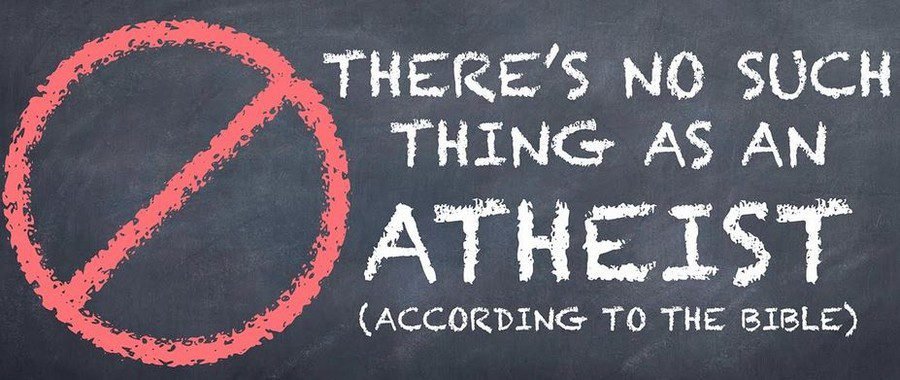
  • Christians Say the Darnedest Things: There are No Atheists

    there is no such thing as an atheist

    Atheists claim that they don’t believe in God. But God, according to the Bible, doesn’t believe in atheists.

    ….

    The Bible teaches that there are no atheists; there are only people who suppress the truth about God in their unrighteousness. Romans 1 teaches that people know intuitively and from creation that there is a Creator, but they choose to pretend as though they don’t believe.

    ….

    Of course, [Brad] Pitt is just affirming the Bible. Atheism is an act. Deep down, there are no atheists. There are only spiritualists and supernaturalists who reject truth as a means to place themselves as Lord and Savior of their own life.

    At least Pitt was honest…atheism is for actors, both amateur and professional. Every person knows intuitively that supernaturality exists.

    — Pulpit & Pen, In GQ Interview, Brad Pitt Admits Atheism Is Just an Act, Doesn’t Really Exist, September 17, 2019

  • Quote of the Day: Morals Without Religion

    It’s the most common question religious folks pose to atheists: “Where do you get your morals?”

    Whether at a dinner party or class reunion, a PTA meeting or a pig pickin’, whenever God-fearing people find out that we don’t believe in the Lord, don’t believe in an afterlife, don’t attend church, synagogue, mosque, or temple, don’t follow a guru, don’t obsess over ancient scriptures, and don’t care much for preachers or pontiffs, they immediately inquire about the possible source of our morality — which they find hard to fathom.

    And the question “Where do you get you morals?” is usually asked with an embedded implication that morality obviously comes from God and religion, so if you don’t have either, then you must have no source for morality. On top of this problematic implication, there is often an accompanying judgmental, sneering tone; it’s as if what they really want to say is “You must be an immoral lout if you aren’t religious and don’t believe in God.”

    To be fair, not everyone who asks atheists where they get their morals is implying something unkind. Given that religion has so fervently, forcefully insisted that it is the only source of morality for so many centuries, many people just honestly and naively believe that to be the case. Thus, not having thought too much about it, they are genuinely curious about where a person gets his or her morals, if not from religion.

    But even if the question is asked in total unprejudiced earnestness, it is still a rather odd query. After all, “Where do you get your morals?” suggests that morals are things that people go out and find in order to possess. Like shoes. Or a new set of jumper cables. It implies that people are living their lives, doing this and that, and then at some point, they decide to drive downtown or go online and get ahold of some morals — as if ethical tenets and moral principles were consciously adopted in some sort of deliberate process of acquisition.

    Morality, however, doesn’t really work that way. While people may deliberately choose to get their donuts from a certain shop or decide to get their dog from a certain pound, when it comes to the core components of our morality — our deep-seated proclivities, predilections, sentiments, values, virtues, and gut feelings in relation to being kind and sympathetic — these things are essentially within us. They are an embedded, inherited part of us. We don’t go out and “choose” them, per se. Sure, we may change our minds about a certain social issue after learning more about it and critically reflecting upon it; we may develop a love or distaste for something after having had certain new experiences in relation to it; we may start to live our lives differently, with different ethical priorities, after we marry a certain person and cohabitate with them for an extended period of time; we may find our political positions shift when we move to a new state or country and live there for a while.

    However, when it comes to our underlying morality, it is not generally something that we “get” in a conscious, deliberate, choosing way. Rather, our deep-seated sense of how to treat other people, our capacity for empathy and compassion, our desire for fairness and justice — these are things that we naturally manifest: our morals have been inherited from our evolutionary past, molded through our early childhood nurturance, enhanced and channeled through cultural socialization, and as such — to paraphrase sociologist Émile Durkheim — they “rule us from within.”

    What exactly is it that rules us so — morally speaking? And what are the specific foundational sources of our moral proclivities and ethical tendencies? There are four: 1) our long history as social primates, evolving within a group context of necessary cooperation; 2) our earliest experiences as infants and toddlers being cared for by a mother, father, or other immediate caregivers; 3) unavoidable socialization as growing children and teenagers enmeshed within a culture; and 4) ongoing personal experience, increased knowledge, and reasoned, thoughtful reflection.

    — Phil Zuckerman, What It Means to Be Moral: Why Religion Is Not Necessary for Living an Ethical Life

    Purchase What It Means to Be Moral: Why Religion Is Not Necessary for Living an Ethical Life

  • Christians Say the Darnedest Things: Doctrine is the Cure for Loss of Faith

    The common denominator[with people who deconvert]concerns one’s knowledge and relationship to the doctrines of the church. Nearly all my friends who were naturally interested in doctrine remain faithful members in churches to this day, and those who were not have “moved on” from Christianity, as if it were an intermediary step on their greater “spiritual journey.” [Wait needs to get out more. I can introduce him to hundreds of one-time faithful Christians — including pastors, missionaries, and professors — who were “naturally interested in doctrine” and are now atheists/agnostics/unbelievers.]

    The “spiritual journey” narrative so common among the de-converted is indicative of what was prioritized in their (and so many of our) church experiences. Formal doctrine was held in less esteem than authentic spiritual experience. Doctrine was impractical; community life was practical. Theology was for the intellectuals in the church, but the average member just needed to be loved. Doctrine was less essential for the youth than the need to attend a purity conference. In short, the church was largely a pragmatic, life-enhancing place to encourage individuals on their own “spiritual journeys.” [Wait seems to have a point to make, so he dispenses with facts. He takes a subcategory of former Christians and makes them representative of all ex-Christians.]

    This low view of doctrine and high view of personal spirituality is often the first step for those at the precipice of de-converting. They begin to frame the church and its teachings merely as products of a distant time and culture, irrelevant to one’s personal spiritual experiences. At best, such teachings help some express their faith (mostly people in the past); at worst, they are man-made rules and tools of manipulation and oppression.

    ….

    If the church is to not only retain its members but also disciple them in everything Jesus commanded (Matt. 28:20), we must invite our members outside of their individual “spiritual journeys” and into the thrilling story of orthodoxy, where God is recreating and consecrating an entire people. We must show, in our teaching and worship and discipleship, how this bigger story is more beautiful and compelling than our individual subplots. Jake Meador says it well: “Any response to our moment that focuses more on the individual story of lost faith and less on a fairly dramatic shift in our approach to liturgy, catechesis, and repentance will be inadequate to the demands of the day.” 

    To scrutinize and focus on an individual’s de-conversion story—only to ask “what happened to them?”—is to isolate their story from the community they are leaving. Our strategy must not be to dilute our doctrine or distill it to what’s culturally acceptable, nor should it be to downplay the importance of story. Rather, our strategy must be to recast the beauty of orthodoxy and catechesis—not just as concepts to be believed, but as truth to be lived, from one century to the next, by the storied people of God.

    — Caleb Wait, The Gospel Coalition, A Common Denominator in De-Conversions, September 9, 2019