Tag: Heaven

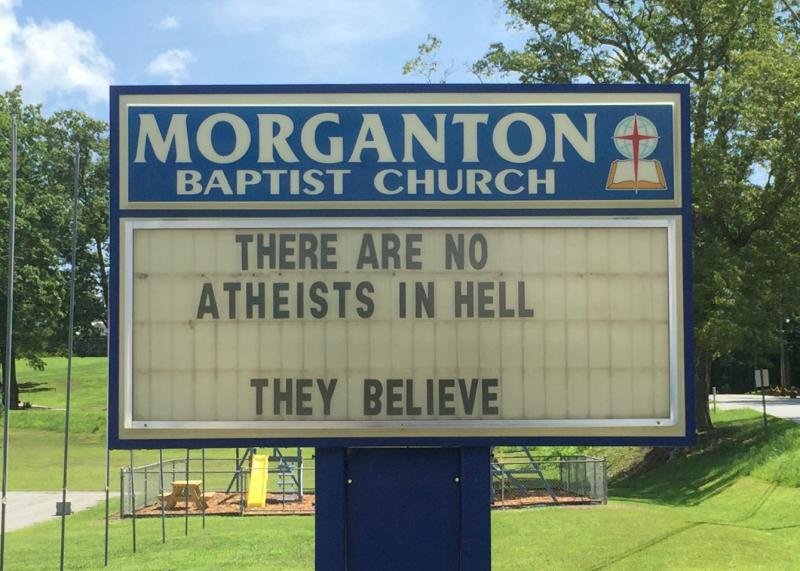
  • Christopher Hitchens is in Hell

    christopher hitchens
    Christopher Hitchens

    Originally published in 2015. Updated, corrected, and expanded.

    According to those who KNOW the mind of God (Please see Do Evangelical Christians “Know” the Mind of God?) and KNOW the names written in the Book of Life, when Christopher Hitchens died on December 15, 2011, he went straight to Hell to be tortured day and night by the Evangelical God for refusing to admit said God exists and for rejecting the salvation proffered by Jesus Christ. (The irony here is that all four Evangelicals mentioned in this post are Calvinists, men who believe no one can “choose” to be saved.)

    Al Mohler, Fundamentalist president of Southern Baptist Theological Seminary had this to say:
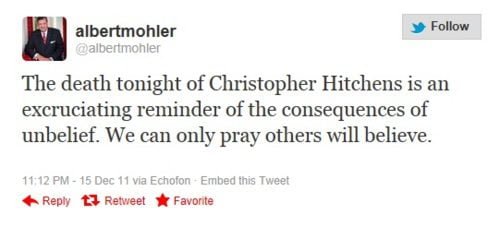
    al mohler tweet christopher hitchens

    Rick Warren, Fundamentalist pastor of Saddleback Church pontificated thus:
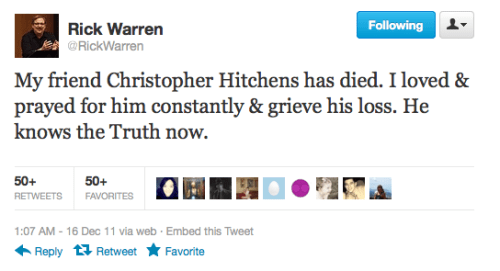
    rick warren tweet about christopher hitchens

    Doug Wilson, Fundamentalist pastor of Christ Church in Moscow, Idaho said:

    We have no indication that Christopher ever called on the Lord before he died, and if he did not, then Scriptures plainly teach that he is lost forever.

    And finally, Chris Hohnholz, a writer for the Defending Contending blog (link no longer active), took the pious approach and said that Hitchens lived his life as a hater of God, but since no human can know the true spiritual state of any person, he couldn’t say whether Hitchens is in Hell:

    The question that stands before us today of course, is where is Christopher Hitchens today. According to Mr. Hitchens, he simply ceased to exist, nothing more. But for the Christian, we know that we exist for eternity once this mortal body ceases functioning. There are only two possibilities as to where, Heaven or Hell. As Mr. Hitchens was created by God, and was bound to God’s laws, as we all are, he can only be in one of those two places. At first, it may seem quite easy to figure it out. He denied God, spoke vehemently against the Christian faith, and was often hateful and vitriolic in his speech regarding it. Considering that he made the statement there would be no deathbed conversion, it would be a simple thing to declare God sent him to hell. However, the truth is, we simply do not, and cannot know.

    It is clear that Mr. Hitchens made a career of hating the very idea of God. But it is also clear that he was a common sinner just like the rest of us. He had a conscience, he was aware of right and wrong. He, like the rest of us, committed acts that were in violation of that conscience. We know that our consciences are God’s laws written upon our hearts. When we violate our conscience, we are violating God’s laws. Additionally, Mr. Hitchens debated with many Christians, he had heard the gospel presentation many times. There is little question that by the time of his death, Mr. Hitchens knew what God required of him. It is that time just prior to his death that we cannot know about. Is it at least possible, that as he faced those last moments, knowing death was coming that he considered those sins he committed, that he contemplated the gospel he had denied so many times, that he just might have repented and trusted Christ. If we are intellectually honest, we must say that it is possible. And since we cannot know, we hope that is what happened. We hope that we will find Mr. Hitchens in Heaven one day, for we do not wish the wrath of God on any man.

    But we must also be honest say that he may not have repented. It is entirely possible that Mr. Hitchens held on to his rejection of God all the way into death. If so, Mr. Hitchens now stands before God in judgment for his sins. And not just for his atheism. As said before, our consciences are merely God’s law written on our hearts. When any man or woman breaks those laws, through lying, stealing, coveting, lusting, or blaspheming, they have sinned against a holy and righteous God. It is not just because he was an atheist that Mr. Hitchens may have stood condemned, it is because, as we all are, he was a sinner against the God who created him. And if that indeed is what occurred, even we Christians must mourn his death, for we do not wish Hell on any man. But we also rejoice that God is glorified, because His justice is perfect.

    So what does that mean for the Christian? First, let us not run around proclaiming we know where Christopher Hitchens is, only God knows that. Let us share with people the truth, that if he repented and trusted Christ (which is our hope), he is in Heaven. But if he remained in his sins, he was condemned (as we all deserve). Let us not rejoice that another atheist voice is silent, that presents us as unkind and unloving. But let us not ignore that what he taught was blasphemous. As we engage in conversation with others on this, let us remember that, whatever Mr. Hitchens fate was, all of us face the same date with death.

    This “sounds” nice, but don’t be deceived. I have heard these words many, many times, and they are words uttered by people who don’t want to look bad before the world so they refrain from saying in public what they proclaim every week in the pulpit or behind closed doors.

    There is NOTHING, I repeat NOTHING, in the life of Christopher Hitchens that remotely suggests he is now with God and the angels. He is in Hell and Hohnholz knows it! I wish Evangelicals like Chris Hohnholz would at least own the abominable, horrendous doctrine of eternal punishment they preach.

    The Dead Logic blog (link no longer active) pretty well sums up my feelings about people such as Mohler, Warren,Wilson and Hohnholz:

    I feel even more sadness for those who are so blinded by religious prejudice that they see the death of Hitchens as an opportunity to peddle their religious wares. I’ve already expressed what I think about Albert Mohler’s recent comment on Twitter. Turns out that “purpose-driven” Rick Warren is just as classy as Mohler. Warren had his own douchebag moment on Twitter when he wrote: “Hitchens has died. I loved & prayed for him & grieve his loss. He knows the Truth now.” Yes, Rick, use a man’s death as a tool in your propaganda machine. If Warren truly “loved” Hitch, he would be honoring his memory instead of disgracing Hitchens for the sake of “the Truth” with a capital T.

    How did Christopher Hitchens spend the final days of his life? Ian McEwan of the New York Times wrote:

    The place where Christopher Hitchens spent his last few weeks was hardly bookish, but he made it his own. Close to downtown Houston is the Medical Center, a cluster of high-rises like La Défense of Paris, or London’s City, a financial district of a sort, where the common currency is illness…..

    ….. While I was with him another celebration took place in far away London, with Stephen Fry as host in the Festival Hall to reflect on the life and times of Christopher Hitchens. We helped him out of bed and into a chair and set my laptop in front of him. Alexander delved into the Internet with special passwords to get us linked to the event. He also plugged in his own portable stereo speakers. We had the sound connection well before the vision and what we heard was astounding, and for Christopher, uplifting. It was the noise of 2,000 voices small-talking before the event. Then we had a view from the stage of the audience, packed into their rows.

    They all looked so young. I would have guessed that nearly all of them would have opposed Christopher strongly over Iraq. But here they were, and in cinemas all over the country, turning out for him. Christopher grinned and raised a thin arm in salute. Close family and friends may be in the room with you, but dying is lonely, the confinement is total. He could see for himself that the life outside this small room had not forgotten him. For a moment, pace Larkin, it was by way of the Internet that the world stretched a hand toward him.

    The next morning, at Christopher’s request, Alexander and I set up a desk for him under a window. We helped him and his pole with its feed-lines across the room, arranged pillows on his chair, adjusted the height of his laptop. Talking and dozing were all very well, but Christopher had only a few days to produce 3,000 words on Ian Ker’s biography of Chesterton.

    Whenever people talk of Christopher’s journalism, I will always think of this moment.

    Consider the mix. Constant pain, weak as a kitten, morphine dragging him down, then the tangle of Reformation theology and politics, Chesterton’s romantic, imagined England suffused with the kind of Catholicism that mediated his brush with fascism and his taste for paradox, which Christopher wanted to debunk. At intervals, Christopher’s head would droop, his eyes close, then with superhuman effort he would drag himself awake to type another line. His long memory served him well, for he didn’t have the usual books on hand for this kind of thing. When it’s available, read the review. His unworldly fluency never deserted him, his commitment was passionate, and he never deserted his trade. He was the consummate writer, the brilliant friend. In Walter Pater’s famous phrase, he burned “with this hard gem-like flame.” Right to the end.

    Christopher Hitchens is greatly missed. I always appreciated his sharp tongue and pointed critique of religion. He made the religious fuss, fume, and squirm as he attacked their beliefs and practices.

    Someday, I will die. I have thought a lot about this, and while I am no Christopher Hitchens I can only imagine how my demise will play out in the blogosphere and in the pulpit. According to my critics, when death comes to take me, I will be cast in Hell with the Devil and Christopher Hitchens. A special Hell, punishment, and torture await me because I was once a believer and an Evangelical pastor.

    I’ve spent the last twelve years being threatened with Hell and God’s judgment, and if I have a choice between Heaven with Mohler, Warren, Wilson and Hohnholz and Hell with Hitchens, Steven Hawking, my dear friend Steve Gupton and a cast of people I greatly admire, give me Hitch and Hell every time.

    The world is richer because a man named Christopher Hitchens lived among us. While his body rots in the grave, his words remain. May his words continue to inspire people to consider a life and world without religious ignorance and oppression. There can be a better tomorrow without God.

    Let me conclude this post with a few quotes from Hitch’s last published work Mortality:

    • The notorious stage theory of Elisabeth Kübler-Ross, whereby one progresses from denial to rage through bargaining to depression and the eventual bliss of ‘acceptance,’ hasn’t so far had much application to my case. In one way, I suppose, I have been ‘in denial’ for some time, knowingly burning the candle at both ends and finding that it often gives a lovely light. But for precisely that reason, I can’t see myself smiting my brow with shock or hear myself whining about how it’s all so unfair: I have been taunting the Reaper into taking a free scythe in my direction and have now succumbed to something so predictable and banal that it bores even me. Rage would be beside the point for the same reason. Instead, I am badly oppressed by the gnawing sense of waste. I had real plans for my next decade and felt I’d worked hard enough to earn it. Will I really not live to see my children married? To watch the World Trade Center rise again? To read — if not indeed to write — the obituaries of elderly villains like Henry Kissinger and Joseph Ratzinger? But I understand this sort of non-thinking for what it is: sentimentality and self-pity.
    • To the dumb question ‘Why me?’ the cosmos barely bothers to return the reply: Why not?
    • Myself, I love the imagery of struggle. I sometimes wish I were suffering in a good cause, or risking my life for the good of others, instead of just being a gravely endangered patient. Allow me to inform you, though, that when you sit in a room with a set of other finalists, and kindly people bring a huge transparent bag of poison and plug it into your arm, and you either read or don’t read a book while the venom sack gradually empties itself into your system, the image of the ardent soldier or revolutionary is the very last one that will occur to you. You feel swamped with passivity and impotence: dissolving in powerlessness like a sugar lump in water.
    • It’s normally agreed that the question ‘How are you?’ doesn’t put you on your oath to give a full or honest answer. So when asked these days, I tend to say something cryptic like, ‘A bit early to say.’ (If it’s the wonderful staff at my oncology clinic who inquire, I sometimes go so far as to respond, ‘I seem to have cancer today.’) Nobody wants to be told about the countless minor horrors and humiliations that become facts of ‘life’ when your body turns from being a friend to being a foe: the boring switch from chronic constipation to its sudden dramatic opposite; the equally nasty double-cross of feeling acute hunger while fearing even the scent of food; the absolute misery of gut-wringing nausea on an utterly empty stomach; or the pathetic discovery that hair loss extends to the disappearance of the follicles in your nostrils, and thus to the childish and irritating phenomenon of a permanently runny nose . . . It’s no fun to appreciate to the full the truth of the materialist proposition that I don’t have a body, I am a body.
    • The man who prays is the one who thinks that god has arranged matters all wrong, but who also thinks that he can instruct god how to put them right.
    • However, one thing that grave illness does is to make you examine familiar principles and seemingly reliable sayings. And there’s one that I find I am not saying with quite the same conviction as I once used to: In particular, I have slightly stopped issuing the announcement that “whatever doesn’t kill me makes me stronger. In fact, I now sometimes wonder why I ever thought it profound . . . In the brute physical world, and the one encompassed by medicine, there are all too many things that could kill you, don’t kill you, and then leave you considerably weaker.
    • Like so many of life’s varieties of experience, the novelty of a diagnosis of malignant cancer has a tendency to wear off. The thing begins to pall, even to become banal. One can become quite used to the specter of the eternal Footman, like some lethal old bore lurking in the hallway at the end of the evening, hoping for the chance to have a word. And I don’t so much object to his holding my coat in that marked manner, as if mutely reminding me that it’s time to be on my way. No, it’s the snickering that gets me down.
    • So far, I have decided to take whatever my disease can throw at me, and to stay combative even while taking the measure of my inevitable decline. I repeat, this is no more than what a healthy person has to do in slower motion. It is our common fate. In either case, though, one can dispense with facile maxims that don’t live up to their apparent billing.

    From the last page of Mortality:

    “From Alan Lightman’s intricate 1993 novel Einstein’s Dreams; set in Berne in 1905:

    With infinite life comes an infinite list of relatives. Grandparents never die, nor do great-grandparents, great-aunts…and so on, back through the generations, all alive and offering advice. Sons never escape from the shadows of their fathers. Nor do daughters of their mothers. No one ever comes into his own…Such is the cost of immortality. No person is whole. No person is free.”

    You can buy Mortality here
    About Bruce Gerencser

    Bruce Gerencser, 62, lives in rural Northwest Ohio with his wife of 41 years. He and his wife have six grown children and twelve grandchildren. Bruce pastored Evangelical churches for twenty-five years in Ohio, Texas, and Michigan. Bruce left the ministry in 2005, and in 2008 he left Christianity. Bruce is now a humanist and an atheist. For more information about Bruce, please read the About page.

    Are you on Social Media? Follow Bruce on Facebook and Twitter.

    Thank you for reading this post. Please share your thoughts in the comment section. If you are a first-time commenter, please read the commenting policy before wowing readers with your words. All first-time comments are moderated. If you would like to contact Bruce directly, please use the contact form to do so.

    Donations are always appreciated. Donations on a monthly basis can be made through Patreon. One-time donations can be made through PayPal.

  • Songs of Sacrilege: Raising Hell by Kesha

    kesha

    This is the latest installment in the Songs of Sacrilege series. This is a series that I would like readers to help me with. If you know of a song that is irreverent towards religion, makes fun of religion, pokes fun at sincerely held religious beliefs, or challenges the firmly held religious beliefs of others, please send me an email.

    Today’s Song of Sacrilege is Raising Hell by Kesha.

    Video Link

    Lyrics

    [Intro]
    Ooh, oh, oh, oh
    Let’s go

    [Verse 1]
    Hallelujah
    I’m still here, still bringin’ it to ya
    Ohm, like Buddha
    Good girls know how to get hard too, ya (Uh huh)

    [Pre-Chorus]
    I’m all fucked up in my Sunday best
    No walk of shame ’cause I love this dress
    Hungover, heart of gold, holy mess
    Doin’ my best (Ah), bitch, I’m blessed

    [Chorus]
    Oh, if you couldn’t tell
    We can always find the trouble, we don’t need no help
    Singing oh, mama raised me well
    But I don’t wanna go to Heaven without raisin’ hell (Get it)

    [Post-Chorus]
    Get it
    Drop it down low, hit it, hit the floor with it
    Drop it down low, drop it down low
    Drop, dr-drop it down low, drop it down low (Get it)
    Drop it, drop it, drop it, drop-drop-drop it down, down low
    Bounce it up and down where the good Lord split it

    [Verse 2]
    Hands up, witness
    Solo cup full of holy spirits
    Somethin’ wicked (Ooh)
    Speakin’ in tongues in my blood-red lipstick (Brrah)

    [Pre-Chorus]
    I’m all fucked up in my Sunday best
    No walk of shame ’cause I love this dress (Ooh)
    Only God can judge this holy mess (Ah, ah)
    Bitch, I’m blessed

    [Chorus]
    Oh, if you couldn’t tell (Oh well)
    We can always find the trouble, we don’t need no help
    Singing oh, mama raised me well (Uh huh)
    But I don’t wanna go to Heaven without raisin’ hell (Ah!)

    [Post-Chorus]
    Get it
    Brrah
    Drop it down low, hit it, hit the floor with it
    Drop it down low, drop it down low
    Drop, dr-drop it down low, drop it down low (Get it)
    Drop it, drop it, drop it, drop-drop-drop it down, down low
    Bounce it up and down where the good Lord split it

    [Interlude]
    Ladies and gentlemen (Oh, shit)
    Let’s shake what the good Lord gave us (Oh yes, baby)
    Come on, let’s go

    [Bridge]
    Aw, dang, this that shit (Uh huh)
    Beat like this, wanna shake my ooh
    Oh, dang, this that shit (Ah, ah)
    Beat like this, wanna shake my ooh
    Aw, dang, this that shit (Ah)
    Beat like this, haters, suck my ooh
    Woo, Lord, feelin’ it
    Beat like this, make me feel that power

    [Chorus]
    Oh, if you couldn’t tell
    We can always find the trouble, we don’t need no help
    Singing oh, mama raised me well
    But I don’t wanna go to Heaven without raisin’ hell

    [Outro]
    Can I get an amen? (Ah)
    This is for the misfits of creation (You’re welcome, ah)
    Take this as your holy validation (Come on)
    You don’t need to hide your celebratin’ (Sing it, Kesha, bitch)
    This is our salvation


  • Independent Baptist Songs: Heaven Came Down by John W. Peterson

    john w peterson

    From time to time, I plan to post lyrics from the songs we sang in the Independent Fundamentalist Baptist (IFB) churches I grew up in and pastored. Unbelievers and non-Fundamentalists might find some of these lyrics quite interesting, and, at times, funny or disturbing. Enjoy!

    Today’s Independent Baptist Song is Heaven Came Down by John W. Peterson. I was able to find a video of this song being sung by the Temple Baptist Church congregation in Knoxville, Tennessee.

    Heaven Came Down was one of my favorite songs. The churches I attended and pastored would lustily sing this song, with congregants with higher pitched voices singing the last line right out of the ballpark.  Heaven Came Down reminded me, at the time, of the wonderful relationship I had with Jesus and Heaven that awaited me after I died.

    I am many years removed from my church singing days, but songs such as Heaven Came Down still lurk deep within my mind. As I listened to the video below, I sang along, not missing a word. Using music to religiously indoctrinate people works, as I can surely attest. I suspect many readers can say the same; that try as we might to wash our religious past from our minds, songs and Bible verses live on.

    Video Link

    Heaven Came Down by John W. Peterson

    O what a wonderful, wonderful day, day I will never forget;
    After I’d wandered in darkness away, Jesus my Savior I met.
    O what a tender, compassionate friend, He met the need of my heart;
    Shadows dispelling, with joy I am telling, He made all the darkness depart.

    Chorus
    Heaven came down and glory filled my soul,  (filled my soul)
    When at the cross the Savior made me whole;  (made me whole)
    My sins were washed away and my night was turned to day,
    Heaven came down and glory filled my soul!  (filled my soul)

    Born of the Spirit with life from above into God’s family divine,
    Justified fully thru Calvary’s love, O what a standing is mine!
    And the transaction so quickly was made, when as a sinner I came,
    Took of the offer, of grace He did proffer, He saved me, O praise His dear name!

    Chorus
    Heaven came down and glory filled my soul,  (filled my soul)
    When at the cross the Savior made me whole;  (made me whole)
    My sins were washed away and my night was turned to day,
    Heaven came down and glory filled my soul!  (filled my soul)

    Now I’ve a hope that will surely endure after the passing of time;
    I have a future in heaven for sure there in those mansions sublime.
    And it’s because of that wonderful day, when at the cross I believed;
    Riches eternal and blessings supernal, from His precious hand I received.

    Chorus
    Heaven came down and glory filled my soul,  (filled my soul)
    When at the cross the Savior made me whole;  (made me whole)
    My sins were washed away and my night was turned to day,
    Heaven came down and glory filled my soul!  (filled my soul)

    Heaven came down and glory filled my soul.

    About John W. Peterson:

    John W. Peterson (1921-2006) was born in Lindsborg, Kansas, and began his musical career while he was still in his teens. During World War II, he served as an Army Air Force pilot flying the famed “China Hump.”Later, he attended Moody Bible Institute and served on the radio staff there for a number of years. In 1953, he graduated from the American Conservatory of Music in Chicago and shortly thereafter settled in Pennsylvania to continue his songwriting career. He then moved to Grand Rapids, Michigan, where for over ten years he was President and Editor-in-Chief of Singspiration, a sacred music publishing company. He also served on the board of Gospel Films, Inc. of Muskegon, Michigan for several years. Later he moved to Scottsdale, Arizona where he continued his writing and co-founded Good Life Productions. A few years later, the John W. Peterson Music Company was established. During this time, he also served on the board of Family Life Radio Network in Tucson, Arizona. He had wide experience as a choral director, and throughout his career was in great demand as a guest conductor of his own works.

    His music is loved and sung around the world. Mr. Peterson has composed well over 1000 individual songs, including titles such as: “It Took a Miracle,” “Over the Sunset Mountains,” “So Send I You,” “Springs of Living Water,” “Heaven Came Down,” “Jesus Is Coming Again” and “Surely Goodness and Mercy.” In addition, he has written 35 cantatas and musicals. Among these are “Night of Miracles,” “Born a King,” “No Greater Love,” “Carol of Christmas,” “Jesus Is Coming,” “King of Kings,” “Down from His Glory” and “The Last Week.” Approximately 10,000,000 copies of these cantatas and musicals have been published and sold.

    In 1967, the National Evangelical Film Foundation presented Mr. Peterson with the Sacred Music Award in recognition of his accomplishments in the field of sacred music. In the same year, he received the honorary degree, Doctor of Sacred Music, from John Brown University. In 1971, he received the honorary degree, Doctor of Divinity, from Western Conservative Baptist Seminary in Portland, Oregon; and in 1979, he received the honorary degree, Doctor of Fine Arts, from Grand Canyon University in Phoenix, Arizona. In 1977, his autobiography, “The Miracle Goes On,” was published by Zondervan Publishing House, and a film by the same title was released by Gospel Films. In 1986, Mr. Peterson was inducted into the Gospel Music Hall of Fame, and in 1996 at MusiCalifornia, he received the prestigious Ray DeVries Church Music Award. He’s listed in “Who’s Who in America” and “Who’s Who in the World.”

  • Independent Baptist Songs: When the Roll is Called Up Yonder by James Black

    soul strirring songs and hymns

    From time to time, I plan to post lyrics from the songs we sang in the Independent Fundamentalist Baptist (IFB) churches I grew up in and pastored. Unbelievers and non-Fundamentalists might find some of these lyrics quite interesting, and, at times, funny or disturbing. Enjoy!

    Today’s Independent Baptist Song is When the Roll is Called Up Yonder by James Black. I was able to find a video of this song being sung by Bill Gaither and Friends.

    Video Link

    When the Roll is Called Up Yonder by James Black

    When the trumpet of the Lord shall sound,
    and time shall be no more,
    and the morning breaks, eternal, bright and fair;
    when the saved of earth shall gather
    over on the other shore,
    and the roll is called up yonder, I’ll be there.

    Refrain:
    When the roll is called up yonder,
    when the roll is called up yonder,
    when the roll is called up yonder,
    when the roll is called up yonder, I’ll be there.

    On that bright and cloudless morning
    when the dead in Christ shall rise,
    and the glory of his resurrection share;
    when his chosen ones shall gather
    to their home beyond the skies,
    and the roll is called up yonder, I’ll be there. [Refrain]

    Let us labor for the Master
    from the dawn till setting sun,
    let us talk of all his wondrous love and care;
    then when all of life is over,
    and our work on earth is done,
    and the roll is called up yonder, I’ll be there. [Refrain]

    The Story Behind the Song

    He loved young people and tried to win them for Christ. One day, as he passed through an alley, he met a ragged fourteen-year-old girl. She was the daughter of an alcoholic. He invited her to his Sunday school and youth group and she began to attend.

    However, one day when he took roll, the girl did not respond. Each child had to say a Scripture verse when his or her name was called. James saw a lesson in her silence. “I spoke of what a sad thing it would be when our names are called from the Lamb’s Book of Life, if one of us should be absent.”

    He was not the kind of man to let the matter die with a moral lesson. After Sunday school, he went to his pupil’s home to find out why she had not showed up for class. He found her dangerously ill and sent for his own doctor–they still made house calls then. The doctor said that she had pneumonia. Since that was before the days of antibiotics, death was highly likely.

    James returned home. He tried to find a song to fit the thought of a heavenly roll call but could not locate one. An inner voice seemed to say, “Why don’t you write one.”[Black then wrote When the Roll is Called Up Yonder]

    I remember the Sunday School teachers of my youth “calling the roll.” Not that he needed to do so. How hard could it have been to look over the seven or so boys seated there and not know who was or wasn’t present. One church I attended in my teen years would have the Sunday School Superintendent go to each class and collect the attendance books and offerings. Baptists can’t do anything without passing the plate. The purpose of taking the roll was primarily an evangelistic tool. Teachers were expected to visit the homes of those absent from the Sunday School. Not that any teacher ever visited my home. No need. I was at church every time the doors were opened, and that included Sunday School.  I even got pins for “perfect attendance.” My, oh my, aint God proud of me!

    About James Black:

    James Milton Black was born on August 19, 1856 in South Hill, New York. He acquired an early musical education in singing and organ playing and knew such famous songsters of his day as Daniel Towner and John Howard. Around 1881, he moved to Williamsport, Pennsylvania where he carried on Christian work through the Methodist Episcopal church. Teaching music during the week, he was a song leader, Sunday school teacher and youth leader in his spare hours. In addition to all this work, he edited hymnals.

  • Songs of Sacrilege: Wrong Side of Heaven by Five Finger Death Punch

    five finger death punch

    This is the two hundredth installment in the Songs of Sacrilege series. This is a series that I would like readers to help me with. If you know of a song that is irreverent towards religion, makes fun of religion, pokes fun at sincerely held religious beliefs, or challenges the firmly held religious beliefs of others, please send me an email.

    Today’s Song of Sacrilege is Wrong Side of Heaven by Five Finger Death Punch.

    Video Link

    Lyrics

    I spoke to God today, and she said that she’s ashamed.
    What have I become, what have I done?
    I spoke to the Devil today, and he swears he’s not to blame.
    And I understood, cause I feel the same.

    Arms wide open, I stand alone.
    I’m no hero, and I’m not made of stone.
    Right or wrong, I can hardly tell.
    I’m on the wrong side of heaven, and the righteous side of hell.
    The wrong side of heaven, and the righteous side, the righteous side of hell.

    I heard from God today, and she sounded just like me.
    What have I done, and who have I become.
    I saw the Devil today, and he looked a lot like me.
    I looked away, I turned away!

    Arms wide open, I stand alone.
    I’m no hero, and I’m not made of stone.
    Right or wrong, I can hardly tell.
    I’m on the wrong side of heaven, and the righteous side of hell.
    The wrong side of heaven, and the righteous side, the righteous side of hell.

    I’m not defending, downward descending,
    Falling further and further away!
    Getting closer every day!

    I’m getting closer every day, to the end.
    To the end, the end, the end,
    I’m getting closer every day!

    Arms wide open, I stand alone.
    I’m no hero, and I’m not made of stone.
    Right or wrong, I can hardly tell.
    I’m on the wrong side of heaven, and the righteous side of hell.
    The wrong side of heaven, and the righteous side of hell.
    The wrong side of heaven, and the righteous side, the righteous side of hell.

  • Dear Evangelical, Threatening Atheists with Hell Doesn’t Work

    no atheists in hell

    Over the past decade, I have received numerous emails from Evangelicals filled with Bible verses and warnings. These zealots want me to know that there is a special place in Hell for people such as myself. These threats and warnings are supposed to make me realize the error of my ways, leading me, then, to repentance and faith. What Evangelicals don’t realize, however, is that this approach NEVER works. I don’t believe in the existence of the Christian God, nor do I believe in the existence of Heaven and Hell. No God, No Hell, No Worries®. But Bruce, the BIBLE says . . . And your point is? The Bible says lots of things, but I reject its supernatural claims, including the notion that Jesus was the virgin-born son of God who was crucified on a Roman cross, resurrected from the dead three days later, and then ascended back to Heaven. I don’t believe the teachings of the Bible as Evangelicals do, so threatening me with a bunch of Bible quotations doesn’t work. I am immune to such proof-texting. In fact, I likely know more about the Bible and its teachings than the people quoting verses AT me. Come on, give me some credit for learning a thing or two over the 50 years I spent in the Christian church or the 25 years I spent in the ministry. I know the Bible inside and out. Yet, I reject its teachings and view it as no different from any other book. Sorry, Evangelicals, the Bible has no authority, power, or control over me.

    Yesterday, Bill Wiese released a video warning to atheists. According to Wiese, today is the day of salvation. Death and Hell are coming, and we will one day regret not believing in Jesus. We may mock God/Bible now, Wiese says, but there is coming a day when we will bow our knees before Jesus and confess that he is the Lord of Lords and King of Kings. In other words, Jesus is gonna git you some day!

    Video Link

    Wiese, who allegedly spent 23 minutes in Hell, said:

    What is the price of a decision? I won’t address those that mock the things of God, deny Him, or completely ignore His existence. Some of these people have no fear of Almighty God and have such arrogance toward Him. We all must be informed of what we will face one day. This is a loving message, because it’s a message of warning. One day you will stand before the one and only, holy, awesome, eternal God in heaven with all His infinite power and His millions of mighty warrior angels at His side. On that great judgment day, God will reveal your every thought, action, and motive. Everything you have ever done will be shown to all and nothing will be hidden. You will be found guilty of your sins and you will have no excuse. There is a payment required for those sins. Did you trust in Jesus to pay for them?

    You might not believe this now, but it says in Romans 14:11, “As I live sayeth the Lord, every knee shall bow to me and every tongue shall confess to God, so then every one of us shall give account of himself to God.” Your knee will bow. You will then be drug off into an eternal hell by hideous, wicked demons and thrown into a furnace of fire for all eternity. It won’t be God’s fault. He warned you over and over throughout your entire life by sending people to tell you the way to heaven. In addition, we have the Bible, we have churches, we have the internet, TV, and radio proclaiming Jesus is Lord and Savior. He even gives dreams and visions to man to keep back his soul from the pit. As it says in Job 33, “but you ignored it all.” You won’t be able to accuse God of being unloving or unfair.

    Wiese needs to realize, to quote Solomon, that there is nothing new under the sun. Most atheists have heard this kind of Christian drivel countless times. We know, we know, we know, and we — are you ready for it? — don’t give a shit. We are confident that we have one life to live and then we die. End of story. No God. No Heaven. No Hell. No matter how often you threaten us, pray for us, or quote the Bible, the fact remains that we are atheists out of conviction. We are atheists because we have carefully examined and rejected the claims of Christianity. We are not ignorant or ill-informed. We know what you know, and more, yet we still say, nah baby nah, there is no God.

    About Bruce Gerencser

    Bruce Gerencser, 61, lives in rural Northwest Ohio with his wife of 40 years. He and his wife have six grown children and twelve grandchildren. Bruce pastored Evangelical churches for twenty-five years in Ohio, Texas, and Michigan. Bruce left the ministry in 2005, and in 2008 he left Christianity. Bruce is now a humanist and an atheist. For more information about Bruce, please read the About page.

    Bruce is a local photography business owner, operating Defiance County Photo out of his home. If you live in Northwest Ohio and would like to hire Bruce, please email him.

    Thank you for reading this post. Please share your thoughts in the comment section. If you are a first-time commenter, please read the commenting policy before wowing readers with your words. All first-time comments are moderated. If you would like to contact Bruce directly, please use the contact form to do so.

    Donations are always appreciated. Donations on a monthly basis can be made through Patreon. One-time donations can be made through PayPal.

  • Quote of the Day: If Christians Have Free Will on Earth, Will There be Free Will in Heaven?

    bart ehrman

    Most people who believe in God-given free will also believe in an afterlife. Presumably, people in the afterlife will still have free will (they won’t be robots then either, will they?). And yet there won’t be suffering (allegedly) then. Why will people know how to exercise free will in heaven if they can’t know how to exercise it on earth?

    — Dr. Bart Ehrman, God’s Problem: How the Bible Fails to Answer Our Most Important Question — Why We Suffer

    In other words, Dr. Ehrman is asking, will there be sin in Heaven? If Christians in Heaven have free will, there exists, then, the possibility that they will sin. And if Christians won’t have free will in Heaven due to some sort of divine action, why can’t  God do the same now on Earth?  If you want to read an unsatisfying “the Bible says” response to this conundrum, please read this post by  former atheist Erik Manning.

    Books by Dr. Bart Ehrman

    The Triumph of Christianity: How a Forbidden Religion Swept the World

    Misquoting Jesus: The Story Behind Who Changed the Bible and Why

    How Jesus Became God : the Exaltation of a Jewish Preacher from Galilee

    Jesus Before the Gospels: How the Earliest Christians Remembered, Changed, and Invented Their Stories of the Savior

    Jesus, Interrupted: Revealing the Hidden Contradictions in the Bible (And Why We Don’t Know About Them)

    Did Jesus Exist?: The Historical Argument for Jesus of Nazareth

    Forged: Writing in the Name of God–Why the Bible’s Authors Are Not Who We Think They Are

    God’s Problem: How the Bible Fails to Answer Our Most Important Question — Why We Suffer

  • Independent Baptist Songs: I Know Who Holds Tomorrow by Ira Stanphill

    ira stanphill

    From time to time, I plan to post lyrics from the songs we sang in the Independent Fundamentalist Baptist (IFB) churches I grew up in and pastored. Unbelievers and non-Fundamentalists might find some of these lyrics quite interesting, and, at times, funny or disturbing. Enjoy!

    Today’s Independent Baptist Song is I Know Who Hold Tomorrow by Ira Stanphill. I was able to find a video of this song being sung by The Isaacs.

    I Know Who Holds Tomorrow by Ira Stanphill

    I don’t know about tomorrow;
    I just live from day to day.
    I don’t borrow from it’s sunshine
    For it’s skies may turn to grey.
    I don’t worry o’er the future,
    For I know what Jesus said.
    And today I’ll walk beside Him,
    For He knows what is ahead.

    Many things about tomorrow
    I don’t seem to understand
    But I know who holds tomorrow
    And I know who holds my hand.

    Every step is getting brighter
    As the golden stairs I climb;
    Every burden’s getting lighter,
    Every cloud is silver-lined.
    There the sun is always shining,
    There no tear will dim the eye;
    At the ending of the rainbow
    Where the mountains touch the sky.

    I don’t know about tomorrow;
    It may bring me poverty.
    But the one who feeds the sparrow,
    Is the one who stands by me.
    And the path that is my portion
    May be through the flame or flood;
    But His presence goes before me
    And I’m covered with His blood.

    Video Link

    I Know Who Holds Tomorrow is one of the songs Baptists sing when life is shitty.  When your life is swirling the toilet bowl, sing songs about the care and promises of God and the Heaven that awaits born-again Christians. Think of this as religious Valium, except Valium is real and Heaven is not.

    About Ira Stanphill:

    Stanphill  (February 14, 1914 to December 30, 1993) was an Assemblies of God pastor, singer, and Gospel songwriter. A gifted musician, he was already playing piano, organ, ukulele and accordion by age 10. By the time he reached 17, he was composing and singing, participating in revival crusades, prayer meetings, and tent campaigns. He graduated from the Junior College in Chillicothe, Missouri, and was later awarded an honorary Ph.D. from Hyles-Anderson College in Crown Point, Indiana. As a singing evangelist, he preached all over America and in over 40 other countries. He was inducted into the Gospel Music Hall of Fame in 1981, and published his autobiography, This Side of Heaven, in 1983.